1

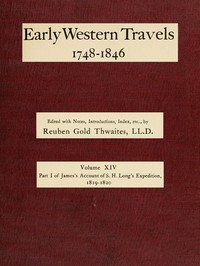
James's Account of S. H. Long's Expedition, 1819-1820, part 3 — Reading Companion
(0 User reviews)
2773
Project Gutenberg
2014
Not confirmed
Indians of North America; West (U.S.) -- Description and travel; Rocky Mountains; United States -- Discovery and exploration
Readers of public-domain and historical texts
Project Gutenberg digital edition
en
Edition facts
Words
92,281
Reading time
402 min
Text sections
10
James's Account of S. H. Long's Expedition, 1819-1820, part 3 — Reading Companion can be approached with a clearer sense of reading commitment from its source measurements: 92,281 words, 6 hr 42 min estimated reading time, and 10 detected text sections.
The text analysis averages about 28.1 words per sentence, while the detected sections provide another way to judge how the source is divided.
Project Gutenberg metadata also associates the work with “Indians of North America,” connecting these edition facts with the source record’s subject description.
Source:
Project Gutenberg record #46280
Edwin James's account of Stephen H. Long's 1819-1820 expedition, part 3, documents the party's descent of the Arkansas River, encounters with Kaskaias, and observations of geology, flora, and fauna. The narrative shifts between scientific description and the physical toll of travel.
Read the complete public-domain text at its original source.
Read on Project GutenbergJames's narrative in this third part of the Long expedition account alternates between measured scientific observation and the immediate, taxing realities of travel. The prose shifts from detailed geological descriptions—such as the gray sandstone formations and the greenish tint of river water—to the visceral struggle of horses and men navigating quicksands and dense forests. This dual register gives the account its distinctive texture: the same writer who notes the precise dimensions of an isolated rock in the river also records the exhaustion of horses thrown to the ground by sudden sand collapses. The voice is consistently that of a naturalist under duress.
Geological Detail and Narrative Pace
James frequently pauses the travel narrative to deliver extended geological observations. In the description of a sandstone rock standing isolated in the Arkansas River, he notes its height (twenty-five feet) and diameter (fifty to sixty feet), comparing it to the Grand Tower in the Mississippi. These passages slow the pace considerably, as the writer shifts from movement to static description. The effect is a rhythm of progress and pause: the party moves downstream, then stops to examine a formation. James also speculates on the rock's origin, suggesting it broke from a high promontory of gray sandstone. Such moments reveal a mind trained to read landscape as evidence of past processes, even when the immediate goal is finding grass for horses.
The Physical Strain on Men and Horses
Alongside the scientific passages, James records the physical toll of the journey with unembellished directness. The party is forced to travel in the riverbed because the valley is choked with forest; horses are kept almost constantly in water. Quicksands cause sudden falls, and the animals must exert themselves to extricate themselves. James writes of these faithful servants failing near the journey's end. The language here is stripped of ornament: our horses and ourselves were thrown to the earth without a moment's notice. This plainness contrasts with the more elaborate geological passages, creating a tension between the observer's detachment and the participant's fatigue. The reader is reminded that every observation comes at a cost of physical effort.
River Dynamics and Human Naming
James's account of the Arkansas and its tributaries includes a passage on how islands and sandbars shift constantly, and how willows and cottonwoods colonize new beaches. He notes that boatmen have adopted terms like willow-bar and willow-island to describe these transient features. This is a rare moment where James steps back from his own observations to note the language of those who live and work on the river. The passage suggests an awareness that the landscape is not only a subject for scientific description but also a space shaped by human use and naming. The willows, he writes, confine the soil with their roots and arrest the dirt and rubbish—a small but telling instance of how natural processes and human categories intersect.
Readers should attend to the shifts in register between James the naturalist and James the traveler. The account rewards those who read for the interplay of precise measurement and bodily exhaustion, of geological time and the immediate present. The excerpts suggest a narrative that is as much about the limits of endurance as about the accumulation of knowledge.
Reading the descent along the Arkansas, I kept thinking how Edwin James’s body wore down just as his scientific notes grew more precise. There’s a particular ache in that—recording beauty while exhausted. Part one of James's Account of S. H. Long's Expedition, 1819-1820, part 1 — Text and Context holds that same quiet tension, the wonder and the weariness braided together. I finished this volume feeling I’d travelled beside someone truly.
There are no reviews for this eBook.
There are no comments for this eBook.
Reader reflection
Your personal reading reflection
Build a private reading journal entry for this title.
Your progress
0
/
10
2
How did the book work for you overall?
3
Would you pass this book on to a friend?
4
Did the language feel accessible?
5
Was the book easy to understand?
6
What was its emotional impact?
7
Did anything about the book feel genuinely new?
8
Did the book give you something worth debating?
9
In one sentence, what did you learn?
10