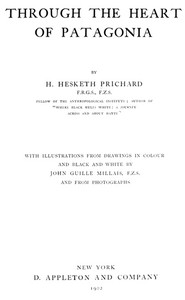
Through the Heart of Patagonia — Text and Context

(12 User reviews)   3026
In Category - Exploration
Hesketh-Prichard, H. (Hesketh), 1876-1922, Millais, John Guille, 1865-1931 [Illustrator] Project Gutenberg 2013 Not confirmed
Indians of South America -- Patagonia (Argentina and Chile); Patagonia (Argentina and Chile) -- Description and travel; Natural history -- Patagonia (Argentina and Chile); Patagonia (Argentina and Chile) -- Discovery and exploration -- British Readers of public-domain and historical texts
Project Gutenberg digital edition en

Edition facts

Words 127,324
Reading time 554 min
Text sections 17

Before opening Through the Heart of Patagonia — Text and Context, the edition data offers a quick orientation: 127,324 words, 9 hr 14 min estimated reading time, and 17 detected text sections.

The text analysis averages about 22.1 words per sentence, while the detected sections provide another way to judge how the source is divided.

Project Gutenberg metadata also associates the work with “Indians of South America -- Patagonia (Argentina and Chile),” connecting these edition facts with the source record’s subject description.

Hesketh Prichard's 1902 expedition narrative blends natural history, Tehuelche ethnography, and personal travelogue. The opening chapters establish a methodical observer who records hospitality, landscape, and hunting techniques with a dry, precise eye. Excerpts show a writer attentive to detail—from a widow's makeshift home to the bones of eighty guanaco—and willing to quote Darwin. The later sections shift toward exploration and discovery, including the naming of Lake Pearson.
Share
Editorial Edition Score 4.9/5

Calculated from edition completeness, EPUB availability, text structure and catalogue metadata. Not a user rating.

How this score is calculated
  • Description quality20 pts
  • Title & short description10 pts
  • Source metadata20 pts
  • Text length15 pts
  • Chapters / structure15 pts
  • EPUB file integrity20 pts

Total of 100 points, scaled to a 2.5-5.0 range. Editions with an empty description or a missing EPUB file are not scored.

Edition quality

Read the Text

a good many people, but peoples, on board; all nations in ragged ponchos with round fur caps or those pointed sombreros that one associates with pictures of elves in a wood. As wild-looking a crew were gathered for'ard as ever sailed Southward Ho! Germans, Danes, Poles, and heaven knows what other races besides; each little party formed laagers of their possessions and resented intrusion with volley-firing of oaths. There was one laager in which I found myself taking a particular interest; it was made up of two men, a woman, and her brood of children. Their only belongings appeared to consist of four ponchos, a _maté_ pot and kettle, and a huge basket of cauliflowers. They crept in and entrenched themselves between the cauliflowers and the port bulwark in the waist of the ship. From there they did not move, but sat swaying their bodies during the entire voyage. Was Patagonia an Eldorado to which those people were journeying? On that dark night, as the ship slid groaning and creaking over the brown waters, the dark scene, lit by stray blurs of light, called up a memory of Leighton's picture, "The Sea shall give up its Dead."

Among the passengers was the Governor of Santa Cruz, Señor Don Matias McKinlay Tapiola, who speaks English very well. There were also one or two gentlemen interested in sheep-farming in Patagonia. Of these, Mr. Greenshields, whose _estancia_ or farm we visited later, owned the credit of having broken new ground in colonising a part of the country some one hundred and fifty miles south of the Welsh settlement of Trelew. The earlier sheep-farms lay about Punta Arenas, eight degrees to the southward, and there the men of the south swore by the south, and much difference of opinion existed as to how sheep would flourish in the more northerly region chosen by Mr. Greenshields. But it seemed that his daring was likely to be richly repaid, and that many, when they heard of his success, would follow his example.

At length it was bedtime, and we turned in with the comforting reflection that when we woke "first night out" would be over.

Next morning land had sunk from sight and there was a light ground-swell, but the _Primero de Mayo_ was rolling heavily, a trick that Government transports possess and seem to regard in the light of a privilege all the world over. The evenings and the mornings followed each other in grey but serene regularity, till on the 12th we turned coastwards, heading for Puerto Belgrano, and ran between low, green, hummocky banks up a stretch of shallow, mud-coloured water to our anchorage. It was a reddish sunset with lightning playing continuously upon the horizon, and while we were at dinner a thunderstorm broke with heavy rain. That night we were permitted the privilege and amusement of choosing the morrow's _menu_. We chose a truly British repast; roast beef, jam-roll and plum-pudding figuring amongst the items. There are no employments too trifling to help one to pass the time on board a ship doing service as a coaster. As to the arrangements made for our well-being on the transport, the Minister of Marine had, I was informed, kindly given most generous orders with regard to our treatment.

In the morning we disembarked forty-two sailors for the four men-of-war lying at anchor in the bay. Then we sailed away again for the south with a warm sun upon the crowded planking and a cold wind blowing aft. It was at this time that I altered my original plans and decided on landing at Puerto Madryn, our next stopping-place, instead of at Santa Cruz, which lies some seven degrees of latitude farther to the south. Upon hearing that winter had not yet relaxed its grip on the country south, it became clear that the horses down there would be thin and in poor condition, with the spring sickness upon them, and therefore quite unfitted to start upon such a journey as lay before us. The new scheme also promised a saving of time, as the _Primero de Mayo_, owing to the necessity of calling at various little places on the way down to Santa Cruz, would be a good deal delayed; besides, the horses we required could probably be got together more quickly at Puerto Madryn.

We had a number of Welsh with us on the transport, who were on their way home to the Welsh settlements of Trelew, Gaiman and Rawson. In the evenings of the voyage it was their custom to forgather and sing psalms in Welsh, psalms the sound of which took one's memory back to the Scottish hills and the yearly ante-communion preachings in the open-air. The surrounding greyness aided the idea--grey sea, grey sky, grey weather.

By the way, on board we learnt a fact, or so we were assured it was, about the South African War, which is certainly not well known even among those who love the Boer. One night at table, one of the diners solemnly declared that at Mafeking the English ate the flesh of the Kaffirs and were thereby enabled to hold out for so long. He was not attempting to hoax us, he really believed the fable himself, poor fellow! I did not gather the gentleman's name.

Coming on deck on the morning of the 15th, we saw, drawn across the western sea-rim, a low brown line. Above it a sky of steel-blue gleamed coldly and below a wash of grey sea. This was our first view of Patagonia. All day we crept along the grim, quiet, solitary-looking cliff, until at last the _Primero de Mayo_ was swallowed up in the vast embrace of the Golfo Nuevo. It was between evening and night when we approached our harbourage, Puerto Madryn. The half-lights were playing above it, and the afterglow of the sunset still shone feebly behind the land. We saw only raw cliff capped by dark verdure--the rim of the vast pampas which roll away in rising levels league upon league towards the Andes.

The sea was cold, the wind was cold, the land looked forlorn and a-cold. Presently from it a little boat put out containing a figure wrapped in a long military cloak. This was the sub-prefect, who thus welcomed us to these desolate shores, for Patagonia from the sea is a desolate prospect indeed. It would be difficult to give an adequate idea of the dismal aspect presented by Puerto Madryn upon that evening. Suffice it to say that the settlement consists of half a dozen houses and a flagstaff; the first crouch on the lip of the tide and the second shivers above on the bare pampa-rim.

There seals and divers haunt the sea, a few guanaco-herds live upon the coast-lands, and there, in inhospitable fashion, the little colony of human beings clings, as it were, upon the skirts of great primordial nature. In the evening lights the cliffs showed curiously pallid above a strip of dead sand and shingle, only the sky and the water seemed alive.

Next morning we hoped to get our baggage ashore and were moving early with that object in view. But the trend of public opinion in Puerto Madryn appears to be towards the conviction that there is no sort of reason for hurry under any circumstances. Hence the cargo disgorged itself slowly, and after interminable waiting we found our particular share of it would not be reached that night. It was, in fact, not till the afternoon of the second day that we achieved a partial recovery of our belongings from the holds and took the first consignment of it ashore. The morning had broken clear and fine, but mid-day brought a change. And by the time we had our boatload completed and rocketed away shorewards at the tail of the _Primero de Mayo's_ steam-launch, a beam sea was flying in spray high over us.

There was an anxious moment when the launch slipped the towing-cable and the sailor in the bows flung a rope, which dropped short of the black wooden jetty, and we were swept some boat-lengths away by a big broken sea. To be swamped at the moment of landing!--the thought was too disastrous to be dwelt on; half our rifles and a box of instruments were on board. It cost us a long hour and a half of hard work before everything was safe ashore. And while we toiled a dozen seals came and stared at us with their doglike faces, and lazy, solemn eyes.

When all our property had been brought to land, luckily without mishaps of any kind, I left Scrivenor with our _peones_ to bring up the heavy baggage and went on with Burbury to Trelew by the miniature train which plies to and fro between the Welsh colony and the coast. From Trelew a ten-days ride takes you beyond the farm of the last settler and into the waste places of the pampas.

Trelew is a new and pocket Wales, but very much Wales all the same. To prove the accuracy of this statement it is only necessary to say that the waggon which set us on the first leagues of our way belonged to a Jones, that another Jones accompanied the expedition to the Cordillera, that I negotiated with a third Jones for a supply of mutton to take with us for use on the first part of our journey, that I was introduced to several Williamses and did business with various Hugheses. And all this in a day and a half.

Trelew itself is a bare settlement of raw-looking houses and shanties, which has started up on the emptiness of the pampas. It cannot lay any claim to picturesqueness, and a pervading impression of being unfinished adds a suggestion of discomfort to the place. All round about the mud houses the pampa rolls away to the distances, harsh, stony, overgrown with little humpy bushes of thorn and dotted here and there with wheat-land. All through and over the settlement you are never out of hearing of three languages--English, Welsh and Spanish.

For thirty-five years the Welsh have lived in this little colony of their own founding. Exactly all the reasons which led them to forsake their far-off homes for Patagonia it would serve no purpose to set out in detail, but the root of the matter appears to have lain in the fact that they objected to the laws relating to the teaching of English in the schools; and, having the courage of their convictions, they came several thousand miles across the sea to escape the _régime_ they disliked. At present, however, they seem to have slipped from the frying-pan into the fire, for they like still less the Argentine code, by which every man born in the Republic is subject to conscription and Sunday drilling.

Some time ago the colonists of Trelew appealed to England to intercede for them with the Argentine Government with a view to obtaining release from these disabilities. But as the Welsh had of their own free will deliberately placed themselves under the Government of the Republic, it was impossible for England to interfere, and this fact was notified to the suppliants, much to their disappointment and disgust. Even when I was there they remained rather sore over the matter, complaining that England had taken all the money subscribed for the expenses of the appeal and given them no redress in return.

The difficulties and hardships which must inevitably have beset the commencement of their settling in Patagonia, contrasted with their present condition, show the Welsh to be splendid people. The resolute spirit that drove them to emigrate across the seas has served to make their township there, though perhaps not particularly inviting to look at, a flourishing one in its quiet pastoral way. They have laid a railway, as has been said, to the coast at Puerto Madryn and established a telephone. Spanish and Welsh live here as neighbours. The Spaniard keeps the store while the Welshman farms, growing a certain amount of grain, but his chief business lies in breeding horses, cattle and sheep.

The Welshmen are not wanting in keen business quality. Any one who has tried to buy horses in Trelew will bear me out in this statement. The mere fact that a stranger has arrived in their colony, who wants to invest in horseflesh, awakens all their commercial instincts, and they are not at all behind the rest of the world in knowing how to form a combine for the purpose of plundering the Philistines. Quite right too. A man who can resist making a bargain over a horse whenever he gets the chance is, like "the good young man who died," over-perfect for this corrupt old world.

From their first settlement the Welsh have spread south through the coast-towns of Patagonia, and six weeks' journey from Trelew they have formed another settlement in the Cordilleras to the north-west which they have called the "16th October Colony." Thither waggons are always trekking, and waggon-drivers and others who return bring with them glowing and rosy descriptions of the young settlement of the interior. The adaptability of the Welsh to the peculiar needs of colonisation is very remarkable. They have certainly stepped into the "larger life" with success.

The influence of the new conditions of existence, so different from that of the Welsh peasant in his own country, is very noticeable in several ways. The older and the younger generation are unlike each other now, and will probably continue to become more so as time goes on. Physically the younger people are far better developed than their elders, red-faced, open-eyed, straight-backed boys in big felt hats, each with a bright-coloured handkerchief knotted round his neck and the guanaco-wool poncho hanging from his shoulders. They are very picturesque and look their best on horseback. In this matter of riding also there is a wide difference between the styles of the old and the young men. The latter, who are Patagonian born, seem to be part of their horses, but the elders, however excellent long practice has made them, never attain to the proficiency of their sons.

Although the colony of Trelew is to-day in a more or less flourishing condition and very Welsh, a grave danger menaces it. In fifty years time how will it be with the racial element? Will there be as many Welsh then as now? I fear not, and the result is difficult to foresee. The danger takes the form of the dark-eyed Argentine maiden, who is rather apt to "make roast meat of the heart" of the Welsh youth. While the Welsh girls do not take very readily to Spanish-speaking husbands, the Welsh boys fall very much in love with the daughters of the South. So it is to be concluded that the language difficulty will settle itself, or, at any rate, become more easy of arrangement with each succeeding generation. If the girl you love speaks only Spanish, it is quite obvious you must learn Spanish in order to be able to talk to her, and, under the circumstances, you will not find the task a very hard one. Then children nearly always show a preference for the mother's tongue and speech in contradistinction to that of the father. Probably, if these prophecies were uttered in Trelew, the men of to-day would scoff at them. But onlookers often see most of the game. In 1865 the Welsh, in deep sorrow, left their own land to escape the tyranny of the English law, as they considered it, which sought to force upon them the English language. Their desire was to preserve their own tongue. And flying from Scylla they will fall (and to some degree have already fallen) a prey to Charybdis. But it is a very pleasant Charybdis, typified by a dark-haired, dark-eyed, lissom maiden, who will bear them sons no longer of the old pure-bred Welsh stock, but of a mixed race. And so the effort of the forefathers, who fared overseas to found a new home, shall be made null and void.

Now and again it is the fate of frontier towns to be stirred to their depths by some incursion from the old world they have left behind them. Trelew was still recovering from such an experience when we arrived there. The settlement, in short, had been suffering from a plague of lords. First appeared an aristocrat, who wished to travel in the interior, and he bought up horses with a lavish hand, and generally made preparations which, no doubt, filled the purses of the inhabitants. This gentleman's projected tour, however, fell through for some reason, and he departed whence he had come into the unknown world outside of Trelew's daily cognisance.

Presently after him followed a second "lord," who gave his name as Lord Reed, and who was received with open arms by an enthusiastic community. A run of lords appeared to be setting in, and was regarded by the Trelewians as a distinct dispensation in their favour, which it was their happy duty to work out thoroughly to their own advantage. By some mistake Lord Reed had left his ready money behind him, and, therefore, borrowed pretty extensively from the kind-hearted Welshmen. After a time Lord Reed vanished, and upon inquiry being made it was discovered that no such title as Lord Reed was to be found in the Peerage of Great Britain. When this fact became established, more than one Welshman is reported to have gone out after Lord Reed with the family gun, and, I believe, he was finally caught with a lasso! But the incident was not without its bearing on our personal affair, for the Bank of Trelew would have nothing whatever to say to my Cook's letter of credit. In vain I recited my credentials, and gave such proof of genuineness as was in my power to give. They would none of me. The bank evidently argued that it was easier to pretend that you were a _bona-fide_ traveller than that you were a lord. Lord Reed too; it was rather a taking title. I could not at first understand where the humour of the question, put to me by several people I met in Trelew, of "Are you not Lord Prichard?" came in. In fact, it was disconcerting; but later on, when I heard the above story, I did not grudge the colonists any fun that might be got out of the situation, for certainly Lord Reed, taken all in all, had been far from a subject of pure amusement to them.

We remained six days at Trelew making those last few purchases which were necessary with the small stock of extra money that I had left myself as a margin. It was directly owing to Lord Reed that I finally set forth into the interior with but thirty dollars in Argentine notes and large drafts on Cook and Son, which were quite useless. Although the wilderness does not seem a likely field for spending money, yet, before our travels were at an end, I was glad to sell horses to supply the needs of our party.

The journey which lay before us to Lake Buenos Aires was about six hundred miles in length, and this distance might be subdivided into three stages: the first, from Trelew to Bahia Camerones, where the expedition became complete; the second, from Bahia Camerones to the Lakes Musters and Colhué; and the third, to Lake Buenos Aires itself. My instructions gave me an entirely free hand, within reasonable limits, as to the number of men I might take with me.

I had from the first been convinced that the smallest number possible would also be, in our case, the wisest. The immense extent of the country to be traversed, and the difficulties which must inevitably lie in our way to hinder and delay us, as well as the practical emptiness of the country, which requires that an expedition shall be self-supporting, were salient facts; and our plans had to be made and modified in relation to these facts. The mobility of the party was the main point to aim at. Hence it was necessary to cut down the _personnel_ of the expedition to as low a number as possible, and it was further most important to have plenty of horses and to spare.

The difficulty of feeding several men when travelling through such a country was obvious, and therefore not to be thought of, as, besides the four horses each individual needed for riding, the extra animals for carrying provision and bedding, clothing, tents, &c. had to be taken into account. No pack-horse should be allowed to carry his load two days consecutively, and, in fact, one day's work in three is enough. If waggons are taken, each should be allowed three teams of six horses each.

Hesketh Prichard opens Through the Heart of Patagonia with a chapter simply titled “Patagonia,” setting a tone of deliberate, empirical observation. The narrative voice is that of a Fellow of the Royal Geographical Society and the Anthropological Institute, yet the prose avoids academic stiffness. Instead, Prichard describes a landscape of “bare yellow levels” and “very dark green bush, so dark as to seem almost black,” and he does not hesitate to quote Darwin’s description of the Santa Cruz valley. This early blend of personal travel and scientific reference signals a work that will move between firsthand experience and established knowledge.

The excerpts also reveal a writer attentive to social detail. At a shanty called La Ultima Casa, he notes the hospitality of an Argentine widow and the suspicion of a Scottish farmer who bolts his door. Such moments ground the expedition in human encounters, not just geographical discovery.

A Methodical Observer at Work

From the first chapters, Prichard establishes himself as a careful recorder. He notes the dimensions of a kitchen—four beams lengthways and four across—and the contents of a widow’s “sanctum”: five magazines, lions’ claws, a skunk-skin rug, hen’s eggs, and the hen herself. This inventory is delivered with a touch of wry humor (“a regular widow’s cruse of a place”), but the precision is unmistakable. He also records the number of guanaco carcasses (eighty) and the time of day (7:15 P.M.) when he reaches a turbid stream. Such details accumulate to create a sense of an author who trusts his own eyes and notebook above all.

This observational habit extends to people. The description of the Tehuelche—their hunting methods, their toldos (tents), their use of boleadores—is rendered with the same factual clarity. Prichard does not romanticize; he reports. The reader is given a sense of a traveler who moves through Patagonia as a naturalist might, cataloging what he sees without imposing a narrative arc beyond the journey itself.

Landscape as Character and Obstacle

The Patagonian landscape in these excerpts is not a backdrop but an active presence. Prichard emphasizes its aridity and emptiness: the pampa is “very dry,” the cañadon “bare and grassless” except where springs create “a line of vivid green.” He notes the difficulty of finding water and the need to descend into the river valley for a camp. The terrain dictates the pace of travel and the mood of the narrative.

Yet the landscape also produces moments of beauty. Prichard writes of “the glory of Patagonia, its wonderful sunsets, which gleam out over the dull-hued empty wastes in a splendour of colour.” This juxtaposition of harshness and sublimity is a recurring note. The reader is encouraged to see the environment as both a physical challenge and a source of aesthetic reward, a duality that shapes the expedition’s character.

Encounters with Hospitality and Suspicion

Prichard’s interactions with settlers reveal a social landscape as varied as the physical one. At La Ultima Casa, the Argentine widow offers food, magazines, and an invitation to stay an extra day. In contrast, a Scottish farmer bolts his door and demands that the travelers wait outside until he returns. Prichard reflects that “the wayfarer is not always a wandering angel in Patagonia,” acknowledging the caution of isolated residents.

These encounters are not merely anecdotal; they serve as data points about the region’s social fabric. Prichard notes that Argentines are “far more ready to show hospitality than are our own countrymen,” a generalization he supports with specific instances. The reader gains a sense of a frontier society where trust is earned slowly, and where a traveler’s reception depends on reputation and circumstance.

From Observation to Discovery

The later chapters shift from travelogue to exploration narrative. Prichard’s journey to Lake Argentino and the downstream navigation of the River Leona introduce elements of hazard and discovery. The chapter “First Passing through Hellgate” suggests a dramatic passage, while “Discovery of River Katarina and Lake Pearson” culminates in naming a geographical feature after the expedition’s patron, C. Arthur Pearson.

These sections maintain the same factual tone but add a sense of purpose: the expedition is not merely traversing known territory but extending the map. The appendices—including a description of a new puma subspecies and a list of plants—reinforce the scientific dimension. For the reader, the book becomes a record of how exploration was conducted at the turn of the twentieth century, blending physical endurance with systematic documentation.

Prichard’s narrative rewards a reader who pays attention to small details: the number of beams in a ceiling, the contents of a widow’s barn, the precise time of arrival at a stream. These specifics build a world that feels inhabited and observed, not imagined. The book is best approached as a layered document—part travel diary, part natural history, part ethnography—held together by a consistent, unpretentious voice. Let the excerpts guide your attention to the ordinary moments that, in Prichard’s hands, become evidence of a place and a time.

That methodical eye Prichard turns on a widow’s home and guanaco bones—so quiet, so unhurried—reminds me of something else I once sat with, where early voices along a colder coast are given the same patient regard. Sailors Narratives of Voyages Along the New England Coast, 1524-1624 — Reading Companion lingers in that same gentle way, like a tide that stays with you long after the page turns.

Sebastian Clark
2 weeks ago

Avery Allen
1 month ago

Amelia Williams
3 weeks ago

Sebastian Adams
1 week ago

James Williams
2 weeks ago

4.5
4.5 out of 5 (12 User reviews )

Add a Review

Your Rating *
  • ...
    Kevin Hawkins - 1 month ago
    A breathtaking exploration of Patagonia's raw, untamed beauty. The author's vivid descriptions of the towering peaks, glacial lakes, and endless pampas make you feel the biting wind and hear the crunch of ice underfoot. This is not just a travelogue; it's a spiritual journey through one of the world's last frontiers. I was completely captivated from start to finish!

  • ...
    Benjamin Jones - 1 month ago
    "Through The Heart Of Patagonia" is a solid travel narrative with interesting observations about the landscape and the people. The author's enthusiasm is palpable, and the historical insights add depth. However, some passages feel rushed, and the lack of photographs is a letdown, making it harder to visualize the described scenery. A good read, but not exceptional.

  • ...
    Alicia Anthony Wilson - 4 weeks ago
    Honestly, this book was a chore to finish. The writing is overly verbose and dry, focusing more on geographical data than on the experience itself. There's little emotional connection, and the narrative lacks a clear direction. It reads like a scientific report rather than an adventure memoir. I'd recommend other Patagonia travelogues instead.


Reader reflection

Before you leave, reflect on the book

Use these questions to collect your thoughts before moving on.

Your progress 0 / 10
1

Which reading stage best describes you?

2

What was your overall reaction to the book?

3

Would you recommend this book to another reader?

4

What was the reading difficulty like?

Related eBooks