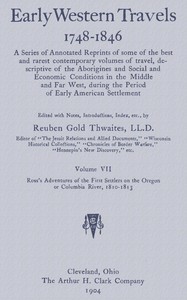
Ross's Adventures of the first settlers on the Oregon or Columbia River, 1810-1813 — Story, Setting & Ideas

(3 User reviews)   775
In Category - Exploration
Thwaites, Reuben Gold, 1853-1913 [Editor], Ross, Alexander, 1783-1856 Project Gutenberg 2024 Not confirmed
West (U.S.) -- Description and travel; United States -- Description and travel; Mississippi River Valley -- Description and travel Readers of public-domain and historical texts
Project Gutenberg digital edition en

Edition facts

Words 101,201
Reading time 441 min
Text sections 32

For Ross's Adventures of the first settlers on the Oregon or Columbia River, 1810-1813 — Story, Setting & Ideas, the stored edition analysis reports 101,201 words, 7 hr 21 min estimated reading time, and 32 detected text sections.

The text analysis averages about 27.7 words per sentence, while the detected sections provide another way to judge how the source is divided.

Project Gutenberg metadata also associates the work with “West (U.S.) -- Description and travel,” connecting these edition facts with the source record’s subject description.

Alexander Ross's firsthand account of John Jacob Astor's Pacific Fur Company expedition (1810–1813) details the founding of Astoria, encounters with Native tribes, and harrowing overland journeys. Based on contemporary journals, this narrative supplements Franchère's record with specific observations on leadership, survival, and Chinook vocabulary.
Share
Editorial Edition Score 4.9/5

Calculated from edition completeness, EPUB availability, text structure and catalogue metadata. Not a user rating.

How this score is calculated
  • Description quality20 pts
  • Title & short description10 pts
  • Source metadata20 pts
  • Text length15 pts
  • Chapters / structure15 pts
  • EPUB file integrity20 pts

Total of 100 points, scaled to a 2.5-5.0 range. Editions with an empty description or a missing EPUB file are not scored.

Edition quality

Read the Text

r’s home (1804) to seek a fortune in the then “dissolute, extravagant, and butterfly” Province of Canada. He confesses that only stern Scotch pride kept him from returning to the parental roof, for which he secretly longed during several years after his departure. In the new land his fortunes did not flourish. Endowed with a good education, he at first eked out a scanty livelihood by teaching school; but after five years purchased some land in Upper Canada, and turned farmer. The reports of Astor’s enterprise and of fortunes to be acquired in the fur trade, tempted him to abandon the soil and embark in the promising project for a Columbia settlement, and he was a member of the contingent that sailed from New York in the “Tonquin,” in 1810. Arrived at Columbia River, Ross was soon assigned to a post in the interior, where he whiled away the tedium of existence by studying Indian languages and characteristics, by copious journalizing, and much reflection. Nor was incident lacking to divert the isolated fur-trader, as the various brigades of the rival North West Company swept up and down the Columbia, and the fate of Astoria hung trembling in the balance. Most of the “Nor’ Westers” were Scotchmen like himself, and Ross’s sympathies appear to have been enlisted strongly in their behalf. As the books of reminiscence written during his retirement grew, they took on the form of apologies for McDougal and McKenzie, the Scotch partners of the American house, and virtually became tirades against the associates of Astor, and his business management as well.

Upon the consummation of the sale of Astoria (October, 1813), Ross was easily induced to enter the service of the new British owners, and he remained upon Columbian waters so long as the Nor’ Westers operated in that district. With accustomed Scotch canniness he stipulated for an agreement in writing that he should be promoted at the end of seven years’ service; but just before the expiration of that term the North West Company merged with its great rival, the Hudson’s Bay (1821), and Ross’s hopes were again dashed. However, the governor of the Hudson’s Bay Company placed him in command of a large brigade for hunting and exploring the country of the Snake Indians—the vast region of the Rocky Mountain divide, in the present states of Montana and Idaho. Here for two years (1823–25) he led his motley crews of Canadians, half-breeds, Iroquois, and Hawaiians, crossing and recrossing the path of Lewis and Clark, and exploring the fastnesses of the Snake and Salmon rivers.

But the wilderness had now lost its charm, and Ross returned to at least the borders of civilization, there to live in quiet and rear his half-breed children. In recognition of his services, the Hudson’s Bay Company granted him a hundred acres of land in the Red River Valley, where he became one of the earliest and most prominent citizens of the present city of Winnipeg. His estate was known as “Colony Gardens,” and upon the profits of his trade among the settlers and of his relations with the aborigines he grew wealthy and influential. Being chosen the first sheriff of Assiniboine (the present province of Winnipeg), he was later (1835) appointed a member of its first Government Council. Some account of his life as a settler, and a few of his letters, are published in the Historical and Scientific Society of Manitoba _Transactions_ No. 63 (Winnipeg, 1903).

At last blessed with leisure, Ross now turned author, and published three works detailing the differing phases of his life. The first— _Adventures of the First Settlers on the Oregon or Columbia River_— relates his experiences as a fur-trader in American employ, and was issued from a London press in 1849; this book we here republish. The narrative of his life upon Western waters under the direction of British companies, appeared in 1855, as _The Fur Hunters of the Far West_. His final essay was a history of _The Red River Settlement, its Rise, Progress, and Present State_, which appeared in 1856, the year of the author’s death. All of these books are written in a simple, clear, unpretentious style, being mainly narrations of daily events.

Referring specifically to the _Adventures_, which we have chosen for reprinting, it is evident that the author’s interest in topography was but slight. It is surprising to find a man who has had many years of intimate acquaintance with the interesting regions penetrated transiently by Lewis and Clark along narrow trails, contributing so slightly as does Ross to the world’s knowledge of the country; whereas Lewis and Clark brought back from their hurried journey a wealth of detailed information. With ethnology, Ross exhibits greater concern. His alliance with an Okanagan woman, and his constant contact with the natives of the coast, gave him a command of tribal habits, traditions, and beliefs which makes his work a valuable source for the study of Western Indian life. The last four chapters present a good sociological treatment of the natives of the Shahaptian family—their religion, government, family life, and characteristics—in the primitive state, before contact with the whites had brought modification and degeneracy. Ross’s account of the Indians of the coast, the Clatsop and Chinookan tribes, gives evidences of truth and accurate observation.

But it is chiefly as a narration of the fortunes of the Astorian expedition, that we value Ross’s book. Unlike Franchère, he exhibits no reserve, and unhesitatingly expresses his opinion of the conduct of Captain Jonathan Thorn and Astor’s partners, during the now famous voyage. His accounts of the adventures of the “Tonquin” and its passengers are consequently the more vivid and personal of the two. The dramatic situation evidently appealed strongly to our author’s temperament; the incidents at the Falkland and Hawaiian islands, the irascibility and unreasonableness of Thorn’s conduct, the useless sacrifice of life to the strictness of naval discipline, are related with no assuaging touch. Neither does the writer spare the reader an account of the hardships and trials of the adventurers, the poor and scanty food, the toil in felling trees and erecting buildings, the feuds and ill feeling between the workers, and the caprices of the commanding partners. Later, in describing the transfer of Astoria and its property to British hands, our author unhesitatingly appears as an apologist for the transaction, and an advocate of the pro-British party. His criticism of Astor’s management, while partly justifiable from Ross’s standpoint, seems to possess an element of personal pique; and for the clerks who, like Franchère, chose to remain loyal to the American owners, Ross has but few words of commendation. For a just estimate of the transaction, the reader must balance probabilities between the conclusions of Irving, Franchère, and Ross, and likewise take into consideration the emergencies arising from the Anglo-American war.

Aside from its historical value, Ross’s _Adventures_ possesses abundant interest for all who are stirred by clearly-delineated accounts of life in the great silent places of earth. Our author has a graphic touch: dangers from Indian treachery, perils of the forests and the waterways, thrilling escapes of every sort, lose nothing under his pen; wilderness life is vividly portrayed—the sharp contrasts between civilization and savagery, the obstacles which beset man’s progress through the vast solitudes of the North-west, the forbidding aspects as well as the beauties of primeval nature; all these are presented with force and not seldom with charm.

Assistance in annotating this volume has been received from Louise Phelps Kellogg, Ph. D., and Edith Kathryn Lyle, Ph. D.

MADISON, WIS., August, 1904.

ALEXANDER ROSS’S ADVENTURES OF THE FIRST SETTLERS ON THE OREGON OR COLUMBIA RIVER

Reprint of the original edition (London, 1849)

ADVENTURES OF THE FIRST SETTLERS ON THE OREGON OR COLUMBIA RIVER: BEING A NARRATIVE OF THE EXPEDITION FITTED OUT BY JOHN JACOB ASTOR, TO ESTABLISH THE “PACIFIC FUR COMPANY;” WITH AN ACCOUNT OF SOME INDIAN TRIBES ON THE COAST OF THE PACIFIC.

BY ALEXANDER ROSS, ONE OF THE ADVENTURERS.

LONDON: SMITH, ELDER AND CO., 65, CORNHILL.

Having been one of the first commercial adventurers to the Columbia River, and having spent fifteen years of my life travelling among the savage tribes west of the Rocky Mountains, I was induced, from time to time, to note down such incidents and opinions, illustrative of savage life and manners, as appeared to me either new or interesting.

To the characteristic details of Indian life, I have added that of personal adventure, the trials and misfortunes which the first adventurers had to undergo among the Indians in that quarter; connecting therewith an account of the trade and commerce of the country during the early days of that bold spirit which animated the first explorers of the Columbia.

These different subjects have been arranged and {iv} linked together in their natural order, so as to form one complete narrative, embodying the history of “the Pacific Fur Company.”

It is not an arm-chair narrative, derived from hearsay tales, but the result of practical experience on the spot. From beginning to end, I had personally to act my part in the scenes described; they passed under my own eyes; and the account altogether may derive more value from being authentic than from any adventitious embellishment bestowed on it.

While on this part of our subject, it may be observed that there is an error which most travellers, especially those pioneers who first penetrate into dark and remote regions, fall into: they generally run into the extreme, and spoil a simple story by colouring. Not content to leave nature in its simple garb, they must brighten or darken, magnify or diminish, everything they describe, until at last the real likeness of the thing is entirely effaced, and truth itself, by over-refinement, is thrown into the shade.

What belongs to oneself is generally viewed with a partial eye; and perhaps that partiality influences {v} my own opinion as to the interest of the subject before us. In reference to this subject, however, others have written on it as well as myself. Let our readers, therefore, judge for themselves.

In presenting the present work to the public, I have no very sanguine expectations. All I aim at is to lay before my readers a faithful and impartial statement of what took place, during my own times, in a quarter hitherto but little known.

Freedom from imperfection is not to be expected; yet, on the whole, I hope that this volume will prove to the calm inquirer, in all matters connected with the subject generally, a sure and satisfactory guide: allowance being made for any changes that may have taken place since this account was written—thirty years ago.

_Red River Settlement, Rupert’s Land. Aug. 1, 1846._

Introductory remarks—John Jacob Astor—Grasping views—Early traders of Canada—The Hudson’s Bay Company—American fur companies—Astor’s policy—Russian settlements—Coasting vessels—The Pacific Fur Company—Flattering results—Oregon territory—New association—Mr. Hunt—Golden prospects—Proposals accepted—List of adventurers—Land party—Sea party—The ship _Tonquin_—Remarks—Opinion against opinion—Observations—Land expedition departs—Sea party set off for New York—Bark canoe—Spectators—Canadian voyageurs 33

The _Tonquin_ sails—Quarrels on board—The captain’s character— Accommodations—A sudden squall—Flying fish—The captain’s harshness—Cape de Verd Islands—Alarm of fire—A suspicious sail— Crossing the line—Springing a leak—Short allowance of water— Immense wave—The Falkland Islands—Rocky passage—Wild fowl—Port Egmont Bay—The party on shore—Mr. Farnham’s gray goose—Old graves renewed—Epitaphs—Party left behind—New dangers—Mr. Robert Stuart’s determined conduct—Feuds on board—Cape Horn doubled—The weather—Pilot fish—Trade winds—Rogues’ mess—Little pilot—Mouna Roa—A man overboard—The mate in irons 43

Karakakooa Bay—The sailors desert—The captain’s conduct—Productions of Owhyhee—Tocaigh Bay—Governor Young—Royal proclamation—Woahoo— Ourourah, the residence of Tammeatameah—Harbour fees—Excursion on shore—The Queen’s umbrella—The King’s appearance—Royal palace and guards—Arsenal, or royal workshop—Royal dinner—His Majesty’s fleet—Morais, or places of public worship—Sacred or puranee ground tabooed—Storm—A sailor left to his fate among the natives— Parting visit from his Majesty—His meanness—Diving of the natives—Native proas: how made—Clothing—Customs and peculiarities—Character of the women—White men at the Sandwich Islands—The King’s disposition towards foreigners—Captain Cook— Pahooas, or war spears—A sham fight—Religion—Tammeatameah conqueror and king—Apparent happiness of the natives—Prophetic hint—Distressed situation of a boat 57

Departure from the Sandwich Islands—Bad weather—Live stock destroyed—Columbia River—A boat and crew lost—Captain’s conduct towards Mr. Fox—Mouth of the river—Bar and breakers—Cape Disappointment—Point Adams—Narrow escape of the long boat— Sounding the bar—A boat and crew left to perish—The ship in the breakers—Critical situation—Melancholy narrative of Steven Weeks— Search made for the lost boat, and narrow escape—Long boat swamped—Fidelity of the natives—Preparations for leaving the ship—Captain Thorn—The voyage concluded 74

Preparations for landing—Site of the new emporium of the west— Astor’s representative—Hard work—Huge trees—Natives—Comecomly— Mode of felling the trees—Danger—Trying scenes—Three {ix} men killed—Three wounded—Party reduced by sickness—Disaffection— Conduct of the deputy—Desertion—Mr. Astor’s policy—Climate—Indian rumours—Comecomly’s intrigues and policy—Trip to the cascades—Mr. M‘Kay and north-west notions—Anecdote—Exploring party to the north—Several persons killed—Hostile threats of the Indians— Potatoes and other seeds planted—New building—Astoria—Departure of the ship—Dangerous situation of the whites—Great assemblage of Indians—People under arms—Blunderbuss accident—Alarming moment— Two strangers arrive—Mr. Thompson at Astoria—M‘Dougall’s policy— The two great functionaries 88

The ten tribes—Number of warriors—Their laws—Chief’s arbitrary power—Dress, games, and arms of the men—Dress of the women, slaves, and basket-making—Lewdness of the women—Food, ornaments— The salmon—Superstitious customs—Sturgeon—Fathomfish—Roots and berries—Circulating medium—Econé, or Good Spirit—Ecutoch, or Bad Spirit—Etaminua, or priests—Keelalles, or doctors—War canoes— Diseases—Winter houses—Temporary, or Summer houses—Fleas—Practice of flattening the head—Colonization—Wallamitte—Cowlitz, or Puget’s Sound—Conclusion 102

First expedition into the interior—Number of the party—Tongue Point—Canoe swamped—Sailing difficulties—Indian villages—Cedars— First night’s encampment—Mount Coffin—Cowlitz—Wallamitte—Columbia Valley—Point Vancouver—Difficulties—The Cascades—Concourse of Indians—General appearance of the country—The portage—Description of the cascades—The roll of tobacco—Pilfering—Mr. Thompson— Exchange of men—The Long Narrows—Warlike appearance of the Indian cavalry—Button contract—Critical situation of the party—Camp of gamblers—The Narrows {x}—Hard work at the carrying place—A day’s work—Description of the portage—Number of Indians—Aspect of the country—The plains begin—End of the woods—Want of sleep—Demeanour of the Indians 115

Columbia Falls—A canoe swamped—Suspicious behaviour of the Indians— Stratagem—Umatallow—Walla Walla—Great body of Indians—Harangues— Indian ceremonies—The great forks—Difference in the waters—Length of the forks—The British flag—Mr. Thompson’s design—Indian ideas— Salmon—European articles—Tummatapam—Departure from the Forks— Indian honesty—Eyakema—Marl hills—Dead children—Superstitions— Priest’s Rapid—Rattlesnakes—Appearance of the country— Kewaugh-chen—Perilous situation of a canoe—The two sisters—The old Indian—Hunting party—Horses—The priest—Piss-cows—Sopa—Great assemblage of Indians—The comet—Oakinacken—Distance from Astoria— Indian council—Resolve to winter—Some account of the place—The stolen watch—The priest dismissed—Voyage concluded—The two strangers—First building—Division of the party—Lonely winter—The lost party—Indian trade—Mr. Stuart’s adventures 131

Anxieties at Astoria—Indians depart—A schooner built—The _Dolly’s_ first trip—Criminal curiosity—The powder keg—The schooner condemned—Mr. Astor’s cargoes—His policy—Remarks on the North-West coast—Unwelcome rumours—Calpo’s statement—Rumours renewed—Hard cases—Joe Lapierre—Kasiascall’s account of the _Tonquin_—Strange Indian—Kasiascall’s conduct—His character—His design on Astoria—Remarks 159

Land expedition—Hunt and M‘Kenzie—Montreal recruits—La Chine—Devout farewell—Mackina in 1810—Fur traders of the South—Frolic parties— Comparison between the South and North—Arrival at St. Louis— Recruiting service—Yankees—Canoemen—Delays at St. Louis— Difficulties—Mr. Miller—The Missouri—Canadian voyageurs—Winter quarters—Mr. Hunt revisits St. Louis—M‘Kenzie—Mr. Astor’s policy— The Yankees desert—Winter quarters broken up—Rocky Mountains— Pilot knobs—New scenes—Columbia River—The horses abandoned—Take to canoes—The canoes abandoned—Trappers—Mr. Miller—Party on foot— Hardships—Starvation—Conflicting councils—Gloomy prospects— Property _en cache_—The party divided—Three men perish—M‘Kenzie’s speech—He arrives at Astoria—Mr. Crooks and others left behind— Mr. Hunt’s arrival at Astoria—Voyage concluded 173

Doings at Astoria—Three parties on foot—Their object—M‘Lellan’s resolution—Hostile attack at the Long Narrows—Mr. Reed—Two Indians shot—Heroic conduct of M‘Lellan—Difficulties adjusted— Advance of the party—Remarks—Arrival at Oakinacken—Departure again for Astoria—Scene at Umatallow—Mr. Crook’s adventures and suffering—Yeck-a-tap-am—Umatallow left—Merit rewarded—Arrival of the party at Astoria—The ship _Beaver_ there also 186

General meeting of the partners—Resolutions passed—Departure of the parties for the interior—Mr. Clarke—The cascades—Wyampam, or the Long Narrows—Situation of the party—Loss of time—Mr. M‘Kenzie—A stroll through the Indian camp—Mr. Clarke’s alarms—Command transferred—Reed’s rifle recovered—A robber in irons—The five shots—Yeck-a-tap-am rewarded—Mr. Stuart’s departure {xii} for St. Louis—Second division—Summer trip to She Whaps—Boullard and his squaw—Mr. Stuart’s arrival at Oakinacken—Departure for She Whaps— Winter operations at Oakinacken—Visits—Travelling scenes—A night in the snow—Jacque and his powder-horn—Mr. Stuart’s account of his journey—Arrival at Walla Walla 194

Mr. Clarke—Stragglers—Hard Travelling—Cox’s pilgrimage—Visit to Spokane—Trade—Mr. Pillet—Mr. Farnham—Cootanais and Flatheads— M‘Lennan—Plunge in the lake—Adventures—Outposts—Catatouch chief— Curiosity—Fracas—Introduction of civilization—Commotion—M‘Kenzie— Great Snake River—Caches robbed—Canadian wanderers—Character of the Shahaptains—Visit to Spokane—M‘Tavish—Account of the war— Winter travels—M‘Kenzie at Astoria—New resolves—M‘Kenzie’s return to his post—Indian chiefs—Bold enterprize—Property recovered— Chiefs and their horses—Stratagems—Indians outwitted—Plotting— Friendly Island—Conference—Marauding propensities—Treaty of peace—System changed—Plentiful market—The island abandoned— Arrival at Walla Walla—Commotions among the savages—Tummeatapam— Arrival at Astoria 207

Mr. Stuart—Snake River—Trappers—Joyous meeting—Trapper’s resolution—Crow Indians’ troubles—Horses change masters—Mr. Stuart on foot—M‘Lellan left alone—Hardships of the party—Famine— Le Clerc’s horrid proposition—The old bull—The old horse—Pilot knobs—Winter quarters—Unwelcome visitors—Change of quarters— Spring—Travelling at random—An Otto Indian—River Platte—Two traders—News of the war—The Missouri—The old horse given for an old canoe—St. Louis—Mr. Astor—Wallamitte—Falls—Scenery—Habits of the Collap-poh-yea-ass tribes—Concourse of savages—M‘Dougall’s letter—{xiii} M‘Kenzie’s stratagem—Indian disappointment—The ship _Beaver_—Coasting voyage—Mr. Astor’s policy—Captains—Their instructions—Mr. Hunt baulked in his plans—The Boston merchants— Mr. Astor’s conduct—Difficulties of Mr. Hunt’s situation—The ship _Albatross_—All the parties at headquarters 222

Meeting of the partners—Warm discussion—M‘Kenzie—Eloquence of the times—Reasons for dissolving the company—Dissenting partners converted—Final resolve—The deputy’s powers—Departure of the brigade—A canoe lost—A man’s leg in jeopardy—Rumours at the narrows—Snake party—Rumours renewed—Tummeatapam’s counsel—Hostile appearance at the forks—Number of Indians—Nez Percés’ fleet—Fears of the whites—Indian visit—Strong guard—Mr. Clarke—Relic of the silver goblet—Mr. Hunt at Astoria—Face of affairs changed—Mr. Hunt departs from Astoria—North-West squadron—A great Eri duped— Bill of sale—Petty manœuvring—Rumours of ships—The Astorians at their post—Bill signed—Astoria delivered up—North-West Company 236

Mr. Franchère—Comecomly’s anxiety—His report of a sail—His attachment to the Americans—Laframboise, the interpreter—Mr. M‘Dougall’s visit—The _Racoon_ sloop-of-war—Comecomly grows partial to the British flag—North-West partners—British officers— Astoria changed to Fort George—Captain Black’s character—Mr. Hunt’s voyage—Commodore Porter—Mr. Hunt leaves the Marquesas— Arrival at the Sandwich Islands—Rumours—The ship _Lark_—Eight persons perish—Columbian affairs—The property delivered—No ice— The people assembled—Voyage—The Cascade banditti—Two North-West canoes—North-West affray at the cascades—Mr. Stuart wounded—Mr. Keith’s conduct—Preparations for war—The great expedition—Conduct of the Cath-le-yach-é-yach Indians—Expedition fails—The effect— Remarks 246

Alexander Ross's narrative, published in 1849 but drawn from journals written during the Astorian expedition of 1810–1813, offers a detailed, first-hand perspective on the founding of Astoria and the struggles of early overland travel. Unlike a retrospective summary, Ross's account preserves the immediacy of daily hardships: men drowning, succumbing to starvation, or pressing forward under a partner's exhortation. The editor, Reuben Gold Thwaites, situates this volume as a supplement to Gabriel Franchère's earlier narrative, noting that Ross's work appeared twenty-nine years later yet retains the value of a contemporary record.

The Opening: A Narrative Anchored in Journals

The preface and opening pages establish Ross's credibility as a participant who wrote from immediate experience. Thwaites emphasizes that Ross's account is based on journals written at the time, lending it the authority of a first-hand relation. The author's own preface and table of contents signal a structured approach, while the inclusion of a Chinook vocabulary and a weather table from March to July 1811 suggests an interest in ethnographic and environmental detail. Readers should note how Ross balances personal observation with broader expedition logistics, a pattern that continues throughout the text.

Mid-Narrative: Leadership and Survival Under Duress

An excerpt from the middle of the book recounts the division of the expedition into four parties, each headed by a partner, with the goal of reaching the Columbia River mouth. The passage highlights the leadership of M‘Kenzie, who rallies his men with direct speech: “Now, my friends, there is still hope before us; to linger on our way, to return back, or to be discouraged and stand still, is death.” His party endures five days without food, subsisting on a single beaver and its skin. Ross notes that M‘Kenzie carried two men's blankets, a detail that underscores the physical toll. The arrival at Astoria on January 10, 1812, contrasts with the later, more emaciated arrival of Hunt's party on February 15, illustrating the varying fates of the groups.

Later Excerpts: Conflict and Resolution at the Long Narrows

In a later chapter, Ross describes preparations for the spring of 1812, including the dispatch of three parties to the interior. A notable incident involves a hostile attack at the Long Narrows, where M‘Lellan's resolution and the shooting of two Indians are recounted. The passage emphasizes the precariousness of relations with Native groups and the quick decisions required for survival. Ross's narrative does not moralize but presents events as they unfolded, leaving readers to infer the complexities of cross-cultural encounters. The mention of specific place names like Umatallow and Oakinacken grounds the account in geographic reality.

Structural Features: Appendices and Editorial Framing

The volume concludes with a Chinook vocabulary list and a table of weather observations at the mouth of the Columbia River from March 22 to July 22, 1811. These appendices reflect Ross's methodical recording of data, complementing the narrative's dramatic episodes. Thwaites's editorial preface also notes that Ross's work supplements Franchère's, providing additional details on the Astorian attempt to colonize the Northwest Coast. Readers should consider how these paratexts—the vocabulary, weather table, and editor's notes—shape the interpretation of the main text, offering both linguistic and climatic context for the events described.

Ross's account rewards readers who attend to the interplay between personal anecdote and systematic record-keeping. The narrative's strength lies in its unvarnished depiction of hardship, from starvation to leadership under pressure, without romanticizing the expedition. For those interested in early American overland travel or Pacific Northwest history, this volume provides a granular, participant's view that complements other Astorian narratives. Approach the text as a primary source shaped by its author's perspective and the editorial apparatus of the Early Western Travels series.

There’s something humbling in Ross’s account, how every river bend meant another unknown, yet he kept notes as if expecting us to follow. I felt that same quiet awe reading Pike’s journal—two men, different trails, same solitary wonder at a land that didn’t yet have names for itself. The Expeditions of Zebulon Montgomery Pike, Volume 1 (of 3) To Headwaters of the Mississippi River Through Louisiana Territory, and in New Spain, During the Years — Background and Themes rests beside it on my shelf now, two old friends sharing a quiet afternoon.

Charlotte Williams
3 weeks ago

Michael Hill
2 weeks ago

Wyatt Ramirez
1 month ago

5
5 out of 5 (3 User reviews )

Add a Review

Your Rating *
There are no comments for this eBook.

Reader reflection

Your personal reading reflection

Build a private reading journal entry for this title.

Your progress 0 / 10
1

Which reading stage best describes you?

2

Did this book hold your interest?

3

Would you encourage someone else to read it?

4

What was the reading difficulty like?

Related eBooks