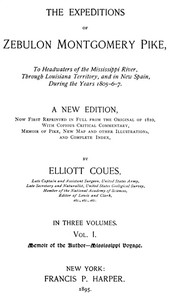
The Expeditions of Zebulon Montgomery Pike, Volume 1 (of 3) To Headwaters of the Mississippi River Through Louisiana Territory, and in New Spain, During the Years — Background and Themes

(1 User reviews)   274
In Category - Exploration
Pike, Zebulon Montgomery, 1779-1813, Coues, Elliott, 1842-1899 [Editor] Project Gutenberg 2013 Not confirmed
Mississippi River -- Description and travel; West (U.S.) -- Description and travel; West (U.S.) -- History -- To 1848; New Mexico -- Description and travel; Pike, Zebulon Montgomery, 1779-1813 -- Travel -- West (U.S.); West (U.S.) -- Discovery and exploration Readers of public-domain and historical texts
Project Gutenberg digital edition en

Edition facts

Words 214,269
Reading time 932 min
Text sections 22

The source record for The Expeditions of Zebulon Montgomery Pike, Volume 1 (of 3) To Headwaters of the Mississippi River Through Louisiana Territory, and in New Spain, During the Years — Background and Themes measures this digital text at 214,269 words, 15 hr 32 min estimated reading time, and 22 detected text sections.

The text analysis averages about 16.6 words per sentence, while the detected sections provide another way to judge how the source is divided.

Project Gutenberg metadata also associates the work with “Mississippi River -- Description and travel,” connecting these edition facts with the source record’s subject description.

This first volume of Elliott Coues's 1895 edition of Pike's expeditions pairs the original 1810 narrative of the Mississippi voyage with extensive critical footnotes, revealing the editor's meticulous corrections and contextual annotations.
Share
Editorial Edition Score 4.9/5

Calculated from edition completeness, EPUB availability, text structure and catalogue metadata. Not a user rating.

How this score is calculated
  • Description quality20 pts
  • Title & short description10 pts
  • Source metadata20 pts
  • Text length15 pts
  • Chapters / structure15 pts
  • EPUB file integrity20 pts

Total of 100 points, scaled to a 2.5-5.0 range. Editions with an empty description or a missing EPUB file are not scored.

Edition quality

Read the Text

ITINERARY: ST. LOUIS TO ST. PAUL, AUGUST 9TH-SEPTEMBER 21ST, 1805, 1-81

ITINERARY, CONTINUED: ST. PAUL TO LEECH LAKE, SEPTEMBER 22D, 1805-JANUARY 31ST, 1806, 82-151

ITINERARY, CONCLUDED: LEECH LAKE TO ST. LOUIS, FEBRUARY 1ST-APRIL 30TH, 1806, 152-215

WEATHER DIARY OF THE MISSISSIPPI, 216-220

CORRESPONDENCE AND CONFERENCES, 221-273

COMMERCE OF THE MISSISSIPPI, 274-286

GEOGRAPHY OF THE MISSISSIPPI, 287-336

ETHNOGRAPHY OF THE MISSISSIPPI, 337-354

VOCABULARY OF MISSISSIPPIAN PLACE-NAMES, 355, 356

PREFACE TO THE ORIGINAL EDITION.

Books of travels, journals, and voyages have become so numerous, and are so frequently impositions on the public, that the writer of the following sheets feels under an obligation to explain, in some measure, the original circumstances that led to the production of this volume. Soon after the purchase of Louisiana by an enlightened administration, measures were taken to explore the then unknown wilds of our western country--measures founded on principles of scientific pursuits, combined with a view of entering into a chain of philanthropic arrangements for ameliorating the condition of the Indians who inhabit those vast plains and deserts. His Excellency, Meriwether Lewis, then a captain of the first regiment of infantry, was selected by the President of the United States, in conjunction with Captain C. Clarke [Wm. Clark], to explore the then unknown sources of the Missouri, and I was chosen to trace the Mississippi to its source, with the objects in view contemplated by my instructions; to which I conceived my duty as a soldier should induce me to add an investigation into the views of the British traders in that quarter as to trade, and an inquiry into the limits of the territories of the United States and Great Britain. As a man of humanity and feeling, I made use of the name of my government to stop the savage warfare which had for ages been carried on by two of the most powerful nations of aborigines in North America. Why I did not execute the power vested in me by the laws of the country, to ruin the British traders and enrich myself, by seizing on the immense property of the North West Company, which I found in the acknowledged boundary of the United States, will be explained by my letter to Hugh M'Gillis, Esq., to whom I own eternal gratitude for his polite and hospitable treatment of myself and party.

In the execution of this voyage I had no gentleman to aid me, and I literally performed the duties (as far as my limited abilities permitted) of astronomer, surveyor, commanding officer, clerk, spy, guide, and hunter; frequently preceding the party for miles in order to reconnoiter, and returning in the evening, hungry and fatigued, to sit down in the open air, by firelight, to copy the notes and plot the courses of the day.

On my return from the Mississippi voyage, preparations were making for a second, which was to be conducted by another gentleman of the army; but General Wilkinson solicited as a favor that which he had a right to command, viz., that I would agree to take charge of the expedition. The late dangers and hardships I had undergone, together with the idea of again leaving my family in a strange country, distant from their connections, made me hesitate; but the ambition of a soldier, and the spirit of enterprise which was inherent in my breast, induced me to agree to his proposition. The great objects in view by this expedition, as I conceived in addition to my instructions, were to attach the Indians to our government, and to acquire such geographical knowledge of the southwestern boundary of Louisiana as to enable our government to enter into a definitive arrangement for a line of demarkation between that territory and North Mexico.

In this expedition I had the assistance of Lieutenant James [D.] Wilkinson, and also of Dr. John H. Robinson, a young gentleman of science and enterprise, who volunteered his services. I also was fitted out with a complete set of astronomical and mathematical instruments, which enabled me to ascertain the geographical situation of various places to a degree of exactitude that would have been extremely gratifying to all lovers of science, had I not been so unfortunate as to lose the greater part of my papers by the seizure of the Spanish government.

With respect to the great acquisitions which might have been made to the sciences of botany and zoölogy, I can only observe that neither my education nor taste led me to the pursuit; and if they had, my mind was too much engrossed in making arrangements for our subsistence and safety to give time to scrutinize the productions of the countries over which we traveled, with the eye of a Linnæus or Buffon; yet Dr. Robinson did make some observations on those subjects, which he has not yet communicated. With respect to the Spanish part, it has been suggested to me by some respected friends that the picture I drew of the manners, morals, etc., of individuals generally of New Spain, if a good likeness, was certainly not making a proper return for the hospitality and kindness with which those people honored me. Those reasons have induced me to omit many transactions, and draw a veil over various habits and customs which might appear in an unfavorable point of view, at the same time that I have dwelt with delight on their virtues.

There have not been wanting persons of various ranks who have endeavored to infuse the idea into the minds of the public that the last voyage was undertaken through some sinister designs of General Wilkinson; and although this report has been amply refuted by two letters from the Secretary of War, published with this work, yet I cannot forbear, in this public manner, declaring the insinuation to be a groundless calumny, arising from the envenomed breasts of persons who, through enmity to the general, would, in attempting his ruin, hurl destruction on all those who, either through their official stations or habits of friendship, ever had any connection with that gentleman.

As a military man--as a soldier from the time I was able to bear arms--it cannot be expected that a production of my pen can stand the test of criticism; and I hope, by this candid appeal to the justice and indulgence of the learned, to induce them to spare their censure if they cannot award their praise.

The gentleman who prints this work knows under what a variety of disadvantages it has gone to the press.[OP-1] At a distance during its publication, and engaged in my professional duties, it was impossible to give to it that attention which, in order to reach its proper degree of correctness, such a work necessarily would require.

[OP-1] The publisher owes it to truth, and to Colonel Pike, to state that he very much doubts whether any book ever went to press under so many disadvantages as the one now presented to the public. Some of those disadvantages must be obvious to every man who reads the work; but there are many others of a nature not sufficiently interesting for publication, yet of sufficient magnitude to retard the work, embarrass the publisher, and impose more anxiety than has fallen to his lot in the various books which he has published. It is, however, confidently believed that, notwithstanding all those circumstances, the Journal and its Appendixes will be found particularly interesting and pregnant with important information.

PREFACE TO THE NEW EDITION.

Pike's expeditions were the first military and the second governmental explorations which were pushed to any considerable extent in our then newly acquired territory of Louisiana. The name and fame of the brilliant young soldier who impersonated the authority of the United States over all the ground between British and Spanish possessions are thus inseparably linked with those of Lewis and Clark in the beginning of our history of the Great West--a West so great that it reached from the Mississippi to the Pacific. The two movements were similar in scope and plan; both were in the nature of claiming possession of property; they were alike fruitful of permanent good results; but they differed entirely in the circumstances under which each was devised, and to a marked degree in their respective purposes. Lewis and Clark's enterprise originated with the President of the United States; and though both of the men to whom that most memorable exploration was confided were officers of the regular army, their military organization was entirely subservient to affairs of state, being simply designed to secure the most efficient discipline in the discharge of certain civilian duties. Jefferson had invested heavily in real estate; the Louisiana purchase had been made with the people's money; he naturally wished to know what sort of a bargain he had made with Napoleon; so he sent Lewis and Clark to explore the vast extent of country he had bought. While their faces were still fixed on the setting sun, which for them still dipped behind the shining snow-caps, Pike set forth on his first journey northward; while they were homeward bound from the South Sea by way of the mighty Missouri and the rugged Roche Jaune, he was pressing on his second way toward the Mexican mountains. Both his expeditions originated with the commander-in-chief of the army; both were as strictly military in method as in purpose. Pike was the simon-pure and simple soldier, who had been ordered by his general to carry our flag among British traders and Sioux, Ojibways, and other Indians of the Northwest, in the first instance; in the second place, to display that emblem of authority among the Osages, Pawnees, and Comanches, and plant that standard of the republic on the still disputed boundary of New Spain in the Southwest. All else that he accomplished was incidental to Wilkinson's main aim. How daring were Pike's exploits, these volumes testify. Their moral effect was enormous; their results proved far-reaching; and some of these are still in evidence of intrepid adventure pushed to successful issue.

If the record of Pike's expeditions be overshadowed by the history of still greater and partly prior achievement, we may remember that its luster is dimmed only in comparison with the incomparable story of Lewis and Clark. If this witness of arduous duty ardently done in the service of his country stand dumb before that startling tragedy which set the seal of sacrifice upon a devoted life, we may reflect that such a consummation of noble aspirations but capped the climax of unswerving patriotism and unwavering fidelity to lofty ideals when it transfigured the already celebrated explorer into a national hero and a popular idol. Pike's personality is not less picturesque than is his career unique; our interest in his character becomes vivid as we study its manifestations, and perhaps even outgrows that regard we may bestow upon those of his achievements which have passed into permanent history. The present volumes tell his own story, in his own way; they are autobiographical in all that relates to the principal incidents and most stirring scenes of his life, before that final catastrophe which turned the tide of international warfare. If the narrative never halted at the point of an unaccustomed pen it would not be Pike's, and it would lack a certain quality which not even a Biddle could impart to the more polished and finished history of Lewis and Clark. It now seems probable that both books will endure, side by side, so long as any interest in the beginnings of our Great West finds a place in the hearts of the people.

Pike anticipated Lewis and Clark by about four years in bringing the results of his partly simultaneous explorations before the public. Since the first appearance of his work, there has never been a time when it has not been cited by scholars as an original authority in the many matters of historical, geographical, ethnological, and related interests of which it treats. Nevertheless, it is undeniable that Pike has never been so widely or so well known as he deserves to be in his double character of traveler and author. The soldier could hardly desire greater fame than fell to the happy lot of the hero of York, victorious in death; but what of his life? Who was this General Pike before that? Who was Lieutenant or Captain Pike--where did he go exploring--what did he discover--how should we know? In searching contemporaneous records of the War of 1812 for biographical data in the preparation of the Memoir which introduces these volumes, it was always the great soldier--General Pike--whom I found, with scant recognition, if anything more than mere mention, of the still greater explorer--the youthful, the dashing and winning, the ardent and enthusiastic lieutenant, who dreamed of glory till his dream came true. The fact would seem to be that Pike's death on the field of battle, under exceptionally thrilling circumstances, obscured rather than accentuated those earlier exploits which set his title to fame in the clearest and truest light. Probably no good general would have failed in what Pike accomplished on the day of his death; but how many subalterns in their twenties have won imperishable renown by achievements in the field of exploration? One purpose I had in view in preparing a new edition of this work will have been subserved if I have succeeded in eliminating a certain popular aberration, in calculating aright the parallax of Pike as viewed from different standpoints, and in thus placing his name in proper historical perspective.

Nearly or quite all that an editor might be expected to say in his preface concerning the subject-matter of his author will be found to have been said already in one place or another in the course of the extensive and minute commentary which appears upon almost every page of the present edition. Nevertheless, so few are the persons who have any clear or coherent ideas on the subject of Pike's performances, that it will be to consult the convenience of most readers who may take up this book to give here a brief statement of his journeyings.

Pike conducted two entirely separate and distinct expeditions. One of them, in 1805-6, was from St. Louis by way of the Mississippi to the headwaters of this river, and return--for the most part by the same way he went. This round trip, which I have called the "Mississippi Voyage," forms Pt. 1 of his book. The other expedition was taken westward from St. Louis into the interior parts of the then Louisiana, to the sources of the Arkansaw river, and among the Rocky mountains of present Colorado. In so far as Pike protracted this exploration of his own volition, it forms Pt. 2 of his book, which I have designated the "Arkansaw Journey." But at one point in the course of this journey Pike was captured by the Spaniards, and conducted against his will by a roundabout way through Mexico to the then Spanish-American boundary between Texas and Louisiana. This episode, unflattering to Pike's sensibilities, if not wholly unforeseen by him, he saw fit to make the subject of Pt. 3 of his book; I have entitled it the "Mexican Tour."

I. In July, 1805, Pike was ordered by General Wilkinson to explore and report upon the Mississippi river from St. Louis to its source, select sites for military posts, treat with the Indians, make peace if possible between the Sioux and Ojibways, and find out what he could about the British traders who still occupied posts in our newly acquired territory. Excepting these establishments of the Northwest Company, there were then no white settlements on or near the river beyond the village of Prairie du Chien, and our flag had never flown in that quarter. Pike navigated his boats to the vicinity of present Little Falls, but could get them no further. He there built a stockade, in which some of his men were left for the winter, and with the rest pushed on by land along the river to Lower Red Cedar Lake--Sandy lake--Grand rapids and Pokegama falls--mouth of Leech Lake river--up the latter to Leech lake--and thence to Upper Red Cedar (now Cass) lake, at the mouth of Turtle river. This was the furthest point he reached. He considered the Leech Lake drainage-area--which I have called the Pikean source--to be the true origin of the Mississippi, and remained in ignorance of the fact that this river flowed into Cass lake from such lakes as Bemidji and Itasca, though these and others were already known to some of the whites. Returning from Cass to Leech lake, and thence, by a more direct overland route than he had before taken, to the Mississippi in the vicinity of Lower Red Cedar lake, he descended the river to his stockade, picked up the men who had wintered there, and as soon as the ice broke up started in boats for St. Louis, which he reached in safety with all his party in April, 1806.

II. In July, 1806, Pike left St. Louis on his second expedition. He ascended the Missouri to the Osage, and the latter to the villages of the Indians of that name. Thence he continued westward overland, entered Kansas, and proceeded to the Pawnee village on the Republican river, near the present Kansas-Nebraska line. Turning southward, he reached the Arkansaw river at the present site of Great Bend. There he dispatched his junior officer, Lieutenant Wilkinson, with a few men, to descend the Arkansaw, while with the rest of his company he ascended the same river into Colorado, as far as Pueblo. From this point he made an unsuccessful side-trip which had for its object the ascent of the since famous peak which bears his name, and returned to his camp at Pueblo. Thence pushing up the Arkansaw, he was halted by the Grand cañon, at the site of present Cañon City. He then made a detour to the right, which took him up Oil creek into South Park. He traversed this park, along the South Platte and some of its tributaries, left it by way of Trout Creek pass, and was thus again brought to the Arkansaw. He pushed up this river till he viewed its sources, in the vicinity of present Leadville, turned about, and with great difficulty descended it to the very camp he had left at Cañon City. This part of his journey was not accomplished without much hardship, and ended in chagrin; for he had fancied himself on the headwaters of that Red river whose sources he had been pointedly instructed to discover. Nothing was known at that time, to Americans, of the origin of that great branch of the Mississippi which was called Red river lower down; nor was it known till years afterward that what the Spaniards had called high up by a name equivalent to Red river was really that main fork of the Arkansaw which is now designated the Canadian river, whose sources are in the mountains not far from Santa Fé. _This_ was the river which Pike might have found, had his search been more fortunately directed, though neither he nor any other American was aware of that fact at the time. Nevertheless, he determined to carry out his orders to the letter, and with more courage than discretion pushed southward from his camp at Cañon City to discover an elusive Red river. He passed up that tributary of the Arkansaw which is now called Grape creek, and thus into the Wet Mountain valley. There the party suffered almost incredibly from cold and hunger; some of the men were frozen and crippled for life. But Pike managed to extricate himself and most of his companions from their perilous situation by crossing the Sangre de Cristo range through the Sand Hill pass into the San Luis valley, where he found himself on the Rio Grande del Norte. He descended this river to the Rio Conejos, and there established himself in a stockade--in part at least for the purpose of tarrying while he sent a small party back for those of the men who had been left behind, both at Cañon City and in Wet Mountain valley.

The secret which underlay Pike's ostensible instructions from General Wilkinson, and the mystery which is supposed to have enshrouded his movements on this portion of his second expedition, are fully discussed in my notes, at various points in Pike's narrative or in my Memoir, where the subject obtrudes. Without going into any particulars here, it is to be said simply that Pike may have been ordered to proceed to Santa Fé--or as near that capital of Spanish New Mexico as he could go with the force at his command--without being informed of whatever ulterior designs the general of the army may have entertained.

Elliott Coues's 1895 edition of Zebulon Pike's expeditions is as much a work of scholarly reconstruction as it is a travel narrative. The volume opens with a new memoir of Pike and then presents the 1810 text of the Mississippi voyage, but the reader quickly discovers that the original account is enveloped in a dense apparatus of footnotes. Coues, a former army surgeon and naturalist, corrects dates, identifies obscure officers, and points out errors in the original—such as a barometer reading that “seems to be missing a digit.” This editorial presence transforms the reading experience: one is constantly aware of two voices, Pike's and Coues's, separated by eighty-five years.

Two Voices, One Page

The most striking feature of this volume is the typographical and intellectual tension between Pike's original prose and Coues's commentary. Pike's dedication addresses “the President and Members of the U. S. M. P. S.” with a soldier's modesty, calling his work “merely a volume of details” and claiming only “perspicuity and exactitude.” Coues, however, immediately undercuts this humility by supplying biographical footnotes that trace the careers of every officer Pike mentions—often correcting Pike's own spellings or omissions. For instance, a footnote on Lieutenant “Hilton” notes that the name is “probably an error,” and then provides a mini-biography of the correct officer. The result is a layered text where the original narrative is constantly interrupted, enriched, and sometimes contradicted by the editor's voice.

The Editor's Obsession with Precision

Coues's footnotes reveal a relentless drive for factual accuracy. He does not simply annotate; he corrects. In one note, he observes that a date in the original—1892—should “probably be 1792.” Elsewhere, he flags a missing digit in a barometer reading. His biographical notes are exhaustive: for example, he traces John De Barth Walbach's entire military career from 1799 to 1857, quoting an unpublished letter from General Wilkinson that calls Walbach “the ablest horse officer in America.” This level of detail suggests that Coues saw his role not merely as an editor but as a historian correcting the record. The reader must navigate between Pike's firsthand observations and Coues's second-guessing, which can be both illuminating and disorienting.

Pike's Narrative Voice and Its Limitations

Pike's own writing is direct and unadorned, consistent with his claim to “perspicuity and exactitude.” He describes landscapes, distances, and encounters with Native Americans in a matter-of-fact tone, rarely indulging in reflection. Yet the excerpts show that his account is also shaped by the conventions of early 19th-century military reporting: he lists officers, supplies, and routes with bureaucratic precision. The reader must infer the human experience behind the data. Coues's footnotes sometimes fill this gap, but they also highlight what Pike omits—such as the broader political context of his expedition. The volume thus offers two kinds of evidence: Pike's raw data and Coues's contextual framework, leaving the reader to synthesize them.

Readers of this volume should be prepared to read in two directions: forward through Pike's narrative and downward into Coues's footnotes. The editor's corrections and biographical sketches are not mere appendages but integral to understanding the text's reliability and historical context. For those interested in the mechanics of exploration writing—how a military report becomes a historical document—this edition is a revealing case study. Approach it as a dialogue between a young officer and a meticulous scholar, each shaping the record in his own way.

Sometimes I think about how Pike’s edited pages feel like a quiet argument with history, footnotes whispering corrections. That sense of unfinished truth stayed with me, and I found a similar ache in the Narrative of an Expedition Through the Upper Mississippi to Itasca Lake, the Actual Source of This River Embracing an Exploratory Trip Through the St. Croix and Burntwood — A Closer Reading. It lingers differently, softer, like a river you once crossed and still remember.

Harper Garcia
3 weeks ago

3
3 out of 5 (1 User reviews )

Add a Review

Your Rating *
  • ...
    Melissa Strong - 1 month ago
    This expedition journal is a remarkable piece of American history. Pike's detailed observations of the land and its original inhabitants are invaluable. His resilience and spirit of discovery are inspiring. The annotations and context provided in this edition make it accessible to modern readers. A must-have for history enthusiasts and lovers of exploration narratives.

  • ...
    Jennifer Cross - 1 month ago
    I expected more excitement from an exploration saga, but this book is bogged down by mundane diary entries and bureaucratic details. Pike's constant complaints and the lack of dramatic tension make it a chore to read. Only for dedicated historians; general readers will find it tedious.

  • ...
    Harold Michael Cole - 3 weeks ago
    A historically significant account with rich primary-source material. Pike's journey is fascinating, but the writing style can be dry and repetitive at times. The extensive footnotes and appendices are helpful but may overwhelm casual readers. Recommended for students of American expansion, though not a light read.


Reader reflection

How did this book work for you?

Your answers remain private and are stored only in this browser.

Your progress 0 / 10
1

Where are you in your reading?

2

Did this book hold your interest?

3

Would you encourage someone else to read it?

4

How much effort did this book require?

Related eBooks