1

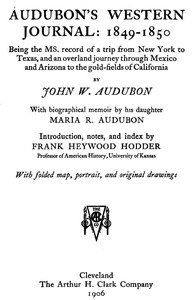
Audubon's western journal: 1849-1850 Being the MS. record of a trip from New York to Texas, and an overland journey through Mexico and Arizona to the gold-fields of — A Closer Reading
(0 User reviews)
1445
Project Gutenberg
2018
Not confirmed
Mexico -- Description and travel; United States -- Description and travel; Overland journeys to the Pacific; California -- Gold discoveries; Southwest, New -- Description and travel; Audubon, John Woodhouse, 1812-1862
Readers of public-domain and historical texts
Project Gutenberg digital edition
en
Edition facts
Words
60,107
Reading time
262 min
Text sections
23
The catalog record for Audubon's western journal: 1849-1850 Being the MS. record of a trip from New York to Texas, and an overland journey through Mexico and Arizona to the gold-fields of — A Closer Reading provides practical reading context through 60,107 words, 4 hr 22 min estimated reading time, and 23 detected text sections.
The text analysis averages about 24.1 words per sentence, while the detected sections provide another way to judge how the source is divided.
Project Gutenberg metadata also associates the work with “Mexico -- Description and travel,” connecting these edition facts with the source record’s subject description.
Source:
Project Gutenberg record #58575
John Woodhouse Audubon's 1849-1850 journal records an overland journey from New York to California's gold fields, with detailed observations of Mexican and Arizona landscapes, wildlife, and indigenous peoples, framed by editorial apparatus from his daughter and a historian.
Read the complete public-domain text at its original source.
Read on Project GutenbergJohn Woodhouse Audubon, son of the famed naturalist, kept this manuscript record of a journey from New York to Texas and then overland through Mexico and Arizona to the California gold fields in 1849-1850. The journal, published posthumously in 1906, is framed by a biographical memoir by his daughter Maria R. Audubon and an introduction by historian Frank Heywood Hodder. Unlike a polished travelogue, the entries retain the immediacy of daily hardship: scarce provisions, difficult terrain, and encounters with local inhabitants. The catalog subjects—overland journeys, gold discoveries, and Southwestern travel—are all present, but the excerpts reveal a text more concerned with natural history and ethnographic observation than with mining or adventure.
A Naturalist’s Eye in a Miner’s World
Though Audubon traveled to California for gold, his journal entries dwell on the natural world with a naturalist’s precision. He notes the American Avoset, long-billed curlew, Canada crane, and red-shafted woodpecker, and describes a rattlesnake nest unearthed near a cactus patch: “a tolerably large female, which had in her nest nine young; beautiful little creatures, about a foot long.” He also records the behavior of a small lizard with a banded tail that “curls its tail on its back, and waves it gently four or five times most gracefully.” These observations align with the Audubon family legacy, yet the journal is not a scientific catalog; it is a personal record where wildlife appears alongside the mundane struggles of travel.
The Texture of Daily Hardship
Audubon’s entries repeatedly emphasize scarcity and discomfort. On September 17, 1849, near Papago villages, he writes: “we sat down to our supper of bread and water, our sugar, coffee and all other matters culinary having been used up, and the country affords no game.” The party rises at 5 a.m. and marches until 7 p.m., yet the promised antelope proves “like the meat of a poor two-year-old beef, hardly so good.” Water holes are “filled with animalculæ, and contained many turtles and snakes.” The journal does not romanticize the overland journey; instead, it conveys a persistent sense of depletion—of food, energy, and morale—punctuated by small transactions, such as buying a cow for four dollars and refusing the seller’s later demand for seven.
Encounters with People and Place
Audubon’s descriptions of indigenous peoples are brief but telling. Of the Papagos, he notes: “fifty Papagos would count all we have seen, and they are fast passing away judging from the dilapidations of the towns, and the numbers of empty houses.” He observes their diet of turtles and game, their horses ridden “with only a rope around the neck,” and their burial mounds where “kettles and culinary articles” are left for the dead. The landscape itself is rendered in stark colors: “strips of red gravel,” “dried parched-up white clay,” and mountains of “blackish stone, looking in the distance almost purple.” These passages suggest a traveler attentive to both human and physical geography, though his judgments are filtered through the assumptions of his era.
Readers approaching this journal should expect a document that is neither a complete narrative nor a systematic natural history. The editorial additions—the memoir, introduction, notes, and index—provide context but do not fill the gaps in the manuscript. Audubon’s voice is direct, often weary, and occasionally sharp. The value of the text lies in its unpolished details: the price of beef, the color of a lizard’s tail, the emptiness of a Papago house. It is a record of what one man noticed while crossing a continent in search of gold, and what he noticed was rarely the gold itself.
It’s funny how a journal can feel like a hand on your shoulder. That old Audubon trip stayed with me long after I closed it—the quiet weight of all that open land. It made me think of Through Glacier Park: Seeing America First with Howard Eaton — Reading Companion, which has that same unhurried feeling of moving through a place that asks nothing of you but to notice.
There are no reviews for this eBook.
There are no comments for this eBook.
Reader reflection
Before you leave, reflect on the book
Use these questions to collect your thoughts before moving on.
Your progress
0
/
10
2
Was reading this book enjoyable?
3
How likely are you to recommend this book?
4
What was the reading difficulty like?
5
Would you like to discuss this book with someone?
6
What did you appreciate most?
7
How much did the book move you?
8
How clear did the writing feel?
9
What did this book teach you most?
10