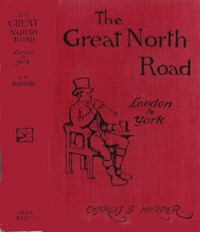
The Great North Road, the Old Mail Road to Scotland: London to York — Text and Context

(0 User reviews)   39
In Category - Places Peoples
Harper, Charles G. (Charles George), 1863-1943 Project Gutenberg 2014 Not confirmed
Great Britain -- Description and travel; England -- Social life and customs; A1 Road (England and Scotland) Readers of public-domain and historical texts
Project Gutenberg digital edition en

Edition facts

Words 68,552
Reading time 299 min
Text sections 9

The source record for The Great North Road, the Old Mail Road to Scotland: London to York — Text and Context measures this digital text at 68,552 words, 4 hr 59 min estimated reading time, and 9 detected text sections.

The text analysis averages about 25.7 words per sentence, while the detected sections provide another way to judge how the source is divided.

Project Gutenberg metadata also associates the work with “Great Britain -- Description and travel,” connecting these edition facts with the source record’s subject description.

Harper's 1901/1922 travelogue traces the Great North Road from London to York, blending roadside history, vanished coaching inns, and the early motorist's perspective. Excerpts show precise descriptions of Stilton's decline, Stangate Hill's highwaymen lore, and the revival of the Bell at Barnby Moor.
Share
Editorial Edition Score 4.7/5

Calculated from edition completeness, EPUB availability, text structure and catalogue metadata. Not a user rating.

How this score is calculated
  • Description quality20 pts
  • Title & short description10 pts
  • Source metadata20 pts
  • Text length15 pts
  • Chapters / structure15 pts
  • EPUB file integrity20 pts

Total of 100 points, scaled to a 2.5-5.0 range. Editions with an empty description or a missing EPUB file are not scored.

Edition quality

Read the Text

r, was born in 1717, and lost his eyesight at six years of age. A native of Knaresborough, he filled in his time many parts; being fiddler, huckster, soldier, carrier, proprietor of the first stage-wagon between York and Knaresborough, and road and bridge maker and contractor by turns. The marvellous instinct which served him instead of sight is scarce credible, but is well authenticated. He joined Thornton’s company of Yorkshire volunteers raised at Boroughbridge to meet the Scots rebels in the ’45, and marched with them and played them into action at Falkirk. His marvellous adventures have no place here, but his solitary walk from London to Harrogate in 1741 concerns the Great North Road. Being in London, and returning at the same time, Colonel Liddell of Harrogate offered Blind Jack a seat behind his carriage, which Metcalf declined, saying that he could easily walk as far in a day as the colonel could go in his carriage with post-horses. This incidentally shows us how utterly vile the roads were at the time. Metcalf, although blind and unused to the road, having travelled up to London by sea, walked back, and easily reached Harrogate before the colonel, who posted all the way.

Liddell, who had an escort of sixteen mounted servants, started an hour later than Metcalf. It had been arranged that they should meet that night at Welwyn, but, a little beyond Barnet, on Hadley Green, where the roads divide, Metcalf took the left hand, or Holyhead, road by mistake and went a long distance before he discovered his mistake. Still he arrived at Welwyn first. The next day he was balked at Biggleswade by the river, which was in flood, and with no bridge to cross by. Fortunately, after wandering some distance along the banks, he met a stranger who led the way across a plank bridge. When they had crossed, Metcalf offered him some pence for a glass of beer, which his guide declined, saying he was welcome. Metcalf, however, pressed it upon him.

“Pray, can you see very well?” asked the stranger.

“Not very well,” replied Blind Jack.

“God forbid I should tithe you,” said his guide. “I am the rector of this parish; so God bless you, and I wish you a good journey.”

In the end, Metcalf reached Harrogate two days before the colonel.

Metcalf made many roads around Knaresborough and in different parts of Yorkshire, but none actually on the Great North Road. He died, aged ninety-three, in 1810, five years before Macadam and Telford began their work upon the roads. Like them, he rather preferred boggy ground for road-making, and forestalled both them and Stephenson in adopting fagots as foundations over mires. At that time the ignorant surveyors of roads repaired them with dirt scraped from ditches and water-courses, in which they embedded the first cartloads of stones which came to hand; stone of all kinds and all sizes. This done, their “repairs” were completed, with the result that the roads were frequently as bad as ever and constantly in the most rugged condition. Roads—it may be news to the uninstructed—cannot be made with dirt. In fact, a good road through anything but rock is generally excavated, and the native earth being removed, its place is taken by coarse-broken granite or rock; this in its turn receiving a layer of “macadam,” or smaller broken granite or whinstone, which is finally bound together by a sprinkling of red gravel, of the kind known by builders as “hoggin,” whose binding qualities are caused by a slight natural admixture of clay. In his insistence upon broken stones, Macadam proved a power of observation not possessed by the generality of road-makers, whose method was the haphazard one of strewing any kind upon the road and trusting in the traffic to pack them. With rounded pebbles or gravel stones thus chafing against one another, they never packed into a solid mass, but remained for all time as unstable as a shingly beach. Generations of road-making had not taught wisdom, but Macadam perceived the readiness of the angularities in broken stones to unite and form a homogeneous mass, and in introducing his system proved himself unwittingly a man of science, for science has in these later days discovered that ice is compacted by the action of ice-crystals uniting in exactly this manner.

A great scheme for laying out the whole of the Great North Road between London and Edinburgh on a scientific basis was in progress when the successful trial of the competing locomotives at Rainhill, near Liverpool, cast a warning shadow over the arrangements, and finally led to the project being entirely abandoned. Had the work been done, it is quite possible that the railways to the north would have taken another direction; that, in fact, instead of land having to be surveyed and purchased for them, the new, straight, and level road would have been given up to and largely used by the railways. Telford was the engineer chosen by the Government to execute this work, of which the portion between Morpeth and Edinburgh was actually constructed. The survey of the road between London, York, and Morpeth was begun as early as 1825, and had been not only completed, but the works on the eve of being started, when the Rainhill trials in 1829 stopped them short, and caused the utter waste of the public money spent in the surveying.

IT were vain, nowadays, to seek any of the old starting-points from London. The late Mr. Frederick Locker-Lampson asked in 1896, “Are ‘The Bull and Mouth,’ ‘The Spread Eagle,’ The Swan with Two Necks,’ and ‘The Green Man and Still,’ yet in existence?” With some little research he would have discovered that—with the sole exception of the last-named—they are not. The “Bull and Mouth” in later years became the “Queen’s Hotel,” and was demolished only when the site was required for an extension of the General Post Office in 1887. At the same time as the “Queen’s” disappeared, the street at the side of it, called from the old inn “Bull and Mouth Street,” was stopped up. In this street was the entrance to the famous old coaching-stables which were in the last years of their existence used as a railway receiving-office for goods. On their being pulled down, the grotesque plaster sign, representing a giant face with yawning mouth in which stood a bull, was removed to the Guildhall Museum, where it may still be seen, together with the yet larger and more elaborate sign which decorated the frontage of the “Queen’s.” This also included a mouth and a bull, set amidst a frame of plaster fruits and flowers, with the inscription:—

“Milo the Cretonian, An ox slew with his fist, And ate it up at one meal, Ye gods! what a glorious twist.”

The origin, however, of the curious sign had nothing to do with this hungry person. Precisely what was that origin is never likely to be known; for although the legend that it derived from the capture of “Boulogne Mouth”—_i.e._ Boulogne Harbour—in the reign of Henry the Eighth is in general acceptation, it has been shrewdly suspected that this was a tale wickedly invented by George Steevens, a literary practical joker, who palmed off many similar stories upon unsuspecting antiquaries at the end of last century. A perhaps more likely story is that the sign was originally the “Bowl and Mouth.”

Under Sherman’s rule the “Bull and Mouth” became a mighty resort of coaches to and from all parts, but more especially the north, and his underground stables formed one of the sights of London.

Edward Sherman was a man of many parts, and had a varied career. Originally a stockbroker, he followed Willans at the “Bull and Mouth” in 1823, and rebuilt it as the “Queen’s” in 1830, continuing the stables under the old name, and eventually reconstructing them. The money for these enterprises came from three old and wealthy ladies whom he married in succession. If the stranger, unversed in the build and colour of coaches, could not pick out the somewhat old-fashioned, bright-yellow vehicles as Sherman’s, he was helped in identifying them by the pictorial sign of the inn painted on the panels—rather a startling one, by the way, to the rustics. Sherman, however, had not the prescience of Chaplin or of Horne, who clearly foresaw the success of railways, and he kept his coaches on the roads for some time after they were opened to their destinations. He was sufficiently ill-advised not to come to terms with the railway companies, and actually attempted, with the “Red Rover,” to run the Manchester trains off. Of course this could not last very long, and Sherman withdrew after having lost seven thousand pounds in a gallant, but futile, competition with steam.

In its prime the “Bull and Mouth” sent forth the Edinburgh and Aberdeen Royal Mail by York; the Edinburgh, Glasgow, and Aberdeen coach by Ferry-bridge to Newcastle, where the Glasgow passengers changed; the Glasgow and Carlisle Royal Mail; the Newcastle “Wellington”; Shrewsbury and Holyhead “Union” and “Oxonian”; Birmingham “Old Post Coach” and “Aurora”; Leeds Royal Mail and “Express”; and Leicester “Union Post Coach.”

The site of the “Swan with Two Necks” is now occupied by the London and North-Western and South-Western Joint Goods Depot, in Gresham Street. Modern sculptured keystones may be seen over the entrances, bearing the effigy of a double-headed swan. This sign, like that of the “Bull and Mouth,” is a corruption of a widely different term; originally, indeed, the “Swan with Two Nicks,” from the particular “nicks” with which the bills of the swans belonging to the Vintners’ Company on the Thames were marked. The City Companies each had their swans on the river, and even nowadays they are maintained on the upper reaches. The young cygnets were marked at the annual festival of “swan-upping,” at which the City magnates used hugely to enjoy themselves. The old and the new “nicks” of the Vintners’ Company are pictured here.

[Picture: Old And New Swan Nicks] So far back as 1556, the “Swane with ij Nekes at Mylke Street End” was known, and was then the property of the Vintners. In the coaching era it is best remembered as the headquarters of the great William Chaplin’s huge coaching business. Chaplin succeeded William Waterhouse, who had established himself here in 1792, issuing a curious token bearing the representation of a mail-coach on one side and that of the Double-Necked Swan on the other, with the legend, “Speed, Regularity, and Security. Payable at the Mail Coach Office, Lad Lane, London, W.W.”

Lad Lane was until recent years the name by which this part of Gresham Street was known, while the inn itself was generally called by the coaching fraternity the “Wonderful Bird.”

Chaplin had in early days been a coachman himself. His career would have delighted that sturdy moralist, Hogarth, painter of the successful career of the Industrious Apprentice, for from that useful but humble position he rose to be the largest coach-proprietor in England, Deputy-Chairman of the London and Southampton (now London and South-Western) Railway, and Member of Parliament for Salisbury. He is said to have accumulated half a million of money. Twenty-seven mails left London every night, and of these Chaplin horsed fourteen for various distances. Very many stage-coaches were in his hands, and at the height of the coaching era he is said to have owned nearly two thousand horses. He was an entirely level-headed man, and, seeing at an early stage that railways must succeed, threw in his lot with them. Railway directors were exceedingly anxious to win over the coaching proprietors, and to induce them to withdraw from the road, so that with no coaches running the public should of necessity, whether they liked it or not, be compelled to travel by rail. Chaplin sold off his stock before the oncoming railways depreciated it, and, joining Benjamin Worthy Horne, of the “Golden Cross,” Charing Cross, founded the great carrying firm of Chaplin and Horne, which enjoyed the exclusive agency for the London and Birmingham Railway. There can be little doubt, although it was denied by the early officials of that line, that Chaplin and Horne were really bought off the road, and the sum of £10,000 has been mentioned as the price of their withdrawal. Before that time had come, coaches issued from Chaplin’s yard for many places on the north-western roads: the Carlisle Royal Mail; the Birmingham Royal Mail, “Courier,” and “Balloon Post Coach”; the Chester “New Coach”; Coventry “Light Post Coach”; Liverpool Royal Mail; Holyhead “New Mail” and a stage-coach without any particular name; and the Manchester Royal Mail, “Defiance,” “Regulator,” and “Prince Saxe-Cobourg.” The “Spread Eagle” in Gracechurch Street has also disappeared. It was at one time a house of Chaplin’s, and was afterwards owned in succession, together with the “Cross Keys” next door, by Mrs. Nelson and Mrs. Mountain.

[Picture: Modern sign of the “Swan with Two Necks”]

The “Green Man and Still,” the last of the quartet of inns inquired after by Mr. Locker-Lampson, is the only one now standing, and may be seen at the corner of Oxford and Argyll Streets, close by Oxford Circus. It was not a coaching hostelry in the fullest sense, being only a place of call for the Oxford “Age,” and for the Harrow and other north-westerly “short stages,” running between London and the suburbs. It is now a railway receiving-office. This curious sign probably alludes to the old profession of the “herb-doctors,” who distilled medicines from wild or cultivated herbs. There were other inns whence Great North Road coaches set out, but they have all vanished. The “George and Blue Boar,” Holborn, whence the famous “Stamford Regent” started, has long since been pulled down, and the “Inns of Court Hotel” stood on its site. The hotel building remains, but about 1912 it ceased to be a hotel, and has since been converted into offices for an Insurance Company. The “Regent” originally left London at six o’clock in the evening, but in 1822 the hour was altered to six in the morning, an unearthly time for those who had to go some distance to reach Holborn, and necessitating, perhaps, getting up at three o’clock. The announcement by the proprietors that this alteration was for the “more perfect convenience” of their patrons seems ironical:—

SIX O’CLOCK IN THE MORNING From London.

THE PROPRIETORS OF THE REGENT COACH

Respectfully inform the public and their friends in particular, that, for their more perfect convenience, and to keep pace with the daily improvements in travelling, the hour of its leaving London will be altered on Monday, the 13th of May (and continued during the summer months),

TO SIX O’CLOCK IN THE MORNING, _Instead of Night_.

The arrangements that are forming in furtherance of this long-desired alteration will ensure a steady and punctual conveyance of Passengers to Stamford by a Quarter before Six o’clock, and to Melton by a Quarter before Nine o’clock in the Evening.

The hours of leaving Melton and Stamford will NOT be altered.

The proprietors take this opportunity to acknowledge their sense of the decided patronage shown to the REGENT COACH under their several regulations, and to repeat their promise that no exertion shall be wanting to make it one of the most desirable conveyances to and from London.

Passengers and Parcels booked at Mr. Weldon’s, and the Bull and Swan Inn, Stamford; and at Mr. Sharp’s, Bell Inn, Melton.—_Stamford_, _May_ 1, 1822.

[Picture: The “Spread Eagle,” Gracechurch Street]

The “Saracen’s Head,” Snow Hill, which must not he confounded with the other and equally celebrated “Saracen’s Head” in Aldgate High Street, was another very notable coaching establishment, and a galleried inn of picturesqueness and antiquity. Alas! that it has long since disappeared. Its history went back beyond the fifteenth century, and a reference made to it in 1522, when the suite of the Emperor Charles the Fifth lay here, speaks of the house as of some importance:—“The signe of the Sersyns hed: xxx beddes, a stable for xl horses.”

The sign, of course deriving from the Crusades, itself gives the inn a very high antiquity. It was a sign of a gruesome and savage aspect, and had its origin in the pictures the returning Crusaders drew of their adversaries. As Selden says:—“Our countrymen pictured them with huge, big, terrible faces, when in truth they were like other men. But this,” he adds slyly, “they did for their own credits.” The inn owed its later celebrity to Dickens, who made it the London inn of Mr. Squeers. Thus he describes it:—“Near to the jail, and by consequence near to Smithfield, on that particular part of Snow Hill where omnibus horses going eastward seriously think of falling down on purpose, and where horses in hackney cabriolets going westward not unfrequently fall by accident, is the coachyard of the Saracen’s Head Inn; its portal guarded by two Saracens’ heads and shoulders frowning upon you from each side of the gateway. The inn itself, garnished with another Saracen’s head, frowns upon you from the top of the yard. When you walk up this yard you will see the booking-office on your left and the tower of St. Sepulchre’s Church darting abruptly up into the sky on your right, and a gallery of bedrooms upon both sides.”

There is a “Saracen’s Head” on Snow Hill to this day, but it is a modern building. From the old house went the “Lord Nelson,” York, Newcastle, and Edinburgh coach; the “Post,” despite its name, a slow-coach, for Carlisle and Penrith, by Doncaster, Ferrybridge, and Greta Bridge, doubtless the one by which Mr. Wackford Squeers took his “dear pupils” to Dotheboys Hall; and coaches to Hull, Liverpool, Manchester, Birmingham, and Shrewsbury, besides others for the western roads. The “Saracen’s Head” was kept by Mrs. Mountain, in succession to her husband and her husband’s father. Her son, Peter, managed the business for her, but it must not be supposed that she took no active part in it. To the contrary, Mrs. Sarah Ann Mountain, like her contemporary, Mrs. Nelson, of the “Bull,” Aldgate, possessed the most brilliant business capacity. She built coaches, as well as horsing them, and earned a profit by charging her partners down the road the mileage which in the usual course of business would have been paid over to a coach-builder. There was no more expressive sight in the London of the beginning of the nineteenth century than the simultaneous starting of the mails every evening from the General Post Office. Londoners and country-cousins alike were never weary of the spectacle of the smart coaches, the business-like coachmen, and the resplendent, scarlet-coated guards preparing to travel through the night, north, south, east, or west, with his Majesty’s mails. Even the passengers shone with a reflected glory, and felt important as, one after the other, the twenty-seven mails began at the stroke of eight o’clock to move off from the double file that lined the street.

[Picture: The “Saracen’s Head,” Snow Hill]

That street was not the broad thoroughfare of St. Martin’s-le-Grand, but the narrow one of Lombard Street, in which the General Post Office was situated for many years, until 1829, when what is now called the “old” General Post Office, but was then the newly completed building of Smirke’s, was occupied. The old headquarters can still be seen, in the Lombard Street Post Office of to-day. It is from here that the picture of the mails starting, forming the frontispiece of this volume, was taken. To our eyes, accustomed to the crowded thoroughfare of modern times, the street appears supremely dull and desolate, but that is only a retrospective way of looking at it.

Charles G. Harper's The Great North Road, the Old Mail Road to Scotland: London to York (first published 1901, revised 1922) opens with a preface that situates the reader at a hinge in transport history: the motorcar had been legalized only five years earlier, and long-distance journeys by car were still uncertain experiments. Harper notes that the Automobile Club's "Thousand Miles Tour" of 1900 was a special effort, and that the road itself has since become heavily traveled. This framing—looking back from the early motor age at a coaching era already lost—gives the book a dual perspective. The excerpts that follow show Harper as a keen observer of physical remains: the tarred roadway, the revived Bell inn on Barnby Moor, and the silent streets of Stilton, where the railway never came.

A Road of Two Eras

The preface establishes the book's temporal pivot. Harper describes how the Great North Road, once a lonely highway, became a busy motor route. He singles out the Bell on Barnby Moor, closed around 1845 and converted to a farmhouse, then reopened as an inn for motorists in 1906. This specific revival—"a romance" in his words—illustrates the road's changing fortunes. The reader is alerted that Harper will move between the coaching past and the motorized present, often noting what survives and what has vanished. The opening thus prepares us for a narrative that values both the old-time inns and the new asphalt, without nostalgia overwhelming observation.

Stangate Hill and the Vanished Abbey

In the middle excerpt, Harper descends Stangate Hill, a spot where the road forks and the left-hand route to Huntingdon "is seen going off on the level to a vanishing-point lost in the distant haze." He notes the lonely churchyard of Sawtry St. Andrews, whose church has disappeared entirely, and the site of Sawtry Abbey, besieged by medieval tramps. An old rhyme is quoted: "Sawtry-by-the-Way, that old Abbaye, Gave more alms in one day than all they." Today only Monk's Wood and Abbey Farm remain. Harper also mentions De Foe's conjecture that "Stangate" derives from paved stone, and his spelling "Saltries" preserves the original "Salt Reeth," indicating ancient salt marshes. The passage shows Harper's method: physical description, historical anecdote, and philological note woven together.

Stilton: A Coaching Centre Preserved in Amber

Harper's treatment of Stilton is the most sustained set-piece in the excerpts. He describes the village as "strangely silent," dreaming of bygone busy times, and credits the Marquis of Exeter and others for resisting the railway, which looped away and left Stilton "preserved in a glass case." The coaching era is evoked through details: night and day coaches, post-chaises, fly-wagons, and drovers doing twenty miles a day with sheep and cattle. At Stilton, cattle were shod like horses, a blacksmith's entire trade. The Bell and Angel inns face each other, the Bell older (built early 1600s) and "more racy of the soil." Harper lingers on the Bell's wrought-iron sign, painted on copper for lightness, now supported by a post—"incomparably the finest sign on the road." The description is precise and affectionate, but never sentimental.

Reading the Road's Relics

Harper's eye for material culture gives the book its texture. He notes the warm yellowish stone of the Bell, the red brick of the Angel, the tarred and asphalted roadway of his own day. The Crown and Woolpack, a large red-brick posting-house, is partly an inn, partly cottages, its stables given over to spiders and lumber. These details are not mere decoration; they are evidence of how the road's function has shifted. The reader is encouraged to look for similar traces: a signpost, a farm name, a stretch of paving. Harper's voice is that of a knowledgeable companion, pointing out what might otherwise be missed. The book rewards those who read with attention to the landscape's layered history.

Harper's account is best approached as a series of local investigations rather than a continuous narrative. The excerpts suggest that each stopping place—a hill, a village, an inn—receives its own compact treatment, combining topography, anecdote, and quotation from earlier travelers like De Foe. Readers interested in the physical remains of coaching roads, or in the transition from horse to motor traffic, will find Harper a reliable and often vivid guide. The book does not attempt a complete history; it offers a traveler's observations, sharpened by the knowledge that the road itself is always changing.

I remember the old mail road, its charm already fading when Harper drove it—coaching inns gone quiet, highways less wild. That same gentle regret lives in the pages of Adventures While Preaching the Gospel of Beauty — Background and Themes, where beauty itself grows shy of the modern world. Both books mourn a slower pace, still worthy of a long afternoon's musing.

There are no reviews for this eBook.

0
0 out of 5 (0 User reviews )

Add a Review

Your Rating *
  • ...
    Keith Robert Taylor - 1 month ago
    {'rating': 3, 'text': "This is a well-researched book that offers a wealth of information about the Great North Road and its history. The writing is clear, but at times the sheer volume of details makes the narrative feel like a data dump. A bit more storytelling and a bit less listing would have made it more engaging, but it's still a valuable reference."}

  • ...
    Joshua Moore - 1 month ago
    {'rating': 5, 'text': "An enchanting journey along the historic Great North Road, from London to York. The author's meticulous research brings to life the various inns, towns, and landmarks along the way. Filled with anecdotes and historical insights, this book is both educational and charming. A perfect read for history buffs and travelers interested in England's past."}

  • ...
    Heather Lee - 2 weeks ago
    {'rating': 2, 'text': 'While the historical content is commendable, the writing style is dry and uninspired. The book reads like a collection of facts rather than a cohesive narrative, making it difficult to stay engaged. Additionally, the lack of illustrations or maps is a significant drawback for a book about a road journey. A more creative approach is needed to bring the route to life.'}


Reader reflection

Your personal reading reflection

Build a private reading journal entry for this title.

Your progress 0 / 10
1

How far have you progressed with this book?

2

Was reading this book enjoyable?

3

Would you encourage someone else to read it?

4

How demanding did the text feel?

Related eBooks