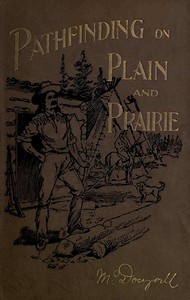
Pathfinding on Plain and Prairie Stirring Scenes of Life in the Canadian North-west — A Closer Reading

(11 User reviews)   3069
In Category - Places Peoples
McDougall, John, 1842-1917, Laughlin, J. E. [Illustrator] Project Gutenberg 2020 Not confirmed
Northwest, Canadian -- Description and travel; Frontier and pioneer life -- Northwest, Canadian; McDougall, John, 1842-1917 Readers of public-domain and historical texts
Project Gutenberg digital edition en

Edition facts

Words 63,945
Reading time 279 min
Text sections 5

Before opening Pathfinding on Plain and Prairie Stirring Scenes of Life in the Canadian North-west — A Closer Reading, the edition data offers a quick orientation: 63,945 words, 4 hr 39 min estimated reading time, and 5 detected text sections.

The text analysis averages about 24.7 words per sentence, while the detected sections provide another way to judge how the source is divided.

Project Gutenberg metadata also associates the work with “Northwest, Canadian -- Description and travel,” connecting these edition facts with the source record’s subject description.

John McDougall's 1898 memoir recounts his experiences as a Methodist missionary in the Canadian North-West, focusing on daily life, relationships with Indigenous peoples, and the challenges of frontier existence. The narrative blends vivid descriptions of landscape, hunting, and travel with observations on cultural encounters and spiritual work.
Share
Editorial Edition Score 4.7/5

Calculated from edition completeness, EPUB availability, text structure and catalogue metadata. Not a user rating.

How this score is calculated
  • Description quality20 pts
  • Title & short description10 pts
  • Source metadata20 pts
  • Text length15 pts
  • Chapters / structure15 pts
  • EPUB file integrity20 pts

Total of 100 points, scaled to a 2.5-5.0 range. Editions with an empty description or a missing EPUB file are not scored.

Edition quality

Read the Text

Camping in the snow--Our costume--Brilliant sunrise effects--Maple and her pups found at last--Striking example of "dog sense"--The Fort Garry packet

We visit Edmonton--Nature's grand cathedral--Adventure with a buffalo bull--A trip to Pigeon Lake--Racing with dog-teams--An infidel blacksmith--Old Joseph proves an unerring guide--Caching our provisions

Epidemic breaks out among the Indians--Snow-blindness--I take to me a wife--Our modest dowry--My father officiates as a Stationing Committee--Fearful mortality among the Indians--Our journey to Pigeon Lake--The epidemic attacks our camp--A rude hospital--An exciting buffalo hunt--Chased by a maddened bull--Narrow escape

Our caravan moves on--Difficulties of packing--Oliver's adventures with a buffalo--Novel method of "blazing" a path--Arrival at Pigeon Lake--House-building--Abundance of fish--Indians camp about the Mission--I form many enduring friendships--Indians taught fishing with nets

We are visited by a band of Crees--Our guests steal away with a bunch of horses--Stonies set out in hot pursuit--Little William's strategy--Horses recaptured--We begin farming operations--Arrival of Mr. Steinhauer--Home to Victoria again--A memorable Sabbath--My gun bursts--Narrow escape--My mother's cares and anxieties--Home-made furniture

I travel with Maskepetoon's camp--Effects of environment on the Indians--Nature's grandeur and beauty--Degradation through paganism--The noble Chief Maskepetoon--Indian councils--On the fringe of the buffalo herds--Indian boy lost--A false conjurer--The lad recovered

The "Thirst Dance"--"Tobacco messages"--The head conjurer--"Dancing lodges"--The rendezvous--The "idol tree"--Meeting of the head conjurer and the chief of the warriors--An anxious moment--Building the "temple"--Self-torture, dancing and sacrifices--The festival concluded--Romantic situation for our camp

Our great camp a study of native types--I attend a "wolf feast"--A disgusting orgie--Paul and I start for home--Our horses stampede--Difficult tracking--Enormous herd of buffalo--Home again and all well--Party of half-breeds from the Red River settlement visit our Mission--Father returns, bringing a brother and sister from Ontario

We return to Pigeon Lake--"Scarred Thigh" exchanged for "Blackfoot"--Planting Gospel seed--We organize a buffalo hunt--A moose chase--The buffalo as a "path-finder"--We encounter a hostile camp--All night on guard--My friend Mark's daring exploit--Wood Stonies visit the Mission--Gambling, polygamy and superstition among the Indians

We return to Victoria--War parties abroad--Father's influence over the Indians--We organize a big fresh meat hunt--David's first buffalo hunt--Mark's adventure with a war party--Surrounded by wolves--Incidents of our journey--Preparing for the winter

A visit to Whitefish Lake--A devoted Indian missionary--Mark and I go out after buffalo--Mark proves himself a brilliant hunter--Our camp visited by wolves--Muddy Bull's generosity--We reach home with full loads of meat

A run to Edmonton--Mr. Hardisty and other Hudson's Bay Company officers spend New Year's with us--Sports and amusements--Our party sets out for Mountain House--I experience a "scare"--Intense cold--A cunning dog--Mishaps to a cariole--In the foot-hills--My first view of the Rockies--Hearty reception at Mountain House--Back to Victoria

Home occupations--A course of lectures--Mark and Jimmie as _raconteurs_--Mark's success as a deer-killer--A buffalo chase on a dog-sled--Our first child is born--Chickens at eight shillings apiece!

David and I visit Lac la Biche--High-priced seed wheat--Our party sets out for Pigeon Lake--Old Joseph--Paul Chian--Samson--Our larder depleted--We organize a bunt--Precarious living--Old Paul proves himself a skilful guide--Samson tells of a tragic murder by Blackfeet--We move cautiously--Broiled owlets as a delicacy--I shoot an elk--Little Paul's flint-lock hangs fire--Samson's brilliant hunting feats--Feasting on antlers

Samson and I go on a moose hunt--Samson's clever tracking--He comes up with the moose and tries a shot--No bullet in the gun--Two dejected hunters return to the camp--We have better luck next time--Roses make a thorny path--We disturb a band of wolves--Samson stampedes them with his riding-whip--"Firing Stony" and I go hunting--I bring down a noble elk--Novel method of fishing

Our camp visited by a band of Mountain Stonies--My schooling in the university of frontier life--Back to our Mission again--Limited _cuisine_--Home-made agricultural implements--We visit Victoria--Off to Fort Carlton for Mission supplies--Inquisitive Chippewyans--My eldest sister married to Mr. Hardisty, of the Hudson's Bay Company--The honeymoon trip to Mountain House--Rival sportsmen--Charging a flock of wild geese at full gallop--Return to Pigeon Lake--Our work extending

Father visits our Mission--A dream that proved a portent--Drowning of Mr. Connor--"Straight fish" diet--We are visited by a war party of Crees--I am given a problem to solve--Francis and I set out to seek fresh provisions--Feasting on fat bear steaks--A lonely Christmas--Mr. Hardisty visits us--We in turn visit Mountain House--A hard winter in the Saskatchewan country--Rations on short allowance--A run to Victoria--David and I have a hard experience--Father and mother as "good Samaritans"

We start out to hunt for buffalo--Fish and frozen turnips--A depleted larder--David's bag of barley meal--At the point of starvation--We strike Maskepetoon's camp--An Indian burial--Old Joseph dying--We leave the camp--Generous hospitality--A fortunate meeting--Frostbites--A bitterly cold night--Unexpected visitors--Striking instance of devotion--I suffer from snowshoe cramp--Arrival at Victoria--Old Joseph's burial--Back to Pigeon Lake

My brother a "ready-made pioneer"--Hunting rabbits--Two roasted rabbits per man for supper--I find my friend, Firing Stony, in a flourishing condition--Poisoning wolves--A good morning's sport--I secure a wolf, two foxes and a mink--Firing Stony poisons his best dog--I enjoy a meal of bear's ribs--I meet with a severe accident--Samson treats me to a memorable feast

Alternate feasting and fasting--We start out on a buffalo hunt--Old Paul brings down a fine moose--Providential provision--Enoch Crawler kills another moose--Magnificent landscapes--Entering the great treeless plains---Wonderful mirages--We come upon the tracks of buffalo--Our men shoot a huge grizzly--Charging a bunch of cows--A lively chase--Samson's plucky plunge over a bank after the buffalo--I chase and kill a fine cow--The camp busy killing and making provisions--Guarding against hostile Indians

A busy camp--Process of butchering and drying meat--How pemmican is made--Our camp in peril--Chasing a herd of buffalo up a steep bank--Mark scores a point on me--We encounter a war party of Blackfeet--A fortunate rain-storm--A mirage gives us a false alarm--Unwritten laws as to rights of hunters

Into the timber country again--Craving for vegetable food--Wild rhubarb a treat--I shoot a big beaver--My horse objects to carrying it--A race for the life of my child--Terrific fight between my dogs and a huge wolverine--Reach Pigeon Lake and find father there--Anxiety felt for our party--A meagre bill of fare--A visit to Victoria--I narrowly escape drowning--Father leaves for Ontario, taking with him my three sisters--Francis leaves us to return to Victoria--My varied offices among the Indians

Our first interment--Jacob's tragic death--Hostile Flatheads in quest of horses, scalps and glory--Stonies attacked by a party of Blackfeet--A hot fusilade--Mark's father is killed--Destitution prevalent--Hunting lynx--My dogs seized with distemper--All have to be shot--Another provision hunt organized--Among the buffalo--I narrowly escape being shot--Heterogeneous character of our camp--Mutual distrust and dislikes--United by fear of a common foe--The effects of Christianity

Through new country--"Greater Canada"--Antelopes--Startling effects of mirage--War parties keep us on the alert--Remarkable speed of a plain Cree--A curious superstition--A Cree's gruesome story--Returning with carts fully loaded--Followed by hostile Indians--I sight and chase a "sitting" bull--My shot wounds him--Paul's son thrown under the brute's feet--Firing Stony's clever shot to the rescue--We arrive at the Mission--Road-making

Another visit to Victoria--Fall in with a war party of Kootenays and Flatheads--Samson and I go moose-hunting--A Sabbath afternoon experience--A band of moose enjoy Sabbath immunity--I start out to meet father returning from the East--The glorious Saskatchewan Valley--Call at Fort Pitt--Equinoctial storms--Entertained by a French half-breed family--Meet Mr. Hardisty and one of my sisters--Camp-fire chat--Meeting with father--Rev. Peter Campbell and others with his party--Father relates his experience in the East--Rev. Geo. Young sent to Red River Settlement and Rev. E. R. Young to Norway House

Father pushes on for home in advance--Hard times for the "tenderfeet"--A plunge into icy water--My brother David gallops into camp--His high spirits prove infectious--Kindness of the Hudson's Bay Company--Oxen sent to help us in to Victoria--A mutinous camp-follower--My threat of a sound thrashing subdues the mutineer--Our long journey is ended--Adieu to my readers

"Here one of the bravest of our men was slain" ... Frontispiece

"The brilliant flashes of the aurora light"

"My cap ... falling right in the face of the bull, for the moment blinded him"

"I saw more buffalo than I had ever dreamed of before"

"I went at him with firebrands"

"Rising up I let drive at the larger of the two"

"Down we ran, and chased them across the full length of the bar"

"We carried the haycocks in between us on two poles"

"And now I ... tapped his nose for him so effectually that he was stunned"

"I succeeded in getting hold of the end of a tree"

"With unerring aim he shot the bull through the head"

"He was a funny-looking specimen as he picked himself up out of the icy stream"

PATHFINDING ON PLAIN AND PRAIRIE.

"Thin leather homes"--Drudgery of the Indian women--Occupations of the men--Hunting parties and scalping forays--Triumphs of endurance.

It was during the last days of January, 1865, in the story of my experiences in our great Canadian West, that I parted company for a time with my readers in "SADDLE, SLED AND SNOWSHOE." We were domiciled for the night in Muddy Bull's lodge. The weather was intensely cold. I believe I am safe in saying that all through January the mercury never rose above 10° below zero, and that it ranged from this down to 50° below.

In our lodge, which was one of the best, with ordinary travelling costume on, a blanket or a robe over our shoulders, and a brisk fire in the centre of the tent, we were passably cosy; but even then we had to turn around every little while and "warm the other side." Great bright, brisk fires were kept up in those "thin leather homes" of our Indian people, entailing a vast amount of work upon the women and girls of the camps. Gradually, by example, perhaps, more than precept, we brought about a lessening of the labor of the women; but in the meantime, during the cold winter months, the furnishing of wood to keep those huge fires going gave them constant employment. It must be said, however, they accepted the labor and drudgery with cheerful alacrity, and could be seen at all hours of the day stringing over the hills and across the plains with dogs and horses and travois, their own backs loaded to the utmost carrying capacity with wood.

The life of an Indian woman in those early days was, indeed, an extremely busy one. Packing and unpacking dogs and horses, making camps, providing wood, making and mending moccasins and wearing apparel, cooking, cutting up, drying and pounding meat, rendering grease, chopping bones to get out the marrow fat, making pemmican, stretching, scraping and dressing buffalo hides to make robes or leather--a long, tedious process, in which not only the brains of the worker were needed in order to excel, but also those of the dead animals as well--kept her going early and late. Besides all this, the manufacturing of saddles, travois, tents and shagganappi also devolved upon the women; and yet, notwithstanding all this, they seemed, generally speaking, to be contented and happy, and with true feminine resource still found time to give to attire and adornment, and the practising of all those mysterious arts which have charmed and magnetized the other sex, doubtless through all the past of our race. No wonder these women and girls were at a premium, and cost all the way from a blanket up to a band of stolen horses! The more of them a man had, then the greater man was he.

Nor was the life of the male Indian altogether that of a sinecure. Somehow or other the idea has gone abroad that these Indians led a very lazy life. But if the man who thought this had spent some time with either wood or plain Indians, and had accompanied them on their hunting and war expeditions, he would have materially changed his views.

To follow a wood hunter on foot from before daylight in the short days, through brush and copse and heavy timber, over big hills and across wide valleys, on and on for many miles, sometimes until noon or late in the afternoon before a "kill" is made; or, having started game, to run for miles at a terrific pace, hoping to head off the quarry and at last secure a shot; then, having killed, to butcher or secure from wolf, or coyote, or wolverine the desired meat and strike as straight as possible for the camp, sometimes many, many miles distant, with thick forest and dense darkness now intervening; or it may be to have all the labor and exhaustion of such a chase without the chance of a shot, reaching camp late at night wearied and disappointed. To continue this for days, sometimes feasting and again famishing--and all this not from choice but of necessity--could be counted no easy matter. It is not for fun, but life; health, income, influence, honor, respect, all these are dependent on your efforts.

It may be with the same wood hunter you start a prime buck moose or elk during those glorious days in the beginning of autumn, and he bounds away in his strength and swiftness. Your Indian says, "We must run him down," and leads off in long, regular strides, and for a time you feel as if your lungs were in your throat and your heart is beating a double tattoo. Over and under fallen timber, down precipitous banks, up steep hills, and it takes some time for you to "catch your second wind," and to brace up your will and say to yourself, "I am also a man," and then settle down like your Indian to steady work.

He, however, is doing more than you, who are but following him. He is noting lay of land and direction of wind, calculating in order to cut across where your game may have gone around, watching the tracks, gauging the distance the buck is ahead of you, noting the settling of the earth at edge of pool or creek where the big fellow left his tracks as he ran. and you are encouraged and spurred on, or contrariwise, as the crafty hunter tells you in hushed tones what he knows.

Then, by and by, after an hour or two, or three, perhaps, of such work, you stand beside the fallen carcase and wipe your forehead and wish you had a dozen towels; but while your exultations and congratulations are hot within you, a word of caution comes from the Indian beside you: "The sun is low and the camp is far; let us hurry," and the work of butchering and skinning the meat goes on, till presently, with a load of meat on your back, you start for the distant camp. Suppose, as you tramped and climbed and panted, some one had said, "What a lazy life yours is," you would have shouted back, "No, sir; not in any sense is this a lazy life!"

Or it may be your hunter friend is in for a "fur hunt," and you start with him to make a line of dead-falls for marten, or to hang a hundred or so of snares for lynx. The snow is deep, and at every step several pounds of it fall in on your snowshoe; but from early morn until late in the evening you tramp and toil, chopping and stooping and grunting over snare and deadfall, and when night is on, having carried your provisions, blanket and kettle all day, besides the baits for dead-falls and snares for lynx traps, you dig away the deep snow, cut some wood and make a fire for the night. While the fire burns, you doze and chill, and pile on fuel and wait for morning, only to repeat yesterday's work, and so on, until, having made a big detour and hung your snares and carefully fixed your deadfalls, you in three or four days reach home. Then in a short time you must visit all these, and in the intervening days make your forays for food. No one who has tried this manner of obtaining a living will pronounce it a lazy life.

But suppose you were with some plain or buffalo Indians, and, as was about the average condition in the winter time, the buffalo were from fifty to two hundred miles from your camp--the rigor of the winter and the condition of grass and wood forbidding the camp moving any nearer to them--the hunting parties had constantly to be organized and the meat and robes brought from long distances home. Under such circumstances the hunter not only had to undergo great hardships, but also to run very great risks. Storms on the bleak, treeless plains, with deep snow, and travel of necessity slow and difficult, were indeed as "the powers of the air" and darkness to encounter and overcome, and the really indolent man was not in it when such work was engaged in.

Then it was incumbent upon every able-bodied man, under the code of honor of the time, to make an annual or bi-annual or even more frequent foray for horses and scalps. These trips generally took place in the spring and fall. With the melting of snow and ice in spring, or the making of the same in autumn, parties large and small would be made up. Each with lariat and a few pairs of moccasins, and, if possessed of a gun, with as much ammunition as he could obtain, or armed with bow and quiver full of shod arrows, in the dead of night these men would start for the enemy's country, depending on sustaining life by the chase on their way. Journeying on, sometimes by day and sometimes by night, fording rapid streams and swimming wide rivers, what signified the breaking up of the season or the plunge into ice-cold water of river and swamp to them? These must be considered as trifles. By and by, when the enemy's presence is felt there will come the weary watching and waiting, amid cold and hunger, for cunning and strategy are now pitted the one against the other, and endurance and pluck must back these up or the trip will be a failure. One, two, three hundreds of miles of steady tramping, with your camp always facing in the direction of where your enemy is supposed to be. Every day or night the scouts, making thrice the distance covered by the party, keep up their constant effort to discover and forestall counter war-parties, or to find the enemy's camp; and when this is found sometimes to hang for days on its movements, and, following up, watch for a favorable spot and time either to make a charge or to steal in under cover of storm or darkness and drive off bands of horses. Then in either case to start for home, and push on regardless of weather so long as men and horses will hold out.

After a successful raid those long runs for home were great tests of horse-flesh and human endurance. With scalded legs, blistered feet and weary limbs, and with eyes heavy for want of sleep, these men, now exultant with victory, would vie with each other in the race for camp. A lazy man assuredly had no place in such trials of endurance and of hardship. Furthermore, upon the men and boys of the camp devolved the care of the horses. The herding and guarding of these gave many a weary tramp or ride, and many a night in cold and storm, without sleep or rest. And finally, the constant need of protecting their camps from the wily enemy was a source of permanent worry, and always rested as a heavy responsibility upon these men.

Camping in the snow--Our costume--Brilliant sunrise effects--Maple and her pups found at last--Striking example of "dog sense"--The Fort Garry packet.

Just now we are surrounded by both wood and plain hunters. Maskepetoon in my time always had a following of both parties. The gambling and conjuring drums are beating in several lodges. In others, as in ours, the evening hymn is being sung and prayer offered, and presently we roll in our blankets and robes, and sleep, though it takes me some time to forget my lost train of Maple and her pups.

John McDougall's Pathfinding on Plain and Prairie opens not with a declaration of purpose but with a death: 'Here one of the bravest of our men was slain.' That line, drawn from page 152 and placed as an epigraph, signals that this is a narrative where violence and faith coexist. McDougall, a Methodist missionary, writes from the 1890s about his decades in the Canadian North-West, but his book is less a sermon than a chronicle of practical survival. He describes 'thin leather homes,' the drudgery of Indigenous women, and the 'triumphs of endurance' required of hunting parties and war parties alike. The voice is that of a participant who is also an observer—someone who notes the beauty of a 'grand cathedral' of nature while also recording the precise logistics of packing horses and caching provisions.

A Missionary's Daily Round

McDougall's account is built from the concrete details of movement and maintenance. He describes how his party 'dried some fish to start with' before leaving Pigeon Lake, and how their diet included 'rabbits, ducks, geese, owls, hawks, bear, beaver, badger, porcupine, skunk'—a list that emphasizes variety in species but uncertainty in quantity. The daily rhythm is shaped by scarcity: 'Sometimes we were filled, and oftentimes we were empty, not knowing when or how we should get our next meal.'

Transport was by horseback or on foot; there were 'no cart or waggon roads in or out of the Pigeon Lake country.' The party relied on old Paul, an invalid with spinal trouble who 'knew that part of the country as other men knew their quarter-sections.' McDougall's method is accumulative: he piles specific observations—the cow that gave no milk, the travois markings on a mossy knoll—into a picture of life governed by weather, game movements, and the knowledge of Indigenous guides.

The Bond with Samson

Among the Crees who came to the mission was Samson, described as old Paul's son-in-law. McDougall writes that 'he and I became fast friends from the first. There was an instinctive understanding between us.' The friendship was formalized 'in the regular native style,' creating a bond that McDougall says 'continues unto this day.' This relationship is presented as central to the narrative: 'Samson and I were inseparable in those days. I wanted to be the friend of all, but I could not help being his friend.'

The excerpts show Samson as a guide and companion on a scouting trip, where he 'quietly regaled us with hunting and war exploits.' On a mossy knoll marked by an old Blackfoot trail, Samson paused and said, 'Right...'—the sentence breaks off in the excerpt, but the gesture points to a specific, shared knowledge of the land. McDougall does not claim to understand Indigenous culture fully; instead, he records moments of mutual reliance and affection.

Ritual and Routine in Camp

McDougall describes a daily pattern of worship that adapted to the conditions of travel. 'Weather permitting and provisions allowing it, we generally held two services in the day.' In the early morning, 'while the dew was on the grass, we sang our hymns and knelt together in prayer.' In the evening, after the hunters returned and the horses were secured, McDougall would 'read a few verses and comment on them, and with hymn and prayer we closed the day.'

The campsites themselves were chosen by old Paul, whose selections balanced 'security, utility and beauty.' McDougall's language rises at these moments: 'Beside rippling stream or glistening lakelet, with growing grass and budding flowers and leafy foliage, with Mother Nature's breath full and fragrant of early summer, how like hallowed sanctuaries those camping spots were!' Yet even here, the practical intrudes—the camp was 'communistic' in food supply, and the congregation was 'scattering to the four winds' by mid-May. The spiritual work is presented as tentative: 'we were but babes ourselves in this great matter.'

Readers should approach Pathfinding on Plain and Prairie as a document of its time—a missionary's memoir that records both the hardships of frontier life and the complexities of cross-cultural encounter. McDougall's voice is that of a man who admires the skills of his Indigenous companions while remaining committed to his own religious mission. The book rewards attention to its small details: the naming of a cow, the description of a trail, the phrasing of a prayer. These are the materials from which McDougall builds his account of a world in transition.

Reading McDougall’s account of the prairie, I kept thinking of his quiet patience—how he measured distance by rivers and days, not miles. That same unhurried attentiveness came back to me in Notes of a Journey on the Upper Mekong, Siam — A Reader’s Guide, where travel becomes a slow conversation with the land itself. Different water, same stillness of heart.

John Anderson
3 weeks ago

Noah Ramirez
3 weeks ago

Scarlett Baker
1 month ago

Noah White
1 month ago

Emma Jackson
1 month ago

5
5 out of 5 (11 User reviews )

Add a Review

Your Rating *
  • ...
    William Colleen Sandoval - 3 weeks ago
    {'rating': 3, 'text': 'This book offers a fascinating glimpse into the challenges of pioneering in the Canadian North West. The narrative is engaging, though at times the pacing feels uneven, with some sections overly detailed. Still, the authentic voice and historical value make it worthwhile.'}

  • ...
    Nathaniel Avery - 2 weeks ago
    {'rating': 5, 'text': "A riveting firsthand account of life in the Canadian North West! The author's vivid descriptions of the plains and prairies make you feel the wind and hear the buffalo. The stirring scenes of survival and adventure are both inspiring and thrilling. A must-read for anyone interested in frontier history."}

  • ...
    Derek Phillips - 1 week ago
    {'rating': 2, 'text': 'While the subject matter is intriguing, the writing style feels dated and meandering. The author spends too much time on trivial details, and the dramatic scenes lack the urgency they deserve. A better editor could have trimmed the prose significantly. For modern readers, it may be a tough slog.'}


Reader reflection

Your personal reading reflection

Build a private reading journal entry for this title.

Your progress 0 / 10
1

How far have you progressed with this book?

2

Was reading this book enjoyable?

3

How likely are you to recommend this book?

4

Did the language feel accessible?

Related eBooks