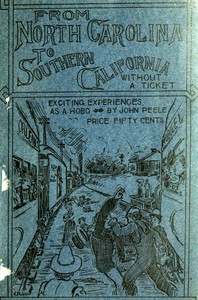
From North Carolina to Southern California Without a Ticket and How I Did It Giving My Exciting Experiences as a "Hobo" — Background and Themes

(1 User reviews)   165
In Category - Places Peoples
Peele, John (John R.) Project Gutenberg 2014 Not confirmed
West (U.S.) -- Description and travel; Southern States -- Description and travel; Tramps Readers of public-domain and historical texts
Project Gutenberg digital edition en

Edition facts

Words 30,826
Reading time 135 min
Text sections 4

The source record for From North Carolina to Southern California Without a Ticket and How I Did It Giving My Exciting Experiences as a "Hobo" — Background and Themes measures this digital text at 30,826 words, 2 hr 15 min estimated reading time, and 4 detected text sections.

The text analysis averages about 17.7 words per sentence, while the detected sections provide another way to judge how the source is divided.

Project Gutenberg metadata also associates the work with “West (U.S.) -- Description and travel,” connecting these edition facts with the source record’s subject description.

John Peele's 1907 memoir recounts his penniless train-hopping journey from North Carolina to California, blending practical hoboing tips with vivid encounters with police, kind strangers, and the American landscape.
Share
Editorial Edition Score 4.6/5

Calculated from edition completeness, EPUB availability, text structure and catalogue metadata. Not a user rating.

How this score is calculated
  • Description quality20 pts
  • Title & short description10 pts
  • Source metadata20 pts
  • Text length15 pts
  • Chapters / structure15 pts
  • EPUB file integrity20 pts

Total of 100 points, scaled to a 2.5-5.0 range. Editions with an empty description or a missing EPUB file are not scored.

Edition quality

Read the Text

CHAPTER I. PAGE. Off for California--My Troubles Begin in Wilmington--Taken for a Deserter--A Drummer Comes to My Rescue 9

Run Out of Town by the Chadbourn Police--Cash Running Low--Getting Schedules Mixed--The First Blush of Shame 20

Snatched from Death--Forty-nine Miles on a Hand-car--Finding a Partner 30

"Look Out for Hoodlums!"--Retribution for Deception--Stranded in New Orleans--Meet With Kind Hearts 52

A Hungry Ride of 308 Miles--"Hello, Hello in the Pipe There!"--To Work Again--Nabbed by a Cop 80

Across the Line Into New Mexico--Barren Sand Hills--Jack Rabbits--Prairie Dogs--A Glorious Sunset, etc. 95

Get a Job in a Law Office--Dirty, Ragged Clothes Put Off--Smallpox Starts Me Off Again 105

"For God's Sake, Give Me a Drop of Water" 109

Thrown Into Jail at Los Angeles 119

After a good deal of persuasion upon the part of my relatives and immediate circle of friends, I have decided to write an account of a few of the many adventures and dangers that befell me while making my way, practically without a penny, from Tarboro, North Carolina, to Tucson, Arizona; and thence to the stricken city of San Francisco, Cal., and other points of interest throughout the West, including New Orleans, Dallas, Texas, Fort Worth, El Paso, Dalhart, Texas, Alamogordo, New Mexico, Juarez, Old Mexico, Bisbee, Arizona, Los Angeles, California, San Pedro, California, Searchlight, Nevada, Denver, Colorado, and more than a hundred other points of interest, coming back home on a telegraphed ticket, via Chicago, Cincinnati, and Richmond, Virginia.

The book bears no relation to fiction, as the reader will discover before reading many of its pages. The writer, believing it will be more interesting, will unreservedly show up all his faults and mistakes along the trip, as well as his good qualities. There is nothing in the book pertaining to the supernatural, nor is it of a highly sensational character, but the writer believes it will prove more than interesting to the intelligent mind. It is a true story from real life that every boy in America can read and profit thereby. The book is a record of facts and incidents, which were written down in shorthand, and transcribed at different stages of the journey by the author. The story is backed by the indisputable evidence of testimonials and correct addresses of the most prominent people with whom the writer came in contact. This book demonstrates the value of physical culture and education to the American youth as the author believes no other work upon the market has yet done. The writer graduated at the Massey Business College, Richmond, Va., in bookkeeping, etc.

Feeling the need of rest and recreation after several years of hard study at school, and being a great sufferer from asthma, the author, hearing of the dry and beneficial climate of Arizona and New Mexico to those who have weak lungs, decided almost immediately after leaving school at Richmond, Va., to go to Tucson, Ariz., and personally verify these reports, and probably settle there permanently himself.

The author, John Peele, of Tarboro, N. C., is just nineteen years of age, and though he had knocked about the world considerably prior to the opening of this story, he had heretofore always held a ticket to his destination. And now, dear readers, follow him patiently and he will attempt to show you how he turned the trick of getting West without a ticket. Trusting the book may be of value to mothers in restraining their wayward sons to stay at home, however humble it may be, I beg to subscribe myself, sincerely, the author,

$50.00 REWARD. $50.00

I am a poor man, but if the darkey, who twice saved my life by catching me while standing up on the end of a loaded flat-car fast asleep, and preventing my falling between the wheels of a rapidly moving freight train about ten or fifteen miles from the town of Woodbine, Fla., on a certain night in May in the year 1906, and who afterwards accompanied me forty-nine miles on a hand-car to Jacksonville, can prove his identity, by telling me what happened when we parted on the railroad in the suburbs of that city, and will communicate his intelligence to John Peele, Tarboro, N. C., he will receive the sum of fifty dollars ($50.00).

John Peele was in my employ here for some time, first as porter, then as bar tender in the Searchlight Hotel.

I hereby give Mr. Peele the privilege of printing this testimonial, both in his book and in the newspaper columns, advertising the book.

JOHN:--Whenever you come out West again, you can get another job. You are all right. U.

This is to certify that John Peele, being pulled down in this town from under the boiler of a morning passenger train bound for Pensacola, Fla., was employed by me at my brick yard.

I hereby give Mr. Peele the privilege of printing this testimonial, both in his book and in the newspaper columns advertising the book.

From North Carolina to Southern California Without a Ticket.

_Off For California--My Troubles Begin in Wilmington--Taken for a Deserter--A Drummer Comes to My Rescue._

The details of my former life will not be given here, but as I stood waiting on the depot platform at Tarboro, N. C., with my brother Joe, who had come to bid me good-bye, one fine day in early May, in the year 1906, I could, at least, say that no other chap of my acquaintance could name any more varied occupations in which he had been engaged than I could.

I had been grocery clerk for my people at Tarboro; water boy at the age of 14 at the Buffalo Lithia Springs in Virginia, where I made scores of friends from all parts of the country; drygoods salesman for Chas. Broadway Rouss, New York City; waiter in a Coney Island restaurant; bell-boy in the Fifth Avenue Hotel, New York City; waiter in Buffalo, N. Y., where I had gone to be treated by the famous Dr. R. V. Pierce for asthma; traveling agent through the South for Jas. M. Davis, New York, with stereoscopic views, at which I cleared over $400.00 in one summer's canvass, nearly ruining my vocal organs; Bible agent through the country for J. S. Peele & Co.; stenographer, bookkeeper, and scores of other things I engaged in, too numerous to mention.

The train, which was to mark the beginning of more adventures, hardships and trials than I, at that time, could possibly imagine, pulled into the station at Tarboro, N. C., and bidding my brother good-bye, I got aboard.

I had four dollars in money, several letters of recommendation, and a ticket. Among the letters was a note of commendation, kindly given me by Mr. John F. Shackelford, of the Bank of Tarboro, and another one, equally as highly appreciated, from Mr. Frank Powell, the editor of the _Tarboro Southerner_. The ticket was labeled Wilmington, N. C., and had been purchased merely as a blind to my parents, who were unaware of the fact that I had come home from school "flat-broke," and as a consequence, of course, unable to purchase my fare to the West.

Parting with my mother affected me no little, for it was my intention not to return home for several years.

Tarboro was soon left behind, however, and now other and graver thoughts began to take possession of me. What was I to do in Wilmington with only four dollars? And how was I to get out of the town anyway, unless I purchased another ticket?

During all of my travels, I had never yet beaten the railroad company out of a penny, and just how I was going to board a train without being caught and locked up was the question.

Little did I think at that time how expert and bold I was to become at this kind of thing before reaching far off Tucson, Arizona.

The train pulled under the shed at Wilmington just after dark. It was with great reluctance I got out of my seat; in fact, all the other passengers had alighted when I got my bundles together.

I would have sworn that there was a big, blue-coated officer waiting to put handcuffs on me the moment I stepped from the car platform, but no such thing happened. Instead the whole train was deserted and the porter informed me that I had better hurry, if I wanted to get through the exit before it closed.

Regaining courage, I hurried along in the direction the other passengers had taken, and a few moments later emerged on Front street, Wilmington's busiest thoroughfare.

I was by no means a stranger to Wilmington, and, therefore, had little trouble in finding a good place at which to put up, without going to an expensive hotel.

Leaving my few belongings behind, I started out afterwards to retrace my steps back to the depot and railroad yards for the purpose of obtaining any information I could regarding the schedule of the trains.

About midway the bridge, which connects the depot with Front street, I noticed two colored men engaged in watching the trains shift in and out of the yards. I at once decided that here was an opportunity to start the ball rolling, and accordingly approached them and told them where I wanted to go. In return they informed me that they were not trainmen, as I had supposed, but were employed on the steamboat _Perdy_.

The name of their Captain was Archie Marine, they said, and added that he was a good, freehearted sort of a man, and might be able to help me get down the coast on a boat. One of them offered to conduct me to the _Perdy's_ wharf, and a short time later we were on board.

The engineer of the boat was the only man on board when we arrived, and he informed me that the Captain hadn't shown up since late in the afternoon.

A significant twinkle of the eye accompanied this remark, and not being altogether blind, I concluded that the _Perdy's_ captain was in some respects the same as all other sea-faring men.

"Do you know where he generally holds forth when on shore?" I asked.

"No, but probably some of the crew on shore can tell you, if you can find them," he replied.

Disappointed, I made my way up town again.

Entering a drug store, and calling for a directory, I soon found Marine's residence address, and a half hour later I had reached his home.

Several children met me at the door, and in response to my query, summoned their mother, a very pleasant-faced woman, as I recall her, who at once seemed to know that I was in trouble.

She gave me explicit directions how to find her husband.

"Please tell him to come home at once, if you find him," she said. It was after 11 o'clock when I bade the lady good-night.

After losing all this time, I was determined to find Marine now, if I had to traverse every street in Wilmington.

Having canvassed views in the town, I had no trouble in finding the section the lady had directed me to.

The place I entered was a kind of half grocery store and half saloon--the saloon, of course, being in the rear.

On entering, my attention was directed to a party of four men, evidently seamen, judging from their language, who were in the front part of the store engaged in a conversation that could easily have been heard a block away.

At last I felt sure I had cornered my man.

It has always been my belief that I was especially blessed with the knack of making friends with a stranger, and this talent, which is the only one I think I ever possessed, had certainly had ample opportunity in my varied life to develop into an art.

"Hello, mates!" I sang out, approaching the quartet with a smile--what wonders a smile will work when used right--"I'm looking for Archie Marine, fellows. Do you know where he is to-night?"

Immediately one of the men stepped forward.

"My name is Marine," he said, "What's up?"

He had a pleasant way of speaking, and it was soon apparent that he embodied all the good qualities which the two darkies on Front street bridge had invested him with.

"It's something important, Marine; come with me and I'll tell you."

Without a word the man turned his back upon the jolly companions with whom he had been lately carousing, and together we left the place.

We went two blocks up the street, and here, under the shelter of a drug store, I told him I wanted to get as far down the coast as Jacksonville, Fla.

He said he thought he could help me do so.

"The boats no longer run from here to Georgetown, S. C.," he said, "but there's a boat from Wilmington to Southport, N. C., daily for seventy-five cents, and you can easily walk across the sands from Southport to Georgetown in a day and a half. You'll not be lonesome," he added, "for there are houses every few miles, and I'll write you a note to a friend of mine in Georgetown, who'll take you to Charleston, S. C., and another note to the engineer who runs between Charleston and Jacksonville."

This was great! I was to get nearly a thousand miles on my journey without incurring the risk of beating a train. The mere contemplation of beating a train seemed to stir up all the animosity in my nature towards all train officials.

What! I, John R. Peele, the boy who had always been so careful at home about washing his face and keeping his clothes brushed, attempt to hide on a train, and beat his fare?

No, I was to preserve my dignity and travel like a gentleman on a large steamboat to Jacksonville, and then other means would surely present themselves, as probably another boat ran from Jacksonville to Galveston, Texas.

Splendid idea! Why the trip was going to prove easy--a regular "cinch," and I could afford to laugh at the train people now, and that for a good long time, too, but alas! my joy was short-lived, for I was soon to learn the truth of the old adage: "The best laid plans ofttimes go astray."

We entered the drug store, and Marine, after much effort, composed the notes, which he wrote down in my memorandum book.

The following is a reproduction of one of them, verbatim, taken from the same little book, which I yet own:

Mr. J. Dunn wil you bee kind enough to help my yung friend over to J. and let me hear from you oblige"

I was also given a letter of introduction to his brother, William Marine, who is a very popular Jacksonville citizen, and who is superintendent of the Clyde Line Docks in that city.

The author desires to publicly thank Mr. Marine through this book for that service, and feels confident, had he ever reached Georgetown, the notes would undoubtedly have been of much assistance.

At 2 p. m. the following day I boarded the boat for Southport, and knowing how I was to travel on leaving home, I had only brought along one suit of clothes, which I had on.

It was a nice fitting khaki suit, with prominent brass buttons, and seemed to be the very thing for the wear and tear of a long journey. It was a homeguard suit, though I was no homeguard, and had never been one, but purchased the suit just before leaving home.

Now, as the reader may not be aware, Southport is a favorite camping resort of North Carolina's home guards, and as luck would have it, there was a company encamped there at this particular time.

Up to this time I had paid no heed to what I was wearing, but it was soon obvious that I was attracting unusual attention.

There were three or four men in blue uniforms on the boat, who seemed to give me their whole attention, for everywhere I went on the boat they would follow me and begin their whisperings, and it was fast becoming a nuisance, when, finally, one of them stepped up to me and asked:

"Are you a home guard?"

"I am not," I replied civilly, realizing my clothes warranted the question.

"The reason I asked," he said, "there has been a desertion in one of the companies lately, and the description of the deserter fits you. If you were to land there now and suddenly make off across the sands towards Georgetown--I had informed him of my intention--you would quite likely be overtaken and held three or four days for identification," he said.

Having never been a home guard, I did not know whether the man was playing a practical joke on me or was telling the truth, but I did not want to be detained there for several days, and I was inclined to believe what he said was the truth. However, I did not betray this fact.

Instead, I laughed and remarked that I was not afraid; but all three of the men stoutly maintained that they had tried to do me a favor, and seeing that I appeared to take it as a joke, one of the men finally got angry and wished me all sorts of bad things, and said he hoped I would be arrested as soon as the boat landed.

The cabin was filled with passengers, and soon it was the topic of conversation, and some thought I would be held, while others took the opposite side.

Sitting almost in front of me was a well dressed man, whom, I noticed, had taken no part in the conversation, and he, catching my eye for a moment, winked at me and arose and left the cabin.

Soon after I followed him to a deserted part of the boat.

"I am a Philadelphia drummer," he said, "and don't know which side to stand on, but if you will go to the engine room, I will follow soon with a sample grip of cheap clothing, and you may pick out a cheap suit free of charge, if you will cut the buttons off your khaki coat and give them to me," and I readily agreed and the change was soon effected.

Whether I was the victim of a practical joke or not, I have never learned, but if so, I was ahead of the game in the clothing by a long sight, for I had selected a good, warm suit.

And now the strangest part of all, I had decided not to land in Southport.

It was seventy-two miles to Georgetown, and bad walking in the sand, I was told.

The more I thought of it, the sicker I became, and now what was I to do? Turn tramp?

Beating the trains would be infinitely preferable, and I would go back to Wilmington and do so.

The boat landed and discharged the passengers, when, to everyone's surprise, I remained on board, and just what they thought I am unable to say.

Quite likely the Philadelphia drummer thought the joke was on him, for I had told him I was so eager to get to Georgetown.

Passengers returning to the city now filed on, and in a short time the boat cast off and headed for Wilmington.

On the return trip I noticed I was charged twenty-five cents more than when coming down, and I supposed the home guards were allowed this discount. We landed in Wilmington just after dark.

My lodging, breakfast and dinner had deprived me of seventy-five cents, and the trip to Southport had cost $1.25, which left me the sum of $2.00, but I had no occasion to regret my trip down the river, for as a result I was now wearing an early spring suit.

All of my fond hopes of reaching Jacksonville easily were now cast to the ground.

Gathering up my bundles and the khaki suit, I made my way on shore.

_Run Out of Town by the Chadbourn Police--Cash Running Low--Getting Schedules Mixed--The First Blush of Shame._

It would be hard to describe my feelings as I started up town. I was hungry and ate a good supper, though I felt like crying as the cashier took my twenty-five cents, for I had never been penniless in a strange town in my life, and now my stock of nerve was weighed exactly by just what money I had left; but the worst thing that hindered my progress, I was heartily ashamed of what I was going to attempt to do.

Arriving at Market Square, I experienced no difficulty shortly afterwards in striking an acquaintance with a rather shabbily dressed young man, who seemed to know all about the trains.

Finding that I was eager to leave at once, he remarked:

John Peele opens his 1907 memoir with a farewell to his brother: “Good-bye, brother. If I never return again, be good to mother.” This line, set apart on its own page, signals both the gravity of his undertaking and the personal, unvarnished tone that follows. Peele, a young man from Tarboro, North Carolina, decides to cross the country “without a ticket,” and he records his experiences in a style that is at once matter-of-fact and dramatic. The preface insists the book “bears no relation to fiction,” and that Peele will “unreservedly show up all his faults and mistakes.” This promise of honesty, combined with the specific, practical details of his journey, sets the stage for a narrative that is part adventure story, part survival manual, and part social document of early twentieth-century tramp life.

A Farewell and a Promise of Candor

The book’s opening pages establish a dual commitment: to family and to truth. Peele’s dedication to his brother and his mother frames the journey as a risky, perhaps reckless, venture. In the preface, he states that the book “bears no relation to fiction” and that he will “unreservedly show up all his faults and mistakes.” This is not a boastful travelogue but a confession of errors, from missed schedules to physical confrontations. The reader is warned that the narrative will include moments of shame, fear, and failure, as well as success. Peele also notes that he wrote down incidents in shorthand and transcribed them at different stages, suggesting a deliberate effort to preserve immediacy and accuracy. This opening section thus primes the reader for a story that values authenticity over heroism.

The Mechanics of Train-Hopping

Peele’s account is rich with the technical vocabulary and tactics of a hobo. He describes catching the “blind baggage” (the front platform of a baggage car), hiding between boxcars, and timing his leaps as trains accelerate. In one sequence, he races alongside a moving train, dodges a sheriff, and delivers a punch learned from boxing lessons at the Ardell Club in Buffalo. The engineer, he notes, sometimes cooperates by increasing speed to help him evade pursuers. These details are not merely thrilling; they form a practical guide for anyone attempting a similar journey. Peele also records the risks: being taken for a deserter, getting “run in” by police, and the constant threat of starvation. The narrative balances the excitement of a successful jump with the grim reality of sleeping on wharves and working for “two bits an hour” unloading bananas.

Encounters with Authority and Kindness

Throughout the excerpts, Peele’s interactions with strangers reveal a spectrum of responses to his vagabondage. Police and sheriffs are frequent antagonists, chasing him out of towns like Chadbourn and searching trains at Biloxi and Gulf Port. Yet he also meets sympathetic figures: a “drummer” (traveling salesman) who helps him in Wilmington, a kind-hearted widow in New Orleans who refuses payment for lodging, and an engineer who silently aids his escape. These encounters underscore the precariousness of his existence—he is never sure whether the next person will offer help or call the authorities. Peele’s narrative does not romanticize the hobo life; it shows how survival depends on reading people quickly and acting decisively. The widow’s request for a letter, which he admits he never sent, adds a poignant note of unfinished human connection.

Landscape and Observation

Peele’s journey takes him through a rapidly changing American landscape, from the Gulf Coast to the desert Southwest. He notes the “barren sand hills,” jack rabbits, and prairie dogs of New Mexico, and describes a “glorious sunset” that briefly interrupts the harshness of the trip. These observations are woven into the narrative of movement and hunger, serving as markers of progress and moments of respite. The table of contents hints at further variety: a chapter titled “For God’s Sake, Give Me a Drop of Water” suggests the extreme conditions of the desert, while “Thrown Into Jail at Los Angeles” promises a different kind of confinement. Peele’s eye for detail—the voices of girls at a depot, the speed of a train, the feel of a punch—grounds the story in sensory experience, making the reader feel the dust, the heat, and the adrenaline of each escape.

Peele’s memoir is best approached as a firsthand document of a specific subculture at a particular moment in American history. Readers should pay attention to the small, concrete details—the cost of a room, the name of a lodging-house keeper, the technique for boarding a moving train—rather than expecting a polished literary narrative. The book’s value lies in its unadorned testimony, its willingness to show failure alongside success, and its implicit portrait of the networks of kindness and suspicion that shaped the hobo’s world.

Reading about Peele’s empty pockets and borrowed rails, I thought of my own Greyhound rides, staring out at fields I’d never walk. That same ache of moving through a country that doesn’t know you. The Diary of a Hunter from the Punjab to the Karakorum Mountains — Background and Themes once gave me that identical hush—strange lands, tired legs, and the quiet thrill of being utterly unclaimed.

Madison Martinez
1 month ago

3
3 out of 5 (1 User reviews )

Add a Review

Your Rating *
  • ...
    Hannah Smith - 1 month ago
    I struggled to enjoy this book due to its repetitive structure and lack of deeper reflection. The author constantly recounts near-misses and narrow escapes, but they begin to blur together. There's also a certain glorification of lawbreaking that might not sit well with all readers. An interesting curiosity, but not a must-read.

  • ...
    Stacy Grant - 4 weeks ago
    An incredible and humorous firsthand account of hobo life and a cross-country journey without a ticket. The author's adventures are both entertaining and eye-opening, offering a unique glimpse into a bygone era of American history. Written with wit and candor, it's a captivating read that you won't want to put down.

  • ...
    Heather Thompson - 2 weeks ago
    This memoir offers a fascinating glimpse into the world of hoboes and the challenges of traveling without money. The narrative is engaging, though at times it feels a bit rambling and episodic. The author's voice is distinct, and his observations are sharp. A good read for those interested in personal histories and American culture.


Reader reflection

What did you think of this book?

Answer a few questions and save a private reflection on this device.

Your progress 0 / 10
1

Which reading stage best describes you?

2

Did this book hold your interest?

3

Would you recommend this book to another reader?

4

How much effort did this book require?

Related eBooks