1

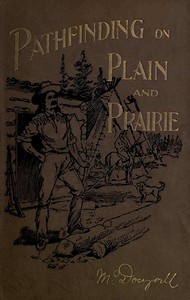
Pathfinding on Plain and Prairie Stirring Scenes of Life in the Canadian North-west — A Closer Reading
(0 User reviews)
3087
Project Gutenberg
2020
Not confirmed
Northwest, Canadian -- Description and travel; Frontier and pioneer life -- Northwest, Canadian; McDougall, John, 1842-1917
Readers of public-domain and historical texts
Project Gutenberg digital edition
en
Edition facts
Words
63,945
Reading time
279 min
Text sections
5
Before opening Pathfinding on Plain and Prairie Stirring Scenes of Life in the Canadian North-west — A Closer Reading, the edition data offers a quick orientation: 63,945 words, 4 hr 39 min estimated reading time, and 5 detected text sections.
The text analysis averages about 24.7 words per sentence, while the detected sections provide another way to judge how the source is divided.
Project Gutenberg metadata also associates the work with “Northwest, Canadian -- Description and travel,” connecting these edition facts with the source record’s subject description.
Source:
Project Gutenberg record #61657
John McDougall's 1898 memoir recounts his experiences as a Methodist missionary in the Canadian North-West, focusing on daily life, relationships with Indigenous peoples, and the challenges of frontier existence. The narrative blends vivid descriptions of landscape, hunting, and travel with observations on cultural encounters and spiritual work.
Read the complete public-domain text at its original source.
Read on Project GutenbergJohn McDougall's Pathfinding on Plain and Prairie opens not with a declaration of purpose but with a death: 'Here one of the bravest of our men was slain.' That line, drawn from page 152 and placed as an epigraph, signals that this is a narrative where violence and faith coexist. McDougall, a Methodist missionary, writes from the 1890s about his decades in the Canadian North-West, but his book is less a sermon than a chronicle of practical survival. He describes 'thin leather homes,' the drudgery of Indigenous women, and the 'triumphs of endurance' required of hunting parties and war parties alike. The voice is that of a participant who is also an observer—someone who notes the beauty of a 'grand cathedral' of nature while also recording the precise logistics of packing horses and caching provisions.
A Missionary's Daily Round
McDougall's account is built from the concrete details of movement and maintenance. He describes how his party 'dried some fish to start with' before leaving Pigeon Lake, and how their diet included 'rabbits, ducks, geese, owls, hawks, bear, beaver, badger, porcupine, skunk'—a list that emphasizes variety in species but uncertainty in quantity. The daily rhythm is shaped by scarcity: 'Sometimes we were filled, and oftentimes we were empty, not knowing when or how we should get our next meal.'
Transport was by horseback or on foot; there were 'no cart or waggon roads in or out of the Pigeon Lake country.' The party relied on old Paul, an invalid with spinal trouble who 'knew that part of the country as other men knew their quarter-sections.' McDougall's method is accumulative: he piles specific observations—the cow that gave no milk, the travois markings on a mossy knoll—into a picture of life governed by weather, game movements, and the knowledge of Indigenous guides.
The Bond with Samson
Among the Crees who came to the mission was Samson, described as old Paul's son-in-law. McDougall writes that 'he and I became fast friends from the first. There was an instinctive understanding between us.' The friendship was formalized 'in the regular native style,' creating a bond that McDougall says 'continues unto this day.' This relationship is presented as central to the narrative: 'Samson and I were inseparable in those days. I wanted to be the friend of all, but I could not help being his friend.'
The excerpts show Samson as a guide and companion on a scouting trip, where he 'quietly regaled us with hunting and war exploits.' On a mossy knoll marked by an old Blackfoot trail, Samson paused and said, 'Right...'—the sentence breaks off in the excerpt, but the gesture points to a specific, shared knowledge of the land. McDougall does not claim to understand Indigenous culture fully; instead, he records moments of mutual reliance and affection.
Ritual and Routine in Camp
McDougall describes a daily pattern of worship that adapted to the conditions of travel. 'Weather permitting and provisions allowing it, we generally held two services in the day.' In the early morning, 'while the dew was on the grass, we sang our hymns and knelt together in prayer.' In the evening, after the hunters returned and the horses were secured, McDougall would 'read a few verses and comment on them, and with hymn and prayer we closed the day.'
The campsites themselves were chosen by old Paul, whose selections balanced 'security, utility and beauty.' McDougall's language rises at these moments: 'Beside rippling stream or glistening lakelet, with growing grass and budding flowers and leafy foliage, with Mother Nature's breath full and fragrant of early summer, how like hallowed sanctuaries those camping spots were!' Yet even here, the practical intrudes—the camp was 'communistic' in food supply, and the congregation was 'scattering to the four winds' by mid-May. The spiritual work is presented as tentative: 'we were but babes ourselves in this great matter.'
Readers should approach Pathfinding on Plain and Prairie as a document of its time—a missionary's memoir that records both the hardships of frontier life and the complexities of cross-cultural encounter. McDougall's voice is that of a man who admires the skills of his Indigenous companions while remaining committed to his own religious mission. The book rewards attention to its small details: the naming of a cow, the description of a trail, the phrasing of a prayer. These are the materials from which McDougall builds his account of a world in transition.
Reading McDougall’s account of the prairie, I kept thinking of his quiet patience—how he measured distance by rivers and days, not miles. That same unhurried attentiveness came back to me in Notes of a Journey on the Upper Mekong, Siam — A Reader’s Guide, where travel becomes a slow conversation with the land itself. Different water, same stillness of heart.
There are no reviews for this eBook.
There are no comments for this eBook.
Reader reflection
Your personal reading reflection
Build a private reading journal entry for this title.
Your progress
0
/
10
2
Was reading this book enjoyable?
3
How likely are you to recommend this book?
4
Did the language feel accessible?
5
Did anything about the book feel genuinely new?
6
Would you start a conversation about this book?
7
What was its emotional impact?
8
Which element worked best for you?
9
What is the main idea you are taking away?
10