Canoe and camera — Story, Setting & Ideas
Edition facts
The catalog record for Canoe and camera — Story, Setting & Ideas provides practical reading context through 21,060 words, 1 hr 32 min estimated reading time, and 7 detected text sections.
The text analysis averages about 24.8 words per sentence, while the detected sections provide another way to judge how the source is divided.
Project Gutenberg metadata also associates the work with “Maine -- Description and travel,” connecting these edition facts with the source record’s subject description.
Calculated from edition completeness, EPUB availability, text structure and catalogue metadata. Not a user rating.
How this score is calculated
- Description quality20 pts
- Title & short description10 pts
- Source metadata20 pts
- Text length15 pts
- Chapters / structure15 pts
- EPUB file integrity20 pts
Total of 100 points, scaled to a 2.5-5.0 range. Editions with an empty description or a missing EPUB file are not scored.
Read the Text
I. PAGE An Angler’s Soliloquy.—Isaak Walton’s ideas.—A fishing minister.—The route to the woods.—Moosehead Lake and vicinity 19
The different routes through Maine.—The Party, Guides, Baggage, Provisions, Canoes, Arms.—Camp appetite.—Studying Geography.—The start.—Bid adieu to Moosehead Lake.—North East Carry.—West Branch of the Penobscot.—First Camp on Moosehorn stream 27
Our first Camp at mouth of Moosehorn stream.—Accommodating one’s self to circumstances.—The “Rips” of the West Branch.—Running the Rapids.—Pine Stream Falls.—Chesuncook Lake.—Umbazooksus River.—A “Bear” welcome.—Mud Pond and “Carry.”—A Picture difficult to photograph.—Third Camp at Chamberlin Lake 51
Chamberlin Farm and Lake.—A novel fly-trap.—A lesson in Natural History.—Telosmis Lake.—The “Cut.”—A three days’ rain-storm.—Webster Lake and Dam.—An Apparition.—The weird stillness of the primeval forests.—An accommodating fly-catcher 64
Passage of Webster Stream.—An exciting day’s sport.—The damaged canoes.—The canvas boat triumphant.—Grand Falls.—Photographing along the route.—Indian “Carry.”—East Branch of the Penobscot. —Matagamonsis Lake.—The discovery of a new Lake.—Trout Brook Farm.—Grand, or Matagamon Lake.—A captured salmon 93
Dangers of wandering from Camp.—An experience on Lake Superior.—The Falls of the East Branch.—Stair Falls.—Incidents of Camp life.—An Enchanted Bower.—Hunt’s Farm.—An Artist’s Canoe.—The ascent of Hunt’s Mountain.—A reverie.—Whetstone Falls.—Discovery of Jasper on Ledge Falls.—Dawn of Civilization.—Mattawamkeag.—The East Branch Canvas-ed 117
1. THE AUTHOR IN HIS SANCTUM Frontispiece.
4. CANOE AND CAMERA 17
4_a_. AN ODD SPECIMEN 18
8. PICKING A COURSE 28
9. MAP OF THE TOUR THROUGH THE MAINE FORESTS 30
11. WE DREAM OF GAME 38
14. MORRIS’S—NORTHEAST CARRY 43
15. IN SYMPATHY WITH NATURE 46
16. DISCOURAGEMENTS 48
17. “CHANGING PASTURE” 49
18. PENKNIFE SOUVENIRS 52
19. PINE STREAM FALLS 54
20. MUD POND CARRY 56
21. MUD POND—LOOKING EAST 59
22. “THIS IS THE WAY I LONG HAVE SOUGHT” 62
24. CHAMBERLIN FARM—LOOKING WEST 65
25. THE ROOM INTO WHICH WE WERE USHERED 66
26. CAMP ON CHAMBERLIN LAKE 67
27. NOT IN THE PATENT OFFICE 70
28. A STUDY IN NATURAL HISTORY 71
29. GREAT NORTHERN DIVER 71
30. TELOS CUT AND LAKE 73
31. PHOTOGRAPHY—THE WET AND DRY PROCESS ILLUSTRATED 77
32. TELOS DAM AND RIVER 79
35. WEBSTER LAKE AND DAM 86
36. FLY CATCHERS VERSUS FLY FISHING 88
38. STUDY OF TROUT—BY THE AUTHOR 91
39. RUNNING RAPIDS ON WEBSTER RIVER 95
41. IT’S NOT ALL POETRY 101
43. STARTING A BOOM 107
46. DISCOVERY OF A NEW LAKE 111
47. MATAGAMONSIS LAKE 113
49. MATAGAMON OR GRAND LAKE 115
50. ON THE EAST BRANCH 120
51. DROPPING CANOES OVER FALLS 122
52. ACCEPTING THE SITUATION 123
54. HULLING MACHINE FALLS 126
55. THE ARCHES—EAST BRANCH OF THE PENOBSCOT 128
57. MT. KATAHDIN—STUDY BY F. E. CHURCH 132
58. JUNCTION OF EAST AND WEST BRANCHES OF THE PENOBSCOT 134
59. GLIMPSES OF CIVILIZATION BEGIN TO DAWN 137
A love for the woods and out-door sports begins early in life. I can hardly remember when the sight of a gun or fish-rod did not awaken within my boyish fancy a feverish desire to follow their lead, be the tramp ever so hard. There never was anything to stop the growth of this passion until I reached the age of ten years, when I nearly destroyed a boy’s eye with an arrow, in my endeavors to excel in archery.
This act slightly dampened my ardor for some months, and retarded that progression in field sports I was then making.
There is also something so free, so stimulating in the woods life, uncontaminated by the gossip, allurements, and exacting dress of the usual watering places, that after one season’s enjoyment, a return to these wildernesses, and repeating its pleasures, is the constant thought of the future.
It also teaches very early self-reliance, and a philosophical endurance of many conditions of life, which add to one’s cheerfulness, while one is surprised how few of the necessities are essential to produce happiness.
“Man’s rich with little, were his judgment true; Nature is frugal, and her wants are few.”
The study also of natural history in the woods takes one into a realm which has no bounds, constantly enlarging his love and admiration of God’s works. The oft-repeated quotation, “Spare the rod and spoil the child,” has been misconstrued for many a long day, and if I had known early in life its real significance it would hardly have made so doleful an impression.
There is no doubt to-day in my mind that this “rod” meant a _fishing-rod_, and that the timely cherishing of it in youth tends to develop that portion of one’s nature to which the former use was entirely innocent.
“The surest road to health, say what you will, Is never to suppose we shall be ill. Most of those evils we poor mortals know From doctors and imagination flow.”
And now, after spending many of the annual short vacations allotted to an active business life in various parts of this country, from Canada to Florida, in the exhilarating sport of hunting, fishing, and exploring, and deriving great physical good thereby, it would not seem strange that the writer should be desirous of exciting in the hearts of others a taste for like recreations. In placing before my readers this sketch of a late canoe tour through Maine—especially that portion pertaining to the east branch of the Penobscot—I am perfectly aware that no two trips through that region can be made under the same circumstances. All days in the woods are alike, and still they are very unlike. Weather, height of water, companions, canoes, guides, sunshine or shadow, a hundred and one things, go to make a day pleasant or unpleasant to the tourist. During the month occupied in making this trip, the writer experienced but _four_ days of rain. But the first rain-storm could not have been more opportune, as it raised the water of Webster stream to a height that permitted the passage of my four canoes, when otherwise I should have endured a wearisome “carry” of seven miles. Unless there is sufficient water in Webster stream to float a canoe with _ease_, I should not recommend the tour of the east branch, for the numerous portages will hardly compensate for the pleasures of the trip.
The writer distinctly remembers meeting an angler who had followed the recommendation of a guide book on Maine, and attempted the journey from Allagash river to Chamberlin lake. Instead of an abundance of water, the stream was almost dry, and a “carry” of seven miles had to be made to Chamberlin lake. Again, the canvas boat added no little enjoyment to the pleasures of the excursion, and the trip would have lost many of its bright experiences without its companionship.
True, it received many a cut, but was more easily repaired than a birch bark, while its qualities of endurance after such an ordeal permitted it to spend the following winter season under the tropical skies of Florida.
No better companion could have been selected than Mr. H. R. Morley, of the Continental Life Insurance Company, Hartford (the “quartermaster” of the expedition), and to his suggestions and efforts to make the best of all difficulties the writer acknowledges himself indebted. It is surprising how selfishness, egotism, and other like traits of character will develop in the woods when it was never recognized in the individual at home, and one must have the true spirit of patient endurance for the sake of accomplishment in order at times to enjoy the forest life.
Thus the entire trip was made on the “flood tide,” from the state of the weather to the volume of water in the streams, facilitating the taking of photographs, and adding height and power to the many picturesque falls on the route. Until I am corrected by further explorations, I think I am right in the discovery of a new lake (not found on any map), between Matagamonsis and Matagamon lakes.
An enlargement of Hay creek has been suggested as this body of water, but if so, all the larger lakes in this region are but a part of the preceding stream which empties into them. This lake has the same area of square miles as Telosmis lake, and empties its waters in to the sluggish stream which connects the two large bodies of water just mentioned.
The pleasure of canoeing these undiscovered lakes and streams, and living from day to day upon their resources, was an element of indescribable delight. Nowhere do such rich thoughts of God’s bounty, grandeur, and control of nature impress one as in the depths of the forests, and there are reveries forced upon one, for which a city of brick walls and dusty streets have no affinity. The individuality of each tree, the strange and rare plants and flowers scattered along the indistinct path one wanders, all coupled with the weird stillness of the forest, bring one nearer to God and His works than almost any other situation. I do not suggest in this book the various ways of camping out, or the necessary preparations for the same, as there are special works on those subjects; I simply desire to direct the attention of tourists, and more especially artists, to a section of Maine _now but little known_, but which, if once explored, will yield to them a bright harvest of pleasure and studies.
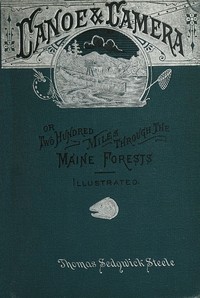
CANOE AND CAMERA. TWO HUNDRED MILES THROUGH THE MAINE FORESTS.
ILLUSTRATED BY TRUE WILLIAMS, BENJAMIN DAY, AUG. WILL, AND OTHER ARTISTS.
“I in these flowery meads would be; These crystal streams should solace me; To whose harmonious, bubbling noise I with my angle would rejoice.” WALTON.
AN ANGLER’S SOLILOQUY.—ISAAK WALTON’S IDEAS.—A FISHING MINISTER.—THE ROUTE TO THE WOODS.—MOOSEHEAD LAKE AND VICINITY.
In the good old times, when the requirements of business kept one out in the open air, and each client or patient resided many miles away, and the only communication was by foot or on horseback, one did not need the indispensable rest and recreation of to-day.
But now all is changed, and within a hand’s grasp at our offices we can communicate by the strange wires of the telephone or telegraph with friends miles away, and save ourselves those steps which would no doubt be of great benefit if taken.
In this fast world of ours, where the work of a week is crowded into a day, recreation is a necessity, and nowhere, it seems to me, has it greater recuperative power than in the depths of the forest.
It is not as a plea for the angler that I pen these lines—he asks for neither judge nor jury on his tastes, although they no doubt frequently receive the verdict of both; he is a law unto himself.
“It is a very easy thing to scoff at any art or recreation, a little wit mixed with ill-nature, confidence, and malice will do it, though they are often caught in their own trap.”
It is only a few weeks since that I was rallied on my pet hobby by a prominent business man, who thought one could hardly be in his right mind who had a fondness for life in the woods, and that it must give one a tendency to coarseness, rather than improving our higher and more æsthetic tastes. But this gentleman was welcome to his ideas, for he was then an invalid from a nervous disease, and had spent the prime of his life regaining his health, when possibly an occasional day’s tramp beside a trout stream would have been a matter of economy to both purse and body.
The father of anglers, Isaak Walton, puts this same idea in a still better light, for although born in 1593, he knew how to read the human nature of to-day; he says: “Yes! there are many grave and serious men who pity us anglers, but there are many more grave and serious men whom we anglers condemn and pity.”
“Men that are taken to be grave because nature hath made them of a sour complexion, money-getting men that spend all their time, first in getting, and next in anxious care to keep it! men that are condemned to be rich, and then always busy and discontented—for these poor rich men we anglers pity them perfectly, and stand in no need to borrow their thoughts to think ourselves so happy.”
Some one has said that an angler consists of a rod with a fool at one end and a fish at the other. But Walton, in his meanderings beside the streams, is reported to have had the constant companionship of a book, and between the nibbles of the fish stored his mind with useful knowledge.
While hunting in the western part of Connecticut last autumn, a good story was told me of a minister who, soon after his settlement in the parish, greatly annoyed his flock by his habitual fondness for angling. He would start off early on Monday morning, and would keep up the diversion until late Saturday night; nevertheless, the quality of his sermons, and the deep thoughts which they contained, so pleased his people that similar excursions were suggested to the pastors of other churches in the town.
So much for an introduction to the inmost thoughts of a lover of the angle, but possibly you would like to know how to reach the solitudes of Maine, whose influences are so bewitching to the writer, and where, with the reader as companion, he proposes to enjoy a canoe ride of two hundred miles.
To one about to make a trip to Maine, we would say, start in all cases from Boston, even though you live in Chicago. Take the 7 P.M. express on the Eastern railroad for Bangor, thereby having a good night’s rest in a sleeper, awaking refreshed for the pleasure of the next day’s journey.
But those who have never traveled this road will do well to see their flight be not in the night, for, commencing with Boston, its main line extends along the shore, giving here and there glimpses of quiet bays and shady inlets, and through cities noted for their thrift and prosperity almost from the country’s settlement.
One would be well repaid for a day spent at almost any station along the route, as the eastern shore of New England has often been the subject for busy pens and famous pencils. From Massachusetts Bay to Passamaquoddy and the Isle of Great Manan, it is filled with nooks and beaches where, in the hot months of summer, the seeker for rest and renewed health can choose the spot suited to his taste. The Eastern railroad—with its numerous branches and connecting lines—forms the most direct and desirable means of access to these points of interest.
It does not, however, limit the choice to the seashore, for it leads also to the heart of the famous White Mountains, and to the vast and partially explored lake region of Maine, towards which I had set my face.
Lynn, eleven miles from Boston, famed for its immense factories of boots and shoes, lies at the head of Nahant Bay, from which there is a delightful drive along the shore to Nahant, a noted, picturesque watering-place. Near by is Swampscott, its shores lined with summer cottages, and from here a short branch road runs to rocky Marblehead, a spot mentioned in letters of travel as early as the year 1633.
Salem, four miles further on, famous since the days of witchcraft, and once the principal port of entry for New England, not only has its pleasant situation to attract the visitor, but is full of relics of the olden time of interest to the antiquary. It was the birthplace of many men whose names have become a part of our nation’s history and literature.
At Beverly, the Gloucester branch leads down to the sea at Cape Ann, with its sunny beaches and rocky headlands, quiet when the wind is off shore, but where the waves come thundering in when driven before an easterly gale.
But we have hardly time to speak of Newburyport, another old seacoast town, and the lovely view to be had from its heights of the surrounding country and ocean, but hasten through to Salisbury, Hampton, and Rye Beach.
Portsmouth is quiet and quaint, and at Conway Junction, eleven miles from Portsmouth, passengers change cars for the White Mountains. At Portland, the angler makes choice of the routes to the two great trouting paradises of Maine—Rangeley Lakes and Moosehead Lake.
If to the former place, he takes the cars for Farmington, eighty-five miles directly north from Portland, and then by stage thirty-six miles over the mountains to Kimball’s Head of the First Rangeley Lake, where he will receive a hearty welcome from as cordial a company of fishermen as it has been my pleasure in other seasons to enjoy.
If the latter be his choice, guns, rods, blankets, and other camp equipage are shifted to the train of the Maine Central railroad for Bangor, where the cars are again changed for the road to Blanchard, which is twelve miles from Moosehead Lake. After a substantial dinner, the tourist mounts to the top of the commodious Concord stage drawn by four horses, and enjoys a delightful ride of eleven miles over the hills to Greenville, foot of Moosehead Lake. Here the baggage is again changed to a steamer, and a most enjoyable sail of twenty miles lands one at the Kineo House, which stands on a prominent point of rocks extending far out into Moosehead Lake, a convenient center of attraction for those who dislike the unadulterated life in the woods.
“A bard is weak enough you’ll find, A humble cat-gut twangler: But for a man of simple mind Commend me to an Angler. He’ll fish and fish the whole year round Devotedly fanatic, To catch one fish that weighs a pound And then his joy’s ecstatic.”
THE DIFFERENT ROUTES THROUGH MAINE.—THE PARTY, GUIDES,—BAGGAGE,—PROVISIONS,—CANOES,—ARMS.—A CAMP APPETITE.—STUDYING GEOGRAPHY.—THE START.—BID ADIEU TO MOOSEHEAD LAKE.—NORTHEAST “CARRY.”—WEST BRANCH OF THE PENOBSCOT.—LANDING FOR OUR FIRST CAMP MOUTH OF MOOSEHORN STREAM.
On leaving Moosehead Lake, the seeker for health or recreation in Maine, who desires to study nature in its primeval state, and drink from her fountains the blessings which she can so bountifully bestow, has three routes of travel before him. These routes are known as the St. John’s River, the West Branch of the Penobscot, and the East Branch of the Penobscot trips, and have for their point of departure the Kineo House, Moosehead Lake, where all that is necessary in camp supplies can always be obtained.
The most frequented route, and on account of its ease generally recommended by the guides, is that to the St. John’s River, which one reaches by passing north from Moosehead Lake through the West Branch, Chesuncook, Chamberlin, Eagle, and Churchill Lakes to the Allagash River, and thence northeast through Canada, emerging from the woods at Grand Falls, New Brunswick. The second, or the West Branch of the Penobscot trip, passes southeast through Chesuncook to Ripogenus Lake, and follows the West Branch through Pamedomcook and Twin Lakes into the Penobscot River.
The third and most difficult course through this wilderness, is the tour of the East Branch of the Penobscot, which leaves the St. John’s route at Chamberlin Lake, and passes south through Telosmis Lake and then east through Telos and Webster Lake and River to the Matagamonsis and Matagamon or Grand Lake into the East Branch, and after tumbling over the most picturesque falls and rapids in the entire State, unites with the West Branch of the Penobscot at Medway.[A]
[Footnote A: Still another trip can be made from Churchill Lake through Spider, Echo, and Mansungan Lake and River, to the Aroostook waters coming out in Maine at Caribou.
Col. Lyman B. Goff of Pawtucket, R. I., with his guides Kelly and Mansell, surveyed this route last season, cutting a good path on the many “carries” for the easy transportation of canoes, and to him the author is indebted for new and correct drawings of that region which have been added to this map. But the scenery is uninteresting and the difficulties will not compensate one for the labor endured, and woe betide the tourist if the water is low.]
To retain my good health, and enjoy for the fifth season the dearly-loved woods and lakes of Maine, the summer of 1879 soon found me again within her fascinations, a willing captive to her charms. We have never failed in the past to impress upon our friends that one companion is sufficient for company in the woods, but this year, the party although it had small beginnings increased in the ratio of the demands of my tastes. As gathered upon the deck of the little steamer “Day Dream” one bright summer morning, while on her way from the Kineo House to the head of Moosehead Lake, we numbered six souls.
Steele organizes his two-hundred-mile tour through Maine forests as a sequence of daily movements between camps, each defined by the practical challenges of canoeing, portaging, and provisioning. The narrative repeatedly pauses to describe the precise logistics of striking camp, navigating rapids, and selecting portage routes—details that ground the journey in tangible, physical effort. A recurring motif is the near-miss with bears: the party encounters bruins six times but never with rifles at hand, a pattern that becomes a running joke around the campfire. Steele also weaves in the work of photography, noting which scenes resisted the camera and how light and weather affected his plates, making the camera itself a participant in the expedition.
The Rhythm of the Carry
Steele’s account is built around the repeated cycle of breaking camp, paddling, and portaging. He devotes careful attention to the carry—the overland haul of canoes and gear around falls or rapids. Knowing which side of a stream offers the best portage, he writes, is “very essential to one’s happiness,” since a wrong choice adds a laborious walk under load. The narrative tracks these decisions with the precision of a field log: the length of each carry, the condition of the trail, the height of logger’s dams. This structural repetition gives the journey a steady, workmanlike pulse, punctuated by moments of stillness on tranquil lakes like Webster, “wooded down to its very edge.”
Bear Stories and Campfire Truth
Bears appear in the text less as threats than as narrative catalysts. Steele notes that “a bear story is always welcomed in camp,” and the party’s own encounters follow a comic pattern: a guide spots a she-bear with cubs, the men grab rifles, but the animals vanish. This happens repeatedly, and Steele dryly observes that the bears were never found when sought. Around the fire, these near-misses inspire tales of other hunters’ exploits, each “having its special locality and party designated.” The effect is to frame the wilderness as a place where stories multiply, their truthfulness measured not by fact but by the pleasure they give the audience.
Photography Against the Elements
The camera in Steele’s title is no mere ornament. He records the difficulties of photographing along the route: a scene that is “difficult to photograph,” the need to time exposures with shifting light, the risk of damage to equipment during portages. The illustrations that accompany the text—sixty of them—are the tangible outcome of this effort, but the narrative also acknowledges failure. Steele does not pretend every shot succeeded; instead, he treats photography as another skill to be managed alongside paddling and campcraft, subject to the same constraints of weather, terrain, and luck.
The Dam and the Beaver’s Lesson
A curious anecdote about a tame beaver illustrates how Steele uses local lore to leaven the travelogue. A farmer’s pet beaver, faced with a leaking faucet, “cut up the chairs and tables” to build a dam across the kitchen floor, saving the house from flood. The story, told by a guide, is offered without skepticism, as part of the fund of knowledge exchanged around the fire. It also echoes the larger landscape: the party repeatedly encounters logger’s dams on Webster Lake and elsewhere, structures that control water flow for timber drives. The beaver’s domestic dam becomes a miniature, comic version of the industrial works that shape the rivers they travel.
Steele’s narrative rewards a reader attentive to the small, repeated actions that define a wilderness journey: the choice of a portage, the drying of a tent, the telling of a bear story. The camera, though prominent in the title, is one tool among many, and its presence reminds us that this is a record shaped by both observation and limitation. Read for the texture of daily camp life and the quiet humor that emerges from mishaps and near-misses, rather than for dramatic adventure.
What stayed with me from that canoe journal was how quiet the days felt—even with bears nearby, the stillness of moving through water seemed to hold everything. Something about that lingering calm made me think of Six months in the gold mines — Edition Insights, a different kind of wilderness, yet carrying that same patient weight of watching and waiting.
-
Carmen David Castillo - 3 weeks ago
An interesting read with some gorgeous photographs and engaging anecdotes about the author's journeys. The focus on the technical aspects of canoeing and camera equipment, while detailed, can slow down the narrative for casual readers. Still, it's a decent choice for those interested in the intersection of photography and outdoor adventures. -
James Christopher Alexander - 3 weeks ago
The concept had promise, but the execution falls flat. The writing is often verbose, and the author spends more time on the minutiae of camera settings than on conveying the beauty and excitement of the canoe trips. The lack of a cohesive structure makes it feel like a collection of disparate logs rather than a compelling narrative. Disappointing overall. -
Sarah Richards - 2 weeks ago
A captivating blend of adventure and photography! This book beautifully captures the essence of canoeing through stunning landscapes, with vivid descriptions and breathtaking images that make you feel like you're right there. The author's passion for nature is infectious, inspiring me to plan my own paddling trip. A must-read for outdoor enthusiasts.
How will you remember this book?
Save your reaction, strongest insight, and memorable passage.

Samuel Young
1 week ago