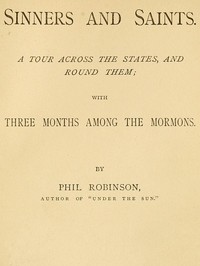
Sinners and Saints A Tour Across the States and Round Them, with Three Months Among the Mormons — Text and Context
Edition facts
This digital edition of Sinners and Saints A Tour Across the States and Round Them, with Three Months Among the Mormons — Text and Context is described by source-level measurements including 118,356 words, 8 hr 35 min estimated reading time, and 10 detected text sections.
The text analysis averages about 26.6 words per sentence, while the detected sections provide another way to judge how the source is divided.
Project Gutenberg metadata also associates the work with “West (U.S.) -- Description and travel,” connecting these edition facts with the source record’s subject description.
Calculated from edition completeness, EPUB availability, text structure and catalogue metadata. Not a user rating.
How this score is calculated
- Description quality20 pts
- Title & short description10 pts
- Source metadata20 pts
- Text length15 pts
- Chapters / structure15 pts
- EPUB file integrity20 pts
Total of 100 points, scaled to a 2.5-5.0 range. Editions with an empty description or a missing EPUB file are not scored.
Read the Text
FROM NEW YORK TO CHICAGO.
By the Pennsylvania Limited--Her Majesty's swine--Glimpses of Africa and India--"Eligible sites for Kingdoms"--The Phoenix city--Street scenes--From pig to pork--The Sparrow line--Chicago Mountain--Melancholy merry-makers.
FROM CHICAGO TO DENVER.
Fathers of Waters--"Rich Lands lie Flat"--The Misery River--Council Bluffs--A "Live" town, sir--Two murders: a contrast--Omaha--The immorality of "writing up"--On the prairies--The modesty of "Wish-ton-Wish"--The antelope's tower of refuge--Out of Nebraska into Colorado--Man-eating Tiger.
The South Park line--Oscar Wilde on sunflowers as food--In a wash-hand basin--Anti-Vigilance Committees--Leadville the city of the carbonates--"Busted" millionaires--The philosophy of thick boots--Colorado miners--National competition in lions--Abuse of the terms "gentleman" and "lady"--Up at the mines--Under the pine-trees.
FROM LEADVILLE TO SALT LAKE CITY.
What is the conductor of a Pullman car?--Cannibalism fatal to lasting friendships--Starving Peter to feed Paul--Connexion between Irish cookery and Parnellism--Americans not smokers--In Denver--"The Queen City of the Plains"--Over the Rockies--Pride in a cow, and what came of it--Sage-brush--Would ostriches pay in the West?--Echo Canyon--The Mormons' fortifications--Great Salt Lake in sight.
THE CITY OF THE HONEY-BEE.
Zion--Deseret--A City Of Two Peoples--"Work" the watch-word of Mormonism--A few facts to the credit of the Saints--The text of the Edmunds Bill--In the Mormon Tabernacle--The closing scene of the Conference.
LEGISLATION AGAINST PLURALITY.
A people under a ban--What the Mormon men think of the Anti-Polygamy Bill--And what the Mormon women say of polygamy--Puzzling confidences--Practical plurality a very dull affair--But theoretically a hedge-hog problem--Matrimonial eccentricities--The fashionable milliner fatal to plurality--Absurdity of comparing Moslem polygamy with Mormon plurality--Are the women of Utah happy?--Their enthusiasm for Women's Rights.
A Special Correspondent's lot--Hypothecated wits--The Daughters of Zion--Their modest demeanour--Under the banner of Woman's Rights--The discoverer discovered--Turning the tables--"By Jove, sir, you shall have mustard with your beefsteak!"
COULD THE MORMONS FIGHT?
An unfulfilled prophecy--Had Brigham Young been still alive?--The hierarchy of Mormonism--The fighting Apostle and his colleagues--Plurality a revelation--Rajpoot infanticide: how it was stamped out--Would the Mormons submit to the process?--Their fighting capabilities--Boer and Mormon: an analogy between the Drakensberg and the Wasatch ranges--The Puritan fanaticism of the Saints--Awaiting the fulness of time and of prophecy.
THE SAINTS AND THE RED MEN.
Prevalent errors as to the red man--Secret treaties--The policy of the Mormons towards Indians--A Christian heathen--Fighting-strength of Indians friendly to Mormons.
REPRESENTATIVE AND UNREPRESENTATIVE MORMONISM.
Mormonism and Mormonism--Salt Lake City not representative--The miracles of water--How settlements grow--The town of Logan: one of the Wonders of the West--The beauty of the valley--The rural simplicity of life--Absence of liquor and crime--A police force of one man--Temple mysteries--Illustrations of Mormon degradation--Their settlement of the "local option" question.
THROUGH THE MORMON SETTLEMENTS.
Salt Lake City to Nephi--General similarity of the settlements--From Salt Lake Valley into Utah Valley--A lake of legends--Provo--Into the Juab valley--Indian reminiscences--Commercial integrity of the saints--At Nephi--Good work done by the saints--Type of face in rural Utah--Mormon "doctrine" and Mormon "meetings."
English companies and their failures--A deplorable neglect of claret cup--Into the San Pete Valley--Reminiscences of the Indians--The forbearance of the red man--The great temple at Manti--Masonry and Mormon mysteries--In a tithing-house.
FROM MANTI TO GLENWOOD.
Scandinavian Mormons--Danish ol--Among the orchards at Manti--On the way to Conference--Adam and Eve--The protoplasm of a settlement--Ham and eggs--At Mayfield--Our teamster's theory of the ground-hog--On the way to Glenwood--Volcanic phenomena and lizards--A suggestion for improving upon Nature--Primitive Art.
FROM GLENWOOD TO MONROE.
From Glenwood to Salina--Deceptiveness of appearances--An apostate Mormon's friendly testimony--Reminiscences of the Prophet Joseph Smith--Rabbit-hunting in a waggon--Lost in the sage-brush--A day at Monroe--Girls riding pillion--The Sunday drum--Waiting for the right man: "And what if he is married?"--The truth about apostasy: not always voluntary.
"Schooling" in the Mormon districts--Innocence as to whisky, but connoisseurs in water--"What do you think of that water, sir?"--Gentile dependents on Mormon charity--The one-eyed rooster--Notice to All!
A Mormon missionary among the Indians--The story Of Jacob Hamblin's life--His spiritualism, the result of an intense faith--His good work among the Lamanites--His belief in his own miracles.
THROUGH MARYSVALE TO KINGSTON.
Piute County--Days of small things--A swop in the sage-brush; two Bishops for one Apostle--The Kings of Kingston--A failure in Family.
FROM KINGSTON TO ORDERVILLE.
On the way to Panguitch--Section-houses not Mormon homes--Through wild country--Panguitch and its fish--Forbidden pleasures--At the Source of the Rio Virgin--The surpassing beauty of Long Valley--The Orderville Brethren--A success in Family Communism.
Red ants and anti-Mormons--Ignorance of the Mormons among Gentiles in Salt Lake City--Mormon reverence for the Bible--Their struggle against drinking-saloons in the city--Conspicuous piety in the settlements--Their charity--Their sobriety (to my great inconvenience)--The literature of Mormonism utterly unreliable--Neglect of the press by the Saints--Explanation of the wide-spread misrepresentation of Mormonism.
DOWN THE ONTARIO MINE
FROM UTAH INTO NEVADA.
Rich and ugly Nevada--Leaving Utah--The gift of the Alfalfa--Through a lovely country to Ogden--The great food devouring trick--From Mormon to Gentile: a sudden contrast--The son of a cinder--Is the red man of no use at all?--The papoose's papoose--Children all of one family.
FROM NEVADA INTO CALIFORNIA.
Of bugbears--Suggestions as to sleeping-cars--A Bannack chief, his hat and his retinue--The oasis of Humboldt--Past Carson Sink--A reminiscence of wolves--"Hard places"--First glimpses of California--A corn miracle--Bunch-grass and Bison--From Sacramento to Benicia.
San Franciscans, their fruits and their falsehoods--Their neglect of opportunities--A plague of flies--The pigtail problem--Chinamen less black than they are painted--The seal rocks--The loss of the Eurydice--A jeweller's fairyland--The mystery of gems.
Gigantic America--Of the treatment of strangers--The wild-life world--Railway Companies' food-frauds--California Felix--Prairie-dog history--The exasperation of wealth--Blessed with good oil--The meek lettuce and judicious onion--Salads and Salads--The perils of promiscuous grazing.
The Carlyle of vegetables--The moral in blight--Bee-farms--The city of Angels--Of squashes--Curious vegetation--The incompatibility of camels and Americans--Are rabbits "seals"?--All wilderness and no weather--An "infinite torment of flies."
THROUGH THE COWBOYS' COUNTRY.
The Santa Cruz valley--The cactus--An ancient and honourable pueblo--A terrible beverage--Are cicadas deaf?--A floral catastrophe--The secretary and the peccaries.
American neglect of natural history--Prairie-dogs again; their courtesy and colouring--Their indifference to science--A hard crowd--Chuckers out--Makeshift Colorado.
Nature's holiday--Through wonderful country--Brown negroes a libel on mankind--The Wild-flower State--The black problem--A piebald flirt--The hippopotamus and the flea--A narrow escape--The home of the swamp-goblin--Is the moon a fraud?
Frogs, in the swamp and as a side-dish--Negroids of the swamp age--Something like a mouth--Honour in your own country--The Land of Promise--Civilization again.
FROM NEW YORK TO CHICAGO.
By the Pennsylvania Limited--Her Majesty's swine--Glimpses of Africa and India--"Eligible sites for Kingdoms"--The Phoenix city--Street scenes--From pig to pork--The Sparrow line--Chicago Mountain--Melancholy merry-makers.
"DOES the fast train to Chicago ever stop?" was the question of a bewildered English fellow-passenger, Westward-bound like myself, as I took my seat in the car of the Pennsylvania Limited mail that was to carry me nearly half the distance from the Atlantic to the Pacific. "Oh, yes," I replied, "it stops--at Chicago."
By this he recognized in me a fellow-innocent, and so we foregathered at once, breakfasted together, and then went out to smoke the calumet together.
To an insular traveller, it is a prodigiously long journey this, across the continent of America, but I found the journey a perpetual enjoyment. Even the dull country of the first hour's travelling had many points of interest for the stranger--scattered hamlets of wooden houses that were only joined together by straggling strings of cocks and hens; the others that seemed to have been trying to scramble over the hill and down the other side but were caught just as they got to the top and pinned down to the ground with lightning conductors; the others that had palings round them to keep them from running away, but had got on to piles as if they were stilts and intended (when no one was looking) to skip over the palings and go away; the others that had rows of dwarf fir-trees in front of them, through which they stared out of both their windows like a forward child affecting to be shy behind its fingers. These fir-trees are themselves very curious, for they give the country a half-cultivated appearance, and in some places make the hillsides and valleys look like immense cemeteries, and only waiting for the tombstones. Even the levels of flooded land and the scorched forests were of interest, as significant of a country still busy over its rudiments.
"All charcoal and puddles," said a fellow-traveller disparagingly; "I'm very glad we're going so fast through it."
Now for my own part I think it looks very uncivil of a train to go with a screech through a station without stopping, and I always wish I could say something in the way of an apology to the station-master for the train's bad manners. No doubt people who live in very small places get accustomed to trains rushing past their platforms without stopping even to say "By your leave." But at first it must be rather painful. At least I should think it was. On the other hand, the people "in the mofussil" (which is the Anglo-Indian for "all the country outside one's own town") did not pay much attention to our train. Everybody went about their several works for all the world as if we were not flashing by. Even the dogs trotted about indifferently, without even so much as noticing us, except occasionally some distant mongrel, who barked at the train as if it was a stray bullock, and smiled complacently upon the adjoining landscape when he found how thoroughly he had frightened it away.
There seemed to me a curious dearth of small wild life. The English "country" is so full of birds that all others seem, by comparison, birdles. Once, I saw a russet-winged hawk hovering over a copse of water-oak as if it saw something worth eating there; once, too, I saw a blue-bird brighten a clump of cedars. Now and again a vagabond crow drifted across the sky. But, as compared with Europe or parts of the East which I know best, bird-life was very scanty.
And presently Philadelphia came sliding along to meet us with a stately decorum of metalled roads and well-kept public grounds, and we stopped for the first of the twelve halts, worth calling such, which I had to make in the 3000 miles between the Atlantic and the Pacific.
How treacherously the trains in America start! There is no warning given, so far as an ordinary passenger can see, that the start is under contemplation, and it takes him by surprise. The American understands that "All aboard" means "If you don't jump up at once you'll be left behind." But to those accustomed to a "first" and a "second" and a "third" bell--and accustomed, too, not to get up even then until the guard has begged them as a personal favour to take their seats--the sudden departure of the American locomotive presents itself as a rather shabby sort of practical joke.
The quiet, unobtrusive scenery beyond Philadelphia is English in character, and would be still more so if there were hedges instead of railings. By the way, whenever reading biographical notices of distinguished Americans I have been surprised to find that so many of them at one time or other had "split rails" for a subsistence. But now that I have followed the "course of empire" West, I am not the least surprised. I only wonder that every American has not split rails, at one time or another, or, indeed, gone on doing it all his life. For how such a prodigious quantity of rails ever got split (even supposing distinguished men to have assisted in the industry in early life) passes my feeble comprehension. All the way from New York to Chicago there are on an average twenty lines of split rails running parallel with the railway track, in sight all at once! And after all, this is only one narrow strip across a gigantic continent. In fact, the two most prominent "natural features" of the landscape along this route are dwarf firs and split rails. But no writer on America has ever told me so. Nor have I ever been told of the curious misapprehension prevalent in the States as to the liberty of the subject in the British Isles.
In America, judging at any rate from the speech of "the average American," I find that there is a belief prevalent that the English nation "lies prostrate under the heel of a tyrant." What a shock to those who think thus, must have been that recent episode of the queen's pigs at Slough!
Six swine and a calf belonging to her Majesty found themselves, the other day, impounded by the Slough magistrates for coming to market without a licence. Slough, from geographical circumstances over which it has no control, happens to be in Buckinghamshire, and this country has been declared "an infected district," so that the bailiff who brought his sovereign's pigs to market, without due authority to do so, transgressed the law. Two majesties thus came into collision over the calf, and that of the law prevailed. Such a constitutional triumph as this goes far to clear away the clouds that appeared to be gathered upon the political horizon, and the shadows of a despotic dictatorship which seemed to be falling across England begin to vanish. The written law, contained probably in a very dilapidated old copy in the possession of these rural magistrates, a dogs'-eared and, it may be, even a ragged volume, asserted itself supreme over a monarch's farmyard stock, and dared to break down that divinity which doth hedge a Sovereign's swine. There are some who say that in the British Isles men are losing their reverence for the law, and that justice wears two faces, one for the rich and another for the poor. They would have us believe that only the parasites of princes sit in high place, and that the scales of justice rise or fall according to the inclinations of the sceptre, with the obsequious regularity of the tides that wait upon the humours of the moon. But such an incident as this, when the Justices of Slough, those intrepid Hampdens, sate sternly in their places, and, fearless of Royal frowns and all the displeasure of Windsor, dispensed to the pigs, born in the purple, and to the calf that had lived so near a throne, the impartial retribution of a fine--with costs--gives a splendid refutation to these calumnies. Where shall we look in Republican history for such another incident? or where search for dauntless magistrates like those of Slough, who shut their eyes against the reflected glitter of a Court, who fined the Royal calf for risking the health of Hodge's miserable herd, and gave the costs against the Imperial pigs for travelling into Buckinghamshire without a licence? Fiat justitia, ruat coelum. There was no truckling here to borrowed majesty, no sycophant adulation of Royal ownership; but that fine old English spirit of courageous independence which has made tyrants impossible in our island and our law supreme. It was of no use before such men as these, the stout-hearted champions of equal justice, for the bailiff to plead manorial privilege, or to threaten the thunders of the House of Brunswick. They were as implacable as a bench of Rhadamanthuses, and gave these distinguished hogs the grim choice between paying a pound or going to one. Nor, to their credit be it said, did either bailiff, calf, or pigs exhibit resentment. On the contrary, they accepted judgment with that respectful acquiescence which characterizes our law-abiding race, and the swine turned without a murmur from the scene of their repulse, and trotted cheerfully before the bailiff out of Buckinghamshire back to Windsor.
The bailiff, no doubt, bethought him of the past, and wished the good old days of feudalism were back, when a King's pig was a better man than a Buckinghamshire magistrate. But if he did, he abstained from saying so. On the contrary, he paid his fine like a loyal subject, and gathering his innocent charges round him went forth, more in sorrow than in anger, from the presence of the magisterial champions of the public interests. The punished pigs, too, may have felt, perhaps, just a twinge of regret for the days when they roamed at will over the oak-grown shires, infecting each other as they chose, without any thought of Contagious Diseases Acts or vigilant justices. But they said nothing; and the spectacle of an upright stipendiary dispensing impartial justice to a law-abiding aristocracy was thus complete.
To return to my car. Beyond Philadelphia the country was waking up for Spring. The fields were all flushed with the first bright promise of harvest; blackbirds--reminding me of the Indian king-crows in their sliding manner of flight and the conspicuous way in which they use their tails as rudders--were flying about in sociable parties; and flocks of finches went jerking up the hill-sides by fits and starts after the fashion of these frivolous little folk.
A mica-schist (it may be gneiss) abounds along the railway track, and it occurred to me that I had never, except in India, seen this material used for the ornamentation of houses. Yet it is very beautiful. In the East they beat it up into a powder--some is white, some yellow--and after mixing it with weak lime and water, wash the walls with it, the result being a very effective although subdued sparkle, in some places silvery, in others golden.
Nearing Harrisburg the country begins to resemble upper Natal very strongly, and when we reached the Susquehanna, I could easily have believed that we were on the Mooi, on the borders of Zululand. But the superior majesty of the American river soon asserted itself, and I forgot the comparison altogether as I looked out on this truly noble stream, with the finely wooded hills leaning back from it on either side, as if to give its waters more spacious way.
And then Harrisburg, and the same stealthy departure of the train. But outside the station our having started was evident enough, for a horse that had been left to look after a buggy for a few minutes, took fright, and with three frantic kangaroo-leaps tried to take the conveyance whole over a wall. But failing in this, it careered away down the road with the balance of the buggy dangling in a draggle-tail sort of way behind it.
Nature works with so few ingredients that landscape repeats itself in every continent. For there is a limit, after all, to the combinations possible of water, mountain, plain, valley, and vegetation. This is strictly true, of course, only when we deal with things generically. Specific combinations go beyond arithmetic. But even with her species, Nature delights in singing over old songs and telling the tales she has already told. For instance here, after passing Harrisburg, is a wonderful glimpse of Naini Tal in the Indian hills--memorable for a terribly fatal landslip three years ago--with its oaks and rhododendrons and scattered pines. In the valleys the streams go tumbling along with willows on either bank, and here and there on the hillsides, shine white houses with orchards about them.
The houses men build for themselves when they are thinking only of shelter are ugly enough. Elegance, like the nightingale, is a creature of summer-time, when the hard-working months of the year are over and Nature sits in her drawing-room, so to speak, playing the fine lady, painting the roses and sweetening the peaches. But, ugly though they are, these scattered homesteads are by far the finest lines in all the great poem of this half-wild continent, and lend a grand significance to every passage in which they occur. And the pathos of it! Look at those two horses and a man driving a plough through that scrap of ground yonder. There is not another living object in view, though the eye covers enough ground for a European principality. Yet that man dares to challenge all this tremendous Nature! It is David before Goliath, before a whole wilderness of Goliaths, with a plough for a sling and a ploughshare for a pebble.
Here all of a sudden is another man, all alone with some millions of trees and the Alleghanies. And he stands there with an axe in his hands, revolving in that untidy head of his what he shall do next to the old hills and their reverend forest growth. The audacity of it, and the solemnity!
It would be as well perhaps for sentiment if every man was quite alone. For I find that if there are two men together one immediately tries to sell the other something; and to inform him of its nature, he goes and paints the name of his disgusting commodities on the smooth faces of rocks and on tree-trunks. Now, any landscape, however grand, loses in dignity if you see "Bunkum's Patent" inscribed in the foreground in whitewash letters six feet high.
What a mercy it is these quacks cannot advertise on the sky--or on running water!
Phil Robinson, a British journalist and author, opens Sinners and Saints with a tone of wry detachment that persists throughout his account of a tour across the United States and three months among the Mormons. His authorial choices in diction, dialogue, and description consistently signal a narrator who is both curious and critical, yet willing to let his subjects speak for themselves. The book's structure—moving from the Eastern states through Chicago and Denver to Utah—allows Robinson to frame Mormon society against the broader American backdrop, a contrast he exploits with deliberate irony.
A Narrator's Voice: Wry Detachment and Direct Address
Robinson's prose is marked by a conversational, often sardonic tone. He describes Chicago as a place where one can observe "eligible sites for Kingdoms" and notes the "melancholy merry-makers" with a dry humor that undercuts grandiosity. His diction frequently shifts between formal observation and colloquial aside, as when he remarks on the "immorality of 'writing up'" a town. This voice is not merely stylistic; it establishes Robinson as a skeptical but engaged witness, one who questions the boosterism of the West while still finding value in its peculiarities.
Dialogue as Evidence: Letting Mormons Speak
Robinson frequently incorporates direct speech from his informants, both Mormon and Gentile. He reports a Mormon woman's assertion that "the standard of public morality among the Mormons of Utah is such as the Gentiles among them are either unable or unwilling to live up to," and records the Church's standing instruction to teachers: "If persons professing to be members of the Church be guilty of allowing drunkenness, Sabbath-breaking, profanity, defrauding or backbiting... they should be visited." These quotations serve as evidence for his arguments, allowing his subjects to articulate their own positions rather than relying solely on his interpretation.
Descriptive Detail: The Texture of Mormon Life
Robinson's descriptions are precise and sensory. He notes the "trimly-dressed damsel" who is the schoolmistress, the "curious, happy-go-lucky style" of schooling, and the shade trees that line every Mormon settlement. He observes that children "can regulate the amount of their own schooling as they please," a detail that grounds his critique of education in specific behavior. His description of the Church's "silent scrutiny into personal character" and the gradual withdrawal of fellowship for persistent vice offers a concrete picture of social control, avoiding abstract moralizing.
Structure and Contrast: Framing the Saints
The book's journey from New York to Utah is itself a structural choice. By first depicting the raucous, competitive energy of Chicago and Denver—where "busted millionaires" and "man-eating Tiger" (a newspaper) thrive—Robinson creates a foil for the ordered, work-driven society of Deseret. He explicitly contrasts the "melancholy merry-makers" of the East with the Mormon motto "Work" as the watch-word of their faith. This framing allows him to present polygamy and Church discipline not as exotic aberrations but as logical, if controversial, responses to the same frontier conditions that produce Gentile excess.
Robinson's account is valuable not for its conclusions—which he himself hedges—but for the texture of its evidence. Readers should attend to the way he lets his subjects speak, the specificity of his observations, and the wry, self-aware voice that guides the narrative. The book is less a verdict on Mormonism than a record of one observer's encounter with a society that defied easy judgment.
Phil Robinson found character in dusty roadways and crowded pews, where faith gets weighed against living. That careful eye always puts me in mind of another traveler, one who measured survival among the Pigmy peoples with equal patience. Both knew that truth hides not in grand declarations, but in the worn details. On the borders of pigmy land — Reading Notes rests beside my copy, old friends in quiet conversation.
There are no reviews for this eBook.
Before you leave, reflect on the book
Use these questions to collect your thoughts before moving on.
Douglas Anderson - 3 weeks ago
Erin Alan Cunningham - 2 weeks ago
Stephanie Cruz - 1 week ago