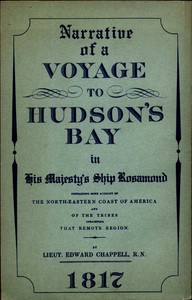
Narrative of a Voyage to Hudson's Bay in His Majesty's Ship Rosamond Containing Some Account of the North-eastern Coast of America and of the Tribes Inhabiting That — Reading Companion
Edition facts
Narrative of a Voyage to Hudson's Bay in His Majesty's Ship Rosamond Containing Some Account of the North-eastern Coast of America and of the Tribes Inhabiting That — Reading Companion can be approached with a clearer sense of reading commitment from its source measurements: 48,616 words, 3 hr 32 min estimated reading time, and 7 detected text sections.
The text analysis averages about 20.1 words per sentence, while the detected sections provide another way to judge how the source is divided.
Project Gutenberg metadata also associates the work with “Northwest, Canadian -- Description and travel,” connecting these edition facts with the source record’s subject description.
Calculated from edition completeness, EPUB availability, text structure and catalogue metadata. Not a user rating.
How this score is calculated
- Description quality20 pts
- Title & short description10 pts
- Source metadata20 pts
- Text length15 pts
- Chapters / structure15 pts
- EPUB file integrity20 pts
Total of 100 points, scaled to a 2.5-5.0 range. Editions with an empty description or a missing EPUB file are not scored.
Read the Text
ands, they finished this affecting ceremony by extending both arms, to their full extent, towards the right side, pointing their snow-white gloves towards the sky. They continued to repeat the same motions without the least variation, until we began to pull away from the shore; when they ceased entirely, and retired into the crowd of natives, who had stood behind the three girls during the foregoing exhibition, and, in profound silence, appeared to be watching every motion. Never had we seen a more interesting spectacle: the young _Esquimaux_ kept the most exact time with each other, and accompanied their gestures by the most graceful motion of their heads; their eyes bespeaking, at the same time, the most tender solicitude for our safety. It is not a trifling matter that can agitate, even for a moment, the rough feelings of a seaman; yet the crews of our boats sat, during this scene, in mute astonishment, with their mouths wide open; and at last, with the utmost reluctance, we tore ourselves away.
Unlike the generality of savage nations, this people did not exhibit any dances peculiar to themselves: the only instance that we observed, to prove they have an idea of dancing, was on board the ship; here a young girl threw one leg out, and then another, alternately, for some time; when, stopping suddenly, she shut her eyes, and, holding her head down, fell to moaning and howling, as if in great pain: next followed a convulsive gurgling in the throat, and deep-drawn sighs; then gradually opening her eyes, and relaxing her features into a smile, she repeated the whole over again.
It is a curious fact, that the inland or hunting tribes of _Indians_ in _Hudson’s Bay_ believe the _Esquimaux_ to be a nation of sorcerers. Should the season prove a bad one in procuring their furs, they say that the _Esquimaux_ have enchanted the game; and they then set off to the northward, to punish them accordingly. Whenever they discover the tents of the supposed magicians, they remain lurking about the place until a favourable opportunity offers; when, raising the dreadful war-whoop, they rush on to the attack with inconceivable fury. Every individual of the vanquished is instantly massacred, whether they make resistance, or implore for mercy. The animosity between them is hereditary, bloody, and implacable.
When Mr. _Hearne_ travelled to the N. W. in search of the long-sought passage to the _Southern Ocean_, he was escorted by a party of _Cree Indians_, and was himself an eye-witness of the massacre of an _Esquimaux_ tribe; although he used his most earnest entreaties with his conductors, to spare an innocent-looking young girl who had supplicated his protection: the _Indians_ frowned furiously upon him; and asking, with haughty contempt, _if he wanted an Esquimaux wife_, they speared her to death on the spot[17].
It is rather remarkable, that the habitations of the _Esquimaux_ had never before been visited by the officers of the _Hudson’s-Bay_ ships, although they had often landed in the Straits: but this may be explained in two ways. In the first place, the _Esquimaux_ are evidently anxious to conceal their places of abode; secondly, the commanders of the _Hudson’s-Bay_ ships have directions from the Company not to go on shore amongst the _Esquimaux_ themselves, nor to send their boats; and they have orders also to be continually on their guard, in all communications with this people. Possibly these orders have been issued since the horrid termination of an attempt to establish a permanent white whale fishery at _Richmond_; and probably that circumstance may have given rise to the regulation. I shall relate the dreadful story in the sequel, when I reach that part of my Narrative where it will be necessary to give a short description of the factories in _Hudson’s Bay_: it would be considered as too long a digression to insert it at present. We had the good fortune, therefore, to be the first _Europeans_ who, for the last forty years, have visited the habitations of the _Esquimaux_. I have thus been enabled to describe them fully, from my own observations. And there is another point upon which I am able to speak _positively_, although the circumstance did not fall under my own inspection: I allude to the manner of disposing of their dead.
His Majesty’s ship _Brazen_, Captain _Stirling_, in the year 1813, convoyed the _Hudson’s-Bay_ ships into the Bay. Captain _Stirling_ and some of his officers landed in the Straits, but could not find any habitations of the natives: however, in wandering about the hills, they discovered an object of no less curiosity; namely, the dead body of an _Esquimaux_: it was closely wrapt in skins, and laid in a sort of gully between two rocks, as if intended to be defended from the cold winds of the ocean: by the side of the corpse lay the bow and arrows, spears, and harpoon of the deceased; together with a tin pot, containing a few beads and three or four _English_ halfpence: the last articles had evidently been procured by the deceased in traffic with the Company’s ships.
The reason of the body having been laid on the surface of the earth, is in consequence of the impossibility of penetrating the flinty rock, of which the whole coast is composed; and the custom of depositing his arms by the side of the corpse of a deceased _Indian_, is common to many barbarous nations.[18]
As it may be expected that something should be said respecting the government and religion of the _Esquimaux_, I shall briefly state, that they did not appear to me to trouble their heads with either. They certainly paid great respect to the old man who sang to us the song before mentioned; but it does not necessarily follow that he was either a prince or a priest. It is probable that they venerated him more on account of his age, than from any civil or ecclesiastical authority with which he was invested. But the _Esquimaux_, and all other nations around _Hudson’s Bay_, have a notion of a superior spirit, whom they concur in styling _Manéto_, or _Good Spirit_. It is not known whether the _Esquimaux_ have any idea of an Evil Being; but the _Cree Indians_ imagine that there is a great number of that species, whose sole delight consists in tormenting mankind[19].
With respect to the language of the _Esquimaux_, I have been able to collect a few specimens: and I shall insert, against each word, in what part of the coast each expression was ascertained to be in use, and the authority from whence I derived my information.
Words. Signification. Where used. Authority.
Chymo _Barter._ On the shores of Ascertained by _Hudson’s myself. Straits_. Pillitay _Give me something._ We-we _A white goose._ Wau-ve _An egg._ Muck Mhameek _A knife._ Kippy Swau, beck _A saw._ Muck-tu _A deer._ Twau-ve _Go away—begone._ Tuck-tu _Seal blubber._ Kiack _Canoe._ _Churchill_, and Ascertained by in _Hudson’s one of the most Straits_. respectable Traders belonging to _Churchill Factory_. Omiack _A ship._ Kannau weet ameg _A dart._ Ye meck _Water._ Hennelay _A woman._ Aunay _Far off._ Cob-loo-nak _An Englishman._ _Churchill Factory._ Mai _Good._ Nagga Mai _Not good._ Karrack _Wood._ Peo-me-wonga _I would have._ By the Natives By the _German_ of the Missionary Missionary before mentioned. Settlement. Ak-ka-karor _It shall have mapock payment._
Having given a short account of the _Esquimaux_, their manners, and customs, I may now proceed with my Journal as before; and content myself with making a few cursory remarks, as we sail along.
August _1st_.—The whole of this day we continued off _Saddle Back_[20]; as the _Hudson’s-Bay_ ships had some arrangements to make, previous to their final separation, which always takes place off _Mansfield Island_, at the entrance of _Hudson’s Bay_. Towards evening, we began to ply to windward, with a fresh breeze at west. Thermometer 40° in the shade.
August _2d_.—Beating to windward with a strong breeze, in the afternoon we hove-to off _Icy Cove_, about a mile to the westward of two remarkable hills, called the _Virgin’s Paps_, which last lay nine leagues to the westward of _Saddle Back_. On firing a gun and hoisting our colours, we were immediately visited by another party of _Esquimaux_: there was no difference whatever in their appearance from those we had seen before. One of our officers purchased a canoe of a native, for which he paid a kettle, a lance, a saw, and a spoon. Our curiosity was considerably excited, to observe in what manner this man would contrive to reach the shore; and we really entertained serious apprehensions for his safety, when we perceived him stretch himself out upon his belly on another canoe, at the back of the man who used the paddle. He was in this dangerous position conveyed to land, not daring to lift his head, through fear of destroying the equilibrium of the canoe; which did not swim two inches above the surface of the sea.
After night-fall, we were compelled to tack ship about, to avoid a large patch of floating ice.
August _3d_.—We continued plying to windward all this day; and in the evening we had reached _Upper Savage Island_. It lays about twenty-three leagues to the west of _Saddle Back_, in an opening which has never been explored. Thermometer 32° in the sun.
August _4th_.—Towards the evening of this day we had a fair wind, the ship butting her way through immense quantities of ice. Passed by a bluff cape, called _Point Look-out_. This cape is eight leagues to the west of _Upper Savage Island_. We saw a number of _Esquimaux_ following us among the windings of the loose ice. These poor creatures laboured hard to overtake us, hallooing and shouting “_Chymo!_” but we were now exceedingly anxious to get forward, and therefore could not wait for them; at which their disappointment must have been great.
August _5th_.—This morning forcing our way with difficulty through the ocean of ice that surrounded us; at length, being enveloped in a thick fog, and the wind dying away, we lashed our ship to a large piece of ice; and firing three guns as a signal for our convoy to do the same, we were astonished at the effect produced by the cannon, The explosion issued like thunder over the ice; then appeared to roll rumbling back towards the ship; bellowing forth again in tremendous peals. The echo died away in distant reverberation.
Shortly afterwards, we imagined that we could distinguish the sound of voices through the fog: we immediately beat the drum, to point out our situation; and, in a few minutes, we plainly heard the shouting of the _Esquimaux_: they soon came alongside the ship, with the usual expressions of delight. It is really surprising that this people should venture so far from the land, in such frail barks, through a mass of ice which is enough to daunt an _European_, even in a stout-built ship.
The fog clearing away, we cast the ship loose, and endeavoured to force our way forward among the ice; until, from its increasing consolidation, we were again obliged to lash to a large piece of it. This operation is called _grappling_; and it is performed by running the vessel alongside of the piece of ice to which it is intended to make her fast: two men then leap on the ice: the one runs, with a sort of pickaxe, to dig a hole in it, using the precaution to stand with his back to the ship; and the other man follows the first, with a serpent-like iron on his back, having a strong rope affixed to one end of it: this serpent (or ice-anchor, as it is termed) is hooked into the hole on the ice, and the rope is fastened on board the ship. Other ice-anchors and ropes are then hooked to different parts of the piece of ice; and the number of ropes is varied according to the state of the weather. In a gale of wind, we had generally five anchors a-head; and with a moderate breeze, not more than two. The whole manœuvre of grappling is generally accomplished in five minutes; and although the ship be lashed to windward of a clump of ice, yet the action of the wind on a vessel’s masts, yards, &c. turns the ice round, and she will consequently soon be under the lee of it, with water as smooth as a mill-pond.
We were employed this evening in filling our casks from a pool of snow-water on the ice; and our people were highly diverted with running upon it, leaping, playing at foot-ball, and shooting at seals. At length, four of the seamen were so imprudent as to venture on a sort of peninsula which projected from the main body of the ice; when the isthmus instantly gave way, leaving them adrift on a small piece that was barely sufficient to sustain their weight. It was long after night-fall, and with the utmost exertion and difficulty, that we succeeded in getting them safe on board again, by the help of a boat.
August _6th_.—In the middle of the night, the prospect from the ship was one of the most awful and sublime that I ever remember having witnessed, during a life spent entirely upon the ocean: and I regret that no language of mine can give an adequate idea of the grandeur of the scene. As far as the eye could reach, a vast alabaster pavement overspread the surface of the sea, whose dark blue waters could only be seen at intervals, where parts of the pavement appeared to have been convulsively torn up, and heaped upon each other in ruined fragments. The snow-white surface of this immense plain formed a most striking contrast to the deep black clouds of a stormy night; through which, uninterrupted flashes of forky lightning succeeded each other with great rapidity, as if intending, by their fiery glare, to shew to us the horrors of our situation, and then to magnify them by leaving us in utter darkness. Add to this, the reiterated peals of thunder that burst forth, in a thousand roaring echoes, over the surrounding ice; also the heavy plashing of the rain, which poured down in torrents; the distant growling of affrighted bears, the screams of sea-birds, and the loud whistling of the wind;—the whole forming a midnight prospect which I would have gone any distance to see; but having once beheld, never wish to witness again.
In the morning, we were surprised by the appearance of two _Esquimaux_, who had contrived to reach the ship, although we were at least seven leagues from the land, and the ice closely hemming us round on all sides: the Indians had effected their passage by dragging their canoes over the different fields of ice which obstructed their progress. At 4 A.M. we got under sail; as there appeared a possibility of our pushing through, the ice having loosened a little; however, we looked in vain for an opening. The ship running fast, with a fair breeze, struck violently upon a large field, and the shock fairly lifted up her bows. We continued butting through until 8 A.M. when we grappled to a large field of ice, as an impenetrable mass now presented itself on all sides of us: the wind shifted into the N. W. and blew a heavy gale, accompanied by drifts of snow and sleet. We lay in this position all night, closely hemmed in, with five ice-anchors a-head. An inspection being made by the carpenter, he found that the heavy shocks which the ship had received this day had started the ceiling about her bows, and also twelve or fourteen of the trunnels.
August _7th_.—During the whole of this day, we continued closely wedged in by the ice. It blew a hard gale from the west, attended by a heavy fall of snow and sleet. The loose ice was incessantly varying its position: at one time, we were so closely hemmed in as to be hardly able to discern any water; then, suddenly, the ice would again open to a considerable distance. This is easily accounted for; as the light pieces of ice drift much faster before the wind than the heavier masses, which are deeper in the water: it will naturally occur, therefore, that the three ships would alter their position, according to the size of the clump to which they were fastened. The _Eddystone_ was three miles to the east of us last night; and at sunset this evening, she was as far to the west; yet that ship was still grappled to the same piece of ice as before; and, from the coagulated mass which surrounded us, one would have been led to conclude that the relative distance from each other could not have been so easily altered: but it varies according to the depth and solidity of the ice to which the ships are affixed.
August _8th_.—In the forenoon, the snow ceased to fall, and we had a finer day. Latitude, by an observation at noon, 62°. 54′. N. The ice loosened considerably in the course of the day, but not sufficiently for us to get under sail. At night-fall, we lost sight of the _Eddystone_, to the west.
August _9th_.—The day had just began to dawn, when an animal was observed swimming near the ship: we at first conjectured it to be a seal, and accordingly sent a quarter-master over the ice, to knock it on the head, if it attempted to get upon it; but the man was fain to make a rapid retreat, when he discovered the form of a prodigious bear emerging from the water. This enormous creature came close to the ship’s head; and had I been armed with a pistol only, it would have been easy to have dispatched him; but during the time we were all bustling for a musquet, the bear marched up the field of ice. Mr. _Wells_, a young midshipman, and myself, instantly pursued him, by different routes; but the grey of the twilight was favourable to him; and his hide being but a shade or two deeper than the ice itself, he escaped unseen. We afterwards traced his footsteps to the edge of the ice, opposite the spot where he landed, and he must therefore have replunged into the sea from that place. I mention this circumstance to shew in what manner these animals contrive to procure subsistence: they swim, during the night, in the quiet manner now described; and drawing close to a piece of ice, they immediately smell if there be any seals upon the top of it; in which case they ascend gently on the opposite side, and suddenly springing upon the sleeping seal, they instantly tear it in pieces.—As this proved to be a fine day, we drew our seamen out upon the ice, and exercised them by firing at a target. Towards evening the ice began to loosen considerably.
August _10th_.—A fine day; but the ice still close. Wind remains at N. W. During the last twenty-four hours, the _Eddystone_ again appeared in sight; and towards evening, she again neared us considerably. We believed this to be owing to her having got into a southerly current. Our latitude this day was 62°. 50′. N.; and at night-fall the thermometer stood at 28°.
August _11th_.—At 4 A.M. ungrappled, and got under sail, with a fair wind, running a zig-zag course amongst the ice; the ship, at intervals, striking excessively hard. Towards evening, we again grappled to a piece of ice; and, upon inspection, we found several more trunnels started, and the ship much shaken, by her repeated blows. The Admiralty must certainly have been deceived by the _Hudson’s-Bay_ Company, respecting a Voyage to _Hudson’s Bay_; or they certainly would never have sent a ship of war to perform it, without previously strengthening her for the occasion. It is exceedingly dangerous for any ship to attempt a passage through the sea of ice in _Hudson’s Straits_, unless her bows be doubled with oak-plank and heavy blocks of wood, bolted to each side of her cutwater; as the floating masses of ice may be considered so many _rocks of crystal_.
This day, in a vacancy between the ice, we saw the first regular whale. On his second rising to blow, I discharged a load of small shot into his back; at which, however, he did not even seem to feel the least annoyance, though we saw him no more.
Edward Chappell's narrative proceeds in a deliberately plain, reportorial style, yet its voice shifts markedly when recounting encounters with Indigenous peoples. The journal's opening dedication and advertisement establish a frame of scientific curiosity—the author's collection of artifacts prompted questions from a Cambridge scholar—but the text soon reveals a tension between detached observation and moral unease.
Chappell's prose is most vivid in practical descriptions of geography and resources, such as the white whale fishery at Churchill Factory. However, when he reaches the account of Richmond Bay, the pace slows and the tone darkens, as he relates a series of violent episodes between European settlers and the Esquimaux. The narrative here becomes more hesitant, marked by phrases like "it is not easy to determine" and "I hope they will be able hereafter to reconcile the deed to God."
A Voice of Measured Detachment
Chappell's narrative voice is consistently that of a naval officer reporting facts. He describes the white whale fishery with clinical brevity: "The fish itself is perfectly white. There is also a small whale fishery at Churchill Factory, but it is not very productive." This plainness extends to his account of the Richmond Bay settlement, where he notes that the Esquimaux "kept them in a continual state of alarm all the winter, by lurking about the woods, in their sledges drawn by dogs." The syntax is straightforward, almost paratactic, with little embellishment. Yet this very flatness creates a contrast when the narrative shifts to moral reflection. Chappell does not editorialize during the action; he saves his qualifiers for after the fact, as when he writes that the settlers "shot the poor maniac in cold blood, without having given themselves the trouble to ascertain whether he were really guilty or innocent." The word "poor" appears twice in close succession, a rare emotional marker that stands out against the otherwise neutral tone.
Shifts in Pace and Moral Weight
The pacing of the Richmond Bay episode is notably uneven. Chappell begins with a rapid sequence of events: the missing boy, the seizure of two Esquimaux, the stratagem of a mock execution, the escape of one prisoner. Sentences are short and action-driven: "A musket was discharged in a remote apartment; and the settlers entering the room... they informed him, by signs, that his comrade had been put to death." Then, abruptly, the narrative slows as Chappell describes the second prisoner's descent into madness: "either the loss of liberty... deprived the poor wretch of reason." The pace becomes deliberative, almost hesitant, as Chappell weighs the settlers' motives: "Possessing only the plain leading facts of this affair, it is not easy to determine how far existing circumstances might have justified such an act of severity." This shift from brisk chronicle to cautious moral assessment is a distinctive structural feature of the journal.
Recurring Details of Colonial Friction
Throughout the excerpts, Chappell returns to specific, concrete details that illuminate the friction between Europeans and Indigenous peoples. The Esquimaux are described using sledges drawn by dogs, a detail that recurs in the context of surveillance: "lurking about the woods, in their sledges drawn by dogs." The settlers' use of a musket shot as a deceptive signal—"a musket was discharged in a remote apartment"—is another recurring motif, emphasizing the role of firearms in both communication and intimidation. Chappell also notes the seasonal pattern of Indigenous visits: "the northern or Hunting Indians, who had visited Richmond in pursuit of game, came, as usual, to barter their furs." This cyclical movement contrasts with the settlers' attempts at permanent occupation, a tension that underlies the entire Richmond Bay episode. The detail that the bodies of some settlers "were afterwards found; although it be by no means certain that they were killed by the Esquimaux" shows Chappell's reluctance to assign blame without evidence.
Readers should attend to the way Chappell's language oscillates between the impersonal and the morally engaged. His journal is not a seamless adventure narrative but a document that registers its own uncertainties. The shifts in pace—from brisk factual reporting to slow, troubled reflection—offer a window into the author's struggle to reconcile his duty as a naval officer with his unease at the violence he records. This tension makes the work a revealing, if unsettling, account of early nineteenth-century colonial encounter.
That Chappell journal stayed with me—the way he records harsh encounters so plainly, as if the cold itself had entered his voice. It reminded me of another travel account I once loved, A thousand miles up the Nile — Story, Setting & Ideas, which lingers for similar reasons: a traveler’s calm observations slowly revealing something darker beneath the journey’s surface.
Grace Carter
1 month agoAria Hernandez
2 weeks agoAlexander Smith
2 weeks ago-
Jason Catherine Mccarthy - 1 month ago
It's an interesting historical document, offering a unique perspective on the region's geography and inhabitants. However, the narrative can be quite dry in places, and the author's cultural biases are evident. Still, for those seeking primary source material on the period, this is a valuable resource. -
Betty Stephen Henderson - 3 weeks ago
The book fails to deliver a compelling narrative, often getting bogged down in mundane details of ship logistics and weather patterns. The author's superiority complex toward indigenous tribes is off-putting and detracts from the historical value. A tedious read for anyone not specifically researching this obscure voyage. -
Anthony Martinez - 2 weeks ago
A fascinating firsthand account of early 19th-century maritime exploration. The author's vivid descriptions of the harsh Arctic conditions and the indigenous peoples of the North American coast are both informative and deeply evocative. This is a must-read for anyone interested in naval history, exploration, or the early encounters between Europeans and Native American tribes.
What was your reading experience?
Capture what you thought, learned, and would like to remember.
Jack Harris
2 weeks ago