A thousand miles up the Nile — Story, Setting & Ideas

(6 User reviews)   1863
In Category - Geography
Edwards, Amelia B., 1831-1892 Project Gutenberg 2023 Not confirmed
Egypt -- Description and travel; Nile River -- Description and travel; Egypt -- History -- 19th century Readers of public-domain and historical texts
Project Gutenberg digital edition en

Edition facts

Words 193,903
Reading time 844 min
Text sections 19

The source record for A thousand miles up the Nile — Story, Setting & Ideas measures this digital text at 193,903 words, 14 hr 4 min estimated reading time, and 19 detected text sections.

The text analysis averages about 23.0 words per sentence, while the detected sections provide another way to judge how the source is divided.

Project Gutenberg metadata also associates the work with “Egypt -- Description and travel,” connecting these edition facts with the source record’s subject description.

Amelia B. Edwards's 1877 travelogue combines precise observation of Egyptian ruins with practical advice for Nile voyagers, contrasting the grandeur of ancient sculpture with the discomforts of sand-slopes and steamer wrecks.
Share
Editorial Edition Score 4.9/5

Calculated from edition completeness, EPUB availability, text structure and catalogue metadata. Not a user rating.

How this score is calculated
  • Description quality20 pts
  • Title & short description10 pts
  • Source metadata20 pts
  • Text length15 pts
  • Chapters / structure15 pts
  • EPUB file integrity20 pts

Total of 100 points, scaled to a 2.5-5.0 range. Editions with an empty description or a missing EPUB file are not scored.

Edition quality

Read the Text

Arrival at Cairo--Shepheard’s Hotel--The Moskee--The Khan Khaleel--The Bazaars--Dahabeeyahs--Ghîzeh--The Pyramids 1

CAIRO AND THE MECCA PILGRIMAGE.

The Mosque of Sultan Hassan--Moslems at Prayer--Mosque of Mehemet Ali--View from the Platform--Departure of the Caravan for Mecca--The Báb en-Nasr--The Procession--The Mahmal--Howling Dervishes--The Mosque of Amr--The Shubra Road 15

Departure for the Nile Voyage--Farewell to Cairo--Turra--The Philæ and crew--The Dahabeeyah and the Nile Sailor--Native Music--Bedreshayn 32

SAKKARAH AND MEMPHIS.

The Palms of Memphis--Three Groups of Pyramids--The M. B.’s and Their Groom--Relic-hunting--The Pyramid of Ouenephes--The Serapeum--A Royal Raid--The Tomb of Ti--The Fallen Colossus--Memphis 43

BEDRESHAYN TO MINIEH.

The Rule of the Nile--The Shâdûf--Beni Suêf--Thieves by Night--The Chief of the Guards--A Sand-storm--“Holy Sheik Cotton”--The Convent of the Pulley--A Copt--The Shadow of the World--Minieh--A Native Market--Prices of Provisions--The Dôm Palm--Fortune-telling--Ophthalmia 65

Christmas Day--The Party Completed--Christmas Dinner on the Nile--A Fantasia--Noah’s Ark--Birds of Egypt--Gebel Abufayda--Unknown Stelæ--Imprisoned--The Scarab-beetle--Manfalût--Siût--Red and Black Pottery--Ancient Tombs--View Over the Plain--Biblical Legend 83

An “Experienced Surgeon”--Passing Scenery--Girgeh--Sheik Selîm--Kasr es Syad--Forced Labor--Temple of Denderah--Cleopatra--Benighted 99

Luxor--Donkey-boys--Topography of Ancient Thebes--Pylons of Luxor--Poem of Pentaur--The Solitary Obelisk--Interior of the Temple of Luxor--Polite Postmaster--Ride to Karnak--Great Temple of Karnak--The Hypostyle Hall--A World of Ruins 121

A Storm on the Nile--Erment--A Gentlemanly Bey--Esneh--A Buried Temple--A Long Day’s Sketching--Salame the Chivalrous--Remarkable Coin--Antichi--The Fellâh--The Pylons of Edfu--An Exciting Race--The Philæ Wins by a Length 140

ASSUAN AND ELEPHANTINE.

Assûan--Strange Wares for Sale--Madame Nubia--Castor Oil--The Black Governor--An Enormous Blunder--Tannhäuser in Egypt--Elephantine--Inscribed Potsherds--Bazaar of Assûan--The Camel--A Ride in the Desert--The Obelisk of the Quarry--A Death in the Town 157

THE CATARACT AND THE DESERT.

Scenery of the Cataract--The Sheik of the Cataract--Vexatious Delays--The Painter’s Vocabulary--Mahatta--Ancient Bed of the Nile--Abyssinian Caravan 176

Pharaoh’s Bed--The Temples--Champollion’s Discovery--The Painted Columns--Coptic Philæ--Philæ and Desaix--Chamber of Osiris--Inscribed Rock--View from the Roof of the Temple 188

Nubian Scenery--A Sand-slope--Missing Yûsef--Trading by the Way--Panoramic Views--Volcanic Cones--Dakkeh--Korosko--Letters from Home 211

KOROSKO TO ABOU SIMBEL.

El-Id el-Kebîr--Stalking Wild Ducks--Temple of Amada--Fine Art of the Thothmes--Derr--A Native Funeral--Temple of Derr--The “Fair” Families--The Sakkieh--Arrival at Abou Simbel by Moonlight 220

Youth of Rameses the Great--Treaty with the Kheta--His Wives--His Great Works--The Captivity--Pithom and Rameses--Kauiser and Keniamon--The Birth of Moses--Tomb of Osymandias--Character of Rameses the Great 236

The Colossi--Portraits of Rameses the Great--The Great Sand-drift--The Smaller Temples--“Rameses and Nefertari”--The Great Temple--A Monster Tableau--Alone in the Great Temple--Trail of a Crocodile--Cleaning the Colossus--The Sufferings of the Sketcher 258

Volcanic Mountains--Kalat Adda--Gebel est-Shems--The First Crocodile--Dull Scenery--Wady Halfeh--The Rock of Abusîr--The Second Cataract--The Great View--Crocodile-slaying--Excavating a Tumulus--Comforts of Home on the Nile 283

DISCOVERIES AT ABOU SIMBEL.

Society at Abou Simbel--The Painter Discovers a Rock-cut Chamber--Sunday Employment--Re-enforcement of Natives--Excavation--The Sheik--Discovery of Human Remains--Discovery of Pylon and Staircase--Decorations of Painted Chamber--Inscriptions 295

Temples _ad infinitum_--Tosko--Crocodiles--Derr and Amada Again--Wady Sabooah--Haughty Beauty--A Nameless City--A River of Sand--Undiscovered Temple--Maharrakeh--Dakkeh--Fortress of Kobban--Gerf Hossayn--Dendoor--Bayt-et-Welly--The Karnak of Nubia--Silco of the Ethiopians--Tafah--Dabôd--Baby-shooting--A Dilemma--Justice in Egypt--The Last of Philæ 324

Shooting the Cataract--Kom Ombo--Quarries of Silsilis--Edfu the Most Perfect of Egyptian Temples--View from the Pylons--Sand Columns 353

Luxor Again--Imitation “Anteekahs”--Digging for Mummies--Tombs of Thebes--The Ramesseum--The Granite Colossus--Medinet Habu--The Pavilion of Rameses III--The Great Chronicle--An Arab Story-teller--Gournah--Bab el Molûk--The Shadowless Valley of Death--The Tombs of the Kings--Stolen Goods--The French House--An Arab Dinner and Fantasia--The Coptic Church at Luxor--A Coptic Service--A Coptic Bishop 370

Last Weeks on the Nile--Spring in Egypt--Ninety-nine in the Shade--Samata--Unbroken Donkeys--The Plain of Abydus--Harvest-time--A Biblical Idyll--Arabat the Buried--Mena--Origin of the Egyptian People--Temple of Seti--New Tablet of Abydus--Abydus and Teni--Kom-es-Sultan--Visit to a Native Aga--The Hareem--Condition of Women in Egypt--Back at Cairo--“In the Name of the Prophet, Cakes!”--The Môlid-en-Nebee--A Human Causeway--The Boulak Museum--Prince Ra-hotep and Princess Nefer-t--Early Drive to Ghîzeh--Ascent of the Great Pyramid--The Sphinx--The View from the Top--The End 421

I. A. McCallum, Esq., to the Editor of _The Times_ 447

II. The Egyptian Pantheon 447

III. The Religious Belief of the Egyptians 450

IV. Egyptian Chronology 452

V. Contemporary Chronology of Egypt, Mesopotamia and Babylon 454

LIST OF ILLUSTRATIONS.

The Secret of the Sphinx. After a Painting by Elihu Vedder, Esq. x

Shrines of Osiris, 1, 2 and 3 205-206

Resurrection of Osiris 207

Cartouches of Rameses the Great 237

Rameses the Great (Bayt-el-Welly) 260

Rameses the Great (Abydus) 260

Rameses the Great (Abou Simbel) 260

Profile of Rameses II (from the Southernmost Colossus; Abou Simbel) 261

Pattern of Cornice 308

Standard of Horus Aroëris 309

Rameses II of Speos 311

Temple of Amada (Wall Inscription) 313

Heraldic Inscription (North Wall of Speos) 317

Goddess Ta-ur-t (Silsilis) 359

Goddess Ta-ur-t (Philæ) 359

Vases and Goblets (Medinet Habu) 385

Prince Ra-Hotep and Princess Nefer-t 439

A THOUSAND MILES UP THE NILE.

CAIRO AND THE GREAT PYRAMID.

It is the traveler’s lot to dine at many table-d’hôtes in the course of many wanderings; but it seldom befalls him to make one of a more miscellaneous gathering than that which overfills the great dining-room at Shepheard’s Hotel in Cairo during the beginning and height of the regular Egyptian season. Here assemble daily some two to three hundred persons of all ranks, nationalities, and pursuits; half of whom are Anglo-Indians homeward or outward bound, European residents, or visitors established in Cairo for the winter. The other half, it may be taken for granted, are going up the Nile. So composite and incongruous is this body of Nile-goers, young and old, well-dressed and ill-dressed, learned and unlearned, that the new-comer’s first impulse is to inquire from what motives so many persons of dissimilar tastes and training can be led to embark upon an expedition which is, to say the least of it, very tedious, very costly, and of an altogether exceptional interest.

His curiosity, however, is soon gratified. Before two days are over, he knows everybody’s name and everybody’s business; distinguishes at first sight between a Cook’s tourist and an independent traveler; and has discovered that nine-tenths of those whom he is likely to meet up the river are English or American. The rest will be mostly German, with a sprinkling of Belgian and French. So far _en bloc_; but the details are more heterogeneous still. Here are invalids in search of health; artists in search of subjects; sportsmen keen upon crocodiles; statesmen out for a holiday; special correspondents alert for gossip; collectors on the scent of papyri and mummies; men of science with only scientific ends in view; and the usual surplus of idlers who travel for the mere love of travel or the satisfaction of a purposeless curiosity.

Now in a place like Shepheard’s, where every fresh arrival has the honor of contributing, for at least a few minutes, to the general entertainment, the first appearance of L---- and the writer, tired, dusty, and considerably sunburned, may well have given rise to some of the comments in usual circulation at those crowded tables. People asked each other, most likely, where these two wandering Englishwomen had come from; why they had not dressed for dinner; what brought them to Egypt; and if they also were going up the Nile--to which questions it would have been easy to give satisfactory answers.

We came from Alexandria, having had a rough passage from Brindisi, followed by forty-eight hours of quarantine. We had not dressed for dinner because, having driven on from the station in advance of dragoman and luggage, we were but just in time to take seats with the rest. We intended, of course, to go up the Nile; and had any one ventured to inquire in so many words what brought us to Egypt, we should have replied: “Stress of weather.”

For in simple truth we had drifted hither by accident, with no excuse of health, or business, or any serious object whatever; and had just taken refuge in Egypt as one might turn aside into the Burlington Arcade or the Passage des Panoramas--to get out of the rain.

And with good reason. Having left home early in September for a few weeks’ sketching in central France, we had been pursued by the wettest of wet weather. Washed out of the hill country, we fared no better in the plains. At Nismes it poured for a month without stopping. Debating at last whether it were better to take our wet umbrellas back at once to England, or push on farther still in search of sunshine, the talk fell upon Algiers--Malta--Cairo; and Cairo carried it. Never was distant expedition entered upon with less premeditation! The thing was no sooner decided than we were gone. Nice, Genoa, Bologna, Ancona flitted by, as in a dream; and Bedreddin Hassan when he awoke at the gates of Damascus was scarcely more surprised than the writer of these pages when she found herself on board of the Simla and steaming out of the port of Brindisi.

Here, then, without definite plans, outfit, or any kind of oriental experience, behold us arrived in Cairo on the 29th of November, 1873, literally, and most prosaically, in search of fine weather.

But what had memory to do with rains on land, or storms at sea, or the impatient hours of quarantine, or anything dismal or disagreeable, when one awoke at sunrise to see those gray-green palms outside the window solemnly bowing their plumed heads toward each other, against a rose-colored dawn? It was dark last night, and I had no idea that my room overlooked an enchanted garden, far-reaching and solitary, peopled with stately giants beneath whose tufted crowns hung rich clusters of maroon and amber dates. It was a still, warm morning. Grave gray and black crows flew heavily from tree to tree, or perched, cawing meditatively, upon the topmost branches. Yonder, between the pillared stems, rose the minaret of a very distant mosque; and here, where the garden was bounded by a high wall and a windowless house, I saw a veiled lady walking on the terraced roof in the midst of a cloud of pigeons. Nothing could be more simple than the scene and its accessories; nothing, at the same time, more eastern, strange, and unreal.

But in order thoroughly to enjoy an overwhelming, ineffaceable first impression of oriental out-of-door life one should begin in Cairo with a day in the native bazaars; neither buying, nor sketching, nor seeking information, but just taking in scene after scene, with its manifold combinations of light and shade, color, costume, and architectural detail. Every shop front, every street corner, every turbaned group is a ready-made picture. The old Turk who sets up his cake stall in the recess of a sculptured doorway; the donkey boy, with his gayly caparisoned ass, waiting for customers; the beggar asleep on the steps of the mosque; the veiled woman filling her water jar at the public fountain--they all look as if they had been put there expressly to be painted.

Nor is the background less picturesque than the figures. The houses are high and narrow. The upper stories project; and from these again jut windows of delicate turned lattice work in old brown wood, like big bird-cages. The street is roofed in overhead with long rafters and pieces of matting, through which a dusty sunbeam straggles here and there, casting patches of light upon the moving crowd. The unpaved thoroughfare--a mere narrow lane, full of ruts and watered profusely twice or thrice a day--is lined with little wooden shop fronts, like open cabinets full of shelves, where the merchants sit cross-legged in the midst of their goods, looking out at the passers-by and smoking in silence. Meanwhile, the crowd ebbs and flows unceasingly--a noisy, changing, restless, party-colored tide, half European, half oriental, on foot, on horseback, and in carriages. Here are Syrian dragomans in baggy trousers and braided jackets; barefooted Egyptian fellaheen in ragged blue shirts and felt skull-caps; Greeks in absurdly stiff white tunics, like walking pen-wipers; Persians with high miter-like caps of dark woven stuff; swarthy Bedouins in flowing garments, creamy-white, with chocolate stripes a foot wide, and head-shawl of the same bound about the brow with a fillet of twisted camel’s hair; Englishmen in palm-leaf hats and knickerbockers, dangling their long legs across almost invisible donkeys; native women of the poorer class, in black veils that leave only the eyes uncovered, and long trailing garments of dark blue and black striped cotton; dervishes in patchwork coats, their matted hair streaming from under fantastic head-dresses; blue-black Abyssinians with incredibly slender, bowed legs, like attenuated ebony balustrades; Armenian priests, looking exactly like Portia as the doctor, in long black gowns and high square caps; majestic ghosts of Algerine Arabs, all in white; mounted Janissaries with jingling sabers and gold-embroidered jackets; merchants, beggars, soldiers, boatmen, laborers, workmen, in every variety of costume, and of every shade of complexion from fair to dark, from tawny to copper-color, from deepest bronze to bluest black.

Now a water-carrier goes by, bending under the weight of his newly replenished goatskin, the legs of which being tied up, the neck fitted with a brass cock, and the hair left on, looks horribly bloated and life-like. Now comes a sweetmeat-vender with a tray of that gummy compound known to English children as “lumps of delight”; and now an Egyptian lady on a large gray donkey led by a servant with a showy saber at his side. The lady wears a rose-colored silk dress and white veil, besides a black silk outer garment, which, being cloak, hood, and veil all in one, fills out with the wind as she rides, like a balloon. She sits astride; her naked feet, in their violet velvet slippers, just resting on the stirrups. She takes care to display a plump brown arm laden with massive gold bracelets, and, to judge by the way in which she uses a pair of liquid black eyes, would not be sorry to let her face be seen also. Nor is the steed less well dressed than his mistress. His close-shaven legs and hindquarters are painted in blue and white zigzags picked out with bands of pale yellow; his high-pommeled saddle is resplendent with velvet and embroidery; and his head-gear is all tags, tassels, and fringes. Such a donkey as this is worth from sixty to a hundred pounds sterling. Next passes an open barouche full of laughing Englishwomen; or a grave provincial sheik all in black, riding a handsome bay Arab, _demi-sang_; or an Egyptian gentleman in European dress and Turkish fez, driven by an English groom in an English phaeton. Before him, wand in hand, bare-legged, eager-eyed, in Greek skull-cap and gorgeous gold-embroidered waistcoat and fluttering white tunic, flies a native saïs, or running footman. No person of position drives in Cairo without one or two of these attendants. The saïs (strong, light and beautiful, like John of Bologna’s Mercury) are said to die young. The pace kills them. Next passes a lemonade-seller, with his tin jar in one hand and his decanter and brass cups in the other; or an itinerant slipper-vender with a bunch of red and yellow morocco shoes dangling at the end of a long pole; or a London-built miniature brougham containing two ladies in transparent Turkish veils, preceded by a Nubian outrider in semi-military livery; or, perhaps, a train of camels, ill-tempered and supercilious, craning their scrannel necks above the crowd, and laden with canvas bales scrawled over with Arabic addresses.

But the Egyptian, Arab and Turkish merchants, whether mingling in the general tide or sitting on their counters, are the most picturesque personages in all this busy scene. They wear ample turbans, for the most part white; long vests of striped Syrian silk reaching to the feet; and an outer robe of braided cloth or cashmere. The vest is confined round the waist by a rich sash; and the outer robe, or _gibbeh_, is generally of some beautiful degraded color, such as maize, mulberry, olive, peach, sea-green, salmon-pink, sienna-brown, and the like. That these stately beings should vulgarly buy and sell, instead of reposing all their lives on luxurious divans and being waited upon by beautiful Circassians, seems altogether contrary to the eternal fitness of things. Here, for instance, is a grand vizier in a gorgeous white and amber satin vest, who condescends to retail pipe-bowls--dull red clay pipe-bowls of all sizes and prices. He sells nothing else, and has not only a pile of them on the counter, but a binful at the back of his shop. They are made at Siout, in Upper Egypt, and may be bought at the Algerine shops in London almost as cheaply as in Cairo. Another majestic pasha deals in brass and copper vessels, drinking-cups, basins, ewers, trays, incense-burners, chafing-dishes, and the like; some of which are exquisitely engraved with arabesque patterns or sentences from the poets. A third sells silks from the looms of Lebanon and gold and silver tissues from Damascus. Others, again, sell old arms, old porcelian, old embroideries, second-hand prayer-carpets, and quaint little stools and cabinets of ebony inlaid with mother-of-pearl. Here, too, the tobacco merchant sits behind a huge cake of latakia as big as his own body; and the sponge merchant smokes his long chibouk in a bower of sponges.

Most amusing of all, however, are those bazaars in which each trade occupies its separate quarter. You pass through an old stone gateway or down a narrow turning, and find yourself amid a colony of saddlers, stitching, hammering, punching, riveting. You walk up one alley and down another, between shop fronts hung round with tasseled head-gear and hump-backed saddles of all qualities and colors. Here are ladies’ saddles, military saddles, donkey saddles, and saddles for great officers of state; saddles covered with red leather, with crimson and violet velvet, with maroon, and gray, and purple cloth; saddles embroidered with gold and silver, studded with brass-headed nails, or trimmed with braid.

Another turn or two, and you are in the slipper bazaar, walking down avenues of red and yellow morocco slippers; the former of home manufacture, the latter from Tunis. Here are slippers with pointed toes, turned-up toes, and toes as round and flat as horseshoes; walking slippers with thick soles, and soft yellow slippers to be worn as inside socks, which have no soles at all. These absurd little scarlet bluchers with tassels are for little boys; the brown morocco shoes are for grooms; the velvet slippers embroidered with gold and beads and seed pearls are for wealthy hareens, and are sold at prices varying from five shillings to five pounds the pair.

The carpet bazaar is of considerable extent, and consists of a network of alleys and counter-alleys opening off to the right of the Muski, which is the Regent street of Cairo. The houses in most of these alleys are rich in antique lattice windows and Saracenic doorways. One little square is tapestried all round with Persian and Syrian rugs, Damascus saddle-bags, and Turkish prayer-carpets. The merchants sit and smoke in the midst of their goods; and up in one corner an old “kahwagee,” or coffee-seller, plies his humble trade. He has set up his little stove and hanging-shelf beside the doorway of a dilapidated khan, the walls of which are faced with arabesque panelings in old carved stone. It is one of the most picturesque “bits” in Cairo. The striped carpets of Tunis; the dim gray and blue, or gray and red fabrics of Algiers; the shaggy rugs of Laodicea and Smyrna; the rich blues and greens and subdued reds of Turkey; and the wonderfully varied, harmonious patterns of Persia, have each their local habitation in the neighboring alleys. One is never tired of traversing these half-lighted avenues all aglow with gorgeous color and peopled with figures that come and go like the actors in some Christmas piece of oriental pageantry.

Amelia B. Edwards opens her account of a Nile journey with a wry epigram from Ampère: “A donkey ride and a boating trip interspersed with ruins.” This framing sets the tone for a work that is at once a practical travel guide and a detailed record of archaeological observation. Edwards writes from the perspective of a seasoned traveler, comparing wooden dahabeeyahs to steamers and noting the cost of her own voyage at about £10 per day. Yet the book’s real substance lies in its vivid, analytical descriptions of ancient sites, where she scrutinizes the colossal statues of Abu Simbel with an artist’s eye for proportion and technique.

The Practicalities of Nile Travel

Edwards devotes considerable attention to the logistics of a Nile expedition, weighing the merits of different vessels. She observes that iron dahabeeyahs often run aground and that steamers frequently wreck—she counted three wrecks between Cairo and the first cataract. Her preference is for the old-fashioned wooden dahabeeyah, flat-bottomed and easily poled off sandbanks. She likens the choice between dahabeeyah and steamer to that between post-horses and rail travel: one is “expensive, leisurely, delightful”; the other “cheap, swift, and comparatively comfortless.” Climate also features: December and January are cool, even cold; Nubia’s climate is “simply perfect,” though cold north winds can chill the air near Abu Simbel. These details ground the narrative in the physical realities of 1870s travel.

The Colossi of Abu Simbel: A Study in Scale and Technique

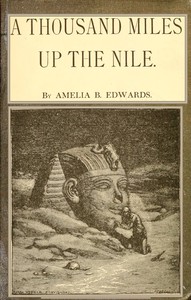
Edwards’s description of the four seated colossi at Abu Simbel is the most sustained piece of art criticism in the excerpts. She notes that the southernmost statue is the only nearly perfect one, and that its face can be correctly seen from only one point—a steep, loose sand-slope that “more disagreeable climbing it would be hard to find.” From below, the face is foreshortened; the British Museum cast, she complains, is “cooped up at the end of a narrow corridor” and shown to “the greatest possible disadvantage.” The ancient artists, by contrast, were “embarrassed by no difficulties of focus.” They carved the mountain “as though it were a cherry stone,” hewing out a great hall and fifteen chambers. The statues sit sixty-six feet high; if standing, they would tower eighty-three feet. Edwards analyzes the sculptors’ choices: the heads are finished in detail, but the trunks and limbs are treated decoratively, with “breadth, massiveness, and repose.” The knee joints, calf muscles, and toe-nails are indicated broadly; the fingers, visible only from below, are treated en bloc. Even the dimples at the corners of the mouth are “circular cavities as large as saucers.”

Contrasts: Ancient Mastery vs. Modern Discomfort

Throughout the excerpts, Edwards sets the sublime achievements of ancient Egyptian artists against the petty hardships of the modern traveler. The sand-slope that must be climbed to see the colossi’s faces is “steep and loose and hot to the feet.” The British Museum display is inept. Yet the ancient sculptors “took a mountain and fell upon it like Titans.” This juxtaposition extends to the journey itself: the Nile traveler endures sandbanks, wrecks, and cold winds, but is rewarded by ruins that inspire awe. Edwards’s tone is wryly practical—she notes the cost of the voyage, the comparative merits of boats—but her prose rises to genuine wonder when describing the statues. The effect is a travelogue that balances the mundane and the monumental, never losing sight of the physical effort required to see these wonders.

Readers approaching A Thousand Miles Up the Nile should expect a hybrid work: part practical handbook for the Victorian traveler, part meticulous record of archaeological observation. Edwards’s voice is that of a knowledgeable, opinionated guide who does not hesitate to criticize museum displays or praise ancient craftsmanship. The book rewards those who read slowly, attending to her descriptions of scale, technique, and the physical sensations of climbing sand-slopes or enduring cold winds. It is a document of a particular moment in travel history, when the Nile was still navigated by sail and pole, and the ruins were less crowded than they are today.

Reading A Thousand Miles Up the Nile, I kept thinking how Edwards’s patient eye caught both the awe of Karnak and the grit of a broken sandal. That same mix of wonder and everyday discomfort seems to linger in Sinners and Saints A Tour Across the States and Round Them, with Three Months Among the Mormons — Text and Context, where grand landscapes and querulous fellow travelers sit side by side, just as they always do when we truly travel.

Samuel Lee
1 month ago

Wyatt Robinson
2 weeks ago

Harper Martinez
3 weeks ago

Evelyn Davis
3 weeks ago

Henry Lopez
3 weeks ago

5
5 out of 5 (6 User reviews )

Add a Review

Your Rating *
  • ...
    Kelly Flores - 1 month ago
    {'review_type': 'negative', 'content': "While 'A Thousand Miles Up the Nile' is a significant historical document, modern readers may find Edwards's writing style overly flowery and subjective. The narrative often focuses on her personal impressions rather than objective facts, leaving the reader wanting more substantive historical or archaeological detail. It's a product of its time but doesn't hold up as well today."}

  • ...
    Mary Miller - 1 month ago
    {'review_type': 'positive', 'content': "Amelia Edwards's 'A Thousand Miles Up the Nile' is a masterpiece of Victorian travel writing. Her vivid descriptions of ancient temples, the river's beauty, and the people she encountered bring Egypt to life. It's both historically informative and personally engaging, a true classic that transports you to another time and place."}

  • ...
    Brian Brown - 1 week ago
    {'review_type': 'neutral', 'content': "This is a detailed and engaging account of a journey up the Nile in the 19th century. The author's observations are sharp and the historical context is valuable. However, the prose can be dense and slow-moving at times, and the book would benefit from more illustrations. Still, a worthwhile read for Egypt enthusiasts."}


Reader reflection

Your personal reading reflection

Build a private reading journal entry for this title.

Your progress 0 / 10
1

Have you finished this book?

2

How much did you enjoy the reading experience?

3

Would you pass this book on to a friend?

4

How easy was the book to follow?

Related eBooks