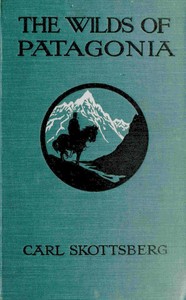
The wilds of Patagonia — A Closer Reading

(2 User reviews)   644
In Category - Geography
Skottsberg, Carl, 1880-1963 Project Gutenberg 2025 Not confirmed
Patagonia (Argentina and Chile) -- Description and travel; Tierra del Fuego (Argentina and Chile) -- Description and travel; Falkland Islands -- Description and travel Readers of public-domain and historical texts
Project Gutenberg digital edition en

Edition facts

Words 109,405
Reading time 476 min
Text sections 28

For The wilds of Patagonia — A Closer Reading, the stored edition analysis reports 109,405 words, 7 hr 56 min estimated reading time, and 28 detected text sections.

The text analysis averages about 22.1 words per sentence, while the detected sections provide another way to judge how the source is divided.

Project Gutenberg metadata also associates the work with “Patagonia (Argentina and Chile) -- Description and travel,” connecting these edition facts with the source record’s subject description.

Carl Skottsberg's 1911 narrative of the Swedish Magellanic Expedition blends botanical and geological observations with vivid accounts of Patagonian landscapes, settlers, and the practical challenges of travel in the early 1900s.
Share
Editorial Edition Score 4.9/5

Calculated from edition completeness, EPUB availability, text structure and catalogue metadata. Not a user rating.

How this score is calculated
  • Description quality20 pts
  • Title & short description10 pts
  • Source metadata20 pts
  • Text length15 pts
  • Chapters / structure15 pts
  • EPUB file integrity20 pts

Total of 100 points, scaled to a 2.5-5.0 range. Editions with an empty description or a missing EPUB file are not scored.

Edition quality

Read the Text

ment was less interested, but we spent most of the time in Chile. I need not repeat this, nor my sincere thanks to the representatives of Sweden. There is, however, one thing that I want specially to mention on the occasion of my book being laid before English readers. We spent part of the time in a British colony, the Falkland Islands, where His Excellency the Governor, Mr. W. L. Allardyce, C.M.G., and Mrs. Allardyce, both deeply interested in scientific work in general as also in our personal welfare, did all they could to promote our success. We are also greatly indebted to the Falkland Islands Company Ltd., to its director in London, Mr. F. E. Cobb, as well as to its representatives in Port Stanley, Mr. W. Harding, Mr. W. C. Girling and Lieutenant Colonel A. Reid, D.S.O. (no longer in the Company’s service). We also owe very much to numerous sheep-farmers, Mr. Allen of Darwin, Messrs. Benney of Saunders Island, Mr. Bertrand of Roy Cove, Dr. Bolus (now in Punta Arenas, then in Fox Bay), Mr. Felton of Westpoint Island, Dr. Foley, of Darwin, Mr. Mathews of Port Howard, Mr. Miller of Hill Cove, Mr. Packe of Port Louis, and many others, too numerous to mention. In Chile as well as in Argentina we met and were assisted by a great number of English people; we made good friends wherever we came, and learnt to admire the English nation as the great civilising power of the world.

It may not be considered unnecessary to mention, that during the whole journey under most trying conditions, I and my comrades remained the same good friends as we had been on leaving Sweden. Nothing is so well calculated to try friendship as a wild life away from culture and from other people. In this case friendship certainly stood the test.

THE COASTS OF THE FALKLAND ISLANDS

We leave Sweden: Visits to Buenos Aires and Montevideo: Arrive at the Falkland Islands: Position: Port Stanley and its Social Life: Communications: The Landscape round the Town: Cape Pembroke Lighthouse and the Forest in the Sea: To the West Falklands: Wild Cattle: The Falkland Fox: Adventure on Fox Island: Life on Remote Islands: Roy Cove and the Tale of a Ship’s Adventure: Westpoint Island: Tussock-grass: Bird Life: The Dead Forest Pp. 1-18

RIDING THROUGH THE FALKLANDS

Hill Cove, a Fine Settlement: Shepherds and their Life: Ascent of Mount Adam: A Nocturnal Excursion: Saunders Island and a Page of History: Valley of the Warrah River: A Dangerous Passage: Port Howard: Across Country to Fox Bay: A miserable Christmas: Notes on Geology: Lafonia and Port Darwin: A Ride to San Carlos: Return Overland to Port Stanley: Port Louis and its History: Departure Pp. 19-31

Punta Arenas: Babylonian Confusion: Preparations: Dawson Island and the Salesian Mission Station: On the Shore of Lake Fagnano: Hardships in the Azopardo Valley: The First Guanaco: We Pitch the Tents at Fagnano: Pagels: The Betbeder Pass and Discoveries South of it: A chilly awakening: Halle’s Excursion to Lake Deseado: Boat Trip on Lake Fagnano: We Raise our Camp: A Difficult Embarking: Back in Punta Arenas Pp. 32-61

OTWAY WATER AND SKYRING WATER

Cape Froward: Jerome Channel: Patagonian Gold Fever: Along the Shores of Otway: Notes on Vegetation: Fitzroy Channel: Storm: A Solitary Hut: Traces of Indians: Excelsior and Glacier Sounds: Gajardo Channel and a Perilous Boat Excursion: _Huemul_ Aground: The Water of Skyring: Fossiliferous Beds: Another Tale of a Mine: A Nocturnal Adventure: Saved Pp. 62-74

THE PATAGONIAN CHANNELS

Preparations: Captain Bordes: Our Indian Interpreter: The Magellan Skärgård: On the Evangelistas Rocks: Unknown Waters: The Patagonian Channels and their Nature: We meet the first Indians: Two Tracks: The Penas Gulf: Baker Inlet: In the unknown Interior of Peel Inlet: Back through Smyth Channel Pp. 75-90

Our first Encounter with Aborigines: Appearance: Visit to an Indian Camp: The Indian Wigwam: Food: Hunting and Weapons: Social Customs: Treatment of the Women: Character: Nomadic Life: Canoes: Travelling: Remarkable Portages: Language: Extermination: Views of the Future Pp. 91-103

CHILOÉ AND THE GULF OF CORCOVADO

Chiloé, Historical Retrospect: Ancud, the Capital: Schools: Power of the Roman Catholic Church: The Chilotes and their Life: A Ride to the Pacific Coast: Pudeto River: Primeval Forest of Chiloé: Castro: Adventurous Voyage to Huafo Island: Forest Scenery: Wild Days: To the Island of San Pedro in the Footsteps of Darwin: Quellon: Corcovado, “el famoso”: The Yelcho Valley Pp. 104-124

IN THE HEART OF CHILE

To the Centre of Chile: Corral and Valdivia: Halle’s Surveys in the Coal-mines of Arauco: Lota: Valparaiso: Santiago and its Swedish Colony: Los Andes: The Uspallata Pass and the Transandine Railway: Aconcagua: Baño del Inca: A Strange Descent: The Great National Festival of Chile: To Port Montt Pp. 125-133

ROBINSON CRUSOE’S ISLAND

The Islands of Juan Fernandez: Discovery and Position: First Impression: Robinson’s “Look-out”: Wonderful Plant World: The Chonta Palm: Marvellous Ferns: Extermination of a Unique Vegetation: The Memorial Tablet of Alexander Selkirk, the real Robinson: The History of the Sandal Tree: The last Sandal Tree: Robinson’s Grotto: Bahia del Padre: Masafuera Island: Topography: Remarkable Plain: Wild Goats: Marvellous Valleys: Our Scientific Results: The Future of the Islands Pp. 134-148

ACROSS THE ANDES INTO ARGENTINA

Plans for the Return South: Notes on the Discoveries in Patagonia: The Boundary Dispute between Chile and Argentina: We leave Port Montt: Osorno and Calbuco Volcanoes: Lake Todos los Santos: On the Glaciers of Mount Tronador: Across the Pass: Snowstorm: Bariloche: Preparations for a Long Journey: Our Caravan and Equipment: On Horseback Pp. 149-166

THROUGH NORTHERN PATAGONIA

First Impression of the Pampas: Our First Camping-place: Norquinco: Half the Caravan Disappears!: Inquiries: Across the River Chubut: Life on the Lelej Farm: A Hearty Welcome: Ostriches and Guanacos: Through the Nahuelpan Pass: 16th October Valley: Notes on Vegetation: Along the Futaleufú River to the Chilean Boundary: South Again: In the Valley of the River Carrenleufú: Another Bankrupt Company and a Swedish Colonist Pp. 167-186

THROUGH THE CORDILLERAS TO THE PACIFIC COAST

Salt Lagoons and Abundant Bird-life: The First “Meseta”: The Cisnes Valley: Excursion to the Forest Region: Tuco-tuco and Patagonian Deer: Senguerr River: No Water: Back in Chile: Lamb-marking: The Coyaike Valley: The Aysen Company: To the Pacific Coast: Luxuriant Rain-forest: Return to Aysen Pp. 187-197

The Swamp of Rio Mayo: Meseta Chalia, an Adventurous Passage: Floating Soil and Tuco-tucos: A Dangerous Descent: The Puma: Valle Koslowsky: A Singular Telegraph Office: The Landscape round Lake Buenos Aires: In the Fenix Valley: Interesting Vegetation: Hunting Young Guanacos: Patagonian Fur-trade: Armadillos: Ruckel’s Peril: Difficulties in the Jeinemeni Valley: Ascent of the Mountain ridge at Zeballos River Pp. 198-220

The Zeballos Pass: Natural Features at Lake Pueyrredon: Troublesome Ascent: In the Tarde Valley: Across to Belgrano River: Unexpected Encounter with German Colonists: Our Sin against the Eighth Commandment: Christmas: We Start on the Lake: Contrary Winds: On the Lake Azara: Glorious Mountain Scenery: A Happy New Year! We strike Camp Pp. 221-238

Across the High Pampas: Crossing the Rivers Belgrano and Lista: The Troublesome Tuco-tuco Rivulet: Through the Forest to Carbon River: The Fósiles Pass, our Worst Day: Lake San Martín: Start with a Berthon Boat: Head Wind: In the Northern Arm: The Schoenmeyr Glacier: Imminent Peril: “Galley-slavery”: Farewell to San Martin Pp. 239-257

ACROSS THE SIERRA DE LOS BAQUALES

The Swamps round Laguna Tar: An Unexpected Encounter: Pavo and the Skunk: On the shores of Lake Viedma: Leona River and a Dead Landscape: With Carlos Fuhr: The Ferry-boat on Santa Cruz River: Visit to Cattle’s Farm: A Lady Gaucho: The Baguales Range: Back to Civilisation!: Notes on the History of South Patagonia Pp. 258-271

Quensel’s Boat Journey in 1908: The Start and Equipment: Squally Weather: Bismarck Glacier, a Splendid Sight: Large Icebergs: With a Canvas Boat in the Ice: To the North Arm: Hell Gate: A Dangerous Landing: A Narrow Escape: Upsala Glacier: Another Clean Shave: Back again with Rich Results Pp. 272-277

OUR JOURNEY TO PUNTA ARENAS

Estancia Payne: Importunate Foxes: Cerro Payne, Patagonia’s most Beautiful Mountain: Quensel’s Excursion in 1907: Cerro Donoso: A Bad Day and a Worse Night: Tame Deer: In the Payne Mountains: The White Stag: A Picnic Party: My Excursion to the Inland Ice: A Heavy March: Ultima Esperanza: The Eberhard Family: The Maylodon Cave: A Night’s Ride: We part with our Horses: Arrival at Punta Arenas Pp. 278-295

Back in the Channels: The Brecknock Pass: Wonderful Glaciers: Lapataia and Lake Acigami: The Mission in Douglas Bay: The Last Yahgans: Notes on Geology: Ushuaia: Bridges’ Farm: Slogget Bay and Gold-digging in Tierra del Fuego: Another Boundary Dispute: Return to Punta Arenas and to Buenos Aires Pp. 296-313

A WINTER TRIP TO SOUTH GEORGIA

We leave on Board the _Cachalote_: Severe Damage of Engines: Adrift on the High Seas: Exciting Situation: The Engines Repaired: Bad Night on the Coast: At Anchor again: Nature and Position of South Georgia: Climate: Flora and Fauna: Winter’s Unexpected Arrival: Along the Coast: Stormy Days: Whaling: A Singular 1st of May: With Escort to Buenos Aires: Return to Sweden Pp. 314-329

LIST OF ILLUSTRATIONS

Carl Skottsberg _Frontispiece_

Typical Landscape in East Falkland with quartzite ridge 10

Mollymawk Rookery, West Point Island 16

Penguin Rookery (Eudyptes), West Point Island 16

The Great Stone-run South of Port Louis, East Falkland 28

The Roads of Punta Arenas, South-wester blowing 32

Punta Arenas from the hills 32

Back from the Betbeder Pass 38

Indians at the Dawson Mission Station 38

The Betbeder Valley 52

Mount Svea, with glacier and moraines 52

The Bottom of Ventisqueros Sound 68

The Entrance of Excelsior Sound 72

Our Interpreter, Channels of Patagonia 78

Two Channel Indians 78

Peel Inlet, with great glaciers 90

Indian Camp, Sarmiento Channel 94

The Plaza in Ancud, Chiloé 106

The Famous Corcovado 116

Harbour at Valparaiso 126

Robinson’s “Lookout,” with commemorative tablet 140

View from top of Masafuera showing canyons 144

Robinson’s Grotto 144

Small Patagonian Sheep Farm 176

Patagonian Rain-forest 194

Valley of Antiguos River looking South 214

The Belgrano Pass, with giant basalt pillars 226

West Arm of Lake Belgrano 226

German Colonists, Lake Belgrano 234

Breakfast Table on Christmas Day, Lake Belgrano 234

View of Pampas, near Lake Argentino 262

Dead Landscape, East of Leona River 262

The Bismarck Glacier, Lake Argentino 274

The Upsala Glacier, Lake Argentino (the biggest in Patagonia) 274

Icebergs and Canvas Boat, Lake Argentino 274

The “Neomylodon” Cave, Last Hope Inlet 292

The Beagle Channel, looking West 296

Ushuaia and Martial Mountains 304

Glacier in N.W. Arm of Beagle Channel 310

Panorama South-west side of Lake Acigami 312

“The Winter’s Bark,” Tierra del Fuego 312

The Norwegian Factory, South Georgia 316

A Meeting in South Georgia 316

Humpback Whale, upside down, South Georgia 324

Three Right Whales, South Georgia 324

Map of South America _At end_

The Falkland Islands _Facing page_ 6

Otway and Skyring Waters ” ” 62

THE COASTS OF THE FALKLAND ISLANDS

The Swedish steamer _Princess Ingeborg_ left Gothenburg on September 10, 1907. Wind and sea favoured us, and, after a most agreeable passage, which came like a strengthening, refreshing rest after all the work of the preceding months, we arrived in Buenos Aires on October 7. The Swedish Minister, Mr. O. Gyldén, gave us a hearty welcome, and informed us that the Argentine Republic had generously granted us the help we had applied for. We had ample time to get a glimpse of the surrounding country, but naturally preferred to confine our attention chiefly to the scientific centres, to La Plata, Buenos Aires, and Cordoba, where people always showed themselves interested in our enterprise and helped us to make a good start.

In Montevideo the Swedish Consul, Mr. Rogberg, met us, and after a short stay, which we thoroughly enjoyed, we began our voyage on the P.S.N.C. liner _Oravia_.

The big steamer made its way over a calm and friendly sea that lay glittering in the bright sunshine. For a couple of days we carried the spring of favoured Uruguay with us, but on the very morning when we expected to get our first glimpse of the Falklands a chill fog slowly descended over the waters, and anxious passengers tried in vain to get a sight of land. All at once, close by, the brown and yellow, storm-beaten coast loomed up out of the heavy mist, and through furious squalls and a deluge of rain the _Oravia_ steered between the Narrows and anchored in the spacious, natural harbour of Stanley.

The first person to greet us was one of the staff of the Falkland Islands Company, Lieut.-Colonel Alexander Reid, D.S.O., who had served with the C.I.V.s during the last South African War. We shall always remember him as one of the best friends our expedition met on its long journey. Presently the acting Swedish Consul, Mr. Girling, arrived on board, and soon afterwards we found ourselves comfortably seated at afternoon tea in our new quarters. Once more the smoke from the Falkland peat-fire filled my nostrils, recalling to memory my old acquaintance with this peculiar land and its inhabitants--an acquaintance that I was now to revive and to increase. We said good-bye to Mr. Quensel for some time, as he was going straight on to Punta Arenas, in order to make an expedition into the interior of South Patagonia.

The Falkland group extends from S. Lat. 51° to 52° 30’ and from Long. 57° 40’ to 61° 25’ W., and consists of two large and a very great number of small islands, which form a regular barrier against the ocean waves. The coast-line is exceedingly broken; long, narrow, and winding creeks penetrate far into the country, marking the course, as there are many proofs to show, of old valleys now submerged under the level of the sea.

On the east coast of East Falkland is situated the little town of Port Stanley, with about 1000 inhabitants. Along the south shore of the harbour and on the slope of a low ridge, which shuts out the view of the ocean towards the south, long rows of houses are erected, for the most part small cottages built of wood. They leave a very homely impression, as their occupants have tried to transform their porches into small conservatories, where the eye rests on bright colours--which the soil itself absolutely refuses to reproduce.

Some buildings attracted our attention more than the rest. In the far “West End” there is a conglomeration of houses, together constituting the Government House, the residence of his Excellency the Governor. Mr. W. L. Allardyce, C.M.G., now holds this position. He is a man warmly interested in the material as well as the spiritual welfare of his colony, and we fully recognized his appreciation of our scientific work, which he tried to promote as far as lay in his power. He rules a vast dominion. Some years ago Great Britain painted red another large section of the globe, the colony now including, besides the Falklands and South Georgia, the South Sandwich Islands, South Orkneys, South Shetlands, and Graham’s Land. The result of this spread of British power was far-reaching. The whaling industry having languished in Norway, energetic whalers started in the South Atlantic and Antarctic Seas, and numerous vessels hunt there every summer and pay their tribute to the Falkland Government, which has thus increased its revenue.

At the other end of the town lies a long white building, representing the second power here--not _the people_, but the F.I.C.--the Falkland Islands Company--a mighty institution. Only with the assistance of its chief on the spot, Mr. W. Harding, were we able to carry out our investigations in the most interesting part of East Falkland, or to visit the western islands, where the company’s small schooners are the sole available means of communication.

The third State power, the press, is closely connected with the Church, as the name of the only paper, _The Falkland Islands Magazine and Church Paper_, issued once a month, bears incontestable witness. Close to the beach rises the cathedral; a proud title which is borne as a matter of fact by a little stone chapel. The city of Stanley is the headquarters of a bishop, but as his diocese includes almost the whole of South America the islanders do not enjoy his presence for more than a fortnight in the year. Naturally, the inhabitants are too numerous to be of one faith. Both Roman Catholics and Baptists have their own churches, but the relations between the different sects seem to be most amicable, at least if one dare judge from a certain little scene that has remained in my memory. A welcome was arranged for the bishop, and on that occasion the faithful gave free scope to their talents, and a Roman Catholic, whose intentions were excellent if his voice was poor, appeared on the stage and sang a little song in honour of his lordship.

It is remarkable and almost touching to observe with what faithfulness the 2300 Falklanders cling to the habits of the old country, from the parlour with its polished stove, the china cats on the mantelpiece, the breakfast of eggs and bacon, to the bedrooms without a fire. When you have drawn the curtains and lit the lamp you can believe that you are in a snug little house in a small English town. But take a look out of doors, and you generally meet a howling west wind, a cold rain beats on your face, and whichever way you turn you always see the same dreary, desolate landscape. You must certainly be born in Northern Europe, or you would lose heart in this forlorn corner of the world.

The centre of Stanley society is Government House, and picnics, dances, and dinners follow hard upon each other. I can assure you that there is plenty to amuse you in Stanley--that is, if you have the privilege of being admitted to the “upper ten” (without a thousand!).

Life is much less easy for those who have been stranded on this inhospitable coast, not of their own free will, but by a cruel fate. Generally they seek refuge in one of the six small “hotels,” where statistics show the consumption of whisky to be considerable. Nevertheless, the police can go to bed early in Port Stanley, where the peace is seldom broken.

Communication with England is kept up by the P.S.N.C. steamers, which touch once a month on their outward and once on their homeward passage from the west coast of Chile and Punta Arenas. Their visits put new life into the little town; boxes and parcels bring dainties and the latest fashions; the post-office is besieged; strangers come ashore to have a look round and to buy illustrated post-cards. But the huge black hull soon disappears, and the town sinks back into its usual quiet. Now and again a sailing-vessel happens to come inside the harbour--generally it is some damaged craft, which then often loses its freedom. To repair it is too expensive, and so the F.I.C. buys the whole thing, and the port makes an addition to its fine collection of old hulks.

It is a day in early spring on the hills near Port Stanley. The heath stretches yellow and dreary, the withered grass is beaten to the ground by an irritating wind, from which you can find hardly any shelter. Grey and broken quartzite ridges run through brown peat-bogs. Nowhere is there a tree visible, scarcely a bush is to be seen; the islands are absolutely destitute of timber, and the inhabitants use dried peat for fuel. Here and there a little white flower has ventured to peep out of the dead grass and stands shivering in the cold. Let us climb one of the low peaks that rise a little above the surroundings, and get a more extensive but not a finer view. Everywhere we see the same sad picture; low ridges, undulating plains, winding brooks, where boggy ground gleams with its dangerous bright green colour as if to warn the horseman. Here and there glitters some little shallow pond. A frightened flock of sheep hurries off, screaming seagulls hasten past, slowly the turkey-buzzard soars away....

Such is often the impression you get on a short visit to the Falklands, especially during the unfavourable season, and even a bright sunny day can hardly give this scenery real charm. Grand it could never be without the assistance of the sea, for here as in so many other places in the world the roaring surf bestows a wild beauty upon the black, inhospitable cliffs.

Expeditions on land ” by sea

Carl Skottsberg, a botanist who had previously served on the Swedish Antarctic Expedition, opens this narrative by explaining how unanswered questions from that voyage led him to organize a new expedition to Patagonia, Tierra del Fuego, and the Falkland Islands in 1907–1909. The preface establishes a scientific purpose—geological and botanical investigation—but the excerpts reveal a work that frequently shifts between technical observation and the mundane realities of expedition life.

The catalog subjects list only the regions visited, but the text itself is equally concerned with the logistics of travel: the purchase and naming of horses, the scarcity of water and fuel, and the hospitality of German settlers. This editorial note examines how the book’s actual content both aligns with and diverges from its catalog description.

Expedition Logistics and the Horse-Trade

The preface outlines a scientific agenda, but the excerpts quickly descend into the practicalities of acquiring and managing horses. Skottsberg devotes considerable space to the naming and character of individual animals: “Solo, the largest of our animals,” “old Manasse,” “Flax,” “Johansson,” “Jacob,” and “Lazarus.” The mare, left unnamed, is described as “not tame” and “often annoyed us with her impertinent looks.” This attention to equine personality is not merely anecdotal; it reflects the central role of horses in Patagonian travel. The catalog subjects—description and travel—imply landscape and culture, but the text’s emphasis on horse management suggests that the expedition’s success depended as much on animal husbandry as on science.

Water, Salt, and the Pampas

Chapter XII offers a detailed account of the pampas’ “want of water and fuel,” describing lagoons “without an outlet” and water “bitter as gall.” Skottsberg notes that the water, though full of “small animals, larvæ and crustaceans,” was drinkable when boiled, adding dryly that “there was more nourishment in it than there would have been otherwise.” This passage exemplifies the book’s blend of natural history and survival narrative. The catalog subject “Description and travel” might lead a reader to expect scenic description, but Skottsberg’s focus on the practical problem of finding potable water grounds the travelogue in bodily necessity. The vivid image of flamingoes, swans, and geese around the salt-encrusted lagoons provides a counterpoint of beauty to the harsh conditions.

Settlers, Estancias, and the Corrugated Iron Company

Skottsberg’s encounters with settlers reveal a Patagonia already shaped by European enterprise. In the valley of Rio Pico, he meets German settlers “brought in by a company to drive sheep and cattle-farm,” who have “a nice garden already.” Later, in the Frias valley, he notes the presence of another customer of the “Corrugated Iron Company, Limited,” which holds leasehold land. The catalog subjects do not mention colonization or economic history, yet the text is punctuated by such observations. Skottsberg records that the company is required to build a road to the Pacific as a condition of its concession. These details, though presented in passing, indicate that the expedition moved through a landscape already marked by commercial interests and boundary disputes, complicating any notion of untouched wilderness.

Readers approaching The Wilds of Patagonia through its catalog subjects should be prepared for a narrative that is as much about the practicalities of expedition life as about the regions visited. Skottsberg’s voice is that of a scientist who must also be a horseman, a water-finder, and a guest of settlers. The book rewards attention to its incidental details—the names of horses, the taste of brackish water, the iron roofs of estancias—which together build a textured portrait of Patagonia at the turn of the century.

I kept thinking about Skottsberg's Patagonia—how quietly he noticed the land shaping the people who stayed. That same feeling followed me into Our Hawaii — Key Ideas to Explore, where place and memory feel braided together, unhurried. It reminded me that some places don't ask to be understood all at once.

Wyatt Wright
2 weeks ago

Anthony Flores
1 week ago

5
5 out of 5 (2 User reviews )

Add a Review

Your Rating *
  • ...
    Bobby Davis - 1 month ago
    {'rating': 5, 'text': "A mesmerizing expedition into one of the most remote and fascinating regions on Earth. The author's passion for Patagonia shines through in vivid descriptions of its jagged peaks, massive glaciers, and unique wildlife. The sense of adventure is palpable, and the cultural encounters with local inhabitants add depth to this extraordinary travelogue. Armchair travelers will be transported."}

  • ...
    Jasmine Thomas - 3 weeks ago
    {'rating': 3, 'text': "This book provides an interesting look at Patagonia's landscapes and wildlife, with some beautiful passages. However, the narrative can get bogged down in minutiae about campsites and food supplies, which might not interest every reader. Still, it's a decent introduction to the region for those who haven't been."}

  • ...
    Casey Lynch - 2 weeks ago
    {'rating': 2, 'text': "Despite the thrilling subject matter, this book left me cold. The writing is overly verbose and meandering, lacking the focus and energy that a tale of wild adventure should have. The author's observations are often superficial, and I never felt truly engaged in the journey. A more disciplined editing hand would have greatly improved the reading experience."}


Reader reflection

What did you think of this book?

Answer a few questions and save a private reflection on this device.

Your progress 0 / 10
1

What is your current status with this title?

2

Did this book hold your interest?

3

Would you encourage someone else to read it?

4

Did the language feel accessible?

Related eBooks