Our Hawaii — Key Ideas to Explore
Edition facts
Our Hawaii — Key Ideas to Explore can be approached with a clearer sense of reading commitment from its source measurements: 137,067 words, 9 hr 56 min estimated reading time, and 14 detected text sections.
The text analysis averages about 24.7 words per sentence, while the detected sections provide another way to judge how the source is divided.
Project Gutenberg metadata also associates the work with “Authors, American -- 20th century -- Biography,” connecting these edition facts with the source record’s subject description.
Calculated from edition completeness, EPUB availability, text structure and catalogue metadata. Not a user rating.
How this score is calculated
- Description quality20 pts
- Title & short description10 pts
- Source metadata20 pts
- Text length15 pts
- Chapters / structure15 pts
- EPUB file integrity20 pts
Total of 100 points, scaled to a 2.5-5.0 range. Editions with an empty description or a missing EPUB file are not scored.
Read the Text
ntirely unceremonious afternoon call. But not for nothing was he the Son of Heaven, equipped with all the perfection of gentleness that belongs to a much longer than a nine-hundred-years-old name. To his dying day Kalakaua never dreamed of the _faux pas_ he committed that day in 1881.
He went directly to the point, exposited the manifest destinies moving from east to west and west to east, and proposed no less than that an imperial prince of the Mikado’s line should espouse the Princess Kaiulani of Hawaii. He assured this delicate, hot-house culture of a man whose civilization was already a dim and distant achievement at the time Kalakaua’s forebears were on the perilous and savage Polynesian canoe-drift over the Pacific ere ever they came to colonize Hawaii—this pallid palace flower of a monarch did he assure that the Princess Kaiulani was some princess. And in this Kalakaua made no mistake. She was all that he could say of her, and more. Not alone was she the most refined and peach-blow blossom of a woman that Hawaii had ever produced, to whom connoisseurs of beauty and of spirit like Robert Louis Stevenson had bowed knee and head and presented with poems and pearls; but she was Kalakaua’s own niece and heir to the throne of Hawaii. Thus, the Americans, moving westward would be compelled to stop on the far shore of the Pacific; while Hawaii, taken under Japan’s wing, would become the easterly outpost of Japan.
Kalakaua died without knowing how clearly he foresaw the trend of events. To-day the United States possesses Hawaii, which, in turn, is populated by more Japanese than by any other nationality. Practically every second person in the island is a Japanese, and the Japanese are breeding true to pure race lines while all the others are cross-breeding to an extent that would be a scandal on any stock farm.
Fortunately for the United States, the Mikado reflected. Because he reflected, Hawaii to-day is not a naval base for Japan and a menace to the United States. The _haoles_, or whites, overthrew the Hawaiian Monarchy, formed the Dole Republic, and shortly thereafter brought their loot in under the sheltering folds of the Stars and Stripes. There is little use to balk at the word “loot.” The white man is the born looter. And just as the North American Indian was looted of his continent by the white man, so was the Hawaiian looted by the white men of his islands. Such things be. They are morally indefensible. As facts they are irrefragable—as irrefragable as the facts that water drowns, that frost bites, and that fire incinerates.
And let this particular haole who writes these lines here and now subscribe his joy and gladness in the Hawaiian loot. Of all places of beauty and joy under the sun—but there, I was born in California, which is no mean place in itself, and it would be more meet to let some of the talking be done by the Hawaii-born, both Polynesian and haole. First of all, the Hawaii-born, unlike the Californian, does not talk big. “When you come down to the Islands you must visit us,” he will say; “we’ll give you a good time.” That’s all. No swank. Just like an invitation to dinner. And after the visit is accomplished you will confess to yourself that you never knew before what a good time was, and that for the first time you have learned the full alphabet of hospitality. There is nothing like it. The Hawaii-born won’t tell you about it. He just does it.
Said Ellis, nearly a century ago, in his _Polynesian Researches_: “On the arrival of strangers, every man endeavored to obtain one as a friend and carry him off to his own habitation, where he is treated with the greatest kindness by the inhabitants of the district; they place him on a high seat and feed him with abundance of the finest food.”
Such was Captain Cook’s experience when he discovered Hawaii, and despite what happened to him because of his abuse of so fine hospitality, the same hospitality has persisted in the Hawaiians of this day. Oh, please make no mistake. No longer, as he lands, will the latest beach-comber, whaleship deserter, or tourist, be carried up among the palms by an enthusiastic and loving population and be placed in the high seat. When, in a single week to-day, a dozen steamships land thousands of tourists, the impossibility of such lavishness of hospitality is understandable. It can’t be done.
But—the old hospitality holds. Come with your invitations, or letters of introduction, and you will find yourself immediately instated in the high seat of abundance. Or, come uninvited, without credentials, merely stay a real, decent while, and yourself be “good,” and make good the good in you—but, oh, softly, and gently, and sweetly, and manly, and womanly—and you will slowly steal into the Hawaiian heart, which is all of softness, and gentleness, and sweetness, and manliness, and womanliness, and one day, to your own vast surprise, you will find yourself seated in a high place of hospitableness than which there is none higher on this earth’s surface. You will have loved your way there, and you will find it the abode of love.
Nor is that all. Since I, as an attestant, am doing the talking, let me be forgiven my first-person intrusions. Detesting the tourist route, as a matter of private whim or quirk of temperament, nevertheless I have crossed the tourist route in many places over the world and know thoroughly what I am talking about. And I can and do aver, that, in this year 1916, I know of no place where the unheralded and uncredentialed tourist, if he is anything of anything in himself, so quickly finds himself among friends as here in Hawaii. Let me add: I know of no people in any place who have been stung more frequently and deeply by chance visitors than have the people of Hawaii. Yet the old heart and _hale_ (house) hospitality holds. The Hawaii-born is like the leopard; spotted for good or ill, neither can change his spots.
Why, only last evening I was talking with an Hawaii matron—how shall I say?—one of the first ladies. Her and her husband’s trip to Japan for Cherry Blossom Time was canceled for a year. Why? She had received a wireless from a steamer which had already sailed from San Francisco, from a girl friend, a new bride, who was coming to partake of a generally extended hospitality of several years before. “But why give up your own good time?” I said; “turn your house and servants over to the young couple and you go on your own trip just the same.” “But that would never do,” said she. That was all. She had no thought of house and servants. She had once offered her hospitality. She must be there, on the spot, in heart and _hale_ and person. And she, island-born, had always traveled east to the States and to Europe, while this was her first and long anticipated journey west to the Orient. But that she should be remiss in the traditional and trained and innate hospitality of Hawaii was unthinkable. Of course she would remain. What else could she do?
Oh, what’s the use? I was going to make the Hawaii-born talk. They won’t. They can’t. I shall have to go on and do all the talking myself. They are poor boosters. They even try to boost, on occasion; but the latest steamship and railroad publicity agent from the mainland will give them cards and spades and talk all around them when it comes to describing what Hawaii so beautifully and charmingly is. Take surf-boarding, for instance. A California real estate agent, with that one asset, could make the burnt, barren heart of Sahara into an oasis for kings. Not only did the Hawaii-born not talk about it, but they forgot about it. Just as the sport was at its dying gasp, along came one, Alexander Ford, from the mainland. And he talked. Surf-boarding was the sport of sports. There was nothing like it anywhere else in the world. They ought to be ashamed for letting it languish. It was one of the Island’s assets, a drawing card for travelers that would fill their hotels and bring them many permanent residents, etc., etc.
He continued to talk, and the Hawaii-born smiled. “What are you going to do about it?” they said, when he button-holed them into corners. “This is just talk, you know, just a line of talk.”
“I’m not going to do anything except talk,” Ford replied. “It’s you fellows who’ve got to do the doing.”
And all was as he said. And all of which I know for myself, at first hand, for I lived on Waikiki Beach at the time in a tent where stands the Outrigger Club to-day—twelve hundred members, with hundreds more on the waiting list, and with what seems like half a mile of surf-board lockers.
“Oh, yes,—there’s fishing in the Islands,” has been the customary manner of the Hawaii-born’s talk, when on the mainland or in Europe. “Come down some time and we’ll take you fishing.”—Just the same casual dinner sort of an invitation to take pot luck. And, if encouraged, he will go on and describe with antiquarian detail, how, in the good old days, the natives wove baskets and twisted fish lines that lasted a century from the fibers of a plant that grew only in the spray of the waterfall; or cleared the surface of the water with a spread of the oil of the kukui nut and caught squid with bright cowrie shells tied fast on the end of a string; or, fathoms deep, in the caves of the coral-cliffs, encountered the octopus and bit him to death with their teeth in the soft bone between his eyes above his parrot-beak.
Meanwhile these are the glad young days of new-fangled ways of fish-catching in which the Hawaii-born’s auditor is interested; and meanwhile, from Nova Scotia to Florida and across the Gulf sea shore to the coast of California, a thousand railroads, steamship lines, promotion committees, boards of trade, and real estate agents are booming the tarpon and the tuna that may occasionally be caught in their adjacent waters.
And all the time, though the world is just coming to learn of it, the one unchallengeable paradise for big-game-fishing is Hawaii. First of all, there are the fish. And they are all the year round, in amazing variety and profusion. The United States Fish Commission, without completing the task, has already described 447 distinct species, exclusive of the big, deep-sea game-fish. It is a matter of taking any day and any choice, from harpooning sharks to shooting flying-fish—like quail—with shotguns, or taking a stab at a whale, or trapping a lobster. One can fish with barbless hooks and a six-pound sinker at the end of a drop-line off Molokai in forty fathoms of water and catch at a single session, a miscellany as generous as to include: the six to eight pound _moelua_, the fifteen pound _upakapaka_, the ten-pound _lehe_, the _kawelea_ which is first cousin to the “barricoot,” the _hapuupuu_, the _awaa_, and say, maybe, the toothsome and gamy _kahala mokulaie_. And the bait one will use on his forty-fathom line will be the fish called the _opelu_, which, in turn, is caught with a bait of crushed pumpkin.
But let not the light-tackle sportsman be dismayed by the foregoing description of such crass, gross ways of catching unthinkable and unpronounceable fish. Let him take a six ounce tip and a nine-thread line and essay one of Hawaii’s black sea bass. They catch them here weighing over six hundred pounds, and they certainly do run bigger than do those in the kelp beds off Southern California. Does the light-tackle man want tarpon? He will find them here as gamy and as large as in Florida, and they will leap in the air—ware slack!—like range mustangs to fling the hook clear.
Nor has the tale begun. Of the barracuda, Hawaiian waters boast twenty species, sharp-toothed, voracious, running to a fathom and even more in length, and, unlike the Florida barracuda, traveling in schools. There are the albacore and the dolphin—no mean fish for light tackle; to say nothing of the ocean bonita and the California bonita. There is the _ulua_ pound for pound the gamest salt-water fish that ever tried a rod; and there is the _ono_, half way a swordfish, called by the ancient Hawaiians the father of the mackerel. Also, there is the swordfish, at which light-tackle men have never been known to sneer—after they had once hooked one. The swordfish of Hawaii, known by its immemorial native name of _a’u_, averages from three to four hundred pounds, although they have been caught between six and seven hundred pounds, sporting swords five feet and more in length. And not least are those two cousins of the amber jack of Florida, the yellow tail and the amber fish, named by Holder as the fish of Southern California par excellence and by him described for their beauty and desperateness in putting up a fight.
And the tuna must not be omitted, or, at any rate, the _thunnus thynnus_, the _thunnus alalonsa_, and the _thunnus macrapterus_, so called by the scientists, but known by the Hawaiians under the generic name of _ahi_, and, by light-tackle men as the leaping tuna, the long-fin tuna, and the yellow-fin tuna. In the past two months, Messrs. Jump, Burnham and Morris, from the mainland, seem to have broken every world record in the tuna line. They had to come to Hawaii to do it, but, once here, they did it easily, even if Morris did break a few ribs in the doing of it. Just the other day, on their last trip, Mr. Jump landed a sixty-seven pound yellow-fin on a nine-thread line, and Mr. Morris similarly a fifty-five pound one. The record for Catalina is fifty-one pounds. Pshaw! Let this writer from California talk big, after the manner of his home state, and still keep within the truth. A yellow-fin tuna, recently landed out of Hawaiian waters and sold on the Honolulu market, weighed two hundred and eighty-seven pounds.
[1] Statistics compiled in 1921 by the Bishop Museum, of Honolulu, show that one out of every six women of Caucasian birth in the Territory of Hawaii marries a Hawaiian or part-Hawaiian; and other figures prove that a large percentage of part-Hawaiian women marry either Hawaiians or part-Hawaiians. Still another large proportion marries Caucasians or Chinese. Further, the figures illustrate that the new stock is better able to withstand disease and is, in that sense, more vigorous than its Hawaiian ancestors, as well as more prolific. It is the creation of a new race, strong, virile, and productive; while the pure-blooded Hawaiians steadily decrease in numbers.
Hawaii is the home of shanghaied men and women, and of the descendants of shanghaied men and women. They never intended to be here at all. Very rarely, since the first whites came, has one, with the deliberate plan of coming to remain, remained. Somehow, the love of the Islands, like the love of a woman, just happens. One cannot determine in advance to love a particular woman, nor can one so determine to love Hawaii. One sees, and one loves or does not love. With Hawaii it seems always to be love at first sight. Those for whom the Islands were made, or who were made for the Islands, are swept off their feet in the first moments of meeting, embrace, and are embraced.
I remember a dear friend who resolved to come to Hawaii and make it his home forever. He packed up his wife, all his belongings including his garden hose and rake and hoe, said “Goodbye, proud California,” and departed. Now he was a poet, with an eye and soul for beauty, and it was only to be expected that he would lose his heart to Hawaii as Mark Twain and Stevenson and Stoddard had before him. So he came, with his wife and garden hose and rake and hoe. Heaven alone knows what preconceptions he must have entertained. But the fact remains that he found naught of beauty and charm and delight. His stay in Hawaii, brief as it was, was a hideous nightmare. In no time he was back in California. To this day he speaks with plaintive bitterness of his experience, although he never mentions what became of his garden hose and rake and hoe. Surely the soil could not have proved niggardly to him!
Otherwise was it with Mark Twain, who wrote of Hawaii long after his visit: “No alien land in all the world has any deep, strong charm for me but that one; no other land could so longingly and beseechingly haunt me sleeping and waking, through half a lifetime, as that one has done. Other things leave me, but it abides; other things change, but it remains the same. For me its balmy airs are always blowing, its summer seas flashing in the sun; the pulsing of its surf-beat is in my ears; I can see its garlanded crags, its leaping cascades, its plumy palms drowsing by the shore, its remote summits floating like islands above the cloudrack; I can feel the spirit of its woodland solitudes; I can hear the plash of its brooks; in my nostrils still lives the breath of flowers that perished twenty years ago.”
One reads of the first Chief Justice under the Kamehamehas, that he was on his way around the Horn to Oregon when he was persuaded to remain in Hawaii. Truly, Hawaii is a woman beautiful and vastly more persuasive and seductive than her sister sirens of the sea.
The sailor boy, Archibald Scott Cleghorn, had no intention of leaving his ship; but he looked upon the Princess Likelike, the Princess Likelike looked on him, and he remained to become the father of the Princess Kaiulani and to dignify a place of honor through long years. He was not the first sailor boy to leave his ship, nor the last. One of the recent ones, whom I know well, arrived several years ago on a yacht in a yacht race from the mainland. So brief was his permitted vacation from his bank cashiership that he had planned to return by fast steamer. He is still here. The outlook is that his children and his grand-children after him will be here.
Another erstwhile bank cashier is Louis von Tempsky, the son of the last British officer killed in the Maori War. His New Zealand bank gave him a year’s vacation. The one place he wanted to see above all others was California. He departed. His ship stopped at Hawaii. It was the same old story. The ship sailed on without him. His New Zealand bank never saw him again, and many years passed ere ever he saw California. But she had no charms for him. And to-day, his sons and daughters about him, he looks down on half a world and all of Maui from the rolling grasslands of the Haleakala Ranch.
There were the Gays and Robinsons. Scotch pioneers over the world in the good old days when families were large and patriarchial, they had settled in New Zealand. After a time they decided to migrate to British Columbia. Among their possessions was a full-rigged ship, of which one of their sons was master. Like my poet friend from California, they packed all their property on board. But in place of his garden hose and rake and hoe, they took their plows and harrows and all their agricultural machinery. Also, they took their horses and their cattle and their sheep. When they arrived in British Columbia they would be in shape to settle immediately, break the soil, and not miss a harvest. But the ship, as was the custom in the sailing-ship days, stopped at Hawaii for water and fruit and vegetables. The Gays and Robinsons are still here, or, rather, their venerable children, and younger grandchildren and great grandchildren; for Hawaii, like the Princess Likelike, put her arms around them, and it was love at first sight. They took up land on Kauai and Niihau, the ninety-seven square miles of the latter remaining intact in their possession to this day.
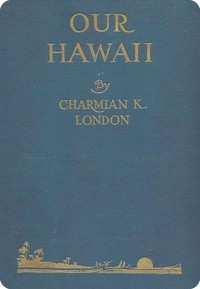
Charmian London opens Our Hawaii by positioning it as a revision of her earlier notes from a two-year cruise aboard the ketch Snark, stripping away personal memoirs already used in her biography of Jack London. The book gains a new structure by placing Jack London's three 1916 essays, 'My Hawaiian Aloha,' at the front, which she calls 'of peculiar value with regard to vital points of view on Hawaii.' This editorial choice signals a deliberate shift from travelogue to a more documentary, collaborative portrait of the islands.
Diction and the Tourist's Gaze
Charmian London's prose often adopts the tone of an informed visitor, blending wonder with cataloguing precision. She describes the Bishop Museum's exhibits with a collector's eye, noting 'the finely built and naked bronze statues that bore the kahilis' and contrasting them with 'clumsy, ill-dressed, commonplace bearers.' Her word choices—'bronze statues' for living men, 'sartorial disfigurements' for modern clothing—reveal a romanticized view of pre-contact Hawaii. She also records native speech, such as the saying 'You can always see the blood of an Hawaiian under his skin,' which she presents without commentary, letting the phrase carry its own cultural weight.
Voice and the Collaborative Narrative
The book's voice is not singular. Charmian's diary-like entries are interspersed with Jack London's more declarative essays. In the foreword, she quotes him saying of the American public, 'They don't know what they've got!'—a refrain that frames the entire work as an act of revelation. Her own voice is more observational, as when she describes a museum model of a heiau and notes a gruesome accident: a young Hawaiian repairman fell and 'his real blood was spilled—Fate his executioner, ilamuku.' The sudden shift to a Hawaiian term for 'executioner' adds a layer of cultural specificity, hinting at her effort to integrate local knowledge into her narrative.
Structure and the Embedded Essay
Charmian London explicitly states that Jack London's three articles are 'placed first, because of their peculiar value.' This structural decision gives his voice priority, making the book a hybrid: part memoir, part anthology. The foreword also explains that she 'eliminated the bulk of personal memoirs' to add 'more detail concerning the Territory of Hawaii.' The result is a text that moves between personal anecdote and encyclopedic description, as when she borrows Mary S. Lawrence's heraldic description of the Royal Hawaiian coat-of-arms, complete with its motto: 'The life of the land is perpetuated by righteousness.' Such inclusions suggest a desire to document as much as to narrate.
Recurring Details: Artifacts and Loss
Throughout the excerpts, Charmian London lingers on objects that signify cultural change. She notes that 'no tapa “cloth” is made in Hawaii to-day,' contrasting the 'almost transparent, paper-like tissue' of old with the 'handsome but heavy modern tapas of Samoa.' The Bishop Museum's wax figures are 'startlingly lifelike, except in the unavoidable deadness of the coloring.' These details accumulate into a quiet elegy for a vanishing way of life. Even the coat-of-arms, she observes, 'has not been used by the government since the islands have been a territory of the United States.' The book thus becomes a record of what is being lost, preserved in prose.
Readers approaching Our Hawaii should attend to the interplay between Charmian's diaristic eye and Jack's essayistic voice. The book is less a continuous narrative than a mosaic of observations, quotations, and descriptions. Pay attention to the moments when Charmian steps back to let a Hawaiian phrase or a museum exhibit speak for itself—these are the points where the text most clearly reveals its documentary ambition.
That rain fell in slow, silver sheets against the window while I drifted through Our Hawaii, the way Charmian London’s words made wet volcanic stone feel like a heartbeat. Later, I found myself wondering how places keep their stories buried, and that led me, almost sleepily, to The Blackmore Country — Context and Discussion, where the English moors seemed to hold their own quiet ghosts, equally patient.
Evelyn Lee
1 month agoWhat did you think of this book?
Answer a few questions and save a private reflection on this device.
Isabella Allen
2 weeks ago