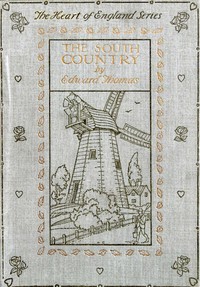
The South Country — Inside the Classic

(0 User reviews)   22
In Category - Geography
Thomas, Edward, 1878-1917 Project Gutenberg 2019 Not confirmed
England -- Description and travel; Natural history -- England; Thomas, Edward, 1878-1917 -- Travel -- England Readers of public-domain and historical texts
Project Gutenberg digital edition en

Edition facts

Words 87,835
Reading time 382 min
Text sections 21

This digital edition of The South Country — Inside the Classic is described by source-level measurements including 87,835 words, 6 hr 22 min estimated reading time, and 21 detected text sections.

The text analysis averages about 28.8 words per sentence, while the detected sections provide another way to judge how the source is divided.

Project Gutenberg metadata also associates the work with “England -- Description and travel,” connecting these edition facts with the source record’s subject description.

Edward Thomas's 1909 prose-poem of a year's wanderings through Kent, Sussex, Hampshire, Wiltshire and Cornwall, blending natural observation with literary meditation and a philosophy of open-road discovery.
Share
Editorial Edition Score 4.9/5

Calculated from edition completeness, EPUB availability, text structure and catalogue metadata. Not a user rating.

How this score is calculated
  • Description quality20 pts
  • Title & short description10 pts
  • Source metadata20 pts
  • Text length15 pts
  • Chapters / structure15 pts
  • EPUB file integrity20 pts

Total of 100 points, scaled to a 2.5-5.0 range. Editions with an empty description or a missing EPUB file are not scored.

Edition quality

Read the Text

y one in the dark; they cut off the heads of a score of tall poplars, lest perchance the west wind should one day do the same thing when one of the million was passing below.

The new people were a mysterious, black-liveried host, the grandchildren of peers, thieves, gutter-snipes, agricultural labourers, artisans, shopkeepers, professional men, farmers, foreign financiers, an unrelated multitude. They were an endless riddle to the old man. He used to stare at their houses as one might stare at a corpse in the hope of discovering that there was something alive there. They were as impenetrable as their houses, when at night the blinds of the lighted rooms were drawn and figures or parts of figures shot fantastically by. He read of their bankruptcies, their appointments, their crimes, their successes, unwittingly, in the newspapers. He could never take it as a matter of course to pass, to be continually surrounded by, thousands of whom he knew nothing, to whom he was nothing. Well did they keep their secrets, this blank or shamefaced crowd of discreetly dressed people who might be anywhere to-morrow.

He turned from them to his garden and cherry-tree, and thinking of those who had walked there, and in the long garden on the other side of the fence, he felt at home again, with his cat and her long line of descendants. That long garden had survived the big house to which it had belonged. A merchant had lived there with his family of four daughters, dark, tall women, whose pride and tender speech the old trees in their garden often recalled. All were beautiful, and they were most beautiful together. They walked, they rode, they played and read in the garden, and the old man could see them there. They were said to be clever and their father was wealthy. They were nearly always together, and as often as possible with him. They were a tribe apart, of extraordinary perfection of strength and grace, holding their own against the world. And yet, as the old man thought to himself, looking at their garden in the rain, not one of them was ever married. They had moved right into London after selling their house and land. They had come to his shop once or twice after and made an excuse for going into the garden: they looked into their own as if they had lost something there. Thinking of them he went into his shop and opened a book. A minute black insect, disturbed from among the leaves, crawled over and over the white page as he pretended to read; it went in zigzags half-an-inch long, lost in the black and white desert, sometimes turning the sharp edge and going to the other side of the page; but as a rule the edge alarmed it and it retreated; it was never still. It reminded him of himself. They were both lost upon the vast surface of the earth.

But, of course, that was not why he left. Nobody knew why he left. In his seventieth year he ran away, bursting out of the crowd as one sheep no braver than the rest will do sometimes, inexplicably. He has brought his cats with him, and he has money enough to last until he is dead. Being considered by his niece as of unsound mind, he is free to do as he will and is happy when he is alone.

A few miles south of that great presiding pollard beech is the boundary line between Surrey and Kent on the north and Sussex on the south. A few miles over the line the moorland organ roll of heather and birch and pine succeeds the grassy undulations and the well-grown beech and oak. The yellow roving lines of the paths cut through the heather into the sand add to the wildness of the waste, by their suggestion of mountain torrents and of channels worn in the soft rock or clay by the sea. The same likeness in little is often to be seen upon a high-pitched roof of thatch when the straw is earth-coloured and tunnelled by birds and seamed by rain. Here the houses are of stone, unadorned, heather-thatched. The maker of birch-heath brooms plies his trade. There are stacks of heath and gorse in the yard. All the more fair are the grooves in the moorland, below the region of pines, where the tiled white-boarded mill stands by the sheen of a ford, and the gorse is bright and white clothes are blowing over neat gardens and the first rose. On a day of rain and gloom the answer of the gorse to sudden lights and heats is delicious; all those dull grey and glaucous and brown dry spines bursting into cool and fragrant fire is as great a miracle as the turning of flames to roses round a martyr’s feet.

It is only too easy for the pheasant lords to plant larch in parallelograms: to escape from them it is necessary to go in amongst them. Yet there are parts of the forest large and dark and primeval in look, with a few poor isolated houses and a thin file of telegraph posts crossing it among the high gloomy pines and down to the marshy hollows, to the strewn gold of dwarf willows, and up again to the deserted wooden windmill, the empty boarded cottage, the heather-thatched sheds at the southern edge of the moor. Looking at this tract of wild land the mind seems to shed many centuries of civilization and to taste something of the early man’s alarm in the presence of the uncultured hills--an alarm which is in us tempered so as to aid an impression of the sublime. Its influence lingers in the small strips of roadside gorse beyond its proper boundary. Then, southward, there are softly dipping meadows, fields of young corn, and oaks thrown among the cowslips. The small farmhouses are neat and good--one has a long stone wall in front, and, over the road, tall Scotch firs above a green pond dappled by the water crowfoot’s white blossoms and bordered by sallow and rush. Narrow copses of oak or wide hedges of hazel and sallow line the road; and they are making cask hoops under lodges of boughs at the woodsides. Bluebells and primroses and cuckoo flowers are not to be counted under the trees. The long moist meadows flow among the woods up and down from farm to farm and spire to tower. Each farmhouse group is new--this one is roofed and walled with tiles; and opposite is a tangle of grass and gorse, with fowls and hen-coops amongst it, a sallowy pond, a pile of faggots, some crooked knees of oak, some fresh-peeled timber: old grey hop poles lean in a sheaf all round a great oak. The gates are of good unpainted oak, and some few are of a kind not often seen elsewhere, lower than a hurdle and composed of two stout parallel bars united by twenty uprights and by two pieces meeting to form a V across these. The gates deserve and would fill a book by themselves.

Green lucent calipers of flags shadow one another in little wayside ponds, white-railed; for this is the Weald, the land of small clay ponds. The hazels are the nightingale’s. In many of the oak woods the timber carriages have carved a way through primroses and bluebells deep into the brown clay. The larger views are of cloudy, oak woods, ridge behind ridge, and green corn or grass and grey ploughland between; and of the sun pouring a molten cataract out of dark machicolated clouds on to one green field that glows a moment and is insignificant again: the lesser are of little brambly precipitous sandpits by the road, of a white mill at a crossing, of carved yews before black-timbered inns, of a starling that has learned the curlew’s call perched on a cottage roof, of abeles all rough silver with opening leaf shivering along the grass-bordered evening road, of two or three big oaks in a meadow corner and in their shadow unblemished parsley and grasses bowed as if rushing in the wind. At an inn door stands a young labourer, tall and straight but loosely made, his nose even and small, his eyes blue and deep set, his lips like those of Antinous, his face ruddy and rough-grained, his hair short and brown and crisp upon his fair round head; his neck bound by a voluminous scarf (with alternate lozenges of crimson and deep green divided by white lines) that is gathered beneath his chin by a brass ring and thence flows down under his blue coat; his trousers of grey cord, dirty and patched with drab to a weathered stone colour, fitting almost tightly to his large thighs and calves and reaching not too near to his small but heavily-shod feet. A prince--a slave. He is twenty, unmarried, sober, honest, a noble animal. He goes into a cottage that stands worn and old and without a right angle in its timbers or its thatch any more than in its apple trees and solitary quince which all but hide the lilac and massed honesty of the little garden. This is a house--I had almost said this is a man--that looked upon England when it could move men to such songs as, “Come, live with me and be my love,” or--

“Hey, down a down!” did Dian sing, Amongst her virgins sitting; “Than love there is no vainer thing, For maidens most unfitting.” And so think I, with a down, down derry.

For a moment or less as he goes under the porch I seem to see that England, that swan’s nest, that island which a man’s heart was not too big to love utterly. But now what with Great Britain, the British Empire, Britons, Britishers, and the English-speaking world, the choice offered to whomsoever would be patriotic is embarrassing, and he is fortunate who can find an ideal England of the past, the present, and the future to worship, and embody it in his native fields and waters or his garden, as in a graven image.

The round unending Downs are close ahead, and upon the nearest hill a windmill beside a huge scoop in the chalk, a troop of elms below, and then low-hedged fields of grass and wheat. The farms are those of the downland. One stands at the end of the elm troop that swerves and clusters about its tiled roof, grey cliff of chimney-stack, and many gables; the stables with newer tiles; the huge slope of the barn; the low mossy cart-lodge and its wheels and grounded shafts; the pale straw stacks and the dark hay ricks with leaning ladders. A hundred sheep-bells rush by with a music of the hills in the wind. The larks are singing as if they never could have done by nightfall. It is now the hour of sunset, and windy. All the sky is soft and dark-grey-clouded except where the sun, just visible and throbbing in its own light, looks through a bright window in the west with a glow. Exactly under the sun the grass and wheat is full both of the pure effulgence and of the south-west wind, rippling and glittering: there is no sun for anything else save the water. North of the sun and out of its power lies a lush meadow, beyond it a flat marshland cut by several curves of bright water, above that a dark church on a wooded mound, and then three shadowy swoops of Down ending at a spire among trees.

South-west, the jagged ridgy cluster of a hillside town, a mill and a castle, stand dark and lucid, and behind them the mere lines of still more distant downs.

I turn into my next inn with unusual hopes. For it was here some years ago that I met for the first time a remarkable man. It was nine o’clock on a late July evening, and the haymakers, only just set free, came stamping into the bar. The last waggon-load stopped at the door while the red-whiskered carter stood, one hand on the latch, and drank his pint before leading his horses into the stall. After the haymakers, in their pale corduroys and dirty white slops, came a tall, spare, shock-headed man, not recently shaved, dressed in grey--grey coat, grey breeches and stockings, and a tall, hard felt hat that was old and grey. He called for sixpenny ale, and wiping the hay dust from his neck sat down beside me.

No, he is not here to-day. Perhaps he will never get out of London again.

I asked him the way to the nearest village, and whether a bed was to be had there. He answered that it was some way off--paused, looked at me, drank from his tankard--and added in a lower voice that he would be glad if I would come and share his place. Such an unusual invitation enforced assent.

A quarter of a mile down the next by-way he opened a little oaken gate that slammed after us, and there, in a corner of a small, flat field, was his sleeping place, under an oak. Would I care to join him in fried bacon and broad beans and tea at six the next morning?

He lit a wisp of hay and soon had a fire burning, and brought over some hay and sacks for the second bed. The lights of the farmhouse shone on the other side of the little field behind lilac bushes. The farmhouse pump gave out a cry like a guinea fowl for a few minutes. Then the lights went out. I asked the name of the farm and he told me.

“I come here almost every summer for the haymaking,” he said, and detecting my surprise that it was not his first year of haymaking, he continued--

“It is my tenth summer, to be exact.”

He was a man of hardly over thirty, and I noticed that his hands, though small and fine, were rough and warty and dark. Thoughtlessly I remarked that he must find the winter hard if he travelled like this all the year round.

“Yes,” he said, with a sigh, “it is, and that is why I go back in the winter; at least partly why.”

I was still perplexed. He had the air of a town-bred man of the clerkly class, but no accent, and I could not think what he did in London that was compatible with his present life.

“Are you a Londoner, then?”

“Yes, and no. I was born at the village of ---- in Caermarthenshire. My father was a clerk in a coal merchant’s office of the neighbouring town. But he thought to better himself, worked hard in the evenings and came to London, when I was seven, for a better-paid post. We lived in Wandsworth in a small street newly built. I went to a middle-class school close by until I was sixteen, and then I went into a silk merchant’s office. My father died soon after. He had never been strong, and from the first year’s work in the city, I have heard my mother say, he was a doomed man. He made no friends. While I was young he gave up all his spare time to me and was happy, wheeling me, my mother walking alongside, out into the country on every Sunday that was not soaking wet, and nearly every Saturday afternoon, too.

“It was on one of these excursions, when they had left me to myself a little while to talk more gravely than they usually did when we were out like that, that there was suddenly opened before me--like a yawning pit, yet not only beneath me but on every side--infinity, endless time, endless space; it was thrust upon me, I could not grasp it, I only closed my eyes and shuddered and knew that not even my father could save me from it, then in a minute it was gone. To a more blessed child some fair or imposing vision might have risen up out of the deep and given him a profounder if a sadder eye for life and the world. How unlike it was to the mystic’s trance, feeling out with infinite soul to earth and stars and sea and remote time and recognizing his oneness with them. To me, but later than that, this occasionally recurring experience was as an intimation of the endless pale road, before and behind, which the soul has to travel: it was a terror that enrolled me as one of the helpless, superfluous ones of the earth.

“I was their only child that lived, and my father’s joy in me was very great, equalled only by his misery at the life which he had to lead and which he foresaw for me. He used to read to me, waking me up for the purpose sometimes when he reached home late, or if he did not do that rousing me an hour before breakfast. His favourite books were _The Compleat Angler_ and _Lavengro_, the poems of Wordsworth, the diaries of Thoreau and the _Natural History of Selborne_. I remember crying--when I was twelve--with despair of human nature’s fickleness to think that White, even though he was an old man, could have it in his heart to write that farewell to natural history at the end of his last letter to Barrington. My father read these books to me several times in a sad, hoarse voice--as it seemed to me, though when he paused he was happy enough--which I had often great trouble to endure as I got older and able and willing to read for myself. So full was I of a sense of the real wild country which I had never seen--the Black Mountains of Caermarthen I hardly recalled--that I became fanciful, and despised the lavish creeper that hung like a costly dress over the fence between our garden and the next, because the earth it grew in was not red earth but a black pasty compound, full of cinders and mortar and decayed rags and kittens. I used to like to go to the blacksmith’s to smell the singeing hoof and to the tram-stables and smell the horses, and see the men standing about in loose shirts, hanging braces, bare arms, clay pipes, with a sort of free look that I could not see elsewhere. The navvies at work in the road or on the railway line were a tremendous pleasure, and I noticed that the clerks waiting for their trains in the morning loved to watch these hulking free and easy men doing something that looked as if it mattered, not like their own ledger work and so on. I had the same sort of pleasure looking up the street that rose from east to west and seeing the sun set between the two precipices of brick wall at the top; it was as if a gate opened there and through it all the people and things that saddened me had disappeared and left me to myself; it was like the pit, too, that opened before me as a little child.

Edward Thomas opens The South Country with a quotation from W. B. Yeats that sets the tone: roads are "the only things that are infinite." This is not a guidebook but a record of a year's foot travel through five southern English counties, structured by seasons rather than itineraries. Thomas moves from the end of winter through spring, summer, and autumn, weaving together precise natural observation, literary allusion, and philosophical reflection. The excerpts show a writer who is as attentive to the shape of a hedge as to the history embedded in a parish boundary. Readers should expect a meditative, associative narrative rather than a chronological travelogue—one that values the digression as much as the destination.

A Year's Walking, Not a Route

The table of contents reveals a structure driven by season and place, not by a linear journey. Chapter titles such as "The End of Winter—Suffolk—Hampshire" and "August—Going Westward—Hampshire and Wiltshire" indicate that Thomas groups observations by time of year, moving between counties within a single chapter. This suggests that the book is best read as a series of impressions rather than a continuous narrative. The opening chapter, simply titled "The South Country," likely establishes the region as a conceptual whole before the seasonal wanderings begin. Readers should note that the chapters are not evenly distributed: Hampshire appears in nine of the sixteen chapters, while Cornwall is mentioned only in Chapter IX. This imbalance may reflect the author's actual travel patterns or his deeper familiarity with certain landscapes.

The Prose Style: Observation and Meditation

Thomas's prose moves between concrete detail and abstract reflection. In the excerpt on nature-study, he argues that knowledge of the outdoors should come from direct sensory experience, not from "stale descriptions of birds and flowers" in books. He advocates for "anatomy, classification, pure brain-work" but insists that the aim is not to produce naturalists but to cultivate "poetical susceptibility." This tension between scientific precision and poetic emotion is central to his method. When he describes a path "by the clipped hedge" or a road that "goes up to the high road," the language is plain and specific. Yet he also reaches for metaphysical comparisons: roads are "the serpent of eternity." Readers will encounter a writer who shifts seamlessly from the particular to the universal, often within a single paragraph.

Literary and Historical Echoes

Thomas does not travel alone; he carries a library of references. The excerpts mention Richard Jefferies, Henry Thoreau, Mark Pattison, and the poet Thomas Traherne (whose name appears in a chapter heading). The naturalist Gilbert White's The Natural History of Selborne is cited as a formative text. These allusions are not decorative—they shape Thomas's way of seeing. He compares a parish to a microcosm, echoing Jefferies and Thoreau, and he traces his own development through Pattison's account of moving from natural history to "poetical sentiment." Readers unfamiliar with these figures will still follow the argument, but the book rewards knowledge of the English nature-writing tradition. The epigraph from Yeats's play Where There Is Nothing signals that Thomas is interested in roads as symbols of endless possibility, not just as routes between places.

The Role of the Reader: Walking Alongside

Thomas addresses the reader as a companion in discovery. In the nature-study passage, he uses "we" and "us," inviting shared reflection on how to teach children to see the natural world. He warns against taking "the study, the lamp and the ink out of doors"—a plea for unmediated experience. Yet his own book is a product of study and ink, a paradox he seems aware of. The reader is asked to hold two ideas at once: that direct contact with nature is paramount, and that books like this one can deepen that contact. The chapter titles that include both a season and a county ("Spring—Hampshire—Kent—Surrey") suggest a rhythm of movement and pause. To read The South Country is to walk at Thomas's pace, stopping when he stops, and seeing what he sees—but also to bring one's own attention to the details he records.

The South Country is not a book to be skimmed for information. Its value lies in the quality of attention Thomas brings to each scene and the connections he makes between a chalk hill, a line of poetry, and a memory of childhood. Readers will find it most rewarding if they read slowly, perhaps one chapter at a time, and allow the author's digressions to lead where they will. The book's structure—seasonal, associative, unhurried—invites the same kind of wandering that Thomas himself practiced. Let the roads be infinite.

There are afternoons when Edward Thomas’s chalk paths feel like old friends, and I find myself wishing for one more quiet mile beside him. That same unhurried ache returns in The wilds of Patagonia — A Closer Reading, where the distances stretch differently but the solitude sings the same familiar tune. I think I’ll carry both books through autumn, slowly.

There are no reviews for this eBook.

0
0 out of 5 (0 User reviews )

Add a Review

Your Rating *
  • ...
    Jennifer Nixon - 1 month ago
    A lyrical and immersive exploration of the English countryside. The author's poetic prose brings the landscape and its history to life, capturing the quiet beauty of the South. A perfect escape for armchair travelers and anyone interested in regional literature.

  • ...
    Alejandra Foster - 1 month ago
    The book offers some lovely passages on the natural world, but the pacing is uneven. It alternates between deep musings and mundane descriptions, leaving the reader wanting a stronger narrative thread. Decent for those who enjoy meditative nature writing.

  • ...
    Jeffrey Owens - 2 weeks ago
    Despite its evocative title, this is a rambling and at times tedious read. The author's overly nostalgic tone and lack of focus make it hard to stay engaged. If you're looking for a structured guide to the region, this isn't it.


Reader reflection

Record your reading impressions

A brief reflection can help important ideas stay with you longer.

Your progress 0 / 10
1

Have you finished this book?

2

How did the book work for you overall?

3

Would you encourage someone else to read it?

4

What was the reading difficulty like?

Related eBooks