Mr. Punch on the Continong — Reading Companion

(2 User reviews)   471
In Category - Travel Narratives
Hammerton, J. A. (John Alexander), 1871-1949 [Editor] Project Gutenberg 2014 Not confirmed
English wit and humor; English wit and humor, Pictorial; Europe -- Description and travel -- Humor Readers of public-domain and historical texts
Project Gutenberg digital edition en

Edition facts

Words 23,952
Reading time 105 min
Text sections 5

The source record for Mr. Punch on the Continong — Reading Companion measures this digital text at 23,952 words, 1 hr 45 min estimated reading time, and 5 detected text sections.

The text analysis averages about 13.9 words per sentence, while the detected sections provide another way to judge how the source is divided.

Project Gutenberg metadata also associates the work with “English wit and humor,” connecting these edition facts with the source record’s subject description.

A curated collection of Punch magazine's humorous observations on British tourists and Continental travel, featuring cartoons and comic prose from the mid-19th to early 20th century, edited by J. A. Hammerton.
Share
Editorial Edition Score 4.7/5

Calculated from edition completeness, EPUB availability, text structure and catalogue metadata. Not a user rating.

How this score is calculated
  • Description quality20 pts
  • Title & short description10 pts
  • Source metadata20 pts
  • Text length15 pts
  • Chapters / structure15 pts
  • EPUB file integrity20 pts

Total of 100 points, scaled to a 2.5-5.0 range. Editions with an empty description or a missing EPUB file are not scored.

Edition quality

Read the Text

Transcriber's Note: Some Illustrations have been moved higher in the book to allow uninterrupted flow of the text.

PUNCH LIBRARY OF HUMOUR

Edited by J. A. Hammerton

Designed to provide in a series of volumes, each complete in itself, the cream of our national humour, contributed by the masters of comic draughtsmanship and the leading wits of the age to "Punch," from its beginning in 1841 to the present day.

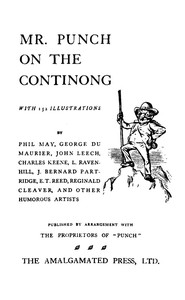
MR. PUNCH ON THE CONTINONG

MR. PUNCH ON THE CONTINONG

_WITH 152 ILLUSTRATIONS_

PHIL MAY, GEORGE DU MAURIER, JOHN LEECH, CHARLES KEENE, L. RAVENHILL, J. BERNARD PARTRIDGE, E. T. REED, REGINALD CLEAVER, AND OTHER HUMOROUS ARTISTS

PUBLISHED BY ARRANGEMENT WITH

THE PROPRIETORS OF "PUNCH"

THE AMALGAMATED PRESS, LTD.

PUNCH LIBRARY OF HUMOUR

_Crown 8vo. 192 pages, fully illustrated, pictorial cover, 1s. net._

MR. PUNCH AT THE SEASIDE

MR. PUNCH'S RAILWAY BOOK

MR. PUNCH ON THE CONTINONG

MR. PUNCH'S BOOK OF LOVE

MR. PUNCH IN THE HIGHLANDS

OFF TO THE CONTINONG!

Nothing is more calculated to give Englishmen a good conceit of themselves in the matter of international courtesy than a careful examination of the archives of Mr. Punch, such as was necessary in the preparation of the present volume. To anyone familiar with the anti-British attitude of the French comic press before these happier days of the _Entente Cordiale_, and of the German press at all times, the complete absence of all manner of ill-feeling from Mr. Punch's jokes about our neighbours across the Channel is little short of wonderful. Even in the days when the English people were the unfailing subject for every French satirist when he suffered from an unusual attack of spleen, our national jester seems never to have lost the good-humour with which he has usually surveyed the life of the Continent. Indeed, as the pages here brought together will readily prove, Mr. Punch has seldom, if ever, laid himself open to the charge of insularity in his point of view. Instead of showing a tendency to ridicule our neighbours on the Continent, he has been more inclined to pillory the follies of his own countrymen, and to contrast their behaviour on the Continent rather unfavourably with that of the natives. But, even so, there is nothing in these humorous chronicles of "Mr. Punch on the Continong" which will not amuse equally the travelling or the stay-at-home Briton and the foreigner, since each will find many of his national characteristics "touched off" in a way that is no less kindly than amusing. The fact that a considerable proportion of these pages are from the pen of George Du Maurier, himself a Frenchman by birth, is a reminder that long before the Governments of France and Great Britain had come into their present relationship of intimate friendliness, Mr. Punch had maintained his own _Entente Cordiale!_

MR. PUNCH ON THE CONTINONG

(_To a Friendly Adviser_)

When starting off on foreign trips, I've felt secure if someone gave me Invaluable hints and tips; Time, trouble, money, these would save me.

I'm off; you've told me all you know. Forewarned, forearmed, I start, instructed How much to spend, and where to go; Yet free, not like some folks "conducted."

Now I shall face, serene and calm, Those persons, often rather pressing For little gifts, with outstretched palm. To some of them I'll give my blessing.

To others--"_service_" being paid-- _Buona mano_, _pourboire_, _trinkgeld;_ They fancy Englishmen are made Of money, made of (so they think) _geld_.

The _garçon_, ready with each dish, His brisk "_Voilà, monsieur_" replying To anything that one may wish; His claim admits of no denying.

The _portier_, who never rests, Who speaks six languages together To clamorous, inquiring guests, On letters, luggage, trains, boats, weather.

The _femme de chambre_, who fills my _bain;_ The _ouvreuse_, where I see the _acteur_. A cigarette to _chef de train_, A franc to energetic _facteur_.

I give each _cocher_ what is right; I know, without profound researches, What I must pay for each new sight-- Cathedrals, castles, convents, churches.

Or climbing up to see a view, From _campanile_, roof, or steeple, Those verbal tips I had from you Save money tips to other people.

Save all those florins, marks or francs-- Or _pfennige_, _sous_, _kreutzer_, is it?-- The change they give me at the banks, According to the towns I visit.

I seem to owe you these, and yet Will money do? My feeling's deeper. I'll owe you an eternal debt-- A debt of gratitude, that's cheaper.

BREAKING THE BANK AT MONTE CARLO

(_A Note from One who has all but done it_)

DEAR MR. PUNCH.--Now that so many of my countrymen (the word includes both sexes) patronise Monte Carlo, it is well that they should be provided with an infallible system. Some people think that a lucky pig charm or a piece of Newgate rope produces luck. But this impression is caused by a feeling of superstition--neither more nor less. What one wants in front of the table is a really scientific mathematical system. This I am prepared to give.

Take a Napoleon as a unit, making up your mind to lose up to a certain sum, and do not exceed that sum. Now back the colour twenty consecutive times. Don't double, but simply keep to the unit. When you have lost to the full extent of your limit, double your stake. Keep to this sum for another twenty turns. By this time it is a mathematical certainty that you must either have won--or lost. Of course, if you have won you will be pleased. If you have lost, keep up your heart and double your stakes again. This time you will be backing the colour with a stake four times as large as your original fancy. Again go for twenty turns, and see what comes of it.

Of course, if you still lose it will be unfortunate, but you cannot have everything. And with this truism, I sign myself,

ONE WHO WISHES TO BENEFIT MANKIND.

(_By a Dipper in Brittany_)

[Apropos of a correspondence in the _Daily Graphic_]

Mrs. Grundy rules the waves, With Britons for her slaves-- They're fearful to disport themselves, Unless the sexes sort themselves And take their bathing, sadly, for French gaiety depraves (!)

'Tis time no more were seen The out-of-date "machine"; Away with that monstrosity Of prudish ponderosity-- Why can't we have the bathing tent or else the trim _cabine?_

I think we should advance If we took a hint from France, And mingled (quite decorously) On beaches that before us lie All round our coasts--we do abroad whene'er we get the chance!

O'er here in St. Maló The thing's quite _comme il faut;_ Why not in higher latitude? I can't make out the attitude Of those who make the British dip so "shocking," dull and slow!

We are with a guide, voluble after the fashion of guides all the world over, and capable of speaking many languages execrably. His English, no doubt, is typical of the rest. "Datt-e building dere," he says, "is de Barze of Caracalla."

"The _what?_" says my companion.

"De Barze of Caracalla--vere de ancient Romans bayze demselfs in de water--same as ve go to Casino, zey take a barze, morning, afternoon, ven zey like."

"It must have been a large building," I venture, ineptly.

"In dem dere barze," he retorts, impressively, "sixteen honderd peoples all could chomp in de water same time!"

"Jolly good splash they must have made," says A.

The guide pays no attention, but continues:--

"Dem dere barze not de biggest. In de Barze of Diocletian four tousand peoples all could chomp in de water same time. In all de barze in Rome forrrty tousand could chomp in same time."

"I wonder," says A., "how they got 'em all together and started them jumping?"

"Vell, dey not all chomp togesser every day same peoples, but ven de barze all full den forrrty tousand chomp in same time."

_At the Bosco Sacro._

"Now," remarks the guide, "I tell you fonny story--make you laugh. Ven dem eight honderd robbers foundated Rome dey live on a 'ill and dey haf no religion. Den come de King Numa Pompilio: he say 'dey most haf religion,' so he can goffern dem better. Den 'e go to diss _bosco_, and ven he come back he tell dem robbers he haf seen de Naimp _Egeea_----"

"The Nymph _Egeria_," A. intervenes, with superiority.

"Vell, I say de Naimp _Egeea_. He say he haf seen her, dat she haf appareeted to him, and so dey get deir religion."

"Yes," concludes the guide, "dat iss a fonny story."

_By the Circus of Maxentius_.

"Diss is de Circus of Massenzio. He build 'im ven his son Romulus die. No, diss is not de same Romulus who foundated Rome, but anosser one, a leetle boy, de son of de Emperor Massenzio. He die ven he vos a leetle boy. In dem days it not permitted to make sacrifice of men, so dey build a race-course instead: it is de same ting, for some of de charioteers alvays get dem killed, and Massenzio tink dey go play wiz Romulus."

"Ven de _martiri_ condemnated to dess and dey kill dem, dey safe some drops blood in a leetle bottle and dey put dem bottles in de valls. Dere iss a bit, you see. San Sebastiano 'e vos condemnated to de arrows--dey shotted 'im--and afterward dey smash his head on a column. Dere is de column."

"What was that you were telling us about Caracalla just now?"

"Caracalla he no like 'is brozzer Geta--so he kill 'im. Den he make 'im a god and tell peoples to vorship him, and 'e say 'I did not like my brozzer ven he vos a man, but I like him very moch ven he is a god.' Dat is anosser funny story."

AT BOULOGNE.--_Mrs. Sweetly_ (_on her honeymoon_). "Isn't it funny, Archibald, to see so many foreigners about? And all talking French!"

WONDERS OF THE WORLD ABROAD

Wonder if there be an inn upon the Continent where you are furnished gratis with a cake of soap and bed candle.

Wonder how many able-bodied English waiters it would take to do the daily work of half a dozen French ones.

Wonder why it is that Great (and Little) Britons are so constantly heard grumbling at the half a score of dishes in a foreign bill of fare, while at home they have so frequently to feed upon cold mutton.

Wonder what amount of beer a German tourist daily drinks, and how many half-pint glasses a waiter at Vienna can carry at a time without spilling a drop out of them.

Wonder how it is that, although one knows full well that many Paris people are most miserably poor, one never sees such ragged scarecrows in its streets as are visible in London.

Wonder how many successive ages must elapse ere travellers abroad enjoy the luxury of salt-spoons.

Wonder why so many tourists, and particularly ladies, will persist in speaking French, with a true Britannic accent, when the waiter so considerately answers them in English.

Wonder when our foreign friends, who are in most things so ingenious, will direct their ingenuity to the art of drainage coupled with deodorising fluids.

Wonder if there be a watering-place in France where there is no Casino, and where Frenchmen may be seen engaged in any game more active than dominoes or billiards.

Wonder when it will be possible to get through seven courses at a foreign _table d'hôte_ without running any risk of seeing one's fair neighbour either eating with her knife or wiping her plate clean by sopping bread into the gravy.

Wonder what would be the yearly increase of deafness in Great Britain, if our horses all had bells to jangle on their harness, and our drivers all were seized with the mania for whip-cracking, which possesses in such fury all the coachmen on the Continent.

Wonder in what century the historian will relate that a Frenchman was seen walking in the country for amusement.

Wonder why it is that when one calls a Paris waiter, he always answers, "V'la, M'sieu," and then invariably vanishes.

Wonder when Swiss tourists will abstain from buying alpenstocks which they don't know how to use, and which are branded with the names of mountains they would never dare to dream of trying to do more than timidly look up to.

Wonder in what age of progress a sponge-bath will be readily obtainable abroad, in places most remote, and where Britons least do congregate.

Wonder if French ladies, who are as elegant in their manners as they are in their millinery, will ever acquire the habit of eating with their lips shut.

Wonder when it will be possible to travel on the Rhine, without hearing feeble jokelets made about the "rhino."

When we came to Amsterdam, we determined, Pashley, Shirtliff and I, that we would take the earliest opportunity of seeing Marken. Wonderful place, by all accounts. Little island, only two miles from mainland, full of absolutely unsophisticated inhabitants. Most of them have never left Marken--no idea of the world beyond it! Everybody contented and equal; costumes quaint; manners simple and dignified. Sort of Arcadia, with dash of Utopia.

And here we are--actually at Marken, just landed by sailing-boat from Monnickendam.

All is peaceful and picturesque. Scattered groups of little black cottages with scarlet roofs, on mounds. Fishermen strolling about in baggy black knickerbockers, woollen stockings, and wooden shoes.

Women and girls all dressed alike, in crimson bodice and embroidered skirt; little cap with one long brown curl dangling coquettishly in front of each ear. Small children--miniature replicas of their elders--wander lovingly, hand in hand. A few urchins dart off at our approach, like startled fawns, and disappear amongst the cottages. Otherwise, our arrival attracts no attention.

The women go on with their outdoor work, cleaning their brilliant brass and copper, washing and hanging out their bright-hued cotton and linen garments, with no more than an occasional shy side-glance at us from under their tow-coloured fringes. "Perfectly unconscious," as Shirtliff observes, enthusiastically, "of how unique and picturesque they are!"

All the more wonderful, because excursion steamers run every day during the season from Amsterdam.

We walk up and down rough steps and along narrow, winding alleys. Shirtliff says he "feels such a bounder, going about staring at everything as if he was at Earl's Court." Thinks the Markeners must hate being treated like a show. _We_ shouldn't like it ourselves!

That may be, but, as Pashley retorts, it's the Markeners' own fault. They shouldn't be so beastly picturesque.

Fine buxom girl approaches, carrying pail. On closer view, not precisely a girl--in fact, a matron of mature years. These long, brown side-curls deceptive at a distance; impression, as she passes, of a kind of Dutch "Little Toddlekins"; view of broad back and extensive tract of fat, bare neck under small cap. She turns round and intimates by expressive pantomime that her cottage is close by, and if we would care to inspect the interior, we are heartily welcome. Uncommonly friendly of her. Pashley and I are inclined to accept, but Shirtliff dubious--we may have misunderstood her. We really can't go crowding in like a parcel of trippers!

Little Toddlekins, however, quite keen about it; sees us hesitate, puts down pail and beckons us on round corner with crooked forefinger, like an elderly Siren. How different this simple, hearty hospitality from the sort of reception foreigners would get from an English fishwife! We can't refuse, or we shall hurt her feelings. "But whatever we do," urges Shirtliff, "we mustn't dream of offering her money. She'd be most tremendously insulted."

Of course, we quite understand _that_. It would be simply an outrage. We uncover, and enter, apologetically. Inside, an elderly fisherman is sitting by the hearth mending a net; a girl is leaning in graceful, negligent attitude against table by window. Neither of them takes the slightest notice of us, which is embarrassing. Afraid we really _are_ intruding. However, our hostess--good old soul--has a natural tact and kindliness that soon put us at our ease. Shows us everything. Curtained recesses in wall, where they go to bed. "Very curious--so comfortable!" Delft plates and painted shelves and cupboards. "Most decorative!" Caps and bodices worn by females of the family. "Charming; such artistic colour!" School copybooks with children's exercises. "Capital; so neatly written!" What is she trying to make us understand? Oh, in winter, the sea comes in above the level of the wainscot. "Really! How very convenient!" We don't mean this, but we are so anxious to please and be pleased, that our enthusiasm is degenerating into drivel. Girl by the window contemplates us with growing contempt; and no wonder. High time we went.

Little Toddlekins at the end of her tether; looks at us as if to imply that she has done _her_ part. Next move must come from us. Pashley consults us in an undertone. "Perhaps, after all she _does_ expect, eh? What do _we_ think? Would half a gulden---- What?"

Personally, I think it _might_, but Shirtliff won't hear of it, "Certainly not. On no account! At all events _he_'ll be no party to it. He will simply thank her, shake hands, and walk out." Which he does. I do the same. He may be right, and anyhow, if one of us is to run the risk of offending this matron's delicacy by the offer of a gratuity, Pashley will do it better than I.

Pashley overtakes us presently, looking distinctly uncomfortable. "Did he tip her?" "Yes, he _tipped_ her." "And she flung it after you!" cries Shirtliff, in triumph. "I knew she would! _Now_ I hope you're satisfied!"

"If I am, it's more than _she_ was," says Pashley. "She stuck to it all right, but she let me see it was nothing like what she'd expected for the three of us."

Shirtliff silent but unconvinced. However, as we go on, we see a beckoning forefinger at almost every door and window. Every Markener anxious that we should walk into his little parlour--and pay for the privilege. All of them, as Pashley disgustedly observes, "On the make"; got some treasured heirloom that has been in the family without intermission for six months, and that they would be willing to part with, if pressed, for a consideration. We don't press them; in fact, we are obliged at last to decline their artless invitations--to their unconcealed disgust. Nice people, very, but can't afford to know too many of them.

"At least the _children_ are unspoilt," says Shirtliff, as we come upon a couple of chubby infants, walking solemnly hand in hand as usual. He protests, when Pashley insists on presenting them with a cent, or one-fifth of an English penny, apiece. "Why demoralise them, why instil the love of money into their innocent minds?" Shirtliff wants to know.

He is delighted when they exhibit no sort of emotion on being thus enriched. It shows, he says, that, as yet, they have no conception what money means.

The pair have toddled off towards a gathering of older children, and Pashley, who has brought a Kodak, wonders if he can induce them to stay as they are while he takes a snapshot. Shirtliff protests again. Only spoil them, make them conceited and self-conscious, he maintains.

But the children have seen the Kodak, and are eager to be taken. One of them produces a baby from neighbouring cottage, and they arrange themselves instinctively in effective group by a fence.

Pashley delighted. "Awfully intelligent little beggars!" he says. "They seem to know exactly what I want."

They also know exactly what _they_ want, for the moment they hear the camera click, they make a rush at us, sternly demanding five cents a head for their services.

Shirtliff very severe with them; not one copper shall they have from _him;_ not a matter of pence, but principle, and they had better go away at once. They don't; they hustle him, and some of the taller girls nudge him viciously in the ribs with sharp elbows, as a hint that "an immediate settlement is requested." Pashley and I do the best we can, but we soon come to the end of our Dutch coins. However, no doubt English pennies will---- Not a bit of it! Even the chubby infants don't consider them legal tender here, and reject them with open scorn.

The volume opens with a full-page cartoon of a steam-launch in Venice, captioned with a dialogue between 'Andsome 'Arriet and Mr. Belleville, who mistakes the Bridge of Sighs for Temple Bar and attributes Byron's 'Our Boys' to the poet. This early exchange sets the tone for the collection: British tourists abroad, confidently misinterpreting landmarks and mangling foreign languages. The editor's foreword, 'Off to the Continong!', notes that Punch's jokes about Continental neighbours are notably good-humoured, lacking the spleen found in French or German comic press of the era. Instead, the target is often the insular English traveller, whose blend of ignorance and self-assurance provides steady material.

The Tourist as Comic Foil

The excerpts repeatedly place the British tourist in situations where their assumptions clash with Continental reality. In one sketch, a provincial tourist asks a German waiter if any horses have died lately, using fractured French ('Chevals morts'), and is unabashed when his joke falls flat. Another scene, 'Consequences of the Tower of Babel', shows a man trying French, German, Spanish, and Italian on a woman at a table d'hôte, only to have her ask in English if he speaks it—to which he replies, 'Hélas! non.' The humour relies on the audience recognising the tourist's limited linguistic reach and the irony of his failed multilingual attempts.

Language Barriers and Broken English

A recurring source of comedy is the mangled English found in Continental notices. The editor includes a Belgian washerwoman's sign offering 'Anglish linge' at '1 sou Shert, cols, soaks, sleep-shert, pokets' and an Italian hotel's announcement that 'the direction of this splendid hotel have bettered himself' and that 'Onclean linens is quick wash'. These are presented as found objects, not invented jokes. The humour derives from the gap between intended meaning and literal absurdity—'No mosquits no parrot no rat' promises a pest-free stay, while 'I eet my hatt' is interpreted as an attempt to use an English catchphrase. The editor's commentary frames these as genuine examples of 'English as she is spoke', adding a layer of documentary amusement.

The Changing Landscape of Travel

Several pieces reflect the impact of modern infrastructure on traditional Continental scenery. A poem titled 'Why We Are So Beloved on the Continent' (though the excerpt is cut) contrasts the pre-railway idyll with the engineer's desecration: 'Where playful kids once blithely skipped... He builds a station.' The speaker declares he will take the train to the summit rather than climb, undercutting the romantic ideal of mountaineering. Another item, 'Roundabout Readings', quotes an advertisement for Ostend that boasts of 'an opulent clientele' and 'dazzling costumes' with 'thousand gems', which the editor dryly notes is the first time 'a similarity to Babel' has been cited as an attraction. The juxtaposition of grand claims and mundane reality is a steady thread.

Social Satire at Continental Resorts

At Monte Carlo, a brief exchange has a Briton observing that one never sees young girls there, to which another replies that the ladies are 'obliged to be trente et quarante to match the tables'—a pun on the card game and the French for 'thirty and forty'. The joke targets both the resort's adult clientele and the speaker's cleverness. In Paris, 'Our Countrywomen in Paris' shows Aunt Jemima paying a cab driver with 'sankont sonteems' (cinquante centimes), mangling the currency as well as the language. These vignettes paint a picture of British tourists abroad as simultaneously gauche and self-satisfied, a type Punch clearly enjoyed skewering.

Readers approaching this collection should treat it as a period piece rather than a travel guide. The humour depends on familiarity with Victorian and Edwardian British attitudes, and the cartoons—though not reproduced in the text—are referenced in captions that often carry the punchline. The editor's framing is minimal, so the excerpts speak for themselves. Pay attention to the recurring motifs of miscommunication, misplaced confidence, and the tension between romanticised travel and its mundane realities. These are the threads that tie the anthology together.

That rainy afternoon, I lingered over Mr. Punch on the Continong, laughing at Victorian travelers grumbling about unfamiliar customs. Their clumsy, earnest attempts to understand foreign lands felt oddly touching. Later, I found myself wondering about Americans doing the same, and somehow landed on Pattie's Personal Narrative, 1824-1830; Willard's Inland Trade with New Mexico, 1825, and Downfall of the Fredonian Republic; and Malte-Brun's Account of Mexico — Key Ideas to Explore. Same bewilderment, different desert.

Wyatt Lewis
1 month ago

Luke White
1 month ago

4.5
4.5 out of 5 (2 User reviews )

Add a Review

Your Rating *
  • ...
    Stephanie Martinez - 1 month ago
    This volume is mostly a rehash of dated jokes that don't translate well today. The repetitive format and lack of substantial context make it a chore to read. Only die-hard Punch enthusiasts with a tolerance for Victorian-era stereotypes will find any value.

  • ...
    Tammy Greene - 1 month ago
    The book offers a humorous glimpse into 19th-century European travel through the lens of Punch. The cartoons are amusing, though the text sometimes feels repetitive. Still, it's a decent light read for history buffs.

  • ...
    William James Hughes - 1 month ago
    A delightful collection of Punch cartoons and articles that offer a humorous yet sharp commentary on European travel and culture. The wit is timeless, and the illustrations are charming. A must-read for anyone who appreciates Victorian humor and social satire.


Reader reflection

How did this book work for you?

Your answers remain private and are stored only in this browser.

Your progress 0 / 10
1

What is your current status with this title?

2

Did this book hold your interest?

3

Would you encourage someone else to read it?

4

Did the language feel accessible?

Related eBooks