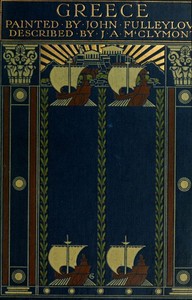
Greece Painted by John Fulleylove; described by J.A. McClymont — Context and Discussion

(2 User reviews)   416
In Category - Travel Narratives
M'Clymont, J. A. (James Alexander), 1848-1927, Fulleylove, John, 1847-1908 [Illustrator] Project Gutenberg 2014 Not confirmed
Greece -- Description and travel; Athens (Greece); Greece -- Antiquities Readers of public-domain and historical texts
Project Gutenberg digital edition en

Edition facts

Words 69,739
Reading time 304 min
Text sections 14

This digital edition of Greece Painted by John Fulleylove; described by J.A. McClymont — Context and Discussion is described by source-level measurements including 69,739 words, 5 hr 4 min estimated reading time, and 14 detected text sections.

The text analysis averages about 29.1 words per sentence, while the detected sections provide another way to judge how the source is divided.

Project Gutenberg metadata also associates the work with “Greece -- Description and travel,” connecting these edition facts with the source record’s subject description.

An illustrated 1906 travelogue pairing J.A. M'Clymont's descriptive text with John Fulleylove's paintings. The excerpts show a focus on classical sites and mythology, but the catalog subjects 'Greece -- Description and travel' and 'Greece -- Antiquities' only partially capture the work's blend of historical narrative and topographical detail.
Share
Editorial Edition Score 4.8/5

Calculated from edition completeness, EPUB availability, text structure and catalogue metadata. Not a user rating.

How this score is calculated
  • Description quality20 pts
  • Title & short description10 pts
  • Source metadata20 pts
  • Text length15 pts
  • Chapters / structure15 pts
  • EPUB file integrity20 pts

Total of 100 points, scaled to a 2.5-5.0 range. Editions with an empty description or a missing EPUB file are not scored.

Edition quality

Read the Text

now Salona), who had taken possession of Cirrha and repeated the old offence of using part of the consecrated ground for their own secular purposes.

The sympathies of Greece were divided in this war, and the final outcome of the struggle was that Philip of Macedonia, who had been called in to finish the previous war, and had been admitted a member of the Amphictyony in place of the dispossessed Phocian tribe, now became master of Greece by reason of his victory over the combined forces of Athens and Thebes at the fateful battle of Chæronea in 338 B.C.

Within the past few years French archæologists have done wonderful work at Delphi. By the removal of the modern village of Castri, the foundations of the temple and the remains of many of the surrounding buildings and monuments have been brought to light. As you pass along the “Sacred Way” you can identify many of the sites mentioned by Pausanias, in the very order in which he describes them. In most places the old pavement still remains, with grooves to keep the feet from slipping. Some of the most precious relics have been removed to the Museum, where there are also models of many of the most beautiful works of art that have perished. Among the former is the famous _Omphalos_ or “Navel-stone,” on which Apollo is often represented as sitting. It marked the spot at which two eagles met, which had been sent out by Jupiter from extreme east and west, of equal speed in flight, to determine the exact centre of the earth. The marble stone which is now shown, although apparently identical with that seen by Pausanias,--for it was discovered on the same spot,--may be only an imitation of the original, like another which has also been recently discovered; and the golden eagles which stood beside the _Omphalos_ have also disappeared. The chasm in the temple floor, from which the vapour ascended that was supposed to inspire the prophetess, cannot now be found, having probably been filled up somehow; but a little way off there is a rock with a rift in it, on which the first Sibyl (mentioned by Plutarch) is supposed to have sat and prophesied. The rift may have been the lurking-place of the dragon which Apollo shot with his darts, when he came from Delos, the land of his birth, to inaugurate the ministry of the Cretan travellers, whom he had enlisted in the service of his new sanctuary. According to the legend the skin of the dragon was left to rot, giving rise to the ancient name Pytho, by which Delphi was known in the days of Homer. In the hymn to the Delphian Apollo the scene of the combat is laid in the gorge of the Phædriadæ, but the other conjecture is supported by the proximity to the Sibyl’s rock of an enclosure like a threshing-floor, which is supposed to be the place where the drama was enacted every fourth year.

A little way above the temple is an open-air theatre--one of the best preserved in Greece. It is in the usual horse-shoe form, with its sloping back, enclosing the sitting accommodation for the spectators, resting on a rising ground. The stadium is still higher, right under the cliffs of Parnassus on the north, and shut in by rising grounds on either side, but commanding a magnificent view to the south over valley and mountain. It was the ancient scene of the Pythian games, and is still recognisable as such in almost every feature. Apollo was regarded as the leader of the Muses, and the Pythian festival was originally a musical, not an athletic contest. The prize of laurel wreath was given for the best song in honour of Apollo to the accompaniment of the lyre. At the conclusion of the first Sacred War, nearly 600 B.C., the chariot races (which are deprecated in the Homeric hymn) were inaugurated in the plain beneath. But the higher form of competition still continued, including even poetry and painting--a distinction of which no other pagan cult can boast. Deeply interesting as the ruins are from an archæological point of view, they bring home a sense of the transitoriness of early glory when one thinks how little remains of the thousand statues and trophies and votive offerings which once filled the spot with “the glory that was Greece.” Time has robbed it of the treasures of art which were to be seen in the days of Pliny, even after the ravages of Sulla and of Nero. Happily, one of the most interesting and beautiful of all the monuments has just been restored, namely the Treasury of the Athenians, which was built of Parian marble in the form of a small Doric temple, from the spoils taken on the field of Marathon. It seems to have been overthrown by an earthquake, but almost all the blocks of which it was constructed have been discovered among the ruins, and have been fitted together with such skill and success as to reproduce the old inscriptions engraved upon the walls, including several hymns to Apollo, with their musical notation. The expense of the restoration has been mainly borne by the city of Athens.

A few hundred yards to the east is the Castalian spring, in the cleft between the lofty Phædriadæ. At one time it was believed to confer the gift of prophecy on those who drank of it; but its rock-hewn basin is now used by the village women for washing clothes. In ancient times its water was used for sacred purposes by the prophetess and her attendants and all who came to consult the oracle. That the purification sought was not merely that of the body may be inferred from a prophetic utterance which has been rendered as follows:--

To the pure precincts of Apollo’s portal, Come, pure in heart, and touch the lustral wave: One drop sufficeth for the sinless mortal; All else e’en ocean’s billows cannot lave.

If the traveller pursue his journey a few hours farther to the east, passing the picturesque little town of Arachova, about 2000 feet above the sea, he will reach the ancient Cleft or Triple Way, in a scene of desolate grandeur at the end of a long, deep, narrow valley. It was there that Œdipus, seeking to escape the destiny which had just been announced to him by the oracle, and unaware of his true parentage, met his father Laius, King of Thebes, on his way to Delphi, and in a fit of anger at the unceremonious way in which he was jostled aside by the royal charioteer, slew the aged king and all his attendants save one,--a crime which was the beginning of those many sorrows in his

family history which were to be the theme of some of the greatest of the Greek tragedies. Pausanias mentions that the tomb of the murdered men, with unhewn stones heaped upon it, was to be seen at the middle of the place where the three roads met: the modern traveller finds a monument with an inscription which tells how Johannes Megas was killed on the same spot in 1856, in an encounter with a band of brigands, which he was seeking to extirpate.

OLYMPIA AND ITS GAMES

Olympia has been described by an ancient writer as the fairest spot in Greece. In so describing it, he must have had in view not only the natural scenery but also the beautiful buildings and statuary with which it was so richly adorned as the time-honoured seat of the Olympian games. The scenery is pleasing without being grand, presenting in this respect a striking contrast to the stern majesty of Delphi. It may be described as a peaceful and fertile plain, traversed by the river Alpheus, whose waters Heracles is said to have diverted from their course to cleanse the Augean stables. On either side, and also at its western end, the plain is shut in by hills, while far away to the east the mountains of Arcadia, where the Alpheus has its rise, can be dimly seen. In the immediate foreground, standing by itself, as if detached from the low range behind, there is a small conical hill, about 400 feet high, covered with pines and brushwood, and bearing a name (Cronius) which calls to mind the primeval deity who was dethroned by his son Zeus, the presiding god of Olympia. Close to this hill, on the south, lies the Altis or sacred enclosure, originally a consecrated grove, which, in course of time, was overspread with altars and temples and other public buildings.

Thirty years ago there was scarcely any trace of this ancient glory to be seen. But within the last generation a great work of excavation and discovery has been carried on by German archæologists, at an expense of £40,000, generously defrayed by the German Government, on the understanding that all objects of interest brought to light should be allowed to remain in Greece. One can form some idea of the labour involved in the undertaking from the fact that the average depth of the _débris_, composed of the clay washed down from the Cronius hill and the alluvial deposits of the river Cladeus (which joins the Alpheus close to the Altis on the west), was fully sixteen feet.

Although associated, more than any other spot in Greece, with the worship of the “father of gods and men,” Olympia seems originally to have been devoted to the honour of his consort Hera, or possibly of both. The oldest architectural remains within the enclosure are those of a temple of Hera, to which Pausanias assigned an earlier date than we can give to any other sacred ruin in Greece, namely, about 1096 B.C. Its great antiquity is proved by the resemblance which it bears in some respects to the architecture of Mycenæ, and also by the fact that the existing columns (of which thirty-four out of the original forty have been more or less preserved) were evidently preceded by columns of wood, one of which, made of oak, was still standing when Pausanias visited the place in the second century A.D. Wood seems to have been the material in which the Doric architecture was originally executed; and in this instance it was only as the wood of each column decayed that it was replaced with stone, the natural result being that the columns differ greatly from one another in thickness and style and the nature of their stone. Some of them must have been substituted for the wooden ones as early as the seventh century B.C., for their capitals are among the oldest specimens of Doric architecture that are anywhere to be found. Pausanias tells us that this temple contained rude images of both Zeus and Hera; and not far from the spot a head has been discovered, twice as large as life, which is supposed with great probability to belong to the latter. It is believed to date from the seventh or sixth century B.C., and is made of the same soft stone as the base still remaining, which could not have lasted so long unless it had been under cover. The eyes are large, the head is crowned, and the face wears a look of complacency, without much dignity or refinement. Hera seems to have had much the same prominence in Olympia as she had in Argolis, where the family of Pelops was also in the ascendant.

It was only gradually that Zeus obtained general recognition as the chief deity in the court of Olympus, becoming the centre of the Pan-Hellenic religion reflected in Homer, which was as powerful a bond of union among the ancient Greeks as Christianity has

proved to be in modern times in preserving the Greek nationality under the Turkish Empire. The supremacy which was given to Zeus in theory in other parts of the country was visibly realised at Olympia, where the chief sanctuary was a temple dedicated to his worship, more than 200 feet long and about 90 feet wide, surrounded by 134 columns, each of them about 34 feet high, dating probably from the fifth century B.C. It was a magnificent edifice, as we may still judge from the appearance of the columns and the decorations of the pediments and the frieze--although built of native conglomerate. On the east pediment of the gable there were twenty-one colossal and imposing figures, representing those interested in the chariot-race from Pisa to the isthmus of Corinth, by which Pelops gained the kingdom and the hand of the king’s daughter; while on the west there was a representation, in a similar style, of the legendary battle of the Lapiths and the Centaurs. On the metopes of the frieze the Twelve Labours of Heracles were depicted, and along the sides of the roof gargoyles projected in the form of lions’ mouths. Many of these figures have been recovered, mostly in fragments, and are exhibited in the local museum. In the same place there is an exquisite statue of Hermes by Praxiteles, which was found under a covering of clay in front of the very pedestal in the temple of Hera where Pausanias mentions that he had seen it standing, and also a Niké of Pæonius, representing the goddess of Victory flying through the air to execute the behest of Zeus.

But the crowning glory of Olympia, the masterpiece of Pheidias and of Greek art, is gone beyond recall. It was a colossal image of Jupiter, made of gold and ivory and ebony, about 40 feet high, and standing on a pedestal of bluish-black stone in the innermost part of the temple. Cicero expressed his admiration of it by saying that Pheidias had designed it not after a living model but after that ideal beauty which he saw with the inward eye alone. Dīo Chrysostom bore still more impressive testimony to its entrancing beauty when he said: “Methinks that if one who is heavy-laden in mind, who has drained the cup of misfortune and sorrow in life, and whom sweet sleep visits no more, were to stand before this image, he would forget all the griefs and troubles that are incident to the life of man.” It is uncertain whether the image perished in the fire which destroyed the temple in the beginning of the fifth century A.D., or was carried to Constantinople and consumed in a conflagration which took place there in 475 A.D.

Near the centre of the Altis has been found the foundation of the great altar of Zeus (which was made of ashes and rose to a height of 22 feet), and not far off an ancient altar of Hera, where an immense quantity of small bronzes and terra-cotta figures has been found. In the same neighbourhood has been traced the _Pelopium_, a precinct sacred to the memory of Pelops, where he was worshipped as a hero with a ritual of a sad and gloomy nature, directed to a pit as an emblem of the grave, and more akin to the primitive worship of the Chthonian or infernal gods than to that of the deities who were enthroned on lofty Olympus.

The fame of Olympia may be said to have rested even more on its games than on its religious associations, though the secular and sacred were so bound up with one another, in ancient Greece, that it is scarcely possible to form a true conception of the one without the other. The Olympian games held the foremost place among those competitive exhibitions, which were so illustrative of the spirit of emulation characteristic of the Greeks, as well as of their ideal of a harmonious development of body and soul. There were three other foundations of the same kind: the Pythian, in honour of Apollo, likewise held every four years; the Nemean (under the care of Argos), every second year, in honour of Zeus; and the Isthmian (under Corinth), also held every second year, in honour of Poseidon. The prizes were respectively a wreath of bay, of pine, and of parsley, a palm-branch being also placed in the hand of the victor. The prize at Olympia was a wreath of olive, cut with a golden sickle by a boy, both of whose parents had to be alive--as among the Gauls the priest had to cut the sacred mistletoe with the same precious metal. At the three other places just mentioned the games dated practically from the first quarter of the sixth century B.C. But the register of victors in the Olympian games went back to 776 B.C., which is the first definite and reliable date (called the First Olympiad) in Greek chronology.

The origin of all these gatherings may probably be traced to the funeral games mentioned in Homer and Hesiod, which were celebrated by a chief in honour of a departed friend or relative. According to one account the Olympian games were instituted by Heracles in honour of Pelops, grandfather of Agamemnon and brother of the ill-fated Niobe, who had come to Pisa from the Lydian kingdom of his father Tantalus--that presumptuous guest at the table of the gods whose name is immortalised for us in the English word which describes the nature of his penal sufferings. The traditional connection of Olympia with Asia Minor is borne out by the resemblance of the bronzes above mentioned to early Phrygian art, as well as by other circumstances; and there is no reason to doubt that Olympia was at one time in the hands of the Achæans.

The Dorian invasion of the Peloponnesus about 1100 B.C., eighty years after the fall of Troy, marked a new era in the history of Olympia. The Heracleids (whose shipbuilding for the voyage across the narrow straits of the Gulf is still commemorated in the name of the port _Naupactus_, on the northern side of the Gulf) are said to have rewarded the Ætolian exile Oxylus, who acted as their guide (answering to the oracular description of “a man with three eyes,” whom they were to find--being one-eyed and riding on a horse with two eyes), by confirming him in the possession of Elis, which in older times was known as Epeia, and is so referred to by Homer. For a long time the Eleans and the Pisatans seem to have superintended the games

jointly, with the support of the Dorian settlement at Sparta, whose great lawgiver, Lycurgus, was said to have put the institution on a new footing in concert with Iphitus, the king of Pisatis, the names of both being inscribed on a famous quoit of which Aristotle speaks. Pausanias tells us that the towns of Elis and Pisatis appointed sixteen women--eight from each state--to weave the festal robe (_peplos_) for the image of the Olympian Hera. The Pisatans, however, were afterwards displaced, and in 570 B.C. their city was destroyed, and Elis obtained the whole right of administration.

The first historic game was a foot-race, and it was only by degrees that other contests were at various times added. The _pentathlon_, during which the Pythian air was played on the flutes in honour of Apollo, consisted of running, jumping, throwing the disc or quoit, throwing the javelin, and wrestling. Finally came chariot-racing (in a hippodrome adjoining the Altis), which, though necessarily confined to men of wealth, added much to the spectacular attractions of the games.

The competitors had to strip naked for the athletic contests, this being a characteristic feature of the Greek games, obligatory on all without distinction of rank. There were games for boys as well as for men, and the celebrations, which at first were confined to a single day, extended ultimately to five days. The women had a festival of their own, with games for girls; but at the ordinary games married women were not allowed to be present. At the same time there was very little coarseness or cruelty about them, compared with a Roman gladiatorial exhibition or a Spanish bull-fight--except in the _pancratium_, a combination of wrestling and boxing, in which the combatants were allowed to get the better of one another by any means in their power, provided they did not make use of any weapon, which was forbidden in all the contests. The conflict was sometimes attended with a fatal result. Pausanias mentions a case of this kind in which a dead man was proclaimed victor, and crowned with the olive wreath.

The excerpts from Greece reveal a work that is less a straightforward travel guide and more a series of historical essays anchored to specific locations. The author, J.A. M'Clymont, draws heavily on classical sources such as Grote's History of Greece and Frazer's commentary on Pausanias, as acknowledged in his note. The text frequently shifts between describing physical remains—like the Cyclopean walls of the Acropolis—and recounting myths, such as the story of Theseus and the Minotaur. This dual focus means the catalog subject 'Greece -- Description and travel' is accurate but incomplete; the work is equally concerned with the legendary past as with the present landscape.

Myth as Historical Explanation

The excerpts show M'Clymont using mythology not as mere decoration but as a framework for understanding sites. For instance, the story of Theseus is presented in detail—his slaying of the Minotaur, the pact with his father Aegeus, and the resulting annual ship to Delos—and then directly linked to a historical footnote: the delay in Socrates' execution. This technique suggests that the author treats myth as a source of cultural memory that shaped Athenian customs. The catalog subject 'Greece -- Antiquities' might imply a focus on artifacts, but here the 'antiquities' include intangible traditions. The text does not verify the historicity of Theseus; instead, it presents the narrative as a tradition that 'the Athenians were in the habit of' commemorating, grounding it in ritual practice rather than fact.

Topography and the Acropolis

M'Clymont's description of the Acropolis is precise about dimensions—'150 feet high, 1150 long, and about 500 in breadth'—and compares it unfavorably to Edinburgh's Castle Rock. Yet he immediately counters that the Acropolis is 'a far more striking object' due to its position and the Parthenon ruins. This blend of quantitative observation and aesthetic judgment recurs throughout the excerpts. The text also notes 'Cyclopean' fortifications attributed to the Pelasgians, and an outwork called the Pelasgicon with nine gates. These details align with the catalog subject 'Athens (Greece)', but the author's method is to layer geological, architectural, and legendary information, creating a composite portrait that goes beyond simple description.

The Role of the Illustrations

Although the excerpts contain no images, the captions and front matter indicate that John Fulleylove's paintings are integral. The frontispiece caption, for example, explains artistic choices: 'For obvious artistic reasons the whole column could not be included in the drawing.' This suggests a dialogue between text and image, where the writer describes what the painter has depicted. The catalog does not list 'illustrated works' as a subject, but the book's structure—with a list of 60+ illustrations and references to color plates—implies that the visual component is essential. Readers should consider how the paintings might complement or complicate M'Clymont's prose, especially given the author's own recent visit to Greece, which he mentions in his note.

The excerpts from Greece present a work that resists easy categorization. It is neither a pure travelogue nor a dry archaeological survey, but a hybrid that uses myth to animate landscape and landscape to ground myth. Readers interested in the interplay between classical literature and physical sites will find much to explore, though the text's reliance on 19th-century scholarship means its interpretations are of their time. The book rewards those who read both the words and the implied pictures.

Sometimes a place stays with you long after the pages close, like Greece in that old 1906 volume, where the ruins felt more alive than the present. I found that same quiet ache in The Seat of Empire — Context and Discussion, a lingering sense of how much history weighs on the land. It reminded me of walking through Athens, alone with the stones.

William Torres
3 weeks ago

Liam Taylor
1 month ago

5
5 out of 5 (2 User reviews )

Add a Review

Your Rating *
  • ...
    Amy Lopez - 1 month ago
    {'review_type': 'positive', 'text': "This is a breathtaking exploration of Greece, beautifully complemented by John Fulleylove's exquisite paintings. The descriptive text by J.A. McClymont brings the landscapes and ancient sites to life, making you feel as if you're wandering through history. The combination of art and prose is a feast for the eyes and mind. A treasure for any Hellenophile."}

  • ...
    Peter Banks - 1 month ago
    {'review_type': 'neutral', 'text': "A lovely book with beautiful illustrations, but the text is a bit dry in places. The descriptions of famous archaeological sites are informative, but the author sometimes gets lost in academic detail. However, the art is worth the price, and it serves as a nice visual companion to Greece's history."}

  • ...
    Brian Mathews - 1 week ago
    {'review_type': 'negative', 'text': "For a book that claims to be about Greece, the text is surprisingly lifeless. The author's style is archaic and overly verbose, making it difficult to engage with the content. The illustrations are the only saving grace, but they cannot compensate for the lackluster prose. I found it a chore to read."}


Reader reflection

What did you think of this book?

Answer a few questions and save a private reflection on this device.

Your progress 0 / 10
1

How far have you progressed with this book?

2

Did this book hold your interest?

3

Would you pass this book on to a friend?

4

Did the language feel accessible?

Related eBooks