A Book of the Pyrenees — Edition Insights
Edition facts
A Book of the Pyrenees — Edition Insights can be approached with a clearer sense of reading commitment from its source measurements: 96,432 words, 7 hr estimated reading time, and 28 detected text sections.
The text analysis averages about 21.5 words per sentence, while the detected sections provide another way to judge how the source is divided.
Project Gutenberg metadata also associates the work with “Pyrenees -- Description and travel,” connecting these edition facts with the source record’s subject description.
Calculated from edition completeness, EPUB availability, text structure and catalogue metadata. Not a user rating.
How this score is calculated
- Description quality20 pts
- Title & short description10 pts
- Source metadata20 pts
- Text length15 pts
- Chapters / structure15 pts
- EPUB file integrity20 pts
Total of 100 points, scaled to a 2.5-5.0 range. Editions with an empty description or a missing EPUB file are not scored.
Read the Text
nized that Spain was in the possession of two races totally distinct, ethnographically and linguistically, and they termed the population of the peninsula Celtiberians.
When the Romans arrived on the scene they carried one main causeway from Arles to Narbonne, and thence to Toulouse, and from Toulouse to Dax. From this, roads branched to the south and crossed the Pyrenees into Spain by three gaps, natural doorways--one to the east, the easiest of all, by Le Perthus, where Pompey set up a trophy; one by Somport leading from Iluro (Oloron) to Saragossa; a third by Roncevaux to Pampeluna.
By the first of these ports Hannibal crossed from Spain on his way to Italy; by it also poured the Saracens to devastate the fields of Gaul. By Roncevaux Charles the Great passed to menace the Saracen power, and on his return met there with disaster at the hands of the Basques, which has been immortalized in song.
East and west were debatable lands. Navarre sat astride on the ridge, with a foot in Spain and the other in Gascony. To the east was Roussillon, that pertained to the kings of Aragon, till ceded definitely to France in 1659.
But to revert to the geological structure of the Pyrenees. The central chain is, as already said, composed of crystalline rocks, granite, and micaceous schist, whereas the northern chain exhibits the upturned beds of superincumbent deposits, and on the Spanish side the limestone lies on the granite. In the department of Haute Garonne the chains are soldered together by a transverse bar of mountain.
J. H. Michon, author of _Le Maudit_, says well:--
“These mountains reveal to me almost the entire history of the successive periods in the terrestrial crust. I have but to follow the torrent of the Arbouste, and mount to the Lac de Seculéjo, and push farther to the Pic d’Espingo, to find myself on the crest of the ridge dividing France from Spain. Often at these altitudes, reaching to 3000 metres above the sea, the prodigious force which has rent the terrestrial crust in a fault of eighty leagues in breadth, which has upheaved, as in the Marboré, enormous masses of limestone that once formed the basin of seas succeeding each other at different epochs--often has this phenomenon filled me with amazement. There in the Marboré lie the beds, retaining their horizontality, as though the aqueous deposits had been formed at this great elevation.
“But more commonly the central chain presents to our view masses of granite of astounding thickness. What a terrible cataclysm must that have been which thus reft and upset the globe, changing an extensive plain long submerged into a gigantic wall of granite shielded right and left with encasing masses of sedimentary formations which the upheaved granite has split and displaced in all directions.”
To the north of the Pyrenees lies a deep trough extending from the Bay of Biscay to the Corbières that links the Pyrenees to the Cevennes, and which at the present day forms the watershed between the Mediterranean and the Atlantic. This gulf was gradually silted up by the torrents from the Pyrenees. Masses of rubble may be seen backing and capping isolated hills of sandstone, and forming long ridges, as that of the Park at Pau. The drift was from east to west. All the low hills are crowned with rolled stones. The boulders vary in size in proportion to the distance they have travelled. At Pamiers, Tarbes, and Pau they are of the size of a child’s head, but farther north dwindle to pebbles and gravel, and finally we enter on a region of clay and sand, which heavy rains convert into quagmires. Indeed, those of Armagnac, between the Garonne and the Upper Adour, have hardly their equal in France. These are not glacier deposits, for the stones and pebbles have been rolled, and the clay or mud is the chewed or mumbled remains of boulders. At a later period the entire basin thus choked was lifted high above its original level.
That there was a glacial period in the south of France is certain, and the glaciers have left their moraines behind them. The glacier of Argelez extended in one stream to Lourdes, and then fanned out towards Tarbes. At Argelez it filled the valley to the height of 4430 feet. To morraine is due the desolate plain of detritus of Lannemezan. Separated from the mountain spurs by the profound depression in which flows the Neste, it is attached to the main chain solely by the isthmus that runs out from the Pic d’Arneille towards the plains.
The true watershed, between the Atlantic and the Mediterranean, lies far to the east, on the frontier between Ariège and the Pyrénées Orientales. All the streams and rivers to the west of the insignificant chain there flow into the Bay of Biscay. The rivers to the east are comparatively unimportant, the Aude alone being of a respectable size; and this does not derive its waters from the main chain of the Pyrenees, its sources are in the spur that acts as the watershed.
The lakes of the Pyrenees are nothing more than mountain tarns; the largest is the Lac Lanoux, in Pyrénées Orientales, lying below an irregular cirque, commanded by the Pic Pédroux. It stands 6500 feet above the sea-level, and is about two and a half miles long. It is usually frozen over from September to the end of June.
But if the lakes be insignificant, the cirques are of the most imposing character. There are none in Europe comparable to that of Gavarnie. This consists of an immense cul-de-sac, a vast amphitheatre, the stages of limestone capped with snow and ice, and above it tower five huge snow-clad mountain crests. The arena is heaped up with rubble brought down by the cascades. The mighty walls are wept over by water from the thawing glaciers. The highest fall of all is that in the lap of the cirque; it is a stream that precipitates itself from a height of 1270 feet, and, speedily resolving itself into spray, waves in the air like an ostrich plume. Superb as is the Cirque de Gavarnie in summer its appearance in winter is even more sublime. Especially is it so when the mountain-tops are enveloped in vapour. Then the aspect is as of a series of walls with snow bars intervening, mounting as a giant staircase into heaven; and the cascades are transformed into crystal columns.
There are other cirques deserving of notice, as that of Estaubé, commanded by the Pic de Pinède, behind which rises the Mont Perdu, on Spanish ground.
Troumousse, to the east of Estaubé, is a basin of pasture, girded about by a rampart 3000 feet in height, above which soars the Munia, a mass of snow and ice.
From the French side long lush valleys run to the roots of the first chain between the buttresses, but above this the character of the scenery changes abruptly. The melted snows descending from peak and terrace have sawn their way through the barrier imposed by the northern belt of limestone, feeling for and finding faults, through which they have torn their way, and debouch abruptly on to the lower broad valleys out of restricted ravines. Above these gorges we light on basins, such as that of Luz, green, in spring a sheet of gold from the crocuses. These were lake-beds, dried up when the torrents had contrived their escape. The rich vale of Ossau, between monotonous spurs, ends abruptly above Laruns, and there, through a cleft in the precipice, rages forth the Gave. It is much the same with the other Gave. Above Lourdes it glides through a broad, well-cultivated valley, but at Pierrefite, the mountain barrier is cleft in two places, through one of which roars forth the river from Luz, through the other the Gave from Cauterets. The Val de Campan, the Val d’Arreau, and that of Luchon, have much the same character.
Of the mountains, undoubtedly the Pic de Midi d’Ossau is the most conspicuous, not on account of its height, for it attains only to 8700 feet, but from its form, resembling a dog’s tooth, cleft near the summit, glittering with snow, and rising in singular majesty above the Val d’Ossau, where the mountains fall back respectfully to allow a full view of its majesty. There are many noble mountains,--the Pic de Midi de Bigorre, 9436 feet; the Vignemale, 10,820 feet; Mont Perdu, 11,168 feet; Maladetta of the same height almost to a foot; but these last hold themselves screened behind the inferior but snow-clad northern range. The Canigou, however, belongs to this latter range, and is afflicted with none of the retiring qualities of the crystalline range. It steps boldly, ostentatiously forth above the plain of Roussillon, and for long was supposed to be the highest peak of the Pyrenees, though actually reaching only to 8360 feet. M. Élisée Reclus says of it:--
“Like Etna, the Canigou is one of those mountains which rise vigorous as masters over a wide stretch of country. From below this grey pyramid, cleft with ravines, streaked with detritus between salient ribs of rock, of every tint, is not a whit less striking in aspect than the Sicilian volcano.”
To the lover of flowers the Pyrenees present greater attractions than even the Alps. They lie farther to the south, enjoy more sun, and exhibit a greater luxuriance of vegetation and more variety in species. We meet in the Pyrenees with all old Alpine friends and make fresh acquaintances. Nowhere does the _Saxifraga longifolia_ or _pyramidalis_ throw up such a _jet-d’eau_ of blossom. I have grown it at home, but it does not equal the beauty and abundance of flower as here wild. Nowhere are the geraniums in greater abundance and variety, springing up among the tufts of sharp-scented box. The crimson _Erodium manescavi_, the yellow _Hypericum mummularium_, the imbricated _Dianthus monspessulanus_, and the still more tattered _Dianthus superbus_, the purple toothwort, the blue stately aconite or monkshood, the lemon-coloured _Adonis vernalis_, the violet _Ramondia pyrenaica_, the _Primula viscosa_ and _P. auricula_, the _Lilium bulbiferum_, the _Lilium pyrenaicum_, and a thousand more. Strange is it that the Alpen rose, the _Rhododendron ferrugineum_, should be as capricious a plant as it is. It luxuriates on the Alps, in the Pyrenees, and in the Dauphiné Alps; but does not appear in the Cevennes, the mountains of Auvergne, or Corsica. The great central plateau of France, though the heights rise to considerable altitudes and the constituent rocks are the same as those of the Pyrenees and the Alps, yet are totally devoid of this beautiful shrub.
The earliest inhabitants of the chain of the Pyrenees have left their traces in the limestone caverns. They were contemporary with the reindeer, the cave-bear, and hyena. Hardly a grotto that has been explored does not reveal that these men had lived there.
There are not many megalithic monuments to the north of the chain, but sufficient remain to show us that the dolmen-builder occupied the land from sea to sea. At Buzy, near the entrance to the Val d’Ossau, is a fine dolmen. I saw it first in 1850; it had been recently dug out by a treasure-seeker. A peasant told me that the man who had rifled it had found a bar of gold so soft that he could bend it. In fact, it consisted of pure gold without alloy. Near the dolmen lay a slab of red sandstone, with circles carved on it, some concentric, much like the carvings on the stones of Gavr’innis, in Brittany, and in the great covered way at Drogheda, in Ireland. Not having a drawing book with me nor a scale, all I could do at the time was to sketch the sculpture on my cuff. Three weeks later I revisited Buzy to make a careful drawing to scale of the slab, and found that in the meantime it had been broken up by the road-menders.
The road from Pau to Tarbes traverses a vast plateau, rising 300 feet above the plain of the Adour. It is composed of marshy moorland covered with fern and gorse. This is actually the old moraine deposited by the glacier of Argelez. It is made up of angular blocks brought down from the mountains, excellent material from which to construct mortuary cells. And on this plateau we find tumuli in remarkable abundance. This, as well as Lannemezan, must have served as huge cemeteries. Of late these cairns have been excavated, and prove to cover dolmens and covered avenues; one, the Grande Butte of the lande of Pontacq, contains a megalithic chamber, recalling the finest monuments of the kind in Brittany.
The tumulus of La Hallade had been violated in the Iron Age, and used then as a place of interment; but underneath the cinerary urns of the Early Gaulish period was discovered the prehistoric monument intact--a long low gallery of stones set on edge and covered with flat slabs. It was subdivided into eight cells, and contained twenty-three vases, some of which contained burnt bones, flakes of schist and quartz, a handful of turquoise beads, and a little blade of gold.
That the people of the rude stone monuments have their modern representatives in the Basques is probable. All this region was held by the Vascones, who gave to it their name--Gascony. They were driven over the Pyrenees by the Gauls, but in the sixth century they forced their way back to their old dwelling places and the tombs of their fathers, and falling on Novempopulania, as the territory was then called, defeated the Duke Bladastus, in 581, and settled down on the plains. But they were beaten in their turn, and, abandoning the plains, settled in those districts known as Labourde, Soule, and Lower Navarre.
The Basques are a people of great interest to the ethnologist, as the last shrunken remains of that Iberian race that once occupied all Western Europe from Scotland to Portugal and Spain, and, indeed, overleaped the Straits and spread as Kabyles and Berbers in Northern Africa. Although overlapped by other races this Basque element forms the main constituent of the French race in the south-west.
Every cook knows what “stock” is. It is the basis on which almost every known kind of soup is built up, whether Julienne, soupe claire, à la marquise, à la vermicelle, and Mrs. Beeton only knows how many more. The Iberian has been the stock out of which the English, Irish, Welsh, French, Italians, and Spaniards have been concocted. In France there was a dash of Gaulish, a smack of the Roman, a soupçon of Frank, _et voilà_; the Frenchman of to-day is at bottom an Iberian.
This same Iberian was an accommodating personage. He was ready to abandon his own rudimentary tongue and adopt the language of his conquerors. He cast his agglutinative tongue behind his back, took in as much Latin as he could swallow, and produced the French language. In Wales he adopted the British tongue, in Ireland the Gaelic.
He was wise in so doing, for his own language, as represented by the Basque of the present day, is crude, unformed, and wanting in flexibility. The first stage in the formation of speech is in the utterance of nouns substantive. A child embraced by a stranger says, “Man kiss baby.” Kiss is a noun substantive. The child has not as yet arrived at the formation of a verb; and baby is a substantive, he has not yet attained to the use of a personal pronoun. The Chinese language remains in this primitive condition. In it the position of the words in a sentence governs the signification.
The second stage is that reached by the agglutinative tongues, where a differentiation of the parts of speech has taken place, and pronouns and particles acting as prepositions are tacked on to the nouns and verbs, but in such an elementary manner as never to become fused into them so as to affect and alter them. Always their separate existence is manifest. The third stage is where they are united and interpenetrate each other. The soldering has been so close that only a skilled eye can discover that an inflexion in a verb, a case in a noun, are composite words.
_Amo_, _amas_, _amat_, are actually formed of the root _ama_, love, with primitive pronouns welded on to them so as to distinguish the person who loves.
In Basque the auxiliary verbs alone undergo conjugation, and they exhibit a peculiarity that deserves notice. Take an instance: the auxiliary verb _izan_, to be. “I am” may be rendered in four different ways, according to the person addressed. In speaking to a male familiarly “I am” is _nuk_; but a woman addressed in like manner is _nun_; “I am,” when used in address to a person highly respected of either sex, is _nuzu_; “I am” spoken without any particular reference to any one is _niz_. So “he or she is” may be rendered _duk_, _dun_, _duzu_, _da_; and “we are” by _gaituk_, _gaitun_, _gaituzu_, _gare_.
The Basque language is capable of an incredible amount of agglomeration in the formation of words, and of indefinite modification of times, conditions, forms of words.
_Etche_ is a house; _argizagi_ is the moon; _elhur_ is snow; _chori_ is a bird; _sagar_ an apple; _oski_ a shoe; _aurhide_ a child; _arrolze_, an egg.
We feel at once that we meet here with a language which has no relations that we can detect with any of the European tongues with which we are familiar.
The Basque has not distinguished himself in literature. It is true that a set of poems pretending to be ancient has been produced and published as relics of Early Basque poetry, but they were forgeries, like Macpherson’s _Ossian_.
The nucleus of the Basque country may be said to be S. Jean-de-Luz. Formerly it was Ustaritz (i.e. the Oak of Judgment), where the Elders assembled in Council; but at the French Revolution this oak was cut down.
The Basque villages have a character of their own. Erected by a people who do not feel eagerness to look in at one another’s windows, a people pushing independence to fanaticism, the villages consist rather of isolated buildings loosely united than of close agglomeration of houses. Like the Welsh, the Basques love whitewash, but paint their shutters brilliant red. The churches stand in the midst of a clump of trees, their towers surmounted by three points, symbolical of the Trinity. They are a healthy people, clean in mind and clean in body, religious and honest. The whole population has been described as “la plus belle, la plus saine, la plus alerte, la plus joyeuse qui se puisse se trouver en Europe.”
The province of Gascony--Protest against inclusion in Aquitaine--Union of Béarn, Foix, and Bigorre--Navarre-- Interest of Gascony to English people--Gascony annexed to the Crown of England--Viscounty of Béarn--The Fors--Independence of the people--A babe with open hands--An elderly wife--John of Béarn’s treatment of a Pope--Charles of Viana--Schemes of Juana--Murder of Blanche--The coveted crown--Death of Francis Phœbus--Choice of a husband--Gascon braggarts.
The province of Gascony included Labourde, of which Bayonne was the capital; the viscounty of Soule, with Mauleon as its chief town; Basse Navarre; Béarn, a viscounty, with its residential châteaux at Orthez and at Pau, and its cathedrals at Lescar and Oloron; Bigorre, a county with its capital at Tarbes; Cominges, and to the south of that Couserans; and finally the county of Foix, on the frontier of Languedoc.
The whole of this stretch of land was included by Augustus in Aquitaine. This the peoples of Vasconia did not like, and they sent to him an embassy to request that they might be organized into a separate province. To this the emperor agreed. Concerning this transaction history is silent; but we know about it from a Roman inscription at Hasparren, set up by the ambassador, to commemorate his journey and the favourable reply he received.
In the thirteenth century the viscounty of Béarn was annexed to the county of Foix, and the intervening county of Bigorre fell to Foix in 1425, through the marriage of an heiress. Finally, Navarre also was united to Foix-Béarn-Bigorre in 1479. It furnished the holder with a royal title, nothing more save the scrap of land on this side the Pyrenees called Basse Navarre, of which the principal town was S. Jean-pied-du-port.
Gascony should be of special interest to us English, as it was for so long a possession of the English Crown.
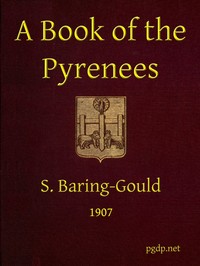
S. Baring-Gould’s A Book of the Pyrenees (1907) moves through the mountain chain not as a continuous itinerary but as a series of discrete chapters, each anchored to a town or valley. The structure is additive: the reader progresses from Bayonne to Perpignan, yet the narrative often pauses for extended historical digressions or architectural inventories. What gives the work coherence is a recurring pattern of transition—between light and shadow, cultivation and wilderness, past and present—that the author repeatedly stages at the boundaries of his scenes.
Architecture as a Fixed Point
Baring-Gould habitually anchors each location with a detailed description of a church or castle. At S. Savin, for instance, he notes the “plainest and most severe Romanesque” exterior, the weathered tympanum, and the marble tomb of the saint. These architectural set-pieces serve as stable centers around which the narrative rotates. The author’s eye moves from the general form to specific features: the organ case “adorned with three faces that loll their tongues,” or the holy water vessel supported by figures of the proscribed cagots. Such details ground the reader in a tangible place before the text expands outward to landscape or legend.
The Threshold Between Valleys
Movement between scenes is often marked by a sharp geographical or atmospheric boundary. When the railway from Argelez enters the gorge toward Cauterets, Baring-Gould writes that “we have passed from one world into another; from golden sunlight into mountain gloom.” The transition is not merely visual: vegetation changes, the rock becomes “dark schist streaked with ferruginous stains,” and the sound of the Gave boiling below intensifies. These thresholds recur throughout the book, giving the journey a rhythmic quality—each valley is a distinct chamber entered through a narrow passage.
Recurring Images of Ruin and Decay
Across the excerpts, ruined castles, abandoned monasteries, and weathered sculptures appear with notable frequency. At S. Savin, the village itself is “small, silent, and deserted,” impressing “a sense of melancholy.” The monastery of S. Orens had fallen into such disrepute that by the eighteenth century its community consisted of only a prior, sacristan, and a single monk—one described as “the craftiest and most dangerous man conceivable.” These images of decay are not merely historical footnotes; they create a counterpoint to the grandeur of the peaks and the vitality of the thermal resorts, suggesting that human works are as subject to erosion as the mountains themselves.
The Gave as a Narrative Thread
Watercourses—especially the Gaves—function as connective tissue between scenes. At Pierrefite, the Gaves from Luz and Cauterets “break out of the cleft rock” and unite. The stream from the Lake of Isaby descends “in a series of cascades” past the ruins of S. Orens. Baring-Gould uses these rivers to guide the reader’s eye and to link otherwise disparate locations. The sound and movement of water also reinforce the theme of transition: the Gave that “boils and thunders” in the gorge contrasts with the still, reflective lakes higher up, and with the quiet, sunlit basins where villages are “strewn thick” over the slopes.
Readers approaching A Book of the Pyrenees will find it most rewarding when they attend to the author’s deliberate shifts in scale—from a weathered tympanum to a whole valley, from a single monk’s misdeeds to the sweep of Roman history. The book is not a continuous narrative but a mosaic; its coherence lies in the repeated patterns of entry, observation, and departure that structure each chapter. Following the Gaves and the railway lines as they cut through the mountains offers a reliable way to navigate both the geography and the text.
Years of shelving these travelogues have taught me that Baring-Gould’s Pyrenean shadows find a distant echo in the harsh, sun-bleached trails of Pattie's Personal Narrative, 1824-1830; Willard's Inland Trade with New Mexico, 1825, and Downfall of the Fredonian Republic; and Malte-Brun's Account of Mexico — Key Ideas to Explore. Both are books of passage, where every gorge or desert crossing marks a quiet leave-taking, a slow fade between one world and the next.
How did this book work for you?
Your answers remain private and are stored only in this browser.
Leo Wright
1 month ago