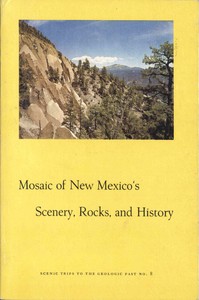
Mosaic of New Mexico's Scenery, Rocks, and History — Context and Discussion

(12 User reviews)   2553
In Category - Geography
Christiansen, Paige W. [Editor], Kottlowski, Frank Edward, 1921- [Editor] Project Gutenberg 2017 Not confirmed
New Mexico -- History; New Mexico -- Description and travel; Geology -- New Mexico Readers of public-domain and historical texts
Project Gutenberg digital edition en

Edition facts

Words 67,028
Reading time 292 min
Text sections 10

Mosaic of New Mexico's Scenery, Rocks, and History — Context and Discussion can be approached with a clearer sense of reading commitment from its source measurements: 67,028 words, 4 hr 52 min estimated reading time, and 10 detected text sections.

The text analysis averages about 20.4 words per sentence, while the detected sections provide another way to judge how the source is divided.

Project Gutenberg metadata also associates the work with “New Mexico -- History,” connecting these edition facts with the source record’s subject description.

This editorial note examines the language, narrative voice, and shifts in pace across ten scenic trips through New Mexico's geology and history, drawing on specific inscriptions, fort descriptions, and road logs.
Share
Editorial Edition Score 4.8/5

Calculated from edition completeness, EPUB availability, text structure and catalogue metadata. Not a user rating.

How this score is calculated
  • Description quality20 pts
  • Title & short description10 pts
  • Source metadata20 pts
  • Text length15 pts
  • Chapters / structure15 pts
  • EPUB file integrity20 pts

Total of 100 points, scaled to a 2.5-5.0 range. Editions with an empty description or a missing EPUB file are not scored.

Edition quality

Read the Text

e was abroad which would grow and strengthen and leave a deep imprint on New Mexico. Beginning on the wild islands of the Caribbean and then fanning out into the heart of Mexico and the South American continent, this new force spread across the face of America. Europeans, more exactly, Spaniards, came bent upon conquest for its own reward, for the glory of God, and for gold. These sturdy men from the Iberian peninsula with weapons vastly superior to the Indians’, with the horse which made them highly mobile and devastating in battle, and with tactics and precision in warfare unknown among the Indians, were to sweep without serious setback across the great cultures of Mexico and Central and South America. By 1540, they were ready to take their next leap forward.

On the west coast of Mexico, at a place called Culiacan, a colorful host gathered. In their ears rang the words of the legend of the Seven Cities of Cibola, seven golden cities, a legend which had been popular in Spain for many generations. Mexico City had produced wealth, and the Spanish were ready to believe that other fabulous cities existed. One Spaniard had already crossed part of North America and had heard from the Indians tales of the rich cities. His name was Cabeza de Vaca, and the exuberance of his tales fired the imagination of the Spaniards.

The soldiers and adventurers gathering in Mexico, commanded by Francisco Vasquez de Coronado, were the first Europeans to organize an expedition to the American Southwest. Leaving from Culiacan in 1540, they went up the west coast of Mexico into modern Arizona, then east into New Mexico. The seven golden cities turned out to be the pueblos around Zuni, New Mexico, and not golden at all. The expedition, although discouraged, marched into the Rio Grande Valley and visited most of the pueblos there. Still they failed to find the treasure they sought. In a final desperate attempt, they explored onto the Great Plains, eventually reaching central Kansas. Broken in spirit and body, they struggled back to the Rio Grande Valley, and then retraced their route to Mexico. In all, the expedition covered a two-year span. A failure? Yes, in terms of wealth and treasure found. Yes, in terms of conquest, for nothing had been conquered. No, in terms of human resources, for the Indians Coronado met were to be the incentive that would bring the Spaniard back to New Mexico. While the Spaniard did seek gold and glory, he also burned with a missionary zeal and sought souls for his deep-running religion, Roman Catholicism.

For fifty-five years after Coronado, interest in New Mexico and the Southwest was spotty. Other things occupied the Spanish—primarily silver discoveries in the central valleys of Mexico. But men did not forget New Mexico and saw there an opportunity for missionary activity and exploitation. Also, other nations of Europe were beginning to take an interest in the North American continent, and New Mexico began to look attractive to the Spanish as a frontier defensive outpost. The frontier line pushed ever northward from central Mexico. By 1595, the Spanish were ready to push a salient into New Mexico.

From among the mining communities of northern Mexico, a force of two hundred colonists was assembled by Don Juan Oñate who had a contract to colonize New Mexico. After countless delays due to politics and supply shortages, the Oñate expedition left Chihuahua in 1598. The route went north across the desert to the Rio Grande near El Paso del Norte (modern Juarez), thence up the Rio Grande into New Mexico. On August 18, 1598, they arrived at San Juan, and there founded the first capital of New Mexico, San Juan de los Caballeros. These lands of the Southwest so long colored by the Indian now received a new imprint, one that would alter the direction and flow of culture and change it from the Indian to the Spanish Southwest.

From San Juan, and later (1610) from Santa Fe, Oñate, his men, and his colonists brought New Mexico under the Spanish yoke. In co-operation with the Franciscan Order, which had been assigned the task of converting the Indian, Oñate supervised the building of missions and mission churches at many of the pueblos of New Mexico. At the same time, Spanish towns developed, the most important being the new capital at Santa Fe. By 1628, New Mexico was solidly in the hands of her new masters.

The period from 1628 to 1680 was one of internal conflict and isolation for New Mexico. It lay far out on the frontier, alone and distant from its source of supplies. It lacked many of the items necessary for frontier life, particularly hardware and clothing. Its population was small, and in constant fear of Indian uprising, and its officials were too weak to act with vigor. Finally, there was a lack of genuine interest on the part of the central authorities. All these problems led to internal conflicts between soldier and colonist; between colonist and Indian; between colonist and official; and, perhaps most bitter of all, between church and state. This latter conflict would erupt time after time, openly, and with bitterness and denunciation from both sides. Governors were excommunicated as heretics; Franciscans were accused of all sorts of crimes and improper behavior. This, plus the other conflicts, gave rise to growing disrespect by the Indians for their European conquerors. The superiority of Christianity was questioned by the Indians as they watched the attacks and counterattacks made by priest and governor. The whole system of Spanish rule seemed a mockery. In 1680, the Indians decided their way was best after all and rose in rebellion.

Led by Po-pé from Taos, the various pueblos banded together in a mighty effort to remove the Spanish from traditional Indian lands. For the first time the pueblos came together, united by a single purpose. There were two exceptions; Isleta, just south of Albuquerque, and the Piro villages farther south (Socorro) remained loyal to the Spanish. Up and down the Rio Grande Valley, the Spaniards fell before the pent-up anger of the Indians. Survivors gathered at Santa Fe, but their water supply was cut, and they were forced to retreat south. At Isleta and later at the Piro villages, they received aid before continuing south to El Paso del Norte. With them went their Indian allies from Isleta and Socorro. It was a total defeat for the Spanish, and the Indian again was master of New Mexico.

But not for long, for at El Paso there gathered a force dedicated to revenge for their comrades who had died before the Indian onslaught. Ably led by Diego de Vargas, this expedition moved into New Mexico in 1692. The Indians, who had achieved such unity for the moment in 1680, were again badly divided. De Vargas, instead of having to subdue an alliance, had only to deal with one pueblo at a time. Very quickly New Mexico was returned to a mission area and frontier military post. The Pueblo Indians became permanently subjected to European domination. Their one and only attempt at unity had, in the final analysis, failed.

During the seventeenth and eighteenth centuries, New Mexico was the heart of the Spanish empire in the Southwest. Only in southwestern Arizona, western Texas, and California did the Spanish hold any land other than in the upper Rio Grande Valley of New Mexico. During these centuries, this valley complex played out its dual role of mission area and military outpost. Its only connection with the resources and ideas of the world was a long hazardous road that stretched from Santa Fe to Chihuahua City and then south to Mexico City. This was New Mexico’s Royal Road, and over it moved everything needed by soldier, priest, and civilian. The trade was dominated by the merchants of Chihuahua, and New Mexico suffered. The tale of New Mexico during this period was one of poverty, hardship, and warfare. And several vital forces moved across the land.

One of these forces had long been in the Southwest, but latent. The Spanish adopted an Indian word meaning _enemy_ to describe it—Apache! The Spanish brought with them domesticated animals which quickly adapted to conditions of the New World and became available to the Indian. Most important was the horse, at least as far as the Apache was concerned. By the early eighteenth century, the Apache, and other groups on the plains, had adapted to the use of the horse. While dangerous as foot soldiers, the Apache became vastly more dangerous as mounted warriors. Whereas they had been satisfied with minor raids against the pueblos and the Spanish holdings prior to 1700, they exploded on a wave of terrorism during the eighteenth century which very nearly drove the Spanish from the frontier. Late in the century, the conflict between the Apache and the Spanish became increasingly bitter. The history of the Southwest became the history of incessant Indian incursions and Spanish attempts to control the raiders. The missions declined and in many instances gave way entirely to the presidio or fort. In New Mexico the military came to dominate the missionary, and only through the heroic efforts of the meager force at the Presidio of Santa Fe did the Spanish manage to hold New Mexico from total collapse. A poor province became poorer, population declined, both among the Spanish and Indian, and the future looked dark indeed.

Far from New Mexico, other forces were stirring which would have a profound effect on the province and the Southwest. Spain and the Spanish empire were in trouble. Spain had failed to develop the supply capability to keep her colonies alive and was forced to spend her wealth in other areas of Europe. After two and a half centuries, the cumbersome and inefficient colonial administrative machinery was breaking down. While Spain’s star was descending, other European nations were on the move. England, France, Holland, and Russia were contesting with Spain for control of the New World. England and France were digging in on the east coast of North America; Holland was penetrating the islands of the Caribbean, and Russia was pushing down the Pacific Coast from Alaska. The weakness of Spain and the failure of her colonial government, plus help from Napoleon by way of his invasion of the Iberian Peninsula in 1808, brought about the collapse of the Spanish empire. In America, patriots, inspired by the earlier success of the American Revolution and afire with the ideas of the French Revolution, struck out at the remnants of Spanish rule. By 1825, all the Spanish colonies but the islands of the Caribbean were free and independent nations. New Mexico and the Southwest became part of the Mexican state.

Almost immediately, Mexico, without leaders, without a political heritage to lead it to stability, and torn by power struggles large and small, was plunged into a period of political anarchy and civil war which would last for half a century. The problems and dangers of a far-flung frontier were lost in the din of conflict, and New Mexico became a forgotten province. Its claims as a mission area were so weak as to be almost nonexistent. It was no longer needed as a military outpost, for the danger to Mexico was not external, but internal. Its reasons for being were forgotten, at least for the moment, and New Mexico had to survive on her own initiative. But for one very important fact, the Spanish salient into the Southwest might have collapsed under the weight of poverty and Indian attacks. That fact was the opening of the Santa Fe Trail in 1821, a trail which linked the Spanish world with the Anglo-Saxon world then pushing its frontiers out from Missouri. This trail, so rich in lore and adventure, so much a part of the history of both the American west and the Spanish north, was the door through which passed the characters for the final act in the history of the Southwest.

Before the final act, however, it is vital and necessary to set down the contribution of two hundred fifty years of Spanish occupation and rule. The coming of the Spaniard to the Southwest began a mixture of white and red races which resulted in a new mixed race. The first generation of those who came up from Mexico were Caucasians; their descendants were usually not. They came seeking wealth and security, but there was neither wealth nor security in New Mexico, and they remained poor, very poor. The society that evolved was to be based upon farming and stock raising, and its organization was to be feudal in nature. There would be no education; hence, there could be no intellectual advance. The world began to go ahead of the people of New Mexico. Only in the house of the rico was there any sign of the wealth and grandeur of Spain; everywhere else was poverty. Farming was left in the hands of the Indian, while the Spaniard chose to be a man on horseback, a cattleman, an aristocrat. In the final analysis, Spanish New Mexico would not develop as democratic and agricultural, but aristocratic and feudal. The hacienda was a part of old Spain in exile. The rico tried vainly to hold to his idea of chivalry and to a decorum suitable to his position. But what chance was there in the face of the increasing poverty, the constant danger to life and property, and time that did not move? While individual courage of the upper class remained, discipline and industry died. When the American army marched into the Southwest, the sons of the conquistadores could offer no armed resistance. Perhaps the most amazing thing about the society of the ricos in New Mexico was that it failed to contribute any lasting monument. It left no art, no music, no great highways, no adequate governmental system.

But many elements of Spanish culture were to persist, and these arose from the collective consciousness of the people of New Mexico. Around the great haciendas were small villages with their artisans and workers. It was among these people that the heritage of Spain clung to this land. Many of these towns yet remain and are not much different from those of two hundred years ago. To a large degree, their Spanish culture seems hidden and undiscovered, but the people, their loves and hates, pleasures and hopes, beliefs and fears, are governed by tradition, a tradition that finds its roots deep in the soil of Spain.

Today, when we look at the cultural scene in New Mexico, we can see direct evidence of Spanish occupation. The language of half the people in the state is Spanish, in some areas still the Spanish of the sixteenth century. Roman Catholicism, of which the Spanish were the most Catholic, dominates the religious scene. The Spanish heritage in political attitudes, in building and architecture, and in the legal tradition of the state is apparent. New Mexico, of all the states in the United States, is the only one that can claim a truly Spanish heritage.

While Spain lost its empire and New Mexico and the Southwest sank into poverty and decay, yet another force was on the march, a force that welled up in an Anglo-American people clinging to the Atlantic Coast of North America. As these people developed a nation, they also discovered a sense of destiny which turned their faces to the west and their footsteps toward the sunset. With them moved their culture. At first, it was a trickle, a few traders bent on profit, crossing the plains on the Santa Fe Trail. Then the trickle became a flood. For New Mexico, these men came as saviors. The Missouri traders broke the Chihuahua monopoly and goods from all parts of the world began to flow into New Mexico, resulting in higher standards of living. These Yankee traders, sensing a good thing, also penetrated the markets of Mexico, using New Mexico’s Royal Road to gain entrance.

Again there was conflict, not Spanish and Indian, but Latin and Anglo-American. Mexico owned the lands of the Southwest and intended to keep them. But this American, with his gaze glued on western skies, refused to turn aside, and he strode on, grinding the feeble efforts of Mexican resistance into the desert sands. The Mexican War in 1846, suddenly transferred ownership of Texas, New Mexico, Utah, Nevada, Arizona, and California from Mexico to the United States. This was nearly half the territory of Mexico. New Mexico, with her already complex cultural pattern, was subjected to still another influence.

The history of the American occupation of the Southwest is as complex and diverse as its predecessors. Its ingredients include cattle, mining, railroads, agriculture, science, and the Indian. All these, and others, combined to give an Anglo-American slant to the Southwest. The Indian culture did not disappear, nor did the Spanish, but rather a new stratum was cast that was to complete the mosaic.

When the American arrived in New Mexico, he found a poor, backward area, hungry for trade and outside contacts. He found the Indians of the Southwest in open rebellion against the white men. The Navajo and other Apache groups, the Comanche, and some of the Pueblos were the primary offenders. This was to be the main problem occupying the time and energy of the American settler and soldier for forty years after 1846. Until the Indian situation was stabilized, there would be little economic and social development.

The method evolved for containing the vicious raids against friendly Indian, Spanish, and American communities was a series of forts placed at strategic passes or trails surrounding the traditional lands of the Apache. The Indian strongholds were located primarily in the mountainous regions of southwestern New Mexico and southeastern Arizona. The line of forts stretched along the Rio Grande south of Socorro to the vicinity of Las Cruces, and west along the southern edge of the mountain escarpment into Arizona. Then the defense complex ran north across the desert to an irregular line running east from Flagstaff through Gallup and back to the Rio Grande. These forts were well garrisoned and provisioned and began to carry the fight to the Indian. Early success was halted by the conflict generated by the American Civil War.

The center of the Civil War in the west was in New Mexico. There was conflict, argument, and some small degree of fighting in other western states and territories as settlers from the north or south struggled to carry this territory or that state into the Union or the Confederacy. These were, however, local matters and as much political as military. In New Mexico, there was a war and there were battles, battles which deserve to be a part of the general Civil War story but that are usually forgotten in the smoke and roar of eastern cannon.

Two major battles were fought in New Mexico, the first a Confederate victory, the second a Union victory which saved New Mexico, and the west, for the Union. The aim of the Confederate forces was to capture, intact if possible, the forts in New Mexico and Arizona with their great store of military provisions, provisions badly needed by the Confederate army. Also, there was a feeling among southern leaders that success in New Mexico might also lead to success in California, badly split on the question of secession, and in Colorado, rich in silver and gold. An army recruited in Texas and commanded by General Henry Sibley was sent to accomplish Confederate aims.

This army entered New Mexico along the traditional route, moving up the Rio Grande from El Paso. It quickly subdued the forts and Union troops in southern New Mexico and continued up-river. On February 21, 1862, it met a Union army commanded by Colonel E. R. S. Canby at Valverde, a small community about twenty miles south of Socorro, New Mexico. Kit Carson, New Mexico’s famous trapper and scout, commanded the New Mexico Volunteers, a part of the Union force. Canby’s troops were beaten and dispersed at the Battle of Val Verde, leaving the upper Rio Grande Valley virtually without defense. Within a few weeks, the Texans had taken Albuquerque and Santa Fe. But one stronghold in New Mexico remained in the hands of the Union forces. Fort Union, northeast of Las Vegas, New Mexico, became the focal point of action by both north and south. Sibley, marching from Santa Fe, knew success depended on the fall of Fort Union. The Union forces, equally aware of the importance of the fort, hurriedly reinforced it with a number of volunteers from Colorado.

The volume opens not with a preface but with a series of scenic trip numbers, each promising a route through New Mexico’s geologic past. The editors, Paige W. Christiansen and Frank E. Kottlowski, adopt a guidebook voice that is at once instructive and historical, blending road-log directions with accounts of Spanish inscriptions and military forts. The language shifts between precise geologic terminology—such as “redoubt,” “parapets,” and “bomb-proofs”—and narrative passages that recount events like the Pueblo Revolt or the Civil War invasion. This alternation creates a distinctive rhythm: the reader moves from the measured pace of a road log to the quicker tempo of historical anecdote, then back to geologic description. The excerpts show that the editors rely on primary sources, quoting directly from inscriptions at El Morro and citing the words of Don Diego de Vargas. The voice remains consistently informative, avoiding overt interpretation while letting the landscape and its recorded history speak.

Voice of the Guidebook: Between Instruction and Narrative

The narrative voice in Mosaic of New Mexico’s Scenery, Rocks, and History is that of a knowledgeable field companion. It addresses the reader directly through the road-log format, using phrases like “you will see” or “the road passes.” Yet it frequently slips into a more formal historical register when describing sites. For example, the entry on Fort Union National Monument begins with a straightforward description of location and purpose, then shifts to a chronological account of the fort’s construction, its role in the Civil War, and the arrival of Confederate forces. The language becomes more vivid with phrases such as “the great Conestoga wagons and prairie schooners” and “the ditches, parapets, and bomb-proofs of this redoubt.” This dual voice—part tour guide, part historian—creates a layered reading experience. The editors do not maintain a single tone; instead, they modulate between the impersonal efficiency of a road log and the engaged storytelling of a historical narrative. The result is a text that feels both practical and evocative, though the transitions can be abrupt.

Pacing Through Inscriptions and Military History

The pacing of the excerpts varies markedly between sections. The El Morro passage moves slowly, dwelling on the inscriptions of Oñate and de Vargas, and pausing to explain the Pueblo Revolt and the later prohibition of carving. The language here is measured, almost meditative, as the text invites the reader to consider the rock as a palimpsest of colonial ambition. In contrast, the Fort Union section accelerates. Sentences become shorter, and the narrative jumps from the fort’s founding in 1851 to the Civil War in 1861, then to the arrival of Sibley’s Texas column. The use of dates—1851, 1861, 1862—creates a rapid chronological pulse. The editors also employ lists of military roles (“mounted patrols of dragoons,” “Quartermaster Depot”) that compress information. This shift in pace mirrors the historical urgency of the events described: the slow accumulation of inscriptions versus the swift movements of armies. The reader experiences a change in tempo that is not merely stylistic but thematic, reflecting the different rhythms of exploration and conflict.

Recurring Details: The Santa Fe Trail and the Language of Movement

Throughout the excerpts, the Santa Fe Trail appears as a recurring motif, described in language that emphasizes movement and commerce. The text notes “the great Conestoga wagons and prairie schooners” and “the Independence-Santa Fe Mail,” and mentions that “century-old tracks of the Santa Fe Trail can be still seen near Fort Union.” This focus on trails, roads, and routes is central to the volume’s structure: each scenic trip is itself a path through geology and history. The editors use directional language— “twenty-six miles northeast of Las Vegas,” “on the route of the old Santa Fe Trail”—to anchor the reader in space. The repetition of such phrases creates a sense of journey, reinforcing the guidebook’s purpose. Moreover, the language of movement extends to the historical figures: Oñate “passed by,” de Vargas “conquered,” and Kearny’s troops were “dispatched.” The text consistently frames history as a series of traversals, whether by Spanish explorers, U.S. soldiers, or modern visitors. This lexical pattern gives the volume a cohesive verbal texture, even as the subject matter shifts from geology to military history.

Readers will find that the volume rewards attention to its shifts in register and tempo. The road-log sections demand a different kind of reading than the historical narratives; one might skim the former for directions and linger over the latter for detail. The editors’ decision to include direct quotations from inscriptions and official documents adds authenticity but also breaks the guidebook’s flow. For a fuller experience, consider reading the historical passages aloud to catch the cadence of nineteenth-century military reports and Spanish colonial proclamations. The mosaic metaphor of the title is apt: the book is assembled from fragments of different genres, and its interest lies in the juxtapositions.

That book about New Mexico’s scenery stayed with me, not for its facts, but for how it slows you down—each rock layer feels like a held breath. Something similar happened reading The Journal of Jacob Fowler Narrating an Adventure from Arkansas Through the Indian Territory, Oklahoma, Kansas, Colorado, and New Mexico, to the Sources of Rio Grande — Inside the Classic. Just a quiet voice, a long trail. It lingered the way those road logs did, softly.

Ava Garcia
4 weeks ago

Grace Baker
2 weeks ago

Oliver Rodriguez
1 month ago

Sophia Gonzalez
2 weeks ago

Anthony Flores
1 month ago

4.5
4.5 out of 5 (12 User reviews )

Add a Review

Your Rating *
  • ...
    Carly Lucas - 1 month ago
    {'rating': 3, 'text': "This book is a beautiful tribute to New Mexico's natural and cultural wonders, with gorgeous imagery that truly showcases the state's unique beauty. However, the historical sections feel a bit brief, especially compared to the extensive focus on scenery. A more balanced treatment would make it an even better resource."}

  • ...
    Scott Thomas - 2 weeks ago
    {'rating': 2, 'text': 'The photographs are nice, but the overall presentation feels disjointed. The chapters jump between topics without a clear narrative thread, and some of the historical explanations are oversimplified. It reads more like a series of magazine articles than a cohesive book. I was hoping for a more in-depth and structured exploration.'}

  • ...
    Emma Thomas - 2 weeks ago
    {'rating': 5, 'text': "A stunning visual and educational journey through New Mexico's diverse landscapes and rich history. The photographs are breathtaking, capturing the vibrant colors of the desert, mountains, and ancient pueblos. The accompanying text is informative and engaging, seamlessly weaving geology, ecology, and human history. A perfect coffee table book for anyone who loves the American Southwest."}


Reader reflection

Record your reading impressions

A brief reflection can help important ideas stay with you longer.

Your progress 0 / 10
1

Where are you in your reading?

2

Was reading this book enjoyable?

3

Would you encourage someone else to read it?

4

How much effort did this book require?

Related eBooks