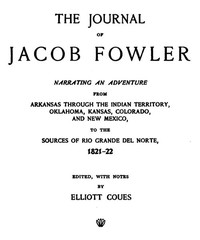
The Journal of Jacob Fowler Narrating an Adventure from Arkansas Through the Indian Territory, Oklahoma, Kansas, Colorado, and New Mexico, to the Sources of Rio Grande — Inside the Classic
Edition facts
Before opening The Journal of Jacob Fowler Narrating an Adventure from Arkansas Through the Indian Territory, Oklahoma, Kansas, Colorado, and New Mexico, to the Sources of Rio Grande — Inside the Classic, the edition data offers a quick orientation: 52,015 words, 3 hr 47 min estimated reading time, and 7 detected text sections.
The text analysis averages about 32.8 words per sentence, while the detected sections provide another way to judge how the source is divided.
Project Gutenberg metadata also associates the work with “West (U.S.) -- Description and travel,” connecting these edition facts with the source record’s subject description.
Calculated from edition completeness, EPUB availability, text structure and catalogue metadata. Not a user rating.
How this score is calculated
- Description quality20 pts
- Title & short description10 pts
- Source metadata20 pts
- Text length15 pts
- Chapters / structure15 pts
- EPUB file integrity20 pts
Total of 100 points, scaled to a 2.5-5.0 range. Editions with an empty description or a missing EPUB file are not scored.
Read the Text
ed expedition came down the Arkansaw and the Canadian in 1820. Pike ascended the main river from its great bend to its sources in 1806, the same year that his lieutenant, Wilkinson, descended this stream from the point where he parted from his captain. For the lower reaches of the river we have Thomas Nuttall’s Journal of Travels into the Arkansa Territory, during the year 1819, and various other accounts. But I know of no record, earlier in date than Fowler’s, of continuous ascent of the river from Fort Smith to the present position of Pueblo in Colorado. He meandered the whole course of the Arkansaw between the points named, except his cut-off of a small portion by the Verdigris trail. One of his men, Lewis Dawson, who was killed by a grizzly bear at the mouth of the Purgatory—and who, let us hope, left that place for happier hunting-grounds—may not have been the first white American buried in Colorado soil; but the record of a prior funeral would be far to seek. Whose was the first habitable and inhabited house on the spot where Pueblo now stands? Fowler’s, probably; for Pike’s stockade was hardly a house, and Jim Beckwourth came twenty years after Fowler. The Taos Trail from Santa Fé through the Sangre de Cristo Pass to the Arkansaw at Pueblo was well known to the Spaniards when Fowler’s party traversed it in the opposite direction; but we have no American itinerary of that passage at an earlier date than his. When Fowler ascended the Rio Grande to Hot Spring creek in the San Juan range, he followed a Spanish road; but never before had an American expedition been so near the sources of that great river Del Norte, and not till many years afterward did any such prolong Fowler’s traces upward. The greater part of Fowler’s homeward journey from Taos to Fort Osage will doubtless prove as novel to his readers as it was unexpected by his editor. South of the Arkansaw, his trail was neither by the way he had gone before, nor by either of those roads which were soon be established and become well known; for he came neither by the Cimarron nor the Raton route, but took a straighter course than either, between the two, over Chico Rico Mesa and thence along Two Butte creek to the Arkansaw on the Kansan-Coloradan border. Again, when Fowler left the Arkansaw to strike across Kansas, he did not take up the direct route which caravans were about to blaze as the Santa Fé Trail from Missouri through Council Grove to Great Bend; but went a roundabout way, looping far south to heads of the Whitewater and Verdigris rivers before he crossed the Neosho to make for the Missouri below the mouth of the Kansas.
This bare outline of the way Fowler went in twice crossing the Plains, to and from the Rocky mountains, suffices to show that, taken as a whole, it was not only the first but also the last such itinerary of which we have any knowledge; for if this route has since been retraversed in its entirety, time has obliterated all sign of such an adventure.
Another point is to be scored in connection with Fowler’s unique performance. The date is a critical one in the history of the whole subject. That elusive “Red river” which Pike sought in vain in 1806 was only the year before Fowler found by Long to be the Canadian fork of the Arkansaw, instead of that separate tributary of the Mississippi which Long imagined he was descending till he reached its confluence with the same stream which the other detachment of his party followed down. Just at the time when Long had finished his exploration, and Fowler was leading his people home from their wide wandering, the Santa Fé trade was taking definite shape. Like every other such enterprise, this one went through its tentative stages of hesitancy and disconcert, before its final organization as a regular industry; and if any year can be named as that of complete equipment for the business, it is that of 1822. Fowler was thus a factor in the beginnings of a commerce which grew by what it fed upon to the immense proportions it had acquired when it was checked by the troubles of 1846.
Whatever be deemed the merit or demerit of Fowler’s work as a whole, viewed in the light of a contribution to the history of Western adventure in connection with the fur trade, I can attest the coherency and consequence of the narrative now before us. The author tells a plain, straightforward story, and never fails to make it intelligible. He never loses the thread of his discourse, never tangles it into an irrelevant skein, and holds himself well in hand through all the asperities he experienced. He is a reasonable sort of a writer, if not a very ready one. I have had little trouble in trailing him from start to finish, for all that compass-points uncorrected for magnetic variation, and distances chained only in the sensations of a tired traveler, are not among the “constants of nature”—especially in the mountains; and I am satisfied that his route is laid down correctly in my notes. The sign is a little dim here and there, in some of the cross-country laps, but we never lose it. Fowler had the good eye for topography to be expected of a professional surveyor, and I only wish that some other persons whose peregrinations I have had occasion to follow had exercised powers of observation equal to those which Fowler displayed under arduous exigencies of trade and travel.
Thus far by way of introducing to the public the hitherto unknown author of a new contribution to Americana, which I hope may find that favor which I believe it deserves.
The task of copying Fowler’s Journal _v. l. p._ was intrusted to an expert, Mrs. Mary B. Anderson, to whom acknowledgments are due for the result. The copy was made in my absence from home last summer, during which the lady was left entirely to her own resources in making out the manuscript; and subsequent critical comparison of the transcription with the original served mainly to show its beauty as well as accuracy. The Index is also her careful handiwork.
1726 N STREET, WASHINGTON, D. C., _January 1, 1898_.
MEMORANDOM OF THE VOIGE BY LAND FROM FORT SMITH TO THE ROCKEY MOUNTAINS.
thorsday 6th Sept 1821
We Set out from fort Smith[1] on the arkensaw and Crossing that River pased threw a bottom of Rich Land Well timbered and much Kaine[2]—thence over Low Ridges the land poor and in some places Rockey—at 30 miles crosed the tallecaw[3] a Crick about 150 feet Wid Large bottoms on bothe Sides and at ten miles farther Crosed the Illinios[4] River about 80 yds Wide and about one mile farther Stoped for the night at Beens[5] Salt Workes—this is the Second night Since We left the fort—the Workes one Small Well With a few kittles about 55 gallons of Watter make a bushil of Salt and the Well afords Watter to boil the kittles about three days in the Weake Been and Sanders Has permission of the govem [government] to Worke the Salt Spring—the Sell the Salt at one dollar per Bushil—from Heare We pased over Some High poor Hills Some valleys and Some pirarie lands about twenty miles to a large bottom Well Covered in parts With Caine and Well timbered—threw Which We pased about Eight miles to grand River or Six bull.[6] this is fine bold Streem of Clear Watter about 150 yd Wide Which We forded but not Without Some doupts—the Watter Runing With great force—about one mile above the mouth of this River is the mouth of the virdegree[7] a River of about one Hundred yds Wide deep and muddy at the mouth and up it to the Rapids about four miles Wheare there is a trading House. but we Stoped at the trading Hous of Conl Hugh glann[8] about mile up the VII degree Wheare We Remained till the 25th Sept makeing a Raingment for our gurney to the mountains—Heare five of our Hunters Left us and Went Home this Sircumstance much dispereted more of our men—tho We Still determined to purced—and on the 25th of Sept 1821 We found our Selves 20 men in all[9] and under the Command of Conl Hugh glann With mager Jacob Fowler Robert Fowler Battis Roy Battis Peno george Duglas Nat Pryer —— Bono —— Barbo Lewis Dauson —— Taylor Richard Walters —— Ward Jesey vanbeber —— Slover —— Simpson —— Maxwill —— Findley Battis moran and Pall a black man the property of mager Fowler we Head thirty Horses and mules Seventen of Which traps and goods for the Indean traid—and Each man mounted on Horsback—We Left the traiding House in the afternoon—North 50 West about five miles to a Small Crick Which Runs West in to the virdegree—the Bottom between the Six bull and verdegree is High and Rich Well timbered With Some Caine and is about one and a Half miles Wide to the Hills—from What We Cold Learn there is no Caine above this on the arkensaw—We pased to day Some Pirarie Cirted With Wood land Some timber on the Crick it Rained Hard We Packed up our goods and Covered them With Skins to keep them dry and Piched our tents for the night—Conl Hugh glann Haveing Left us and gon by the mishenerys,[10] and to meet us Some Wheare a Head—
We Set out Early along the Road Leading to the osage vilege[11] threw fine Pirarie Lands a little Rolling and Scirted With timber the ground is Black and Rich and the vew the most delightfull We this day maid 20 miles threw the Rain Which Continued all day at night Camped on a Crick about 50 feet Wid Runs West With an Extensive Beed of Stone Coal in its bottom there is Some Wood along the Crick but the Cuntry is mostly Pirarie a little Rolling Scirted With groves of timber Heare the Rain Continued all night—Heare one of our Hunters—Slover Lay out all night but Came in in the morning
We Set out Early along the path threw the Pirarie—timber still to be seen in groves and along the Branches—We maid 20 miles and Camped on a Small Crick Well timbered—Heare we found Findley He Left us 2 days ago—and was Heare waiting for us this day was Clear and pleesent Robert Fowler killed a Large Buck—one Hors gave out was left
Rained all day we Remained in Camp—
the Weather Clear We Set out Early and was Soon over taken By Conl glann and soon after in Sight of the osage vilege. Heare We Ware delited With a vew of a nomber of Hills or mounds[12] nearely of the Same Hight. from 70 to 80 feet but of diferent Shapes Some Round and pointed like a Stack others squair and flat. and the top of one neare the vilege Contains about 15 acres of Rich Black land—and great part of the Bluff faced With a parpendickler Rock—so that with but little labour a few men might keep off a large armey—Heare is one of the most delight full peace of Cuntry I Have Ever Seen—of Rich lime stone land mixed With Wood lands the Pirarie is more Exstensive than Woods—
Heare We find not one sole in or about the vilege the Indeans are all gon a buffelow Hunting and are not Exspected to return till in the Winter. We find our Jurney to this place one Continued Corse North 50 W Heare we Crosed the virdegree and got on Higher grounds and Nearly Covered With Rocks in Some places and Steered North 70 West 10 miles to a small Crick[13] Runing South and Well timbered—Heare We Camped for the night—We Seen this day Some Wild Horses. game is scars We this day find our Horses two Heavey loaded and Concluded to leave part [of their loads]
We this morning Berryed or Cashed [cached] as the french Call it 32 Bever traps 2 Cases of tobaco and fifty pounds of Brass Wier on the West Bant of the Creek 200 yds above the large Road and 50 below the small path on Which is a Connu [canoe] marked on an oack
We Set out Early and Stered North 50 West to the little virdegree[14] Wheare a large Indean Road Crosse it this River is about 30 yds Wide With Clear Watter and High Banks—and large inCampment on the East Side. Heare we Crossed to the West Side and followed the North forke of the Road about one mile to another Branch of the Same River but Not more than ten Steps Wide both Streems Running South With Rich timbered bottom be tween the boath—after pasing this forke We Stered the Same Corse threw Roling Pirarie ten miles to a mound. to the North and East the Cuntry is a little Rolling mostly Pirarie With timber along the Branches on our left the mountains or High Hills appeer at from four to five miles distance Heare to avoid the Hills Which Continu on our left We Steered N 30 West six mill [miles] and Camped on the little virdegree—Peno Went off to Hunt in the fore part of this day and did not Return—
We set out Early and pased over High Leavel Pirarie lands North 45 West three miles to the High Hills Crossing a small Bransh Runing North at the futt of them—We after Some time gained the top of the Hills and found the Cuntry Rolling and partly timbered and partly Pirarie at twelve miles farthe We Crossed the little virdegree again and Camped on the North Bank Heare Duglass got lost in the Evenings Hunt and lay out all night
this morning our Horses Ware much Scattered and took us till a late our to Collect them—Duglass found the Way to Camp—and Peno Came in With Some veneson Haveing Killed three deer—Heare we found a large Indean Road going up the Crick and Crossing some of its Branches South 30 West and the Hills being High We followed the Road. the lands poor With Short oack and Hickory for about fifteen miles Wheare the Cuntry begins to appear With fine Rich Piraries Well bordered With Wood lands of a good quality We this day got one deer and Some turkeys game is getting more plenty—We maid 20 miles and Camped on a Small Crick Running South—[15]
We Set out Early and at three miles Crossed a Crick 50 feet Wide Running No 45 West—and at about three miles farther in an open Pirarie We found a large Buffelow Bull lying dead Soposed to be killed by the Indeans We now begin to Hope Soon to kill Some Buffelow our Selves as we Have nothing With us but Salt only What We kill our Selves. Heare We find our Selves in an oppen and Exstensive Pirarie Scarsly a tree to be Seen but as We prograss We find Sign of Buffelow We See some deed and Some Caberey[16]—in the Evening on our left We Seen Ward one of our men on Hors back Running a buffelow Some of [us] put off to asist Him but He killed the large Buffelow Bull before We over took Him—after takeing What meet We Wanted—We Went on makeing 23 miles and Camped on a River about 50 yds Wide Running West Soposed to be the Bad Salean[17]—the Watter is Clear and deep at this place Some Sign of Bever our Corse this day is North 60 West—
the Pirarie threw Which We passed this day is nearly leavel With a Rich Black Sandey Soil there is no other Rock Except that of limestone Which only appeer in Spott on the Sides of Branches and on the top of Some of the Highest ground—for there is no Hills Heare there is Some timber along the branches
We Set out Early Crossing the River a little below our Camp Wheare there is a good ford and at about two miles Crossed a large Crick 100 feet Wide it Corse South East and about 10 miles Crosed a Crick 50 feet Wide all So Running South East Heare the Pirarie is a little more Roleing—and at 18 miles Crosed a crick—and 19 miles inCamped[18] on a Crick the West forke of the Same the meet Below Wheare We Crosed—Heare the Cuntry Still Continues to be a little Roleing the land Rich the limestone appeers in some places along the Bluffs Which are not High or Steep Hear We seen great nombers of Poor Buffelow Bulls and Blame our Hunters for not killing fat Cowes When there is not one to be seen
5th october 1821 [continued]
for We Cold not tell them apart at So great a distance and it Was in vain for our Hunters to tell us there Was no Cows among So many Buffelow as We Cold See at all most any time Corse this No 50 West 19 miles—
We set out Early over Butifull High Pirarie leavel and Rich and at Eight miles West We fell on the arkensaw River[19] Heare there is plenty of timber all a long the River on both Sides as far as We Cold See We are now out of meet and Blameing our Hunters for not finding Buffelow Cows the Have neglected to kill the Bulls When the Cold and the are not so plenty as the Ware and We beleve Have been latly drove off by the Indeans as the are now shy.
6th octor 1821 [continued]
We now steered north leaveing the [Arkansaw] River on our lefft Hand Beleveing the High Hill and Bluffs Near the River Wold be difequal to pass With loaded pack Horses—at 6 miles over High Rich lime stone Pirarie We Camped on a Crick[20] 60 feet Wide Wheare We killed Some turkeys in the Evening—We Ware all So informed by Some of the party that Indeans Ware Camped at no great distance—
We moved West up along neare the [Arkansaw] River over Some High Rockey Bluffs and threw a large Sandy bottom to the bank of the River makeing five miles and Camped near the Indeans from them got Some dryed meet Corn Beens and dryed Pumkins for [which] We paid them In Such artickels as the wanted—these are the osage Indeans and the first We met With on our Route the [they are] frendly the Weather is now giting Cold With High Winds Cloudey and Rained threw the night—the timber in the bottoms and Hill Sides is a king [kind] of Jack oak and very low Cotten Wood and Willow groes along the River—we stoped at this place for the purpose of purchasing Horses Haveing left two be Hind and three more unfitt for Survice makes us bad of for Horses and the prospect of provetions is not promesing as We Heare the Indeans are Camped for alonge Way a Head of us threw Wheare We must pass let [left] one Horse With an Indean—
We moved up the River N 45 West two miles and Camped the Rain Still Continues Heare Conl glann purchased one Poor Hors at a High price and Highered one Indean to go along With us Some of the Hands killed 10 turkeys
We Set out Early and Steered north leaveing the River at Right angles over Riseing butifull Pirarie three miles to White[21] River about 70 yᵈˢ Wide Running West into the arkensaw this River Has a Continued grove of timber all alonge its Cores [course] as far as We Cold see and the land Rich—We Crosed this River leaveing it on our Right and up it at Eight miles Camped on the South West Side for the purpos of purchasing Horses Sucseeded in Swoing [swapping] two and purchasing two at a High price—the Indeans advise us to Cross the arkensaw and Steer West Corse and strike the arkensaw at the big timber Near the mountains but the Season is late and Want of Wood and Watter Renders it a Hazous undertakeing—the Indeans Say it is about two days travel to the little arkensaw—the Hunters Brought in four deer one very fine Buck the first good meet We Have Head the land on this Creek is Rich and Well timbered along the bottoms the Bluffs furnis abundance of lime Stone for all purposes of Building and fenceing—and is Capeable of makeing one of the finest Settlements in the united States—there being a nomber of the best of Springs
Jacob Fowler's journal, written during an 1821–22 expedition from Arkansas to the sources of the Rio Grande, survives in a manuscript that Elliott Coues transcribed with minimal correction, preserving what the editor calls Fowler's “appalling spelling.” The result is a document whose linguistic roughness matches the physical hardships it describes. Fowler rarely pauses to reflect; his entries compress days of hunger, cold, and uncertainty into short, declarative sentences. The text’s value lies not in polished narrative but in the unguarded immediacy of its voice—a voice that records failed hunts, lost horses, and the constant negotiation between hope and desperation.
Spelling as a Record of Sound
Fowler’s orthography is not merely error but a phonetic system. He writes “futt” for foot, “Hors” for horse, “Crick” for creek, and “faceses” for faces. These spellings capture early-nineteenth-century Kentucky pronunciation and suggest that Fowler wrote as he spoke, without concern for convention. The editor’s decision to reproduce the text “verbatim” (apart from a few printing corrections) means the reader encounters the expedition’s voice almost as it was set down. The spelling slows reading, forcing attention to each word—a fitting pace for a narrative where every detail of terrain and provision matters.
The Rhythm of Scarcity
The journal’s structure is driven by the search for food. Entries from late February 1822 show a pattern: “killed nothing,” “Seen a great many deer but killed nothing,” “begin to think of killing one of our Horses.” Fowler’s prose tightens as hunger intensifies. On February 25, he writes of “nothing to Eat but look at Each other With Hungrey faceses.” The next day, two men grow “black in the face” and “white” from starvation. The crisis breaks when Robert kills two deer, and the camp enjoys a “Suntious feest.” Yet the relief is temporary; within days the party is again moving upriver, hoping for elk. The journal’s rhythm—scarcity, crisis, brief plenty, renewed scarcity—mirrors the precariousness of frontier travel.
Silent Landscapes, Abrupt Transitions
Fowler’s descriptions of the landscape are sparse but telling. He notes distances, directions, and physical features: “the mountains High on Each Side—the tops of Which are a great Hight above vegatation.” Such observations appear without commentary, embedded in the daily record of movement. The journal’s pace shifts abruptly between action and stasis. One entry may report a hunt or a river crossing; the next, simply “Some Snow fell.” This flatness of affect is not indifference but a function of the journal’s purpose—to track location and resources. The reader must infer the emotional weight from what is left unsaid: the silence between entries, the gaps where days pass without event.
Because the excerpts cover only a portion of the expedition, the journal’s full arc—from Arkansas to New Mexico and back—remains partly hidden. Readers should attend to the interplay between Fowler’s laconic entries and Coues’s editorial apparatus, which provides historical and geographical context. The journal rewards those willing to read slowly, letting the misspellings and abrupt transitions become a kind of music—the sound of a man writing at the edge of endurance.
That rainy afternoon, Fowler’s raw spelling made his hunger feel closer than history. I lingered on a line about cold mornings and empty packs, and somehow my hand wandered to a shelf, pulling down Six months in the gold mines — Edition Insights. Different terrain, same ache. I sat there until the rain quit, turning pages by lamplight.
How did this book work for you?
Your answers remain private and are stored only in this browser.
Michael Rivera
3 weeks ago