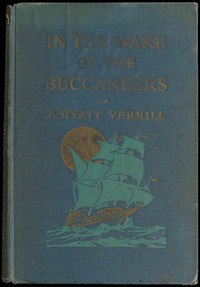
In the wake of the buccaneers — Themes and Context
Edition facts
Before opening In the wake of the buccaneers — Themes and Context, the edition data offers a quick orientation: 86,858 words, 6 hr 18 min estimated reading time, and 22 detected text sections.
The text analysis averages about 29.4 words per sentence, while the detected sections provide another way to judge how the source is divided.
Project Gutenberg metadata also associates the work with “Buccaneers,” connecting these edition facts with the source record’s subject description.
Calculated from edition completeness, EPUB availability, text structure and catalogue metadata. Not a user rating.
How this score is calculated
- Description quality20 pts
- Title & short description10 pts
- Source metadata20 pts
- Text length15 pts
- Chapters / structure15 pts
- EPUB file integrity20 pts
Total of 100 points, scaled to a 2.5-5.0 range. Editions with an empty description or a missing EPUB file are not scored.
Read the Text
und everything not to his liking “pure corruption,” and who proudly boasted of being a Turks Island boy.
With the Chesterfieldian manners of a duke, painstakingly perfect English, and the dignity of a Spanish grandee, Joseph looked down upon the “stupid niggers” of the crew as from an impregnable height, and fraternized with Sam only, the others being merely tolerated. A right good cook and a faithful boy was Joe, and a never-ending source of amusement because of his assumption of a sort of guardianship over me.
But ere the cruise was over he and Sam and one other were the only remaining members of my original crew. Never did the Vigilant’s mud-hook seek bottom in the limpid waters of some lovely isle that one or more of my sailors did not desert. Not that they had aught of which to complain, or found their duties on the ship irksome, but good American dollars in their pockets, a rich green shore, and chocolate-colored sirens were temptations beyond the black man’s power to resist. Yet never were we short-handed. For every man who left, a score clamored to be taken on, and had the Vigilant been on a pirating adventure I could have filled her to the hatches with as varicolored and vari-charactered a crew as ever swarmed over the bulwarks of a stricken prize.
To the West Indians, every American is a millionaire and a philanthropist, and in their eyes, apparently, he is morally bound to carry each, all, and sundry to that dreamed-of-land the States, the Mecca of every inhabitant of the islands. Wherever the Vigilant folded her white wings and came to rest, we were besieged by a small army of black, brown, yellow, and every intermediate shade, all begging to be allowed to accompany us. For the West Indian is a restless soul, never content unless on the move and caring not a jot where day or night may find him, albeit he is intensely patriotic, and thinks his island preferable to all others and his people the salt of the earth.
Thus it came about that, what with deserters and new-comers, the crew was a sort of kaleidoscopic aggregation, shifting from yellow to brown, from black to tan, from soft-voiced, slurring-tongued “patois men” to h-dropping ’Badians and brogue-speaking Montserratans. And a happy family they were at that—good-naturedly chaffing one another, having long-winded arguments over the respective merits of their various island homes, using preposterous, meaningless words of their own invention. And all and each making life miserable for the hapless natives of that “right little, tight little island” designated on the maps as Barbados, affectionately dubbed “Little England” by its sons and daughters, and also known as “Bimshire Land,” [4] whose natives seem for some strange reason ever to be the butt and the jest of the other islanders, and who are the pariahs of their race, if we are to believe their fellow negroes of the Caribbees.
Never did my men tire of taunting some poor ’Badian with the doggerel verse
A ha’penny loaf an’ a bit o’ salt fish, Da’ ’s wha’ de ’Badian call’ a dish. A bottle o’ soda divided ’twix’ t’ree, Da’ ’s wha’ de ’Badian call’ a spree.
If the ’Badians happened to be in the minority, they bore it as best they might or retorted that “You men awnt civ’lized. You don’ know better’n to wear alpargats to a charch of a Sunday,” a response which usually brought on a loud cracking of tough skulls, as, like enraged goats, the men butted one another’s wool-covered craniums—a contest in which the ’Badian always emerged victorious. For to accuse an islander of wearing alpargatas (the sandal-like footgear brought from Venezuela) to church, is an insult not lightly to be suffered. Indeed, if ever there was a being who outshone Solomon in all his glory, it is the West Indian negro on the Sabbath; and his highest ambition is, in order to draw greater attention to his gorgeous raiment, to possess a pair of brilliant, pumpkin-colored shoes which, to quote his own words, “goes queek, queek when Ah walks in de charch.”
As might be expected, in the constant change and interchange of multicolored flotsam and jetsam, we picked up many a strange and interesting, not to say downright weird, character.
There, for example, was Trouble. He appeared one glorious golden morn as we lay at anchor off St. John, like Aphrodite rising from the sea, his scanty garments dripping with brine; for, being both boatless and penniless, he had used nature’s gifts to win his way from shore to ship like the amphibious creature he proved to be. But, aside from the unexpected manner of his appearance, nothing could have resembled the goddess of the sea less. In fact, he was unquestionably the ugliest and most repulsive representative of the genus Homo and the species Sapiens that I have ever gazed upon—bony and big, with gorilla-like arms and a face so broad and forehead so low that his head appeared to have been forced out of shape by hydraulic pressure, while his natural absence of human-like features had been enhanced by some accident which had deprived him of even the semblance of a nose. There, above his immense mouth, were two huge round holes which, when he grinned,—as he constantly did,—stretched into slits that seemed ever on the point of meeting his ears and literally severing his black face into upper and lower hemispheres.
Like a prize bull-pup, he was so extravagantly ugly that he actually was fascinating, and not until he spoke could I take my eyes from him. And his first words were almost as astounding and unexpected as his appearance:
“Ah’m beggin’ o’ yo’ pawdon, Boss, for mah audacity an’ assumption o’ de manner o’ mah absence o’ dignification for precip’tately discommodin’ yo’, but Ah’d like for to propoun’ de interrogation ef yo’ can absorbinate mah sarvices for a member o’ de crew, sir, for to circumnavigate de islan’s, sir.”
Was I dreaming, or had the climate affected my brain? I literally gasped.
But the next instant I had recovered myself, for I knew that this noseless apparition with his wide mouth filled with long words could have originated in but one locality in all the islands, Antigua, whose dusky inhabitants seem to pride themselves upon the amplitude of the words they can command, regardless of their meaning or aptness.
“What’s your name, and what can you do?” I asked, more as a formality than anything else, for I never dreamed of taking this creature on.
The noseless negro scratched his head and wiggled his bare toes.
“Ah was christened wi’ de cognomen o’ Henry Francis William Nelson Wellington Shand, sir,” he replied; and then, as an afterthought, “but Ah’m most usually designated by de name o’ Trouble, sir.”
“Trouble!” I exclaimed.
“Yaas, sir,” responded the grinning negro, instantly. “Thank yo’ sir, for mekkin’ acceptance o’ mah sarvices, sir. Ah’ll endeavor for to conduc’ mahself wif circumspection an’ implicitness. Ah’s a sailor, sir, an’ Ah’m not expandulatin’ buncomb when Ah takes upon mahself de assumptiveness o’ de assertion, sir.”
I was speechless,—so astounded at the man’s “assumptiveness” that he had been hired that I could not find words to inform him of his mistake,—and by the time I recovered from my astonishment he had disappeared in the forecastle.
Sam stood by, chuckling to himself.
“Ah ’spec’s he may be a good sailor, Chief,” he vouchsafed. “An’ we’re in need o’ two han’s, Chief.”
“All right, Sam,” I replied. “I suppose he doesn’t need a nose to run aloft or tail onto a rope.”
And so Trouble came unto us, but if ever a man belied his name it was “Henry Francis William Nelson Wellington Shand, sir,” for Trouble was a very treasure of a hand. He was as much at home in the water as on land or deck, and when, later, our anchor fouled one day, in fifteen fathoms, Trouble made nothing of diving down and releasing the fluke from its lodgment under a mass of coral and rock, while the height of his enjoyment was to challenge Sam to dive overboard and kill a big shark in a single-handed duel beneath the sea. And Sam, though a diver by profession, who had killed many a man-eater with a blow of his long, keen-bladed knife, freely admitted Trouble’s amphibious superiority.
Aloft he was a very monkey; he was ever scouring decks or polishing brass; he was as good-natured as he was ugly, and even dignified Joseph unbent and passed many a half-hour chinning with this weird waif of the sea. As for the other members of the crew, after one or two tests and trials they abandoned all attempts to out-talk or out-argue him, for his ready flow of multisyllabled words left them floundering in a vocabulary totally inadequate to cope with Trouble’s “expandulations” and “supercil’ous methodictions.” On one occasion I overheard a bit of argument between our Antiguan find and a recent addition to the crew—for the older members invariably egged on new recruits to argue with Trouble.
I do not know what the argument had been about nor what the new man had said, but as he was a French mulatto from Dominica,—or, as the other islanders have it, a “patois man,”—I presume he had been referring in no complimentary terms to Henry Francis et cetera’s native heath.
“Yo’ worthless specimen o’ misguided humanity yo’!” exclaimed Trouble. “Yo’ insignificant an’ fragment’ry yaller element! For wherefo’ yo’ have de audacity to let yo’ imagination direc’ yo’ to dat assumption? Who yo’ t’ink yo’ addressin’ in dat highfalutin’, presumptious, dictatious manner? Ah desire yo’ to distinc’ly an’ def’nitely absorbinate de eminen’ly interestin’ an’ important info’mation Ah’s propoundin’, an’ if yo’ declinates to precip’tately reconsider de sentiments yo’ jus’ expressed an’ at once an’ immediately an’ hereby and in witness whereof retrac’ yo’ asservations once, forever, an’ henceforth, der’ ’s boun’ for to occur a casulty an’ a deceased patois nigger, an’ de gentleman is goin’ for to be compulsified for to discommode hisself to acquire another incumbent for to fill de work what yo’ lack o’ intellec’ don’ fit yo’ for.”
Needless to say, in the face of this dire threat—which to the fear-stricken recipient savored of an incantation by a witch doctor or “obeah man”—the French islander promptly and “precip’tately” reconsidered and retracted whatever it was that had inadvertently brought on Trouble’s outburst.
To the last day of the voyage Trouble was with us in name if not in spirit, and never did I regret that he had hired himself, so to speak.
Aside from him and Sam and Joe, the only fixture was a red-haired, freckle-faced Montserratan boy whom I could not resist employing on account of his rich brogue and who served as cabin-boy, laundryman, and clown, and with the ready wit of his wild Irish ancestors kept us all in good humor throughout the cruise.
ST. THOMAS AND ITS PAST
St. Thomas is very beautiful when seen from a distance, with its gray-green mountains rising above the sea, mottled with soft mauves of shadow and dazzling silvery sunlight—a mass of opalescent tints, as though the hills were carven from a giant pearl shell. And as the harbor opens to view, and the little town of Charlotte Amalie is seen spreading fanwise up its three hillsides in triangles of soft buff, creamy white, and red, it seems a bit of the Mediterranean detached and transplanted here in the Caribbean.
But it must be confessed that the enchantment is mainly loaned by distance, for St. Thomas is a barren, arid island. Charlotte Amalie—shut in by the hills—is unbearably hot; there is but one level street, and while steep lanes, often ascending in stairways, lend picturesqueness to the place, they are most discouraging thoroughfares on a sweltering tropical day. Moreover, St. Thomas, having ever been a world’s mart, a free port depending entirely upon commerce, has not the foreign, fascinating atmosphere we find in many of the islands.
Its people, a marvelous potpourri of nationalities, of necessity have become remarkable linguists, with a smattering of virtually every civilized tongue, but they are neither picturesque nor interesting.
On such a cruise as ours, however, this Virgin Island possession of Uncle Sam’s could not well be passed by, although, truth to tell, its piratical associations are somewhat meager and of questionable authenticity.
I had seen this famed source of bay-rum under both Danish and American rule, in rain and in shine, in war and in peace; in prosperity with a forest of masts in its snug harbor, and, again, devastated by hurricanes, its shores strewn with tangled wrecks of countless vessels. But never before had St. Thomas appeared to me just as it did when, passing Sail Rock in the lee of the land, we entered the harbor and dropped the Vigilant’s anchor before Charlotte Amalie.
I was looking at it now from a new point of view. I was blind to the great coaling-piers, to the gaunt dry-dock, to the fact that gray-painted cruisers and big liners rode upon the glassy surface of the harbor, that the Stars and Stripes flew from the mastheads and flagstaffs, that motor-cars scurried along the waterfront street. I was trying to visualize St. Thomas as it had been two centuries and more before, when ships with lateen yards, high poops, and wall-sided hulls pierced with cannon ports had swung to anchor before the town; when roistering crowds of fierce-whiskered, besashed sea-rovers with cutlasses at their belts and bandanas on their heads had swaggered through the steep and crooked streets; when the little pink “Christian’s” fort beside the quay had been looked upon as a real fortification, and the Danes had not been above receiving the corsairs with open arms.
It is not a difficult matter to imagine Charlotte Amalie’s streets filled with buccaneers, for after a few encounters with boatmen, beggars, guides, and gamins the average visitor will be convinced that the pirates still haunt the place in spirit if not in body. Maybe the freebooters’ traits have been passed down in their blood that flows to some extent in the veins of a large proportion of the Virgin Islanders; but, however that may be, the present inhabitants of St. Thomas know little and care less about piratical history or relics.
And an investigation of the contents of the shops in Charlotte Amalie will lead one to think that much of the buccaneers’ loot still remains in stock after a lapse of two centuries or more. Such juxtaposition of odds and ends from all quarters of the world, it would be hard to duplicate in any other port upon the planet.
Predominant, and everywhere in evidence, are the two items inseparably associated with St. Thomas,—jipijapa hats and bay-rum,—although I understand that since my last visit to the island the Volstead law has shown its effects even on bay-rum. But formerly—at any rate, until its acquisition by Uncle Samuel—St. Thomas was more famous for its bay-rum than for anything else; bay-rum and St. Thomas were synonymous around the world. Charlotte Amalie reeked of bay-rum: every ragged negro one met upon the streets besought one to purchase it, and from mysterious pockets or other receptacles produced a bottle or two; every shop was filled with it, and the bumboats that flocked about every incoming and departing ship were laden with it. And, strangely enough, very little bay-rum is or was made in St. Thomas. To be sure, it was adulterated, bottled, and labeled there, but the oil itself, the distilled extract of the aromatic bay-tree, was largely produced in St. John. Not one person in a million has ever heard of St. John, perhaps the most charming island of the Virgins, and yet it is really the home of the bay-rum which made St. Thomas famous. Such are fate and the effects of publicity; and as the St. Johnians ultimately reaped a goodly portion of the profits, I do not suppose they ever complained.
If the visitor to St. Thomas could not be cajoled or nagged into purchasing bay-rum, then the islanders at once pressed upon him their next most famous commodity, the jipijapa or Panama hats. Somehow the visiting public was imbued with the idea that Panama hats could be purchased more cheaply in St. Thomas than elsewhere, and despite the fact that very few of the St. Thomas head-coverings ever saw the Isthmus of Panama, and still fewer ever were made in far-off Ecuador (the home of the bona-fide Panama), tourists, seamen, and other visitors to St. Thomas invariably stocked up. It made no difference, apparently, whether the hats were made in the neighboring Virgins or in Porto Rico; as long as they were bought in St. Thomas the purchasers reasoned that they must be genuine and cheap. Even the braided paper affairs made by the Japanese were often passed off on the unsuspecting and gullible tourists as real Panamas—whatever that may mean. Of course, St. Thomas being formerly under Danish rule and a free port, many articles which were subject to high duties in the United States were to be had in the island at bargain prices, but Monte Cristi Panama hats were not among them.
In the good old days before our country and all its colonies became Saharas, St. Thomas was noted up and down and roundabout the islands for its liquid refreshments. Not only was there the justly famed St. Croix rum, but countless other beverages were procurable there, brought from every liquor-producing country on the globe, in addition to several native concoctions that were not to be laughed at, especially after a few glasses with the jovial Danes on a holiday. Oddly enough, inhabitants of tropical lands, especially the West Indies, consume incredible quantities of alcoholic drinks and seem to thrive upon them. Indeed, it is a source of pride among the islanders that their native islets consume more alcohol per capita than any other lands, and there is always a keen rivalry between Barbados, Bermuda, and Demerara in this respect. But I had never heard that St. Thomas strove for first honors and when, on one occasion, I inquired of a huge blond-bearded St. Thomas Dane why this was so, he informed me in all seriousness that as the St. Thomas people consumed more than all the others combined, it was beneath them even to mention the question. Surely it must make the old buccaneers squirm in their graves to think of St. Thomas, of all places, being dry, dry as old Dead Man’s Chest with its one bottle of rum to fifteen men, at least on the surface, though I know there is many a cask, bottle, and keg stored safely away in private stocks for the proper drinking of a skoal when occasion arises.
But to return to the shops of Charlotte Amalie and their strange and motley contents. Here, with the bay-rum, jipijapa hats, and dried corals and starfish, are French perfumes, picture post-cards, and seed necklaces. Miscellaneous hardware, groceries, tinned goods, cloth, and bric-à-brac are inextricably mixed. A salesman searches among piles of cordage and bundles of rowlocks to find a pair of shoes or a package of patent medicine, for every shop in Charlotte Amalie, save the drug stores, is a little of everything with nothing in its place. I remember seeing a pair of very old-fashioned skates dangling rusty and forlorn outside a shop one blistering December day. Curious to know how such things happened to be in the island, or to whom the proprietor expected to sell them I entered and inquired. Imagine my amusement and surprise when I was solemnly informed that they had been there for years, that no one knew exactly what they were used for, but, in the words of the chocolate-colored shopkeeper:
“I am aware that they are significant of the holiday season, and so I hang them outside regularly each year as an indication to passers-by that my Christmas stock of merchandise is on sale.” Truly, an original method of advertising!
Verrill opens with a sweeping declaration that the Caribbean Sea is 'entrancing,' immediately establishing a tone of romantic admiration. His prose is marked by a deliberate contrast between the beauty of the setting and the brutality of the buccaneers, whom he calls 'villains' yet 'brave beyond compare.' This tension between condemnation and admiration recurs throughout the excerpts, shaping the reader's perception of historical figures. Verrill's descriptive style relies on vivid adjectives—'sapphire sea,' 'stately galleons'—and a rhythmic listing of ships and explorers that evokes a sense of epic continuity. The author's voice is that of a storyteller who admires his subjects' audacity while acknowledging their moral failings, a balancing act that defines the narrative's character.
Diction and the Romanticization of Violence
Verrill's word choices consistently soften the harsh realities of buccaneer violence. He describes them as 'dare-devil spirits' and 'picturesque and romantic,' even as he admits they were 'black-hearted cutthroats.' This juxtaposition is not accidental; it reflects a deliberate authorial strategy to frame the buccaneers as figures of adventure rather than mere criminals. In the account of Ogeron's shipwreck, Verrill uses phrases like 'resourceful pirates' and 'crafty old rascal' to cast the buccaneers in a sympathetic light. The murder of the fishermen is reported with clinical detachment: 'discharged a great blow on his head with the hatchet and soon bereaved him of life.' By quoting Esquemeling directly, Verrill distances himself from the brutality, allowing the historical source to speak while he maintains a tone of scholarly observation. This selective diction—emphasizing bravery and resourcefulness while downplaying bloodshed—shapes the reader's emotional response.
Dialogue as Characterization
Dialogue in the excerpts is sparse but strategically placed to reveal character. Ogeron's 'most eloquent speech' to his fellow buccaneers is mentioned but not quoted, leaving the content to the reader's imagination while emphasizing his persuasive power. In contrast, the buccaneers' loyalty is shown through their actions: they 'stoutly maintained' that their leader had drowned, a detail that Verrill uses to illustrate their 'faithfulness and loyalty to one another.' The only direct speech comes from Esquemeling's account, which Verrill incorporates as a block quotation. This choice creates a layered narrative: Verrill's own voice frames the events, while the historical source provides authenticity. The lack of extensive dialogue suggests that Verrill prioritizes action and description over character interaction, focusing instead on the collective spirit of the buccaneers rather than individual personalities.
Descriptive Techniques and Setting
Verrill's descriptions of the Caribbean are lush and sensory, using color and motion to evoke a vivid backdrop. He refers to the 'sapphire sea' and 'lovely tropical islands,' creating a paradise that contrasts with the violent deeds of the buccaneers. This technique heightens the drama: the beautiful setting becomes a stage for brutal acts. In the shipwreck episode, Verrill describes the buccaneers 'driven ignominiously upon the rocky Guandanillas,' a phrase that combines a sense of shame with a specific geographical detail. His use of place names—Samana Bay, Tortuga, Porto Rico—grounds the narrative in real locations, lending credibility to the adventure. The author's own illustrations and photographs, mentioned in the title page, suggest a visual dimension that complements his descriptive prose, though the text itself relies on evocative language to paint scenes of escape, survival, and conflict.
Narrative Structure and Authorial Voice
Verrill structures his account as a blend of travelogue and history, moving between general observations and specific anecdotes. The introduction sets up a thesis—that buccaneers were 'a most important factor in shaping the destiny of the New World'—which the subsequent narratives illustrate. His authorial voice is confident and opinionated, as when he declares that 'we owe an immense debt of gratitude' to the buccaneers. This direct address to the reader creates a sense of shared perspective. The excerpts show a pattern of beginning with a broad statement, then narrowing to a particular event, such as Ogeron's shipwreck. Verrill often ends episodes with a moral or reflective comment, like the note that the raid ended 'with great confusion in their minds.' This structure gives the work a cohesive argumentative thread, even as it recounts disparate historical incidents. The author's presence is felt throughout, guiding interpretation and shaping the narrative's emotional arc.
Verrill's authorial choices in diction, dialogue, and description reveal a deliberate effort to romanticize the buccaneers while maintaining a veneer of historical objectivity. Readers attentive to his word selection will notice how he balances admiration with moral judgment, using vivid settings and selective quotations to craft a compelling narrative. This work rewards those who examine not just the events described, but the language used to describe them—a language that transforms cutthroats into heroes and the Caribbean into a stage for daring exploits.
Reading about Verrill's sun-bleached prose, I remembered my grandfather's wheezy laugh as he flipped through his old travelogues. That same feeling returned with In Quest of El Dorado — Background and Themes—not the gold itself, but the quiet ache of maps where nothing matches memory. Both books feel like lanterns on a dark porch, casting shadows of places I’ll never truly visit.
Ella Moore
1 week agoIsabella Mitchell
1 month agoJack White
2 weeks agoGrayson Young
4 weeks ago-
Tabitha Kim - 3 weeks ago
An enjoyable read for pirate enthusiasts, offering a mix of history and adventure. The narrative is lively and includes many interesting anecdotes. However, the lack of citations and occasionally exaggerated storytelling make it less reliable as a historical source. Still, it's an entertaining book that paints a colorful picture. -
Michael Ortiz - 3 weeks ago
I found this book to be overly romanticized and lacking depth. The author focuses too much on thrilling tales and not enough on the socio-economic context of piracy. Many chapters feel repetitive, and the dialogue is clearly invented. It reads more like a dime novel than serious history. Pirate scholars will likely be disappointed. -
Alexandra Rodriguez - 2 weeks ago
This book is a swashbuckling delight! It vividly recounts the exploits of buccaneers in the Caribbean with thrilling detail. The author's enthusiasm for the subject is contagious, and the stories of treasure, plunder, and adventure are captivating. A must-read for anyone fascinated by the golden age of piracy.
How will you remember this book?
Save your reaction, strongest insight, and memorable passage.
William Nelson
1 month ago