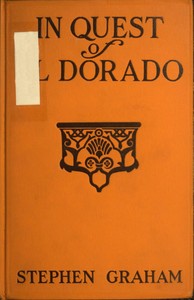
In Quest of El Dorado — Background and Themes

(0 User reviews)   27
In Category - Geography
Graham, Stephen, 1884-1975 Project Gutenberg 2021 Not confirmed
Mexico -- Description and travel; United States -- Description and travel; West Indies -- Description and travel; Panama -- Description and travel Readers of public-domain and historical texts
Project Gutenberg digital edition en

Edition facts

Words 87,527
Reading time 381 min
Text sections 9

Before opening In Quest of El Dorado — Background and Themes, the edition data offers a quick orientation: 87,527 words, 6 hr 21 min estimated reading time, and 9 detected text sections.

The text analysis averages about 19.1 words per sentence, while the detected sections provide another way to judge how the source is divided.

Project Gutenberg metadata also associates the work with “Mexico -- Description and travel,” connecting these edition facts with the source record’s subject description.

Stephen Graham's travel narrative traces a journey from Spain to the Caribbean, Mexico, and the US Southwest, using the Spanish conquistadors' gold quest as a lens to examine early 20th-century American expansion and the persistence of fortune-seeking.
Share
Editorial Edition Score 4.8/5

Calculated from edition completeness, EPUB availability, text structure and catalogue metadata. Not a user rating.

How this score is calculated
  • Description quality20 pts
  • Title & short description10 pts
  • Source metadata20 pts
  • Text length15 pts
  • Chapters / structure15 pts
  • EPUB file integrity20 pts

Total of 100 points, scaled to a 2.5-5.0 range. Editions with an empty description or a missing EPUB file are not scored.

Edition quality

Read the Text

abella did it also, and Columbus must have watched them in his day, saying of those who mocked him--"_They are the blind_; wash them and feed them also."

As we stand in an interior court of the palace behind a row of halberdiers in quilted coats the chime of eleven o'clock seems to blend with Southern sunshine, and there breaks out from a hidden orchestra mysterious Eastern music heralding the approach of to-day's King and Queen. Searching, questing strains tell of mystery, of aching loneliness and hidden loveliness--the haunting introit of Milpager's "Jerusalem." Erect stand the stately halberdiers in their scarlet coats, holding at arm's length their bright halberds of Toledo steel. And along the corridors of the palace come carelessly and as it were at random, in twos and threes, talking together, the Duke of Alva, the Duke of Medina Sidonia, the Duke of San Fernando, the Marquis of Santa Cruz, the Marquis of Torrecilla, and other nobles, all dressed in gold-embroidered coats and wearing orders and insignia and medals. They are the grandees of to-day, and their faces peer out strangely from the midst of their grandeur--peering out, as it were, from their family trees, from time itself.

Come the King and the Queen, and the King is wearing the uniform of an infantry captain, for this King is democratic, but over his shoulders hangs the magnificent collar of the Order of the Knights of the Golden Fleece. I wonder if the Emperor Charles Fifth, Cortes' Emperor, instituting this order of the Golden Fleece, thought first of his Spaniards as the Argonauts of the age, the youth of Spain aflame with a vision of gold. The golden collar hung in a long V on the King's back and seemed to have worked on it some noble history, reminding me there in the midst of the crush of the palace, of that perfect Spencerian verse,

Yt framèd was of precious ivory, That seemed a work of admirable witt; And therein all the famous history Of Jason and Medea was ywritt; Her mighty charms, her furious loving fitt; His goodly conquest of the golden fleece; His falsèd fayth, and love too lightly flitt; The wondred Argo, which in venturous peece First through the Euxine seas bore all the flower of Greece.

Columbus was a Jason of a later time, and there were many other Jasons and would-be Jasons--Cortes, Pizarro, Balboa, Coronado.

The democratic King Alfonso wears his collar, however, with an easy grace, and there is upon his visage a whimsical expression which remains. The Queen looks more like a queen than he does a king. She is wearing the diadem, and she walks like a queen in a picture, her long cream veil of lace enveloping her, trailing downwards and backwards as she walks. Her ladies are in luminous silks, with high combs in their hair, and long lace mantillas like the Queen's, cream-colored, hanging from their combs to the hems of their robes, giving them the mystery of beauty which is part hidden and part revealed.

Following them go the diplomats of all nations, all differently dressed in the full Court dress of their respective nationalities. And they wear their stars and their ribbons, too. There goes the Chinese Ambassador with embroidered golden dragons on his velvet coat; there goes the American Ambassador in spotless lawn and glimmering white tie. The French and the Italian ambassadors look like diplomats, men with old secrets, profound players of human chess; even the English Minister looks as if he knew more than he would ever say, but the American is quite different, a new piece of cloth on a very old garment, as it were upon Joseph's coveted coat of many colors. His fresh, clean-shaven and young face surmounted on its stiff linen collar may have been recruited to diplomacy, and quite likely was, from a guileless Christian brotherhood. Though why turn the light upon him, unless it is because the Power he represents is the power in the New World which to-day affects most the liberties of the children of Spain overseas. Their representatives are here also, of Mexico, of Nicaragua, of Cuba, of Colombia. And here in state comes the "Patriarch de las Indias" himself, and with him the Papal Legate to Spain, the leaders of the Cortes, the Prime Minister, the Government.

All pass, and the halberdiers close up and the public follows, the chosen public asked to witness the monarchs' charity. It is so arranged that all take up their places in the chamber where the poor are waiting, and then the King and Queen come in.

I stand away at the back and look through the veils and screens of the hundreds of ladies' mantillas which hang from the high combs in their hair. It is as if the scene were too gorgeous and had to be viewed through a glass darkly. But yonder are the poor blind waiting in stalls, twelve black-shawled old women waiting for the Queen, twelve empty-eyed men in silk hats waiting for the King. In front of them all stand golden ewers with water, and the ritual of washing commences. One spot of water is dropped on each foot. One rub of the towel to each, and then, stooping, the Queen kisses each woman's big toe; the King kisses each man's big toe, too. Stately Queen Ena never changes her devout expression, but democratic King Alfonso, who rules by smiles, makes a comical face all the while.

Follows the feeding of them. All the grandees and their ladies take part. The Queen takes the center on one side of the room, the King on the other. Vast quantities of viands are brought from the kitchens and pantries of the palace. Begins the Comida de los Pobres, and every helping is enough to feed a family, and every helping is given personally by King and Queen to the chosen poor.

The King smiles all the time, and eats bits of what he gives, and tries to persuade the Archbishop to eat also and so break his fast, part of the King's prevalent facetiousness and jollity. Did he not make a wry face over kissing each old man's foot, as if it really were disgusting? Does he not on purpose break up the solemnity by dropping round rolling cheeses on the floor and letting oranges slip out of his hands? That makes all feel happy, all except the blind. They see nothing; they do not even eat; all that comes to them is taken away and packed into hampers to be sent to their homes. Their happiness is deferred. It is always so with the blind. They enjoy later what those who see enjoy in anticipation. As the King and Queen moved to and fro in that gilded crowd it seemed I saw Columbus there. He _saw_, and he gilded the grandees in time with a deeper crust of gold.

Spain's positive contribution to civilization is a sense of human dignity. This is shown in private life by elaborate manners and the instinctive respect of man for man. Other nations used to have it; it is a marked characteristic of Shakespearian drama, but revolutions have removed it. In Spain there is a delicacy of approach to strangers and even to friends which is unknown in the rest of the world. The bows, the marked attentions, the gravity and stately style of the Spaniard contrast remarkably with the self-enwrapped sufficiency of the Germans, the unrestraint of the Americans, the humorous slap-dash of the English and "devil take the hindmost" of the Scotch.

The Spanish houses too, with their noble portals, interior courts, patios, fountains, bespeak a sense of dignity. It is not a country of deal front doors and bottle-neck passages like England, nor of porches and porch-swings like America, nor of doors on the street like France. It is true that the interiors are devoid of fancy upholstery; there is a bareness as of a castle, an asceticism which expresses itself in straight-back chairs. But there will be flowers blooming and birds singing--there will be a graciousness which is often missed in the seemingly over-comfortable, over-hospitable interiors of English and American houses.

Gravity goes so far with the Spaniard that he hardly will be seen wearing tweeds. Loud attire is an offense. The Spaniard wears black and seems to wear it out of general respect. The women, moreover, do not flaunt their fashions in the churches or the streets. In Madrid the reproach cannot be made that you cannot tell the _monde_ from the _demi-monde_; the latter is always more indiscreetly dressed. The Queen of Spain has no legs.

You still drive with horses in Madrid; it is more decorous than the ill-mannered car bursting with speed even when going slowly. And the rudeness of the klaxon and the tooting horn are distasteful to the Spaniard. Behind fine horses, at ease, leisurely and graciously, there it is true the women will show what Paris wears.

Then in the ways of men to women the Spaniard surely has the first place for real politeness and regard. The French say _place aux dames_ but do not give it. The Englishman is gallant with women when they are good looking or if they remind him of his mother. But the Spaniard's politeness is invariable.

Doubtless the French at their best come nearest to the Spanish in their respect for one another, just as the North-American Yankees are furthest from them. The French are the most humane people in the world, because the most tolerant; and ever so much less cruel in temperament than the Spanish. But their _cochonnerie_, the ribaldry of their burlesques, the wretched homes, the open and stinking conveniences of the capital of civilization, decency forbids in Madrid.

With all that, however, let a _caveat_ be entered. The Spanish hold something which is increasingly valuable in our modern human society because it is all the while getting rarer--the gold of good manners. That is true, and must remain after all adverse criticism of the race. But the Spanish have a negative characteristic which through the centuries has outraged the fellow-feelings of the rest of humanity, and that is cruelty, a lust for torture.

The Auto de Fe, the ordeals of the Inquisition dungeons, these in the past; the survival of the bull ring and the plaza de gallos, these to-day and, remarked at all times, the Spanish inhumanity to horses, seem to outweigh good manners. And the behavior of the crowd about the bull ring--hideously burlesque and unrestrained, may perhaps have marked the crowds who in Seville in the sixteenth century watched brother men burn to death for the good of the Holy Father at Rome and the greater glory of God.

Spain lovers have said to me, "Do not go to the bullfight!" But in facing Spain as in facing any other country with some desire to know it, not merely to be struck by it, one must face what is dark and sinister as well as what is beautiful and annunciatory.

Hence a visit to the Square of the Bulls at Madrid on Easter Sunday, and the King is there and the President of the Sport, and a vast populace in sun and shade. Christ rose this morning; this afternoon six bulls must die. He rose indeed. Fifty thousand church bells told the world, lilies triumphant rose from bare boards in every home; we and all the children ate eggs of peace. This afternoon--Easter has gone--the populace will watch the bulls.

Next to me on the one hand sits a Japanese artist with a score of paper fans. In front are Madonna-faced women with high yellow combs in the crown of their hair and cream-colored lace hanging therefrom in an exquisite effect. The Japanese has crayons and decorates his blank fans rapidly. Group after group he sketches in on these fluttering fans, and then the grand parade of toreadors in all their finery, and then the picadors, and then the fighting. He is concentrated; he seems to feel nothing, but when his twenty fans are done he gathers them together, picks himself up, looks round him circumspectly, and departs.

I suppose bullfights are seldom described except in Spain and the Latin-American countries. In these, the descriptions may exclude all other news and cover whole issues of daily papers with colored supplements as well. But for peoples other than Spanish there is something that is intolerably cruel in the bullfight. It is even thought a little compromising in a public person to have visited one. A British Prime Minister on holiday in Andalusia indignantly denies that he went to a bullfight. It would lose him votes in England. Yet Spain is part of the civilized world and her conscience seems untroubled. Great crowds flock to see them, and in Madrid or Seville on a Sunday afternoon all the town is moving one way. Every city in Spain has its permanent amphitheater for bullfighting, and you may see as many as ten thousand spectators in the circles, tier upon tier, around the arena. On no other occasion could one see as many Spaniards together. The bullfight is for them a great national turnout.

The bulls, which have led a happy country existence up till now, are waiting, each for his last gory twenty minutes. The picadors will prick him, the staff will plant the banderillas in him, the matador will endeavor to plunge a sword into his heart, the public will hiss or clap, the asses will drag the stiff carcass around the arena and away.

A great door opens. Into the arena plunges a big black bull--"into this universe and why not knowing." He is full of mad energy and bolts for any red flag at any distance that his short sight will show him. The elegant toreros save themselves by hiding behind screens or jumping low walls. And while the bull stands thwarted and puzzled, in comes a doleful procession from the wings. The picadors arrive--men with long lances mounted on starved, jaded, spectral-looking horses. The horses are blindfolded; they also have their vocal cords cut, and whatever happens to them, dumb animals will be dumb. The men mounted on them have strong wooden saddles with hooded stirrups and their legs are cased in iron. The toreros with their red and blue capes, and the attendants dressed in deep scarlet, try to lure the bull towards the horses. They stand in front of them and then nimbly step out of the way when the enraged bull charges at them. The picadors drive their lances deep between the shoulders of the bull; the bull murders the horse, lifts horse and rider in the air; the first picador saves himself. His work is done. The second then comes forward, pricks the bull, and has his horse disemboweled. The third does the same. The fourth horse refuses to come into position to be butchered, and escapes with a laceration. The time allotted to the picadors has run out, anyway. One horse lies dead. The remaining horses are beaten till they rise, and the picadors mount them again, though the entrails are hanging out of them, and they ride them out of the arena.

The bull is bleeding. He is greatly enraged. He paws the ground like a dog seeking a bone; he bellows, he charges here and there, and always misses! But the toreros plunge colored darts into his back till he is hanging in a clatter of them, and he cannot shake them out. Then comes the matador, dressed like a gentleman, gold-embroidered, gallant, with his hair in a tiny queue behind, with his blood-red cape, with his straight flashing blade of Toledo. He faces the bull alone, and tempts him and fools him. It is part of his art to perform various showy tricks and deceits, jump the bull's back and the like. On these his repute as a bullfighter depends. Then he must beguile the bull into a convenient attitude for dispatching him in the right way. It is not too easy. The impatient crowd, which bawls and guffaws and cries out witticisms, now hisses and taunts the fighter and claps the bull when the bull makes an aggressive onslaught. The matador must take a risk and make an opportunity. Twice he essays; twice he loses his sword. New swords are brought him. And at the third attempt he puts two feet of steel into the life-blood of the bull.

The bull pauses, stares, still flourishes his horns, keeps his enemies at a distance and then, beginning to lose consciousness, kneels down on his front knees like a cow taking a rest in a meadow. The toreros are all around him. He stares at them with glazing eyes. Then the matador plucks out his sword and the bull rolls over dead. Trumpets blow; out comes the troikas of asses, and one set is harnessed to the dead horse and the other to the body of the bull. In the circles of the amphitheater ten thousand voices are busily discussing it, but ere they have got far in talk the arena has been cleared and all are hushed as the great door opens and bull number two comes rushing on to die.

It makes a devastating impression on the heart of the Northerner; makes you, for that afternoon at least, hate Spain. It is so depressing that for days you cannot get over it. The horror of it haunts one as if one somehow had learned that humanity had gone wrong and no life anywhere was worth while.

Curiously enough, however, you meet Englishmen and Americans who have been many times. I sat next to an Englishwoman who somehow had come to enjoy the fight--thought the matadors so elegant, so wonderful, thought they ran such a risk (and so they do), excused much on the ground that the meat was sold cheap to feed the people of the slums.

And now some time has elapsed, and I can well understand it. Despite all the horror and pain of it I also feel a persistent craving to go again. There is a fatal fascination in this brutal sport. You want to see those fearsome bulls killed; want to look on at death. The last Englishman I met had been to twenty-two, yet at his first he was so ill he had almost to be carried out. Cruelty, like other lusts, grows on what it feeds on. Englishmen, though naturally they at first reject it, can take pleasure in cruelty also.

On the Texan Border where under United States law bullfighting is forbidden, the Spanish population still have mock bullfights at religious festivals. In these you may see Sancho Panza mounted on a turbulent ass as picador, and a lot of very broad farce. But there is often a religious element; the matador coming forth as Christ, and the bull, all in red, as Satan. A remarkable reversal of Christian symbolism this--He who returned to Malchus the ear which Peter had struck off will destroy evil with a sword! Still, it is only a game and well in keeping with the spirit of Church-plays in olden times. The parody of the bullfight is much happier than the fight itself.

A deficiency in Spanish character is humor. The Spaniard is very witty, unusually apt at repartee, but he does not easily smile. This is specially noticeable in the children. There is something of the morose in them which does not readily dissolve in laughter or tears. Perhaps this can be taken as a partial explanation of Spanish cruelty. They have somber minds.

Of course one ought not to make the mistake of placing upon the Spaniards the whole of our iniquity. There is no race that can show a history devoid of cruelty. If the followers of Cortes burned the soles of the feet of the last of the Aztec kings to find out where his gold was hidden, did not the Barons of England do the same to the Jews to furnish them with money for the Crusades; though the Inquisition caused men and women to be burned to death for heresy in Seville are not people to be found in Georgia ready to do the same to-day to Negroes for a smaller offense? Is there a page in Spanish history which shows more inhumanity to man than has been displayed in the Russian Revolution?

Stephen Graham opens In Quest of El Dorado by framing his fourth American voyage as an attempt to follow Columbus's keel, departing from Cadiz, Spain, rather than a British or Danish port. This deliberate choice establishes a structural parallel between his own itinerary and the routes of early Spanish explorers. The narrative moves from Porto Rico to Haiti, Cuba, New Orleans, Santa Fé, Panama, and Mexico, each stop keyed to a specific conquistador—Balboa, Coronado, Cortés. Graham does not simply describe places; he measures the present against the past, noting how the same motive—the quest for gold—continues to drive people toward America.

Following the Conquistadors' Trail

Graham’s journey is organized as a series of deliberate re-enactments. He climbs a peak in Darien to “realize once more what it meant to Balboa” when he first saw the Pacific. He follows Coronado’s route to the Shaleco Dance at the “center of the earth.” In Mexico, he traces Cortés’s conquest, visiting the pyramids of the Anahuac plateau and the buried cities of the South. These episodes are not mere sightseeing; each is a physical attempt to recover the sensory experience of the original explorers. The structure of the book mirrors this layered movement: the reader moves from island to mainland, from coast to highland, from colonial city to ruin. Graham’s prose shifts accordingly, lingering on the heat and dust of the Caribbean, then sharpening into the dry clarity of New Mexico, then thickening with the humidity of Panama.

Recurring Images of Gold and Power

Throughout the excerpts, gold appears not as a literal treasure but as a persistent metaphor for American ambition. Graham describes the United States as standing “with her vast wealth and serried ranks of millionaires,” and he forecasts a “stupendous aggregation of material splendor” over the coming centuries. The phrase “quest of gold” recurs in the preface, where he asserts that “even to-day most people who seek America do so to make money.” This thematic thread ties the historical conquistadors to contemporary migrants and investors. Yet Graham also introduces a counter-image: the soul that “abhorreth a golden treasure house, preferring greatly a humble and a loving heart.” This tension between material accumulation and spiritual loss runs beneath the surface of the travelogue, emerging most clearly in the closing pages of the excerpt, where he wonders how “the soul of America will fare” amid its wealth.

Movement Between Scenes: From Ship to City

Graham’s transitions between locations are often abrupt, signaled by a change in transportation mode. A typical movement: “I sailed to New York from Colon on one of those transports designed for the use of Canal employees.” The voyage itself becomes a liminal space where passengers transform physically and psychologically. On the trip from Panama to New York, Graham notes how the ship’s company “changed itself from white-clad Central Americans into somber New Yorkers” as the climate cooled. The sky “grew overcast” and “more serious expressions crept into people’s faces.” These details emphasize the contrast between the tropical, leisurely Caribbean and the gray, purposeful North. The movement is not just geographic but emotional: the narrator shifts from a lotus-eater’s detachment to a sober engagement with American power. This pattern of departure, passage, and arrival structures the entire narrative, each leg of the journey resetting the mood.

The Caribbean as a Necklace of Empire

Graham deliberately limits his geography to what an American general called “the necklace of the Caribbean”—the islands and coastal territories he sees as the “potential American dominion of the future.” He does not visit the republics south of Panama. This self-imposed boundary gives the book a coherent arc: it traces a semicircle from Spain through the Antilles to the Gulf of Mexico and back to the Atlantic via Panama. Within this zone, Graham observes the interplay of American economic power and local culture. He notes that “Nature is on the side of Peace” in the region, yet he also describes the “drive of events” pushing the American flag southward. The book’s structure thus mirrors an imperial logic: the journey follows the path of expanding U.S. influence, from the old Spanish ports to the new Canal Zone. Graham’s own role as a traveler becomes ambiguous—he is both a detached observer and a participant in the very movement he describes.

Graham’s narrative resists easy categorization: it is part travelogue, part historical meditation, part political forecast. Readers will find the most reward in attending to the precise details of each location—the feel of a ship’s deck, the color of a sky, the weight of a coat—rather than in searching for a unified argument. The book’s strength lies in its accumulation of concrete scenes, each one a small window onto the larger pattern of American expansion. Approach it as an Odyssey, as Graham suggests, and let the journey itself, not the destination, guide your reading.

There’s a moment in Graham’s book where the lustre of gold fades against the vast, harsher horizon, and I found myself recalling a quieter, colder voyage north. That same solitude, the nearly unbearable weight of remote land, hangs over Narrative of a Voyage to Hudson's Bay in His Majesty's Ship Rosamond Containing Some Account of the North-eastern Coast of America and of the Tribes Inhabiting That — Reading Companion. Both are less about arrival than about the long, quiet silence carried between one shore and the next.

There are no reviews for this eBook.

0
0 out of 5 (0 User reviews )

Add a Review

Your Rating *
  • ...
    Joseph Schwartz - 1 month ago
    A thrilling and vivid account of the search for El Dorado. The author's descriptive prose brings the South American landscapes and dangers to life. It's a captivating read for history buffs and adventure seekers alike. You feel the heat of the jungle and the desperation of the quest. Highly recommended.

  • ...
    Mark Winters - 3 weeks ago
    I wanted to like this book, but the writing is dry and repetitive. The author jumps between topics without a clear flow, and the romanticized tone often overshadows the factual content. It feels more like a travelogue than a serious historical study. There are much better books on the subject available.

  • ...
    David Schmidt - 2 weeks ago
    An engaging historical narrative that is both informative and entertaining. The author provides a good overview of the expeditions and the myth of El Dorado. However, at times the storytelling gets bogged down in excessive detail, making it a bit slow-paced. Nonetheless, it's a worthwhile read for those interested in exploration history.


Reader reflection

What did you think of this book?

Answer a few questions and save a private reflection on this device.

Your progress 0 / 10
1

How far have you progressed with this book?

2

How much did you enjoy the reading experience?

3

Would you pass this book on to a friend?

4

How much effort did this book require?

Related eBooks