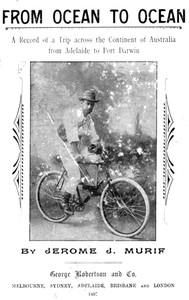
From Ocean to Ocean: Across a Continent on a Bicycle An Account of a Solitary Ride From Adelaide to Port Darwin — Reading Companion

(3 User reviews)   827
In Category - Geography
Murif, Jerome J., 1863-1926 Project Gutenberg 2018 Not confirmed
Northern Territory -- Description and travel; South Australia -- Description and travel; Cycling -- Northern Territory; Cycling -- South Australia Readers of public-domain and historical texts
Project Gutenberg digital edition en

Edition facts

Words 50,064
Reading time 218 min
Text sections 5

The source record for From Ocean to Ocean: Across a Continent on a Bicycle An Account of a Solitary Ride From Adelaide to Port Darwin — Reading Companion measures this digital text at 50,064 words, 3 hr 38 min estimated reading time, and 5 detected text sections.

The text analysis averages about 20.6 words per sentence, while the detected sections provide another way to judge how the source is divided.

Project Gutenberg metadata also associates the work with “Northern Territory -- Description and travel,” connecting these edition facts with the source record’s subject description.

Jerome J. Murif's 1897 account of a solitary bicycle ride from Adelaide to Port Darwin, blending self-deprecating humor with stark descriptions of thirst, heavy sand, and the psychological strain of isolation in the Australian outback.
Share
Editorial Edition Score 4.7/5

Calculated from edition completeness, EPUB availability, text structure and catalogue metadata. Not a user rating.

How this score is calculated
  • Description quality20 pts
  • Title & short description10 pts
  • Source metadata20 pts
  • Text length15 pts
  • Chapters / structure15 pts
  • EPUB file integrity20 pts

Total of 100 points, scaled to a 2.5-5.0 range. Editions with an empty description or a missing EPUB file are not scored.

Edition quality

Read the Text

There was the continent. No bicycle had crossed it. That was my _something_, resolved upon long ago. And if it had to be done alone--it might be misfortune. Who knows--it might also be the other thing!

It was, then, to be a solitary ride. But that the _bona fides_ of it could not very well be disputed, I had printed a many-paged book, ruled vertically. The headings to the spaces were:--"Distance," "Date," "Time," "Presence vouched for at," "By," "Address," "Departure," with a blank page opposite for "Mems _re_ road."

Being well aware that many people would certainly be averse to hurriedly entering their names in the book of an entire stranger--a stranger, too, who must resolutely decline to state his business, his object, or his destination--I determined to call on and make known my intention to two or three "leading men," foreseeing that, could I but obtain their signatures to begin with, others would be only too pleased, or at least would not refuse, to add theirs to the list.

Luckily the first of the notabilities I waited on took kindly to the idea, and at once very courteously obliged me. To him my thanks are once more repeated; and neither of the other two gentlemen next seen demurred.

Yet even this task was not accomplished without the customary kindly-intentioned warnings. Thus one of the three said:--"Do you know you face Death in seriously attempting to do this journey?" What answer could be more common-place than mine--"One has to die _some_ time, sir?"

"Death"!--the word, spoken generally with much unction, and I were grown familiar.

Had the gentleman said--"Pooh! It's easy. You ought to do it without hurting yourself, in so many weeks time,"--had he said that, I should have been sadly disheartened.

When in Adelaide previously I had sounded a cycle-agent as to the reward he would be prepared to offer a man for undertaking the trip.

Like the others he ridiculed the notion--termed it preposterous, spoke of crocodiles, and of the rider having to carry a spare set of tyres, bags of flour, tanks of water, perhaps an extra machine. Nevertheless he proposed that the hare-brained unknown one be got to purchase a bicycle (on the sale of which I, of course, would be allowed a small commission), "and should he get through," remarked the agent, with a wink, "I would not mind returning him the purchase money."

"But, stay," he added, as an afterthought, climbing down yet lower, "it's bound to be a failure, and failure does nobody any good, you know; so I'd rather not have my name or one of my machines mixed up with the thing at all."

As this might be the prevailing feeling among cycle-agents (and I have good reasons now for believing that it was) I determined on acting independently of them also. Than this resolution nothing in connection with the undertaking has since given me greater satisfaction; nor was anything more comforting during the ride than the feeling of complete independence which flowed from it.

I knew a little about bicycles, and did not pick one at random in the first, second, or any other agency I entered. Besides being on the look-out for a good mount, I was also seeking a firm which I could, if occasion arose, recommend others to deal with.

At last my choice was made. I paid the money, said nothing of my plans, and no embarrassing questions were asked.

Being now resolved to take upon my own shoulders all the consequences of failure--if I should fail--I erased the maker's name and substituted my own favorite word "Diamond" in its place.

If I broke down--well, a moral might be pointed on the evil results of riding an unknown make of bicycle. If there came success--well, again, I should have no objection to making my acknowledgment to civil people.

The machine I chose and purchased came nearly up to my ideal for this present purpose. Let us look at it.

A roadster; two 28 in. wheels; weight, 29lbs; gear, 62½; handy interlocking arrangement; dust-proof caps over pedal bearings; bearings not of complicated construction; tangent spokes; the sprocket and back gear-wheels well set on their shafts.

I could not find fault with any part of the machine. Its general appearance pleased me.

The new saddle came off, and an old and comfortable one, with an appropriate tool bag, took its place. This tool bag was circular, and my drinking vessel (a "pannikin," not to put too fine a point upon it) fitted closely over its end. An old, tried, and trusty inflator was added to this part of the equipment.

Then I ordered a more than ordinarily thick tandem tyre to be fitted on the hind wheel in place of the one of the regular roadster pattern, and an endless rubber strip to be solutioned on over the tread of the front wheel.

As for the rest I did not look for gear case or cyclometer. If the country to be traversed came up to expectations in point of roughness, the former would be torn away--an objection which applied also to the cyclometer, as the only reliable make I knew of when in use protruded from the outside of one of the front forks. Neither was missed; and I was glad I did not burden myself with them.

The brake was allowed to remain, and a bell was added. Both of these I intended to throw away when the beaten roads were left behind.

The equipment was completed with a spare air tube, chain-link and rivets, copper wire, file, spanners and plyers, solution and patching rubber, a long length of strong cord, tooth brush, compass, and small bottle of matches.

A pair of luggage-carriers were fitted to the handle bars; on these was strapped a roll of light waterproof sheeting, 6½ feet by 4 feet, containing a change of linen, pair of socks, handkerchief, soap, towel, a small mirror--my extravagance!--a comb, and three small waterproof bags in which to stow papers, etc., in the event of heavy rain falling. A leather satchel slung over one shoulder, and so fastened that it could not slip down, proved a handy receptacle for odds and ends. A rug and other things of which I may have occasion to make mention later on were forwarded to Hergott.

I had intended carrying front and back wheel duplicate shafts, but did not.

A tin to hold one quart of water was strapped against the stays, between the top of the rear wheel and the saddle.

A day was spent in riding through the hills near Adelaide with the object of testing the new machine, and that I might adjust its chain and bearings to my liking, learning the while what I could of its peculiarities, if it had any disagreeable ones--in fact, to break it in.

On the evening of my fourth day in Adelaide, my very few arrangements being nearly complete, I rode down to Glenelg, obtained the local post-master's promise of a signature, and spent the night at the Pier Hotel. Next morning the P.M. walked down with me and stood on the pier--smiling, I observed--while I cycled down the firm sandy beach into the ocean; then, having turned about, found myself dramatically waving my hat to the water.

That was the baptism of Diamond in the Southern Ocean.

The obliging officer entered a short statement in my voucher book to the effect that he had been witness to the incomprehensible ceremony. (The statement served as a preface, and so was written on the first blank page inside the cover.)

And now northwards through a continent.

Still having a little private business to transact in Adelaide, I remained there for another night and well into the following forenoon. Then the bicycle, loaded now for the expedition, was lifted downstairs; I shook hands with the landlady (who "couldn't make me out nohow," I dare say, good soul), told her I might not be back for tea and not to keep it waiting, and quietly pedalled away on my glistening Diamond, without a single person being by to see me off or wish me luck.

But there was the glorious sense of having resolutely acted an independent part. A glad feeling of being alive, untrammelled, free. And so we gaily sped along. It was a very dance on wheels.

We are on the track at last!

Kapunda, 50 miles from Adelaide, gives us shelter for the night. To Gawler is half the distance. The road is good only to four miles from Adelaide, thence bumpy macadam, with clay stretches, to within five miles of Gawler. To the right, the Flinders Ranges; flat country showing to the left. Agriculture everywhere.

Beyond Gawler, I was advised to take the middle one of three roads, known as the Freeling; but after trying it, cut off to the right and got on to the Greenock road. Here was splendid running--down grades, too. Metalled with ironstone--some grand patches. So good that I passed the words "Post Office" at She-oak Log without dismounting to ask someone to sign for me.

About and after She-oak Log was undulating country, with the ranges showing now and again to the right. At a little place named Daveyston, I halted to pick up a signature and a long drink. A resident put down the one, I the other.

Arrived at Greenock. Visited madam the gracious post-mistress, and obtained her signature. Prized, because it is the first in a lady's hand in the book. Then on to Kapunda. Undulating country, with good riding all the way. Arrived about 6 o'clock--hungry.

This afternoon I met a cyclist seated in a spring dray, steadying his machine with one hand and himself with the other. They were noisily approaching at a jig-jog. We stopped.

"No--only this is less like graft. And where are you bound for?"

"Head of the line if all goes well!"

"Mean it--on business?"

"Oh no, merely out for a ride."

But my new mount had betrayed me to this wheeling Sherlock Holmes.

"Ah, you'll get over that sort of thing by-an'-bye. Just after I'd learned to stick on, I was like you--

The stiffest breeze was never too stiff, Nor the highest hill too high.

Ha, ha! Not bad, is it? But as I was saying, I got over it. The bloom is off the rye'-din. Ha, ha!"

"Oh, come now," I expostulated meekly.

"Never mind, no 'fence, you know. Bye-bye." Then to the driver--"S'pose we see if we can't knock a sprint out of the old quad., eh? Ha, ha!"

And he laughed along the Greenock road.

From Kapunda next morning. The road excellent, built up of ironstone, broken small. Gentle inclines, and longish down-grades. Undulating country, fertile and farmed. Before one quite reaches Waterloo, a cemetery is seen away to the left, remindful of a battle field.

The track continues hilly and ironstony to Black Springs; soon after that, at Stony Hut, a rivulet of brackish water crosses the road. Then one gets amongst the highest rises yet encountered. Through these, known as the Black Hills, winds the road, keeping fairly level for eight or nine miles, and so into the Burra. Rather a pleasant ride those last few miles, gums and peppermint or box trees picturesquely dotting the landscape, until at the Burra the ruins of once famous copper-mining works displease the eye.

From the Burra to Mount Bryan an excellent level metalled road keeps close beside the railway line; but a couple of miles beyond Hallett, the cyclist will come on unmade roads, so that he will have only fair riding to Yarcowie and Terowie.

Tyre troubles cause a delay between Yarcowie and Terowie. Ahead are cross-roads innumerable, and it being already sundown I reluctantly decide to stay at Terowie the night. 145 miles from Adelaide.

A drought lay heavily upon the land, giving the township in the eyes of the skurrying passer-by an atmosphere of even greater somnolence than usual. A church, a store (often also the post-office), a blacksmith's shop, a hotel, a school-house, with half-a-dozen suburban tenements, constitute a township. It is affirmed that there are inhabitants, that on Sundays they go to church punctiliously, and that on one other given day in the week the farmers come in from round about with their butter and their eggs to the store, and then the township is "busy." Of the other five days there is no record.

An early start was made from Terowie on an absurdly round-about road to Petersburg--unmade, too, but level, yet only middling for travelling on Head winds, besides.

Breakfasted, and steered for Orroroo; this township appearing to be right in the path of anyone making northwards. Much crossing and re-crossing of the railway. At half-way, Blackrock is passed. A hard, smooth road, running through the fertile Blackrock plains, now withered and parched; high ranges showing afar off on either hand--and so to Orroroo. Thence it is only a few miles to Walloway, where another rivulet is come upon. To Eurelia the road is not good, but it improves as one journeys towards Carrieton.

In a blinding dust-storm blowing against us, a spring cart passed, whose driver invited Diamond and me on board. This was the first offer of the kind we had received, and it was thankfully declined.

My voucher-book was being signed readily. Only twice so far had it been presented without result. One poor human agricultural implement looked cunningly at me. A book canvasser had "had" him once, he said, and added "I ain't a fool."

Disaster is a merciless mocker; it deceives its victims into believing that it has sharpened their wits, whereas in general it has sadly dulled them. Here was a case in point.

In the other case a pot boy, the only "inhabitant" on hand, was so impertinently inquisitive that I did without his help. Perhaps another case.

The evening at Carrieton was more or less profitably occupied in listening to a tap-room discussion of social, political and domestic economy as represented by seed-wheat. No matter into what by-ways the debate drifted, it came back inevitably to seed-wheat. There was infinite pathos in the tales of helplessness of these drought-harried men.

There are abundant proofs as we steer out of Carrieton towards Cradock that we are already on the outskirts of the kingdom of the bicycle. The horses--bony apparitions mostly--have for the machine none of that contempt which tells of its familiarity to the city horse. So the bell is handy. Not so much to warn the equestrian as to soothe the bicyclist's conscience. You ring your bell and by that simple act throw on to other shoulders the full responsibility for all the frightened horse may do.

To Cradock from Carrieton next forenoon. Thirty miles. Strong head winds. Near Yangarrie, cross a gum-lined creek of shallow running water. Travelling stock and mail route all the way.

And on this stage a slight mishap, and an incident. Before creeping into a dam for a drink, I hung my satchel upon the fence. Having drunk, a horse took my notice: it stood listlessly against the fence, on the outside, in a paddock entirely destitute of feed--a sun-baked waste. But for the support of the fence it must have fallen.

I remembered having somewhere seen such another animal described as a barrel-hooped skeleton, held together by raw-hide.

In vain I tried to shift it. It quite frivolously whisked its tail--its only token of animation. No persuasions, no beguilements could move it. I was interested--in the cause of science, and of sport. I had inflated my tyres a little, and now desired to ascertain whether a strong blast from the air-pump would throw it _hors de combat_. Visions rose before me. I should, if I could but succeed, tell a breathless people, ever intent upon the amiable pursuit of killing one another and other more harmless things, that when in the desert I had slaughtered every one of a mob of horses with the help of a new and deadly air-gun.

To discover something so deadly--here was a Companionship of the Bath at the least!

Thus murderously inclined, I approached with the weapon. The animal raised its head, cast upon me a look of mingled sorrow and reproach, lazily lifted its upper lip on seeing the threatening inflator, and--tried to eat it!

Of such stuff are the dreams of the bush.

Thus moralising I rode off without my satchel. Had to race back four miles. And there still leaning against the fence, apparently unmoved in so much as a limb, stood the animal, a pitiful monument to the appalling severity of the drought of '96-7.

After you leave Cradock the ranges appear to be closing in in front. But they are escaped somehow; and Hawker, 17 miles from the last township, is reached. Of Hawker I have two memories: one of a barber; the other of a "specially prepared" (_i.e._ warmed-up) dinner. Neither, I suspect, of absorbing public interest.

In the evening, a strong head-wind having calmed down, rode to Hookina (9 miles); thence, being disappointed there in the matter of "accommodation," to a place known as "The White Well," seven miles ahead.

Was it to be the first camp out? Darkness had fallen, and lone travellers who can give no rational account of themselves must ever labor under dark suspicion also. But, at a roadside cottage, the rare bicycle served me as a talisman, and secured me a supper, bed, and breakfast. For the day, 64 miles.

The road to Hookina goes through the ranges, and for four miles there are rough and very stony hills to traverse. I took to the railway-line and rode alongside the rails; but the "metal" was destructively sharp-cornered, and the riding unsafe, because of the steep embankments and the frequency of culverts. There was also a tyre-tearing levelling-peg protruding at every chain or so between the lines.

From Hookina the track winds through soft but fair riding and level ground, with the high Arkaby ranges keeping well away to the east. Mount Alice shows up most prominently.

On examining Diamond by lamp-light--I made a practice of looking it over every night--I was unpleasantly surprised to observe innumerable burrs sticking in both tyres. The back one, being of more than ordinary thickness, had successfully resisted their endeavors to get through into the air tube, and the strip on the front tyre, being new, had also dissuaded the attacking thorns from intruding too far.

These burrs, common to many of the agricultural districts of South Australia, and especially prolific where the ground is sandy, are known as "three cornered jacks." No matter how they lie upon the ground, one hard and sharp spear points upwards. They are very plentiful in their season from Hookina up so far as Parachilna.

The breeze next morning, though light, was favorable. But the day was Sunday. I debated with myself, in bed, which would be the greater sin--to not avail oneself of an inviting breeze, or to continue cycle-touring on the Sabbath. Being unable to answer the question quite satisfactorily, I compromised, and made a late start.

To Parachilna (40 odd miles): Bad, bumpy road, stony and soft, or hard and guttery. Dined here.

To Beltana (24 miles): Alongside the railway line--on which trains travel occasionally, and even then for the most part only to Hergott. Some stretches of good track, but most of it heavy travelling. Much walking. Some very stony miles traversed over; country broken into low hills.

By way of change, there was fresh-looking high saltbush in the vicinity of Blackfellow's Creek--and also numbers of diamond sparrows. Blackfellow's Creek, a wider stream than had been expected.

I met the first aborigines when close to Beltana. There were four of them, all females, fully dressed. They were walking towards me; and by way of entertaining them I rang my bell and cavalierly doffed my cap. For my entertainment doubtless they smiled, as only one of their kind can, and made grimaces. So we parted the best of friends. "It may not always be so," I thought; "the painful necessity may arise presently to shoot some of your male distant relations."

Bush country is here fairly entered upon; the wheat-producing areas ending about Hawker. The rainfall is too certainly uncertain further north. To the south it certainly is uncertain also.

The everlasting hills yet last, to east and west.

The night at Beltana; 64 miles for the day; 354 miles from Adelaide. In good fettle and with a healthy appetite.

The rough track had been very trying to my Diamond. But all was well. Sunday cycling, too; yet no accidents! Resolved to cycle on the Sabbath in future.

Jerome J. Murif opens his 1897 narrative not with a declaration of scientific purpose but with a confession of restless longing. He describes a vague urge to do something first, which he tries to dismiss with trite sayings, only to wake still yearning. His solution is to buy a book of human records—feats like eating the most eggs or chopping the biggest tree—before alighting on the idea of crossing Australia on a bicycle. This self-mocking tone, laced with irony, sets the stage for a journey that is as much about internal motivation as external terrain.

The excerpts reveal a writer who treats his own ambitions with wry humor, yet the physical ordeal is rendered in unflinching detail. The narrative shifts between philosophical musings and gritty accounts of parched lips, heavy sand, and the torment of a waterbag full of near- undrinkable brine.

Thirst and the Weight of a Waterbag

The most visceral passages in the excerpts center on the search for water. At Taylor Creek, Murif finds only dry holes in the gravel, then a well that yields water so salty he spits it out. He tries boiling it, adding meat extract, but it only grows salter. Without tea, he fills the bag anyway, hoping later desperation will make it palatable. The torment continues: the water sloshes in the bag as he rides, a constant reminder of his need. When he finally drinks it greedily, he immediately calls himself a fool. This episode is not merely a hardship; it becomes a psychological drama where the body's demands override reason, and the landscape itself seems to mock him.

A Landscape of Abandonment and Threat

Murif notes that the country around the Frew River and El Kedra was once stocked with cattle, but the natives proved uncontrollable, spearing many cattle and forcing the lessees to abandon the stations. He reports that the natives are now inclined to 'fancy' themselves, and are 'spoiling for a hidin". This is not a neutral observation; it frames the land as contested and dangerous. The abandoned stations and the threat of attack color the journey with unease. The physical difficulty of floundering through heavy sand is compounded by the knowledge that the region has been emptied of white settlement by force. Murif does not elaborate on his own encounters, but the atmosphere of potential hostility is palpable.

The Body Breaking Down

In a night scene, Murif and his bicycle, Diamond, are thrown heavily as he tries to make out a creek in the evening haze. A numbed knee swells, and he cannot mount again. He contemplates crawling and leaving Diamond behind, but dismisses the thought. No sleep comes. The waterbag torments him. The entry in his notebook—'This five-mile plug is the killing gait'—captures the grinding exhaustion. The narrative here is stripped of humor; the body is failing, and the mind is reduced to a single, desperate focus. The episode illustrates how the journey tests not just endurance but the very will to continue, with the bicycle becoming both a lifeline and a burden.

Murif’s account is valuable not for grand discoveries but for its honest portrayal of a solitary man’s confrontation with a harsh continent. Readers should attend to the interplay between his ironic self-awareness and the raw physicality of his experience. The narrative does not promise triumph; it offers a record of what it means to push through sand, salt water, and swelling joints, all while carrying the weight of one’s own restless ambition.

Reading Murif’s quiet endurance in that endless sand, I remembered sitting alone with Winchester, Painted by Wilfrid Ball — Edition Insights, feeling a similar hush—not of desert heat, but of old stone and river light. Both books share a solitary pace, a way of noticing what empties a place. That companionship in stillness felt familiar, like meeting my own patience on a page.

Sebastian Carter
3 weeks ago

James Hill
1 month ago

Mia Johnson
3 weeks ago

4.5
4.5 out of 5 (3 User reviews )

Add a Review

Your Rating *
There are no comments for this eBook.

Reader reflection

Take a moment to reflect on this book

Create a short personal record of your experience with this book.

Your progress 0 / 10
1

How far have you progressed with this book?

2

How much did you enjoy the reading experience?

3

Would you pass this book on to a friend?

4

Did the language feel accessible?

Related eBooks