1

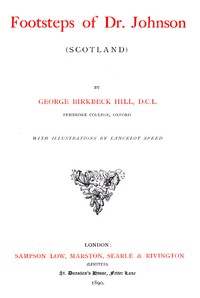
Footsteps of Dr. Johnson (Scotland) — Story, Setting & Ideas
(0 User reviews)
1841
Project Gutenberg
2018
Not confirmed
Scotland -- Description and travel; Hebrides (Scotland) -- Description and travel; Johnson, Samuel, 1709-1784 -- Travel -- Scotland; Hill, George Birkbeck Norman, 1835-1903
Readers of public-domain and historical texts
Project Gutenberg digital edition
en
Edition facts
Words
127,658
Reading time
556 min
Text sections
52
Before opening Footsteps of Dr. Johnson (Scotland) — Story, Setting & Ideas, the edition data offers a quick orientation: 127,658 words, 9 hr 16 min estimated reading time, and 52 detected text sections.
The text analysis averages about 17.3 words per sentence, while the detected sections provide another way to judge how the source is divided.
Project Gutenberg metadata also associates the work with “Scotland -- Description and travel,” connecting these edition facts with the source record’s subject description.
Source:
Project Gutenberg record #57715
George Birkbeck Hill retraces Samuel Johnson's 1773 Scottish tour, weaving together Johnson's letters, his Journey, and Boswell's Journal with historical context and local anecdotes, focusing on the tensions between Highland culture and post-Culloden suppression.
Read the complete public-domain text at its original source.
Read on Project GutenbergGeorge Birkbeck Hill’s Footsteps of Dr. Johnson (Scotland) is not a straightforward travelogue but a layered reconstruction of Samuel Johnson’s 1773 journey through the Highlands and Hebrides. Hill draws on three independent accounts—Johnson’s letters to Mrs. Thrale, his Journey to the Western Islands, and Boswell’s Journal of a Tour to the Hebrides—to create a composite picture that highlights the contrasts between Johnson’s public narrative and his private observations. The work is also a study of manners, reflecting Hill’s stated preference for “the daily life, the briars and roses of the working-day world” over grand historical narrative.
Three Accounts, One Journey
Hill deliberately avoids weaving the three primary sources into a single seamless narrative. Instead, he preserves their independence, allowing readers to compare Johnson’s formal Journey, his candid letters, and Boswell’s more immediate journal. This method reveals discrepancies: Johnson’s letter to Mrs. Thrale describes the rough sea crossing to Raasay as “a kind of dancing agitation,” while Boswell records Johnson’s own remark that telling London tea-tables he had “crossed the Atlantic in an open boat” would make them shudder. Hill’s editorial choice foregrounds the tension between Johnson’s public stoicism and his private dramatization of hardship.
The Politics of Highland Dress
Hill devotes considerable attention to the aftermath of the 1746 Act of Proscription, which banned tartan and traditional Highland garb. He cites contemporary accounts of officers cutting up “blanket-philibegs” and a sheriff dismissing a man whose kilt turned out to be a woman’s petticoat. Smollett’s Humphry Clinker is quoted to illustrate the resentment of Highlanders forced to wear breeches, which they carried “on poles or long staves over their shoulders.” Hill also notes that Sir Walter Scott recorded Highlanders dyeing their plaids a single color to evade the law, while old Malcolm Macleod defiantly wore tartan hose that left his knees bare. These details ground the journey in a specific moment of cultural suppression.
Johnson as Triton, Malcolm as Oarsman
The voyage to Raasay provides a vivid set piece. Johnson, “like a magnificent Triton,” sits high on the stern while Malcolm Macleod, “no less magnificent through his attire,” tugs at an oar and sings an Erse song. Hill juxtaposes Boswell’s description of the rough Atlantic with Johnson’s dismissive letter, and then adds a small, human moment: Johnson’s spurs are lost overboard through a servant’s carelessness, prompting the remark, “There was something wild in letting a pair of spurs be carried into the sea out of a boat.” Hill notes that this incident offers “a fine opening for the enthusiasm of the Johnson Club,” a wry nod to the club to which the book is dedicated.
Hill’s work rewards readers who enjoy comparing sources and noticing small, telling details. The book is structured so that one can follow Johnson’s route while also pausing over the social history that surrounds it—the laws against tartan, the economics of the Highlands, the character of the people Johnson met. The illustrations by Lancelot Speed add a visual dimension, though the text itself is dense with footnotes and quotations. Approach it as a companion to the original travel accounts rather than a substitute for them.
There’s a particular ache in Birkbeck Hill’s tracing of Johnson’s Scottish walk, that grief for a culture already fading beneath his boots. It reminds me, strangely, of the quiet islands I once visited in another book—Reminiscences of the South Seas — A Reader’s Guide—where every footprint also seemed to disappear into tide, leaving only the memory of an older, gentler world behind.
There are no reviews for this eBook.
There are no comments for this eBook.
Reader reflection
Record your reading impressions
A brief reflection can help important ideas stay with you longer.
Your progress
0
/
10
2
Did this book hold your interest?
3
Would you recommend this book to another reader?
4
How much effort did this book require?
5
Is this a title worth rereading?
6
How would you rate its originality?
7
Did it raise ideas you would like to talk about?
8
Did any part of the book feel personally relevant?
9
In one sentence, what did you learn?
10