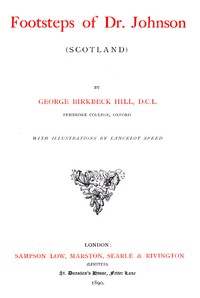
Footsteps of Dr. Johnson (Scotland) — Story, Setting & Ideas

(7 User reviews)   1833
In Category - Geography
Hill, George Birkbeck Norman, 1835-1903, Speed, Lancelot, 1860-1931 [Illustrator] Project Gutenberg 2018 Not confirmed
Scotland -- Description and travel; Hebrides (Scotland) -- Description and travel; Johnson, Samuel, 1709-1784 -- Travel -- Scotland; Hill, George Birkbeck Norman, 1835-1903 Readers of public-domain and historical texts
Project Gutenberg digital edition en

Edition facts

Words 127,658
Reading time 556 min
Text sections 52

Before opening Footsteps of Dr. Johnson (Scotland) — Story, Setting & Ideas, the edition data offers a quick orientation: 127,658 words, 9 hr 16 min estimated reading time, and 52 detected text sections.

The text analysis averages about 17.3 words per sentence, while the detected sections provide another way to judge how the source is divided.

Project Gutenberg metadata also associates the work with “Scotland -- Description and travel,” connecting these edition facts with the source record’s subject description.

George Birkbeck Hill retraces Samuel Johnson's 1773 Scottish tour, weaving together Johnson's letters, his Journey, and Boswell's Journal with historical context and local anecdotes, focusing on the tensions between Highland culture and post-Culloden suppression.
Share
Editorial Edition Score 4.9/5

Calculated from edition completeness, EPUB availability, text structure and catalogue metadata. Not a user rating.

How this score is calculated
  • Description quality20 pts
  • Title & short description10 pts
  • Source metadata20 pts
  • Text length15 pts
  • Chapters / structure15 pts
  • EPUB file integrity20 pts

Total of 100 points, scaled to a 2.5-5.0 range. Editions with an empty description or a missing EPUB file are not scored.

Edition quality

Read the Text

that Johnson replied that he was neither one nor the other. Whereupon Lochbuie cried out, “Damn it, Sir, then you must be a bastard.” There can, I fear, be no doubt that this rejoinder belongs to those _excellens impromptus à loisir_ in which Rousseau excelled[13]—that _esprit de l’escalier_, as the French describe it. If the laird, like Addison, could draw for a thousand pounds, he had, I suspect, but nine pence in ready money.[14] For had this repartee been made at the time, and not been merely an after-invention, Boswell most certainly would not have let it pass unrecorded. The second tradition is scarcely more trustworthy. Johnson at the tea-table, I was told, helped himself to sugar with his fingers, whereupon Lady Lochbuie at once had the basin emptied, and fresh sugar brought in. He said nothing at the time, but when he had finished his tea he flung down the cup, exclaiming that if he had polluted one he had also polluted the other. A lady of the family of Lochbuie, whose memory goes back ninety years, in recounting this story when I was in Scotland, added, “But I do not know whether it was true.” That it was not true I have little doubt. In the first place, we have again Boswell’s silence; in the second place, to the minor decencies of life Johnson was by no means inattentive. At Paris he was on the point of refusing a cup of coffee because the footman had put in the sugar with his fingers; and at Edinburgh, in a passion, he threw a glass of lemonade out of the window because it had been sweetened in the same manner by the waiter. In one of his letters to Mrs. Thrale he expressed his displeasure in Skye at the very practice with which he is charged a few weeks later in Mull. Describing his visit to the house of Sir Alexander Macdonald, he wrote: “The lady had not the common decencies of her tea-table: we picked up our sugar with our fingers.”[15]

It is strange that while in Mull, that “most dolorous country,” that “gloom of desolation,” as Johnson described it, these stories of him are preserved, the boatman who took me across the narrow passage between it and Inch-Kenneth had no traditionary knowledge of his host, Sir Allan Maclean, and of his retirement in that little island. To the forefathers of the men of Mull the head of the Macleans would have been an object of reverence and even of fear, and Johnson only a passing wonder. “I would cut my bones for him,” said one of his clan, speaking of Sir Allan in Boswell’s hearing.[16] But of the Highland chief who lived among them no remembrance remains, while the _Sassenach mohr_, who spent but a few days in the island-home of the Macleans, is still almost “a household word.”

[Sidenote: SCOTTISH SENSITIVENESS.]

I was indeed surprised to find through the Highlands and the Hebrides how much he still remained in men’s thoughts. On Loch Lomond, the boatman who rowed me to the islands on which he had landed, a man of reading and intelligence, said that though he had himself read Johnson’s _Journey_, yet “Scotchmen still feel too sore to like reading him.” Whatever soreness still lingers is, I have little doubt, much more due to his sarcasms recorded by Boswell than to any passages in his own narrative. But it is surprising that Scotchmen cannot more generally join in a hearty laugh at his humorous sallies, though they are at their own expense. That the Scotch of a hundred years and more ago were over-sensitive is not astonishing. At that time in most respects they were still far behind England. It was England that they were striving to follow in their arts, their commerce, and their agriculture. It was the English accent that they were striving to catch, and the English style in which they laboured to write. It was to the judgment of Englishmen that their authors, no small or inglorious band, anxiously appealed. That they should be sensitive to criticism beyond even the Americans of our day was not unnatural. For in the poverty of their soil, and the rudiments of their manufactures and trade, they found none of that boastful comfort which supports the citizen of the United States, even when he is most solicitous of English approbation. But at the present day, when they are in most respects abreast of Englishmen, and in some even ahead, they should disprove the charge that is brought against them of wanting humour by showing that they can enjoy a hearty laugh, even though it goes against them. Johnson’s ill-humour did not go deep, and, no doubt, was often laughed away. Of that rancour which disgraced Hume his nature was wholly incapable. He wished no ill to Scotland as Hume wished ill to England.[17] “He returned from it,” writes Boswell, “in great good-humour, with his prejudices much lessened, and with very grateful feelings of the hospitality with which he was treated.”[18]

Not all Scotch critics were hostile towards him. The _Scots Magazine_, which last century was to Edinburgh what the _Gentleman’s Magazine_ was to London, always spoke of him with great respect. Writing of him early in the year in which he visited Scotland, it says:

“Dr. Johnson has long possessed a splendid reputation in the republic of letters, and it was honestly acquired. He is said to affect a singularity in his manners and to contemn the social rules which are established in the intercourse of civil life. If this extravagance is affected, it is a fault; if it has been acquired by the habitudes of his temper and his indolence, it scarcely merits censure. We allow to the man who can soar so high above the multitude to descend sometimes beneath them.”[19]

In the two reviews of his _Journey_ in the same magazine, there is not one word of censure; neither when Boswell, eleven years later, brought out his account of the tour, had they any fault to find. In the character which they drew of Johnson on his death they leave unnoticed his attacks on Scotland. They are even generous in their praise. Speaking of his pension they say: “It would have been a national disgrace if such talents, distinguished by such writings, had met with no other recompense than the empty consciousness of fame.”[20] There were also men of eminence in Scotland who at once acknowledged the merits of the book. “I love the benevolence of the author,” said Lord Hailes.[21] The “virtuous and candid Dempster,” the “patriotic Knox,” Tytler, the historian, “a Scot, if ever a Scot there were,” had each his word of high praise.[22] Sir Walter Scott, writing many years later, said: “I am far from being of the number of those angry Scotsmen who imputed to Johnson’s national prejudices all or a great part of the report he has given of our country. I remember the Highlands ten or twelve years later, and no one can conceive of how much that could have been easily remedied travellers had to complain.”[23]

These men, nevertheless, formed a small minority. The outcry that was raised against Johnson was at once loud and bitter. To attacks for many a long year he had been used, but yet this time he was startled. “He expressed his wonder at the extreme jealousy of the Scotch, and their resentment at having their country described as it really was.”[24] Boswell mentions “the brutal reflections thrown out against him,” and “the rancour with which he was assailed by numbers of shallow irritable North Britons.”[25] How quickly the storm gathered and burst is shown in a letter written by an Englishman from Edinburgh a few days after the book was published:

“Edinburgh, Jan. 24, 1775. Dr. Johnson’s _Tour_ has just made its appearance here, and has put the country into a flame. Everybody finds some reason to be affronted. A thousand people who know not a single creature in the Western Isles interest themselves in their cause, and are offended at the accounts that are given of them. Newspapers, magazines, pamphlets, all teem with abuse of the Doctor. He was received with the most flattering marks of civility by everyone. He was looked upon as a kind of miracle, and almost carried about for a show. Those who were in his company were silent the moment he spoke, lest they should interrupt him, and lose any of the good things he was going to say. He repaid all their attention to him with ill-breeding, and when in the company of the ablest men in this country, who are certainly his superiors in point of abilities, his whole design was to show them how contemptibly he thought of them. Had the Scotch been more acquainted with Dr. Johnson’s private character they would have expected nothing better. A man of illiberal manners and surly disposition, who all his life long had been at enmity with the Scotch, takes a sudden resolution of travelling amongst them; not, according to his own account, ‘to find a people of liberal and refined education, but to see wild men and wild manners.’”[26]

[Sidenote: ATTACKS ON JOHNSON.]

The “patriotic Knox,” as Boswell calls him, the author of _A Tour through the Highlands and Hebride Isles in 1786_, a man freer from prejudices than the common run, and one who readily acknowledged the merits of Johnson’s book, bears equal witness to the wrath of his countrymen.

“Dr. Johnson (he writes) set out under incurable impressions of a national prejudice, a religious prejudice, and a literary jealousy. From a writer of such abilities and such prejudices the natives of Scotland had reason to expect a shower of arrows without mercy, and it was possibly from this prepossession that they were ready to fall upon him as one man the moment that his book appeared. Their minds were charged with sentiments of indignity, resentment and revenge, which they did not fail to discharge upon his head in whole platoons from every quarter.”[27]

To us, who know Johnson better than we know any other author who has ever lived, the charge of literary jealousy seems ridiculous. But Knox lived before Boswell’s _Life_ was published. Scotland, in which learning and even literature had slumbered for nearly a century, had started up from her long sleep, and was bent on turning the Auld Reekie into the Modern Athens. All her geese were swans, though of swans she had at this season a fair flock. “Edinburgh is a hotbed of genius,” wrote Smollett, shortly before Johnson’s visit, and as a proof of it he instanced among “authors of the first distinction,” Wallace, Blair, Wilkie, and Ferguson. Hume still earlier had proclaimed that at last there was “a hope of seeing good tragedies in the English language,” for Johnny Home had written his _Douglas_. Wilkie of the _Epigoniad_, the great historian held, was to be the Homer, and Blacklock the Pindar, of Scotland.[28] But it was in Ossian Macpherson that the hopes of the country had at one time soared highest. By Dr. Blair, the Edinburgh Professor of Rhetoric, he had been ranked with Homer and Virgil.[29] The national pride, the honour of Scotland, was concerned, and the meanest motive was attributed to the man who had ventured to pronounce his poems an impudent forgery. Macpherson was a dangerous enemy. Against “the menaces of a ruffian” a thick cudgel might avail; but the secret arts of a literary forger were not so easily baffled. His position was one of great power, for from the Court he received a pension at first of £600 a year, and afterwards of £800, “to supervise the newspapers. He inserted what lies he pleased, and prevented whatever he disapproved of being printed.”[30] It was from this tainted source that no doubt sprang many of “the miserable cavillings against the _Journey_ in newspapers, magazines, and other fugitive pieces.”[31] These, as Boswell tells us, “only furnished Johnson with sport.” Nevertheless, though they did not trouble his mind, they marred the fame of his book, and prejudiced not only the immediate, but even the traditional judgment of Scotland. Enough dirt was thrown, and some of it did stick and sticks still. Lies were sent wandering through the land, and some of them have not even yet found their everlasting rest. One disgusting story, not unworthy of the inventive genius of Ossian himself, is still a solace to Scots of the baser sort. That it is a lie can be plainly proved, for it rests on a supposed constant suspicion in Johnson of the food provided for him. Now we know from his own writings that only twice in his tour had he “found any reason to complain of a Scottish table.”[32] Moreover, in his letters to Mrs. Thrale and in Boswell’s _Journal_, we can follow his course with great accuracy and minuteness. Had there been any foundation for this lie it must be found on the road between Inverness and the seashore. Now we know what meals he had at each station. Even in the miserable inn at Glenelg, where his accommodation was at its worst, if he had chosen he could have had mutton chops and freshly-killed poultry. Finding both too tough, he supped on a lemon and a piece of bread.

[Sidenote: M’NICOL’S SCURRILOUS VOLUME.]

The attacks of the angry critics, published as they were in fugitive pieces, might have been forgotten had they not been revived three or four years later in “a scurrilous volume,” as Boswell justly describes it, “larger than Johnson’s own, filled with malignant abuse under a name real or fictitious of some low man in an obscure corner of Scotland, though supposed to be the work of another Scotchman, who has found means to make himself well known both in Scotland and England.”[33] The “low man” was the Rev. Donald M’Nicol, and the “obscure corner” that long and pleasant island of Lismore which the steamers skirt every summer day as they pass with their load of tourists between Oban and the entrance of the Caledonian Canal. M’Nicol’s predecessor in the manse was the Rev. John Macaulay, whose famous grandson, Lord Macaulay, was to rebuke those “foolish and ignorant Scotchmen, who moved to anger by a little unpalatable truth which was mingled with much eulogy in the _Journey to the Western Islands_, assailed him whom they chose to consider as the enemy of their country with libels much more dishonourable to their country than anything that he had ever said or written.”[34] When Johnson was shown M’Nicol’s book he said: “This fellow must be a blockhead. They don’t know how to go about their abuse. Who will read a five shilling book against me? No, Sir, if they had wit, they should have kept pelting me with pamphlets.” The book, however, seems to have been widely read, and in the year 1817 was reprinted at Glasgow in a fine large type. A Scotch gentleman recently told me that he fears that to many of his countrymen Johnson’s tour is only known through M’Nicol’s attack.

[Sidenote: OSSIAN MACPHERSON.]

It was Macpherson at whom Boswell aimed a blow when he wrote of the “other Scotchman whose work it was supposed to be.” If Ossian had no hand in it himself, it was certainly written by someone fired with all his hatred of the man who had branded him as a forger. Johnson is described as “a man of some reputation for letters, whose master-passion was hatred of Scotland. When the _Poems of Ossian_ were published, and became the delight and admiration of the learned over all Europe, his cynical disposition instantly took the alarm.”[35] It was from this time that “we may date the origin of his intended tour to Scotland.” It was from malice that he started so late in the year—a malice, by the way, which nearly brought him to a watery grave. “It was not beauties he went to find out in Scotland, but defects; and for the northern situation of the Hebrides the advanced time of the year suited his purpose best.”[36] Johnson, with a discretion which other travellers in like circumstances would do well to imitate, had passed over Edinburgh with the remark that it is “a city too well known to admit description.” This wise reticence is twisted into a proof of malevolence. So, too, is the brevity with which he mentions Dundee. “We stopped awhile at Dundee,” he recorded, “where I remember nothing remarkable.”[37] Surely this is a very innocent sentence. Even Boswell, whose record was generally far fuller, dismisses this place with three words. “We saw Dundee,” he says.[38] But M’Nicol at once discovered the miserable jealousy of the Englishman. “He passes very rapidly through the town of Dundee, for fear, I suppose, of being obliged to take notice of its increasing trade.”[39] How delicately Johnson treated this town in his published narrative is shown by his description of it in his private letter to Mrs. Thrale. To her he had written: “We came to Dundee, a dirty despicable town.”[40] Much as M’Nicol belaboured Johnson, he could not refrain from claiming him as of Scotch origin. “We are much deceived by fame,” he wrote, “if a very near ancestor of his, who was a native of that country, did not find to his cost that a tree was not quite such a rarity in his days.”[41] This mysterious hero of the gallows was no doubt no Johnson at all, but a Johnston—of Ardnamurchan, probably, or of Glencroe.[42]

M’Nicol is ingenious in his treatment of the great Ossian controversy. “The poems,” he says, “must be the production either of Ossian or Mr. Macpherson. Dr. Johnson does not vouchsafe to tell us who else was the author, and consequently the national claim remains perfectly entire. The moment Mr. Macpherson ceases to be admitted as a translator, he instantly acquires a title to the original.”[43] Granted that he was a ruffian who had tried by menaces to hinder the detection of a cheat. What of that? He was a great original ruffian, and his cheat was a work of great original genius. So that Caledonia, if she had one forger the more, had not one poet the less. She made up in genius what she lost in character. But this Dr. Johnson failed to see, being, poor man, “naturally pompous and vain, and ridiculously ambitious of an exclusive reputation in letters.” It must have been this same pomposity, vanity, and ambition which led him to say of these poems: “Sir, a man might write such stuff for ever, if he would _abandon_ his mind to it.”[44]

George Birkbeck Hill’s Footsteps of Dr. Johnson (Scotland) is not a straightforward travelogue but a layered reconstruction of Samuel Johnson’s 1773 journey through the Highlands and Hebrides. Hill draws on three independent accounts—Johnson’s letters to Mrs. Thrale, his Journey to the Western Islands, and Boswell’s Journal of a Tour to the Hebrides—to create a composite picture that highlights the contrasts between Johnson’s public narrative and his private observations. The work is also a study of manners, reflecting Hill’s stated preference for “the daily life, the briars and roses of the working-day world” over grand historical narrative.

Three Accounts, One Journey

Hill deliberately avoids weaving the three primary sources into a single seamless narrative. Instead, he preserves their independence, allowing readers to compare Johnson’s formal Journey, his candid letters, and Boswell’s more immediate journal. This method reveals discrepancies: Johnson’s letter to Mrs. Thrale describes the rough sea crossing to Raasay as “a kind of dancing agitation,” while Boswell records Johnson’s own remark that telling London tea-tables he had “crossed the Atlantic in an open boat” would make them shudder. Hill’s editorial choice foregrounds the tension between Johnson’s public stoicism and his private dramatization of hardship.

The Politics of Highland Dress

Hill devotes considerable attention to the aftermath of the 1746 Act of Proscription, which banned tartan and traditional Highland garb. He cites contemporary accounts of officers cutting up “blanket-philibegs” and a sheriff dismissing a man whose kilt turned out to be a woman’s petticoat. Smollett’s Humphry Clinker is quoted to illustrate the resentment of Highlanders forced to wear breeches, which they carried “on poles or long staves over their shoulders.” Hill also notes that Sir Walter Scott recorded Highlanders dyeing their plaids a single color to evade the law, while old Malcolm Macleod defiantly wore tartan hose that left his knees bare. These details ground the journey in a specific moment of cultural suppression.

Johnson as Triton, Malcolm as Oarsman

The voyage to Raasay provides a vivid set piece. Johnson, “like a magnificent Triton,” sits high on the stern while Malcolm Macleod, “no less magnificent through his attire,” tugs at an oar and sings an Erse song. Hill juxtaposes Boswell’s description of the rough Atlantic with Johnson’s dismissive letter, and then adds a small, human moment: Johnson’s spurs are lost overboard through a servant’s carelessness, prompting the remark, “There was something wild in letting a pair of spurs be carried into the sea out of a boat.” Hill notes that this incident offers “a fine opening for the enthusiasm of the Johnson Club,” a wry nod to the club to which the book is dedicated.

Hill’s work rewards readers who enjoy comparing sources and noticing small, telling details. The book is structured so that one can follow Johnson’s route while also pausing over the social history that surrounds it—the laws against tartan, the economics of the Highlands, the character of the people Johnson met. The illustrations by Lancelot Speed add a visual dimension, though the text itself is dense with footnotes and quotations. Approach it as a companion to the original travel accounts rather than a substitute for them.

There’s a particular ache in Birkbeck Hill’s tracing of Johnson’s Scottish walk, that grief for a culture already fading beneath his boots. It reminds me, strangely, of the quiet islands I once visited in another book—Reminiscences of the South Seas — A Reader’s Guide—where every footprint also seemed to disappear into tide, leaving only the memory of an older, gentler world behind.

Grayson Adams
3 weeks ago

Liam Clark
3 weeks ago

Mia Harris
2 weeks ago

Sophia Scott
1 month ago

Grayson Thomas
1 month ago

4.5
4.5 out of 5 (7 User reviews )

Add a Review

Your Rating *
  • ...
    Andre Estrada - 3 weeks ago
    {'rating': 3, 'text': "An interesting concept, but the execution is uneven. The historical background is informative, but the author's own experiences often overshadow Johnson's. Some passages are engaging, others drag. A decent read for those keen on Johnson, but not a masterpiece."}

  • ...
    Whitney Shepard - 3 weeks ago
    {'rating': 2, 'text': "This book promises much but delivers little. The author's writing is self-indulgent, and the constant digressions from the topic become frustrating. It feels more like a personal diary than a tribute to Johnson. Disappointing for dedicated Johnson fans."}

  • ...
    Anna Gregory Braun - 3 weeks ago
    {'rating': 5, 'text': "A delightful journey through Scotland in the footsteps of the great Dr. Johnson! The author blends literary history with vivid travelogue, offering fascinating insights into both Johnson's era and the Scottish landscape. Witty and erudite, this book is a treat for literature lovers and travelers alike."}


Reader reflection

Record your reading impressions

A brief reflection can help important ideas stay with you longer.

Your progress 0 / 10
1

Have you finished this book?

2

Did this book hold your interest?

3

Would you recommend this book to another reader?

4

How much effort did this book require?

Related eBooks