1

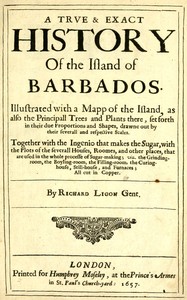
A true & exact history of the island of Barbados — Inside the Classic
(0 User reviews)
746
Project Gutenberg
2023
Not confirmed
Barbados -- Description and travel; Plants -- Barbados; Sugar -- Manufacture and refining -- Barbados
Readers of public-domain and historical texts
Project Gutenberg digital edition
en
Edition facts
Words
83,237
Reading time
362 min
Text sections
16
The source record for A true & exact history of the island of Barbados — Inside the Classic measures this digital text at 83,237 words, 6 hr 2 min estimated reading time, and 16 detected text sections.
The text analysis averages about 43.9 words per sentence, while the detected sections provide another way to judge how the source is divided.
Project Gutenberg metadata also associates the work with “Barbados -- Description and travel,” connecting these edition facts with the source record’s subject description.
Source:
Project Gutenberg record #70489
Richard Ligon's 1657 natural history of Barbados blends precise botanical and sugar-making descriptions with vivid accounts of insects, climate, and colonial life, all rendered in a plain, observant prose that reveals the author's eye for detail and his position as an unlettered gentleman.
Editorial Edition Score
4.9/5
★★★★★
★★★★★
Calculated from edition completeness, EPUB availability, text structure and catalogue metadata. Not a user rating.
How this score is calculated
- Description quality20 pts
- Title & short description10 pts
- Source metadata20 pts
- Text length15 pts
- Chapters / structure15 pts
- EPUB file integrity20 pts
Total of 100 points, scaled to a 2.5-5.0 range. Editions with an empty description or a missing EPUB file are not scored.
Edition quality
Read the complete public-domain text at its original source.
Read on Project GutenbergRichard Ligon opens his True & Exact History by confessing himself “altogether unlettered,” a disclaimer that frames the work as a plain-spoken record rather than a learned treatise. The book’s title page promises copperplate illustrations of trees, plants, and the ingenio (sugar works), and the text delivers a similarly meticulous verbal inventory. Ligon’s prose is at its most vivid when he turns to the island’s insect life: he describes ants as “Ubiquitaries,” cockroaches as “mortal enemies” to ants, and a mysterious fly that rises from the earth after rain, “as big bodied as Bees, but far larger wings.” These passages reveal a writer who observes closely and delights in the particular, even when the subject is vermin.
A Gentleman’s Unlettered Eye
Yet Ligon is not artless. His account of the “ugly wabling gate” of a nocturnal biting insect shows a writer attentive to sound and motion. He notes that the insect “appears in the evening when ’tis dark, and will, when he pleases, flie to your bed,” a sentence that mimics the creature’s sudden, unpredictable movement. The phrase “fetch blood” is blunt and physical, typical of Ligon’s style. He avoids moralizing about the discomfort, instead reporting the fact that “Negres, who have thick skins” are bitten so badly that their skin is “rac’t, as if it were done with a currie-comb.” The simile is homely and precise, drawn from domestic experience.
Insects as Protagonists
Other insects are catalogued with similar care. The “Meriwings” are “so thin and aereall” that they are nearly invisible, their presence announced only by a noise “like a small bugle horn, at a great distance.” Caterpillars attack potato leaves, and the remedy is to drive “a flock of Turkies” into the field. Ligon notes the double harm: the slips are horse food, the roots are human food. This practical calculus—weighing loss against remedy—is characteristic of the book’s blend of natural history and colonial management.
The Sugar Ingenio as a Machine of Words
Yet the sugar works are also a site of labor, and Ligon does not ignore the human cost. He mentions “Negres” in passing, noting their thick skins and hard labor, but he does not dwell on their condition. The book’s focus remains on processes and products, not on the people who operate them. This silence is itself a historical fact, and modern readers will note the gap between Ligon’s meticulous observation of insects and his cursory treatment of enslaved workers.
The Landscape of Detail
He also records the island’s sounds: the “small bugle horn” of meriwings, the silence of ants. His descriptions are often synesthetic, blending sight, sound, and touch. The “ugly wabling gate” of the biting insect is a visual impression that also conveys a sense of awkwardness. Ligon’s world is one of continuous sensory input, and his task is to translate that into words for an English audience that has never seen a guava or heard a meriwing.
Ligon’s True & Exact History rewards readers who attend to its particulars: the exact shade of a fly’s wing, the layout of a boiling room, the noise of an insect at dusk. The book is not a systematic natural history in the Linnaean sense, but a gentleman’s report from a place where everything—ants, flies, sugar—seems to multiply and demand description. Read it for the details, and for the voice of a man who insists he is no scholar but who sees more clearly than many.
Ligon’s careful notes on Barbados feel less like a ledger and more like a friend trying to hold onto a place before it slips away—the exact weight of a sugar cane, the hum of insects at dusk. I found that same patient, wondering voice again in Sixteen months at the gold diggings — Themes and Context, and it lingered with me long after the last page. Quiet, unhurried, almost like a shared secret.
There are no reviews for this eBook.
There are no comments for this eBook.
Reader reflection
How did this book work for you?
Your answers remain private and are stored only in this browser.
Your progress
0
/
10
2
Was reading this book enjoyable?
3
Would you pass this book on to a friend?
4
What was the reading difficulty like?
5
How strong was your personal connection to the text?
6
How valuable was this book for your own interests?
7
What was its emotional impact?
8
How clear did the writing feel?
9
What is the main idea you are taking away?
10