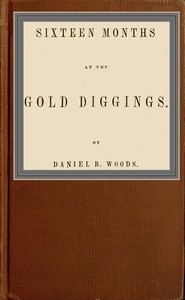
Sixteen months at the gold diggings — Themes and Context

(2 User reviews)   327
In Category - Geography
Woods, Daniel B. Project Gutenberg 2022 Not confirmed
California -- Description and travel; Frontier and pioneer life -- California; California -- Gold discoveries Readers of public-domain and historical texts
Project Gutenberg digital edition en

Edition facts

Words 62,075
Reading time 270 min
Text sections 6

This digital edition of Sixteen months at the gold diggings — Themes and Context is described by source-level measurements including 62,075 words, 4 hr 30 min estimated reading time, and 6 detected text sections.

The text analysis averages about 17.8 words per sentence, while the detected sections provide another way to judge how the source is divided.

Project Gutenberg metadata also associates the work with “California -- Description and travel,” connecting these edition facts with the source record’s subject description.

Daniel B. Woods's firsthand journal of mining on the American and Tuolumne Rivers in 1851-1852 records daily labor, weather, yields, and the contrast between hardship and natural beauty, offering a corrective to romanticized gold rush narratives.
Share
Editorial Edition Score 4.7/5

Calculated from edition completeness, EPUB availability, text structure and catalogue metadata. Not a user rating.

How this score is calculated
  • Description quality20 pts
  • Title & short description10 pts
  • Source metadata20 pts
  • Text length15 pts
  • Chapters / structure15 pts
  • EPUB file integrity20 pts

Total of 100 points, scaled to a 2.5-5.0 range. Editions with an empty description or a missing EPUB file are not scored.

Edition quality

Read the Text

GEOGRAPHY AND HISTORY.

California extends from Oregon to Sonoma and Lower California, and from the Rocky Mountains to the Pacific. It shows a coast-front extending ten degrees of latitude, from the thirty-second to the forty-second parallel. To the voyager it presents only high and forbidding headlands--mountain ranges which step down from the broad table-lands in the interior, and push a bold foot far out into the waters of the ocean.

This country possesses 420,000 square miles, and is remarkable for its lofty ranges of mountains, among which lie interspersed limited but beautiful valleys and more extensive plains. Its diversity of climate and soil is as great as the varieties of its surface.

The channel which forms the entrance into this singular country from the Pacific is two miles in width and three in length, and is opposite, under the same parallel of latitude, to the Straits of Gibraltar. After passing through this channel, the lowest of the series of bays, that of San Francisco, opens broadly before you, dotted with several islands clothed with verdure, and rocks white with their coating of guano, around and upon which hover and settle immense flocks of sea-fowls. Above the ranges of hills, in the east, rises the distant Sierra, crowned till July with its winter snows. The bay opposite the city is twelve miles wide, and, with the bays above, contains anchorage ground sufficient to accommodate every vessel, from the ship of war down to the schooner, in the whole world. In the north, the bay contracts into a narrow passage, and opens soon into a second spacious bay, ten miles in diameter. Still another strait connects this bay with a third, containing numerous islands, and receiving, at its head, the waters of the Sacramento and the San Joaquin. These, with the Colorado, are the principal rivers of California.

The mountain ranges may be briefly described. Fifty miles from the barren and sandy shore of the Pacific, and running parallel with it, is the coast-range, well defined, but not so elevated as the other more remarkable range. This is the Sierra Nevada, or Snowy Range, which bears its lofty peaks, covered even into summer with snow, far into the sky. This range is one hundred and fifty miles farther inland, and also runs parallel with the coast.

Within all this lies the available portion of California, which consists of several fertile valleys, among which I shall notice particularly those of San Juan, and of the Sacramento and San Joaquin. The former is of limited extent, being not more than twenty miles long by twelve wide, but of great fertility. This may be regarded as the garden of California. There can not be found a more salubrious or more equable climate in any part of the world. It is said to resemble that of Andalusia, in Spain. This valley is situated between the coast-range and the Pacific, and extends from the Bay of San Francisco north and south.

The valley of the Sacramento and the San Joaquin lies between the coast-range and the Sierra Nevada. It may be considered as one continuous valley, the two rivers uniting their waters at the head of the bays. It extends in length from about the forty-first parallel of latitude, three hundred miles to the delta of the Sacramento, and thence to the head waters of the San Joaquin. Over this whole region is found scattered the evergreen oak, resembling the trees of an old apple-orchard, and upon the ridges grows the red-wood. A fine growth of pine is found among the mountains.

All the tributaries of the Sacramento and the San Joaquin rise among the Sierra Nevada. It is of importance to have the position of these well understood. The first branch worthy of note in descending the Sacramento is called Feather River. Bear Creek and the Yuba are streams emptying into this river. The American River is another branch of the Sacramento, fed by those streams named North, Middle, and South Forks. In proceeding south up the San Joaquin, the Stanislaus is the first river of note. The next branch is the Tuolumne, and then the Merced--the Rio de los Mercedes of Old California, and abbreviated into Mercey by the miners. Higher up are the Marepoosa, King’s, and some smaller rivers. All these are rapid, clear mountain streams, containing abundant supplies of the finest salmon. The Sacramento and the San Joaquin have no tributaries on the lower or western side.

Still within these interior limits last described lies a comparatively narrow belt of land, difficult of access, guarded by a thousand dangers and privations, yet possessing all the extraordinary and magical influence of Aladdin’s cave, and realizing our boyhood’s dreams when we filled our hats with the shining coins. This--the heart of the country--is the true, the mysterious _California_--the shrine at which tens of thousands of weary and exile pilgrims do homage, and where already great multitudes have left their bones. This is _California_--the country lately an uninviting wilderness, where the Indian and the bear disputed possession, now, all along its streams, upon its bars, in its gulches and ravines, covered with the tented home of the miner, while its hill sides echo back ten thousand eager voices, the din of innumerable picks and shovels, and the scraping and grating sounds of a thousand cradles incessantly rocked, emptied, and refilled.

Let us attempt a description.

Between the Sierra Nevada on the east, and the Sacramento and San Joaquin on the west, and at about twenty-five miles distance from both, are the foot or lower hills of the Nevada. These foot-hills embrace, or rather constitute, the gold region. They are perfectly defined upon the lower side, where they rise abruptly from the level plain below. Upon the upper side they are irregular, often running up toward the mountains, and rising to an elevation of three or four thousand feet. This belt of land is five hundred miles in length and fifty in width. It is traversed by the tributaries of the Sacramento and the San Joaquin which have been mentioned. These streams, rising in the Sierra Nevada, and flowing west, cut their channels through these foot-hills. They also receive, in their progress, the arroyos from a thousand springs, which burst out over all this enchanted region. These creeks and rivulets, sometimes gliding smoothly along to their meeting, and sometimes becoming impetuous mountain torrents, form the world-renowned ravines and gulches of the California gold diggings. During the prevalence of some great freshet, or other cause sufficient to produce such an effect, these streams are sometimes pushed out of their former channels, which instead are filled up, sometimes to the depth of thirty or even forty feet, with a loose foreign soil. Such placers constitute many and the most important of the “dry diggings,” which sometimes spread themselves out over valleys to some considerable extent, and were doubtless formed by washings from the hills in the vicinity.

The “river diggings” include the bars and auriferous portions of the channels of the tributaries of the Sacramento and San Joaquin, during their passage through the foot-hills.

Though the broad belt of ground which has been here described is named the gold region, it is by no means to be supposed that the precious metal is found equally distributed over its surface, as if it had rained down, or been thrown broadcast by some volcanic action over the whole country. The placers where the auriferous dust is found are, in comparison with the whole extent of the country so named, exceedingly limited. The miner often travels many miles over this region--he wanders for days along its river banks and over its bars, and turns aside into some of its numerous ravines--he often pauses to examine spots which appear to him favorable, and with his pick, shovel, and knife--always his companions--digs his fifty holes, testing each with his pan, without success. And even when he comes to the favored bar or placer from which many pounds of gold may have been taken, there is perhaps one chance in fifty in favor of his collecting any considerable amount of gold. Upon these very localities thousands of industrious miners barely make their living. The hopeful miner eagerly hastens, with high expectations, to the diggings. He chooses his bar, and marks off a claim; this he faithfully “prospects,” then abandons it for another and another, till he comes to the conclusion that the whole business is a lottery.

The primitive formations prevailing through the gold diggings are the soft granite and the talcose slate. The superstrata are various, and depend upon the formations in the hills adjoining. The first in importance, as being intimately combined with the gold, is the quartz. This is found in broken fragments, from the fine pebbles to the huge masses, over the whole surface of the country. It is often seen crowning the hill-tops, and sometimes is found in veins in the valleys. There can be no doubt that the quartz and the gold were formed in combination.

This is now so universally admitted as not to require to be substantiated. It is also placed beyond a doubt that the gold of the mines has been attrited, and taken to the various deposits by the action of water; and the gold is found in coarser or finer particles, according as it is exposed to a greater or less degree of this action. In some cases, the gold has been found running in veins, more or less rich, through the quartz, and so closely combined that they must be reduced to powder before they can be separated. With but few exceptions, however, the working of these veins has not proved profitable.

Perhaps there is no part of my whole subject so difficult to be described as the climate of California. One cause of this is, that it is so different in various parts of the state, and in the same part during the various seasons. In general there are two seasons--a wet and a dry. The first commences about the middle of October, and continues to the first or middle of April. It must not be supposed that there is rain continually during this season. My journal exhibits the following statistical results:

In October, 1849, it rained two days--the 9th and 10th.

In November, 1849, it rained fourteen days--cloudy three days.

In December, 1849, it rained eight days--cloudy three days, and snow one day.

In January, 1850, it rained seventeen days--cloudy one day, and snow three days.

In February, 1850, it rained four days--cloudy three days, and snow three days.

In March, 1850, it rained nine days--cloudy three days, and snow one day.

In April, 1850, it rained one day--April 5th.

During the months of October, November, and December, 1849, and of January, 1850, the mean average temperature indicated by the thermometer was as follows:

Lowest at sunrise, 23°.

Highest at sunrise, 48°.

Highest at noon, 50°.

In February, 1850, in the morning, 36°.

In February, 1850, at noon, 62°.

In March, at morning, 39°.

In March, at noon, 58°.

The Hon. T. Butler King estimates, in his report to government, that the soil west of the Sierra Nevada covers an area of between fifty and sixty thousand square miles, and is capable of supporting a population equal to that of Ohio or New York at the present time. A large portion of this land, although fertile, can not be cultivated, owing to the drought. The portion of the soil capable of irrigation is comparatively small, and lies upon the rivers and streams.

The products of this state are various. The climate and soil are well suited to the cultivation of wheat, rye, barley, and oats, the last of which grows spontaneously over the whole length of the sea-coast, and for many miles into the interior. Irish potatoes, turnips, onions, and beets are produced in great perfection. The various fruits are cultivated with facility.

It is not the design of this work to give a history of California previous to the discovery of its gold. But it may be proper, in connection with the geography of the country, to present a brief history of the mines and the operations of the miners.

In the spring of the year 1848, Mr. Sutter employed two men to make an exploring tour along the branches of the American River, where it passes through the foot-hills already described, to find a growth of pine timber, and a suitable site for a mill for sawing it into boards. The site and the timber were found upon the south branch of that river. Little dreamed those day-laborers, as they broke ground for their rude mill, in that solitary wilderness, that the results of that day’s labor would give employment to thousands and tens of thousands of such implements as they then used; that the one spadeful of red dirt, at which they gazed so intently, at the bottom of which a few yellow bits of shining dust appeared, was soon to exert a mysterious, a profound influence upon the commerce, the welfare, the destinies of the whole human family. An influence was about to go forth from that narrow ditch which would return again, and bring with it an innumerable multitude, thronging from every quarter of the world, overcoming all difficulties, bringing with them their houses and supplies, and spreading themselves over the hills and valleys of this country. That moment was an epoch in the world’s history. It was the discovery of GOLD; and, which is of far more importance, it was the _planting of the_ ANGLO-SAXON _upon the shores of the Pacific_.

At this time California contained but fifteen thousand people. The belt of gold country was comparatively uninhabited, and entirely without supplies of provisions, except such as might be procured by the rifle of the hunter, and as entirely destitute of shelter. In a few weeks after the 1st of June, 1848, it is estimated that there were five thousand miners. As they came generally without provisions, these commanded an exorbitant price. At the time Rev. Alcalde Colton visited the mines, which was some time after the discovery, flour sold for $4 the pound, sugar and coffee at $4, a tin pan $6, laudanum $1 the drop, rum $20 a quart, and picks sold at $18 each. It was not until the summer and fall of 1849 that the American emigration began to arrive. They came across the plains, through Mexico, by the Isthmus, and around the Horn; and before the winter it was calculated that there were fifty thousand engaged in this business. During this season the miners extended themselves along many of the streams and through many of the ravines of the gold region. The provisions were scanty and unsuitable. Very few vegetables, and little fresh meat, were to be purchased at any price. Flour and pork were the staples, which were sold at $1 the pound till the rainy season commenced, when they sold for $2. A few bottles of pickles which reached the mines were sold at $6 and $8 the bottle. In the winter good boots brought $96, and ordinary $32 and $64.

The year 1850 opened more favorably in the supplies furnished at the mines. It was estimated by Mr. King, who wrote at that time, that during the year there would be one hundred thousand miners employed. Many of them had built themselves comfortable log or stone houses--provisions were more abundant, and at lower rates. Vegetables, fresh meats, and fish were constantly supplied, many of them from the vicinity of the mines.

It will be perceived that the statistics which I have prepared of the profits of mining differs essentially from other published tables. I have only to say in defense of my own, that they are the result of the most careful observation and inquiry during sixteen months’ residence in the mines. They are furnished by individuals most of whom have given their names and residences in connection with the results of their labors. The table presents the average profits in their most favorable aspect, being furnished by a class of industrious and persevering miners. The winter averages of fifty-six miners in the best of the southern diggings is $3 26 for each day to each miner.

The summer averages were based upon the operations of mining companies located upon the most profitable bars of the Tuolumne, and furnished in every case but one by the secretaries of those companies. The table gives the result of thirty-five thousand eight hundred and seventy-six working days, which was bullion valued at $113,633 95, or an average of $3 16 for each day’s labor to each man.

Hon. T. Butler King, in his report to government, gives the average as $16 per diem. It is a question of some importance which of these is the correct estimate. Let us present the aggregate amount of gold taken out of all the California mines during the year, according to both estimates. According to that of Senator King, and allowing the year to have three hundred and thirteen working days, the one hundred thousand miners would give the sum total of $500,800,000, or over half a billion dollars yearly, while the average sum would be $5008 to each miner. The other estimate would average $1004 73, and present the total profits of the mines for the year as $100,473,000. One would think that the rest of the world should be satisfied with having picked from the pockets of this old California miser who has hoarded his treasures so long, nearly a hundred million of dollars in one year! Half a billion! that would be taking too much!

Not only is the digging of gold the most uncertain of all employments, it is also one in which science and all past experience are at fault. No rules can be given, no evidences furnished for finding the concealed veins or opening the rich deposits. The miner is not sure of his gold till he holds it in his hand, and then it seems very difficult for him to hold on to it. One of our coins is very properly denominated the eagle, since it seems endued with wings, and is so apt to fly away.

VOYAGE TO CALIFORNIA.

On the 1st of February, 1849, we embarked, at the foot of Arch Street, Philadelphia, on board the barque Thomas Walters, under command of Captain Marshman, for Tampico, thence intending to cross Mexico, and, re-embarking at Mazatlan, to proceed up the Pacific coast to San Francisco. Our company consisted of about forty persons, known as the Camargo Company. There were among them men from all the professions and pursuits in life--young and old, grave and gay, married and unmarried.

After the usual amount of adventures, sea-sickness, and home-sickness, we arrived at Tampico on the 21st of February, where we were most happy to exchange the monotony, the junk and other salt provisions, and the green waves of a sea life, for the pleasing variety, the delicious fruits and vegetables, and the beautiful fields of a tropical climate.

We must take our readers with us, first to the theatre of Tampico, where we went, not as spectators, but as actors upon its boards. The first night after our arrival we appeared upon its stage, performing our parts in the celebrated farce, the California Gold Diggers--a play which has since been performed a thousand times, and with unabated interest. To explain myself, our quarters, while in the city, were in the old theatre, the various rooms of which we occupied as sleeping and eating apartments.

This city is pleasantly located upon an elevated promontory, being almost an island, having the River Panuco on the one side, and a lake upon the other. It contains about seven thousand inhabitants, many of whom are Americans. There are several large plazas or public squares, and some pleasant houses. The American consul, Captain Chase, took us to the spot where his heroic wife raised the American flag, and maintained it in spite of the threats of the Mexicans.

Daniel B. Woods opens his preface with a striking metaphor: the gold discovery created a "maelstrom" of human tides, a whirlpool that drew in thousands. He positions himself not as a distant observer but as a miner who "rocked the gold-digger's cradle, wielded his pick and spade, messed and slept with miners." This claim to lived experience shapes every subsequent entry. The journal format—dated entries from March 1851 onward—gives the narrative an immediate, day-by-day texture. Woods explicitly states his purpose: to show "lights and shades, fortunes and misfortunes" for the benefit of friends and families of miners. He also warns young men about the prevalence of "immorality and vice," signaling a moral undercurrent that runs through the practical details of mining life.

The Rhythm of Labor and Luck

Woods's entries reveal the grinding uncertainty of placer mining. On March 5, 1851, his company worked a mountain vein that "ran out" by afternoon, netting $2.06 each. The next day, one man using only a knife extracted three lumps worth $21.75 in minutes, while the rest made under 25 cents. Such volatility is the rule, not the exception. A week of digging eighteen feet deep, battling cave-ins and water, yielded a shared total of $1.87. Woods records these sums without embellishment, letting the numbers speak. The reader sees a world where effort and reward are only loosely connected, where a single lucky strike can offset days of backbreaking toil. This pattern—intense labor, modest returns, occasional windfalls—defines the mining experience as Woods presents it.

Weather as an Adversary

Rain dominates the early entries. On March 16, Woods describes a tent where "our clothes, our blankets, our provisions, are all wet and moldy. Our fire is extinguished." The playful stream becomes a roaring flood, forcing miners to pitch tents higher up the hill. They cut drains through the tent floor to channel water away from their bedding—pine boughs they ironically call "feathers." The next day's sunshine brings relief: clothes and blankets are hung out, birds sing, and Woods turns to worship. But the respite is brief. The dry season eventually sets in, bringing steady winds and a different set of challenges. Weather is not backdrop here; it is a central character that dictates daily survival and morale.

Flowers, Faith, and a Frenchman

Amid the mud and toil, Woods repeatedly notices California's wildflowers. On March 6, he writes that the flowers "far surpass my highest anticipations," describing their brief life cycle: they "spring up at the close of the rainy season, thrive amid frost and snow, live a short life of exceeding beauty, and soon die." This botanical observation echoes the miners' own precarious existence. On Sundays, Woods holds private worship, synchronizing his prayers with the hour of services back home—"a difference of about three hours." These moments of interiority contrast with the comic figure of a French miner who works hatless, festooned with pistols and a knife, treating his claim like a fort. Such details—floral, spiritual, eccentric—prevent the journal from becoming a mere ledger of ounces and dollars.

Prospecting and Trading Ventures

Beyond digging, Woods records other strategies for survival. On March 18, he and two partners pool $300 to send a man to Stockton for goods, forming a trading company. Meanwhile, the others prospect on the Stanislaus River, a ramble that yields twenty-nine flower varieties but no gold. April brings a lull: in the absence of their purchasing agent, the company makes only $4.28 each for the month. These entries show that mining was not a solitary obsession but a social and economic calculus involving partnerships, investments, and diversification. The trading venture hints at the broader commercial ecosystem of the gold fields, where merchants and miners depended on each other. Woods's journal thus documents not just digging but the full texture of camp life—its experiments, its disappointments, and its small adaptations.

Woods's journal is best read as a sequence of concrete days rather than a plotted narrative. The entries reward attention to numbers, weather, and small observations—the cost of a week's labor, the color of a flower, the posture of a neighbor. Because the excerpts cover only the first month, the reader should expect shifts in location, company, and fortune as the sixteen months unfold. The preface promises both hardship and moral caution, but the journal itself lets the details accumulate without editorializing. Let the dates guide you: each one is a fresh attempt to find gold, stay dry, and keep faith.

That rainy afternoon, I kept returning to Woods’s line about how the Sierra light softened even the most grueling labor. Later, drifting through the mudroom shelf, I found myself tracing that same quiet contrast—hardship against beauty—in From trail to railway through the Appalachians — Background and Themes. Different mountains, same stubborn ache of moving forward. The rain never stopped, and I was grateful.

Henry Jones
3 weeks ago

Carter Wilson
3 weeks ago

5
5 out of 5 (2 User reviews )

Add a Review

Your Rating *
There are no comments for this eBook.

Reader reflection

What did you think of this book?

Answer a few questions and save a private reflection on this device.

Your progress 0 / 10
1

How far have you progressed with this book?

2

Did this book hold your interest?

3

Would you encourage someone else to read it?

4

How easy was the book to follow?

Related eBooks