A true & exact history of the island of Barbados — Inside the Classic

(6 User reviews)   739
In Category - Geography
Ligon, Richard, 1585?-1662 Project Gutenberg 2023 Not confirmed
Barbados -- Description and travel; Plants -- Barbados; Sugar -- Manufacture and refining -- Barbados Readers of public-domain and historical texts
Project Gutenberg digital edition en

Edition facts

Words 83,237
Reading time 362 min
Text sections 16

The source record for A true & exact history of the island of Barbados — Inside the Classic measures this digital text at 83,237 words, 6 hr 2 min estimated reading time, and 16 detected text sections.

The text analysis averages about 43.9 words per sentence, while the detected sections provide another way to judge how the source is divided.

Project Gutenberg metadata also associates the work with “Barbados -- Description and travel,” connecting these edition facts with the source record’s subject description.

Richard Ligon's 1657 natural history of Barbados blends precise botanical and sugar-making descriptions with vivid accounts of insects, climate, and colonial life, all rendered in a plain, observant prose that reveals the author's eye for detail and his position as an unlettered gentleman.
Share
Editorial Edition Score 4.9/5

Calculated from edition completeness, EPUB availability, text structure and catalogue metadata. Not a user rating.

How this score is calculated
  • Description quality20 pts
  • Title & short description10 pts
  • Source metadata20 pts
  • Text length15 pts
  • Chapters / structure15 pts
  • EPUB file integrity20 pts

Total of 100 points, scaled to a 2.5-5.0 range. Editions with an empty description or a missing EPUB file are not scored.

Edition quality

Read the Text

mpany, a present of such rarities as he brought from _Guinny_, and _Binny_. We stayed together almost a whole day, the weather being very calme, and almost no wind at all; in the evening, a fresh breese began to blow, which serv’d us both in our severall wayes, and so saluting each other with our ordinance wee took leave.

About this time, our Consort the None-such parted with us, she directly for the Carribby Ilands, we for St. _Jago_, one of the Ilands of _Cape Verd_; where wee were to trade for _Negros_, Horses, and Cattell; which we were to sell at the _Barbados_. So, keeping our course about 80. Leagues from the Coast of _Spaine_ and _Barbarie_, the first land wee discovered, was the Ile of _Porto Santo_; which lyeth in 33. degrees to the _Noreward_; which wee left of our _Larboard_ side: When presently after, we had sight of the _Maderas_, which we sayld close by, and had a full view of the place; so Rocky, and Mountainous, and the ground so miserably burnt with the Sun, as we could perceive no part of it either Hill or Valley, that had the least appearance of green, nor any tree bigger then a small Hathorne and very few of those. Between this and three inconsiderable Ilands called the _Deserts_, which appeared to us like the tops of large buildings; no unevennesse or risings and fallings, but levell as the toppe of a large Church or Barne; but burnt worse then the other, so that instead of the fresh and lively greenes, other Countreys put on at this time of the yeare: these were apparell’d with Russets, or at best _Phyliamorts_. But it fell out that this yeere the summer was there hotter then usually, and the Sea men that were with us, gave us to understand, that they never had seen it so burnt as now, and that the _Leeward_ part of it was, at other times, exceeding fruitfull and pleasant, abounding with all sorts of excellent fruits, Corne, Wine, Oyle, and the best Sugars; with Horses, Cattell, Sheep, Goates, Hogges, Poultrey; of all sorts, and the best sorts of Sea fish. These Ilands lye neere 33. degrees to the _Noreward_.

Having past between these (leaving the _Maderas_ on of our _Starboard_ side) wee found a constant trade-wind to carry us to the _Southward_, When the next Iland that came in our view, was _Bona Vista_; but at such a distance, as we could hardly discerne colours, but the generall Landscape of the hills seemed to us very beautifull, gently rising and falling, without Rockes or high precipices.

This Iland is famous, for excellent Salt, and for Horses, which in one property, excell all that ever I have seene; their hooves being to that degree of hardnesse, and toughnesse, that we ride them at the _Barbados_, downe sharp and steepie Rocks, without shooes; and no Goates goe surer upon the sides of Rockes and Hills then they; and many of them very strong and clean limb’d.

This Iland, wee left ten Leagues, or thereabouts on our Larboard side, and next to it, the Ile of _May_; famous for store of excellent Salt.

The last of those Ilands was _Palma_; a land so high, as after wee first discovered it; which was in the morning; wee thought to have reacht it that night, but found our selves farre short of it, next morning, though wee had a full gaile all that night: so much is the eye deceived in Land which lyes high. This Iland is about 28 degrees to the Noreward, and from it to the Iles of _Cape Verd_ about 13 degrees a long way to bee silent, for there is no land between and therefore I purpose to entertaine you with some Sea delights; for there is no place so void and empty, where some lawfull pleasure is not to bee had, for a man that hath a free heart, and a good Conscience. But these Sea-pleasures are so mixt with Cruelties, as the trouble of the one, abates much the delight of the other, for here wee see the great ones, eate up the little ones, as they doe at Land, and with as little remorse; yet laying that consideration aside the Chase affords some pleasure to the eyes: for some kinds of fishes shew themselves above water, for a long while together. I have seen 20 Porpisces very large of that kinde, Crosse the Prow of our Ship, one behind another in so steady and constant a course, in chase of some other fishes; as I have seen a kennell of large Hounds, in Windsor Forrest, in the chase of a Stag; one following another directly in a track; and the onely difference I finde is, these doe not spend their mouthes, but what they want in that is supplyed by the goodnesse of their noses; for they never are at a fault, but goe constantly on. The Dolphins likewise pursue the flying Fish, forcing them to leave their knowne watry Elements, and flye to an unknowne one, where they meet with as mercilesse enemies; for there are birds that attend the rising of those fishes; and if they bee within distance, seldome fayle to make them their owne. These birds, and no other but of their kinde, love to straggle so far from land; so that it may be doubted, whether the sea may not bee counted their naturall home; for wee see them 500 leagues from any land, at Sun setting; and so it is not possible they should recover land that night; and on the waves they cannot rest without great hazzard. I have seen them sometimes light, and sit upon the waves, but with such Caution: for feare of being taken in by a fish, as her rest is very unsafe; unlesse when the is covered by the nights dark wings. This Bird, is a kinde of sea Hawke, somewhat bigger then a Lanner, and of that colour; but of a far freer wing; and of a longer continuance; and when she is weary, she finds resting places, if the Seas be Calme; for then the Turtles lye and sleep upon the waves, for a long time together; and upon their backs they sit, and sleep securely; and there, mute, prune, and oyl their feathers; rouse, and doe all their Offices of nature, and have roome enough for all, for some of those Turtles are a yeard broad in the back: wee took one with our long Boate, as he lay sleeping on the water, whose body afforded all the Gentlemen, and Officers of the Ship, a very plentifull meal; and was the best meat wee tasted, all the time wee were at Sea. There are of these kinds of Fishes but two sorts, that continue in the mayne; the Loggerhead Turtle, and the Hawkes bill Turtle, of which sorts, the latter is the best, and of that kind ours was that wee took. There is a third kind, called the Green Turtle which are of a lesser Magnitude, but far excelling the other two, in wholesomnesse, and Rarenesse of taste; but of them hereafter for I have no mind to part so leightly, with the forenamed Birds of prey: For having been bred a Faulconer in my youth, I cannot but admire the admirable swiftnesse of wing these birds make. They mount sometimes upon the trayne, to so loftie a pitch: as, if a Faucon were there, Shee might be allowed a double Cancellere in her stooping to her game: they doe it at one entire downe come. Her ordinary flying for her own pleasure, and not for prey is commonly more free then the best Haggard Faulcon, that I have ever seen; but the continuance of it makes it the more admirable, At the times they grow hungry, they attend the _Dolphins_, who are their Spaniels; and where they perceive the water to move, they know they are in Chase, of the flying fish; and being neere them, they rise like Coveys of Partridges by 12 and 16 in a Covey, and flye as far as young Partridges, that are forkers, and in their flight these birds make them their quarry.

These frighted fishes, sometimes in the night have crost our ship, and being stopt by the shroudes, have falne downe; and with their bodies we have baited hookes, and taken their pursuers the Dolphins; which we have found very excellent meat, being drest by a good hand, with Wine, Spice, and sweet herbs, which we never wanted. So here we have excellent hauking, no feare of losing our hauke, by going out at Cheik, or to a village to Poult, and yet eate of the quarrie, and sometimes of the Spaniells, which is an advantage the best faulconers misse at Land. As for the hunting here, we only see the Chase, but suffer the hounds to flesh themselves upon the quarrie, or it may be, a royall fish, such a one as may fill a dish to furnish Neptunes table, & by that meanes we are cosen’d of our quarry. So that as I ever thought on Land, I find the same at Sea, Hawking to be the better sport. I had almost forgot, to tell what kind of fish this flying fish is, which is the cause of such excellent sport, both in himselfe and others, he is just like a Pilchard, but his fins larger, both in breadth & length, & as long as they are wett, so long he flyes; and for their mortall enemies the birds, they continue with us from 33. degrees til we come to 15. and then leave us.

At which time and place, another kinde undertakes us, not much bigger then a Castrill; and as near that colour as may bee, but of another manner of flying: for these flye close to the water, and turne about every wave; so that wee often lose sight of them, by interposing of the waves, and think somtimes that a wave has overwhelmed her. The pleasure she gives the eye, is by the giddinesse of her flying, and often seems to be lost: and yet (contrary to our expectation) appears againe. But I will trouble you no longer with the inhabitants of the Plyant Aire, but dive into the Deep, to try what pleasure that Element affords to give you delight.

There is a Fish called a Sharke, which as he is a common enemy to Saylers and all others that venture, in Calmes, to commit their naked bodies to the sea (for he often bites off Legs, sometimes Armes, and now and then swallowes the whole body, if the Fish bee great): So when the Saylers take them, they use them accordingly. Sometimes by putting out their eyes, and throwing them over bord; sometimes by mangling and cutting their bodies, finns, and tayles, making them a prey to others, who were mercilesse Tyrants themselves; And in this kind of justice they are very Accurate.

Many of these fishes we took; some by striking with harping Irons, some with Fishgigs, some with hookes; and amongst the rest, one very large, which followed the Ship foure houres, before wee went about to take him; and perceived before him, a little Fish which they call the _Pilot Fish_; This little guide of his, swims sometimes a yeard before him, sometimes more or lesse, at his pleasure; and in his greatest adversity often cleaves to him, and like a deare friend, stickes closest when hee needs him most: for when he is taken, this little fish, never fayles to fasten himselfe to his head, or some part neere that, and resolves to dye with him. The experience of this wee found not only in this great fish, but in all the rest wee had formerly taken, for wee never took the one without the other. And the Engine wee took this great Sharke with, was a large Hook, baited with a piece of Beef; which he received into his mouth, his belly being turned upwards, for his mouth being short of his snout a good deale, he could not take it conveniently, his back being upward, by reason his snout drove the line afore it, but as soon as wee perceived the baite to be swallowed, we gave a sudden pull, which fastned the hook so, as we were sure the weight of his body would not teare it out, Wee drew him up, and laid him in the Wast of the Ship, where none durst abide but the Seamen who dare doe any thing.

Wee had aboard divers mastive Dogges, and amongst them, one so large and fierce, as I have seldome seen any like him; this Dogge flew to him with the greatest Courage that might be, but could take no hold of him, by reason of his large roundnesse and sliminesse; but if by chance he got hold of one of his finnes, the Sharke would throw him from side to side of the Ship, as if he had been nothing; and doubtlesse if he had encountred him in his own Element, the Sea, he would have made quick work with him.

Divers of this kind wee took, but none so large; he was about 16 foot long, and 10 foot about the middle. Other fishes wee took, as the _Bonito_, the _Spanish Maquerell_, the _Albucore_, _Dolphin_, _&c._ which wee found excellent meate, but especially the _Albacore_, which is a fish of such a shape, as it pleased me much to look on. Those wee took were not much above a yard long, with forked tayles, the gristles very firme and strong, and the body neer that, no bigger then a mans wrist; but suddenly growing upward to such a greatnesse, as I have seldome seen any like him, and so strong withall, as a sayler a very strong man, holding one of them fast by the gill, when this fish mov’d but his tayle to get loose, gave such a spring, as he had like to have put his arme out of joynt. These kind of fishes, in a cleare Sunshine evening, delight themselves and us, by trying which of them can leap highest above water, so that ’tis a pretty pastime, to see fishes so large, and gloriously colour’d, shew themselves so far above their naturall Element, whose shapes and colours gave such variety. But this sport we saw not often.

I will trouble you no more, with mentioning the variety of shapes and colours of fishes, till I come to St. _Jago_; onely one, and that a very small one; for his body is not much bigger then a large Pomegranate, and yet his faculties are such, as may draw more eyes to look on him and more mindes to consider him, then the Vast _Whale_: for though it be true, that his large body, appearing above the surface of the water being in calmes a smooth leavell superficies, and suddenly appearing, is one of the strangest and most monstrous sights that can be in nature; (and the more admirable, when he is incountred by his two mortall enemies, the _Sword_ and _Theshal_ fishes. For to shake them off, he leapes more then his owne length, above water; and in his fall, beats the sea with such violence, as the froth and foame is seen a quarter of an houre after, White, as when ’tis beaten by a strong West wind against a Rock; and at other times, spouts out the Water in great quantities; the height of an ordinary Steeple.) Yet this great master-piece of Nature, is not in my opinion so full of wonder, nor doth raise the consideration to such a height: as this little fish the _Carvill_, who can when he pleases, enjoy himselfe with his neighbour fishes, under water; And when he putts on a resolution to trie his fortune in another Element, the _Ayer_, he riseth to the top of the sea, let the billow go never so high, and there without the help of a sayler, Raises up his maine Mast, spreads his sayles, which he makes of his own sinewes, fits his Rudder and Ballast, and begins his voyage; But to what Coast he is bound, or what trafique he intends, himselfe and He that made him onely can tell. Fishes there are none to prey on, nor flies, and therefore ’tis not for food he travailes; I have seen them 500 leagues from any land, if his voyage be to any Port, he must have a long time and much patience to get thither; if to sea, hee’s there already; in one thing he hath the advantage of any ship that ever sayled: for he can go neerer the wind by a poynt, then the most yare Friggot that ever was built. Which shewes how farre Nature can exceed Art. Another advantage he has, that in the greatest Tempest, he never feares drowning. Compasse, nor Card he needs not, for he is never out of his way; whether then his voyage be for pleasure or profit we are yet to seeke.

But before wee arive at our next Harbour, St _Jago_, one of the _Iles_ of Cape Verd, and now revolted from the King of Spayne, to the Portugall; Let me tell you, one little observation I made of the Ships way; which in slacke windes, and darke nights, wee saw nothing under water, but darkenes; but in stiffe windes, and strong gayles, wee saw perfectly the keele of the Ship; and fishes playing underneath, as lighted by a torch, and yet the nights of equall darkenes. Which put me in mind of a poynt of Philosophy I had heard discourst of, among the Learned; That in the Ayer, Rough hard bodies, meeting with one another, by violent stroakes, Rarifie the Ayer, so as to make fire. So here, the ship being of a hard substance, and in a violent motion, meeting with the strong resistance of the waves: (who though they bee not hard, yet they are rough, by reason of their saltnes,) doe cause a light, though no fire, and I may guesse, that that light would bee fire, were it not quencht by the sea, in the instant it is made; which in his owne Element, hath the greater power and predominancie.

But before wee came to St _Jago_, wee were to have visited a small Iland called _Soll_; by the intreatie of a Portugall wee carried with us, whose name was _Bernardo Mendes de Sousa_; who pretended, to have a great part of the Iland (if not the whole) to bee his owne; but for that, it lay somewhat out of our waye, and wee could not recover it, by reason the winde was Crosse; and partly for that wee were informed by some of the Saylers, who told us it was uninhabited by any, but Goats, Dogs, and the like; and wee guest, hee would (out of a vaine glorie) shew us something that he Call’d his. But the Master, who well knew the Condition of the place, would not lose so much tyme to no purpose. Which gave some discontentment to the Portugall, which hee exprest in his Countenance, by a sullen dogged looke, till wee came to St _Jago_. But that was but a whetstone, to sharpen a worse humour hee was big with; for though our Merchants redeem’d him out of prison in _London_, intending him a Mayne director in the whole voyage; whose Credulous eares hee highly abused, by telling them, That the _Padre Vagado_ (Chiefe Governour of St _Jago_) was his brother, and that by the power hee had with him, to lay all trade open, for Negroes, Horses, and Cattle, which were there Contrabanded goods; By which perswasion, they gave him the power and Command of the ship and goods. But hee intended nothing lesse then the performance of that trust, but instead of it, meant to make prey of both, and of our Liberties, and probably lives to boote, if wee had not bin verie wary of him.

The first thing wee perceiv’d in him, was a strange looke hee put on, when wee came nere the Iland; which caused us to suspect some great and bad designe hee was bent on, for being Iolly and very good Companie all the voyage, to change his Countenance when wee were nere the place where wee hop’d to enjoy our selves with happinesse and Contentment, was a presage of some evill intent to bee put in practice, which howerly wee expected; and were all at gaze what part of it was first to bee acted; which hee (more speedily then hee needed) discovered, and it was thus.

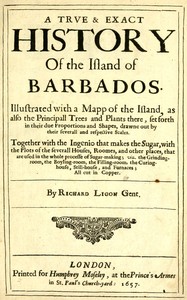
Richard Ligon opens his True & Exact History by confessing himself “altogether unlettered,” a disclaimer that frames the work as a plain-spoken record rather than a learned treatise. The book’s title page promises copperplate illustrations of trees, plants, and the ingenio (sugar works), and the text delivers a similarly meticulous verbal inventory. Ligon’s prose is at its most vivid when he turns to the island’s insect life: he describes ants as “Ubiquitaries,” cockroaches as “mortal enemies” to ants, and a mysterious fly that rises from the earth after rain, “as big bodied as Bees, but far larger wings.” These passages reveal a writer who observes closely and delights in the particular, even when the subject is vermin.

A Gentleman’s Unlettered Eye

Yet Ligon is not artless. His account of the “ugly wabling gate” of a nocturnal biting insect shows a writer attentive to sound and motion. He notes that the insect “appears in the evening when ’tis dark, and will, when he pleases, flie to your bed,” a sentence that mimics the creature’s sudden, unpredictable movement. The phrase “fetch blood” is blunt and physical, typical of Ligon’s style. He avoids moralizing about the discomfort, instead reporting the fact that “Negres, who have thick skins” are bitten so badly that their skin is “rac’t, as if it were done with a currie-comb.” The simile is homely and precise, drawn from domestic experience.

Insects as Protagonists

Other insects are catalogued with similar care. The “Meriwings” are “so thin and aereall” that they are nearly invisible, their presence announced only by a noise “like a small bugle horn, at a great distance.” Caterpillars attack potato leaves, and the remedy is to drive “a flock of Turkies” into the field. Ligon notes the double harm: the slips are horse food, the roots are human food. This practical calculus—weighing loss against remedy—is characteristic of the book’s blend of natural history and colonial management.

The Sugar Ingenio as a Machine of Words

Yet the sugar works are also a site of labor, and Ligon does not ignore the human cost. He mentions “Negres” in passing, noting their thick skins and hard labor, but he does not dwell on their condition. The book’s focus remains on processes and products, not on the people who operate them. This silence is itself a historical fact, and modern readers will note the gap between Ligon’s meticulous observation of insects and his cursory treatment of enslaved workers.

The Landscape of Detail

He also records the island’s sounds: the “small bugle horn” of meriwings, the silence of ants. His descriptions are often synesthetic, blending sight, sound, and touch. The “ugly wabling gate” of the biting insect is a visual impression that also conveys a sense of awkwardness. Ligon’s world is one of continuous sensory input, and his task is to translate that into words for an English audience that has never seen a guava or heard a meriwing.

Ligon’s True & Exact History rewards readers who attend to its particulars: the exact shade of a fly’s wing, the layout of a boiling room, the noise of an insect at dusk. The book is not a systematic natural history in the Linnaean sense, but a gentleman’s report from a place where everything—ants, flies, sugar—seems to multiply and demand description. Read it for the details, and for the voice of a man who insists he is no scholar but who sees more clearly than many.

Ligon’s careful notes on Barbados feel less like a ledger and more like a friend trying to hold onto a place before it slips away—the exact weight of a sugar cane, the hum of insects at dusk. I found that same patient, wondering voice again in Sixteen months at the gold diggings — Themes and Context, and it lingered with me long after the last page. Quiet, unhurried, almost like a shared secret.

John Martinez
1 month ago

Matthew Moore
1 month ago

Lucas Hill
1 month ago

Owen Adams
2 weeks ago

Oliver Jackson
1 week ago

4.5
4.5 out of 5 (6 User reviews )

Add a Review

Your Rating *
  • ...
    Michael William Owen - 3 weeks ago
    A meticulously detailed historical account of Barbados in the 17th century. The author provides an exhaustive look at the island's geography, agriculture, and the brutal realities of the sugar trade. An invaluable resource for historians and those seeking to understand colonial Caribbean life.

  • ...
    Peter Darin Mendez - 1 week ago
    While undeniably a primary source, the book lacks narrative flair and reads like a bureaucratic report. The author's condoning of slavery is deeply disturbing, and the often technical language makes it inaccessible. Only for those with a strong academic interest in colonial history.

  • ...
    Ashley Case - 1 week ago
    This is a comprehensive documentation of Barbados, but the density of information can be overwhelming. The sections on colonial administration are dry, yet the descriptions of native flora and fauna are surprisingly engaging. Recommended for serious historians rather than casual readers.


Reader reflection

How did this book work for you?

Your answers remain private and are stored only in this browser.

Your progress 0 / 10
1

Which reading stage best describes you?

2

Was reading this book enjoyable?

3

Would you pass this book on to a friend?

4

What was the reading difficulty like?

Related eBooks