1

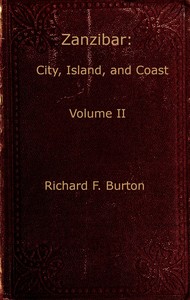
Zanzibar; city, island, and coast. Vol. 2 (of 2) — Text and Context
(0 User reviews)
1013
Project Gutenberg
2023
Not confirmed
Africa, East -- Description and travel; Zanzibar -- Description and travel; Ethnology -- Tanzania -- Zanzibar
Readers of public-domain and historical texts
Project Gutenberg digital edition
en
Edition facts
Words
121,708
Reading time
530 min
Text sections
19
The catalog record for Zanzibar; city, island, and coast. Vol. 2 (of 2) — Text and Context provides practical reading context through 121,708 words, 8 hr 50 min estimated reading time, and 19 detected text sections.
The text analysis averages about 18.7 words per sentence, while the detected sections provide another way to judge how the source is divided.
Project Gutenberg metadata also associates the work with “Africa, East -- Description and travel,” connecting these edition facts with the source record’s subject description.
Source:
Project Gutenberg record #70032
Burton's second volume scrutinizes East African coast and interior through sharp contrasts: Arab coastal settlements vs. African hinterlands, missionary ideals vs. local realities, and his own observations vs. Speke's later claims. A critical, evidence-based travelogue.
Read the complete public-domain text at its original source.
Read on Project GutenbergBurton opens Volume II with a trial trip from Zanzibar to Mombasah on January 5, 1857, but the excerpt quickly shifts to a polemical dissection of his companion Speke's geographical errors. The narrative is as much about contested knowledge as about the coast itself. Burton challenges Speke's 'Mountains of the Moon' as a fiction grown 'under his hands,' and corrects the Tanganyika Lake altitude from 1844 to 2800 feet, citing Baker and Livingstone. This is not a passive travelogue but an active argument, where Burton uses his own observations to dismantle what he sees as romantic Arab geography and Speke's self-serving revisions.
Coastal Encounters and Ethnographic Detail
The journey from Zanzibar to Mombasah is rendered through precise ethnographic and topographical notes. Burton describes the Wanyika tribe with an eye for custom and appearance, noting their 'savage' epithet in the Nyika region. He contrasts the settled Arab-Swahili towns with the 'barbarous' interior, but his observations are grounded in specific details: the Baloch guard at Tongwe outpost, the copal fields of Sa'adani, and the hippopotamus hunt on the return march. Each episode serves as a data point in his broader argument about the region's complexity.
Burton's voice is that of a skeptical empiricist. He records thermometric observations (Appendix II) and commercial notes (Appendix I) with the same care he applies to correcting Speke's altitudes. The reader should attend to how he weaves these technical asides into the narrative, using them to bolster his authority against rival explorers.
Missionary Work and Its Discontents
Chapter III, 'Visit to the Kisulodi-ni Mission House,' offers a rare glimpse into missionary activity on the coast. Burton's tone is measured but critical. He does not praise the mission's spiritual aims; instead, he notes the practical challenges and cultural frictions. The mission house itself becomes a site of tension between European intentions and African realities. Burton's description avoids hagiography, focusing instead on the mundane difficulties of sustaining such an outpost.
This section exemplifies Burton's method: he presents the mission not as a symbol of progress but as a fragile institution embedded in a landscape of competing interests. The reader should compare this with his later accounts of African polities, such as the presentation to King Kimwere of Fuga, where indigenous power structures are treated with a similar blend of curiosity and reserve.
Correcting the Record: Speke and the Nile Sources
The longest excerpt is a sustained critique of Speke's geographical claims. Burton argues that Speke's 'Mountains of the Moon' were a retroactive invention, 'laid down solely on scientific geographical reasons' from 'the depths of his self-consciousness.' He traces the error to Ptolemy, noting how Arab geographers 'wove into one line Jebel Kumri' and transferred ranges north of the equator. The Tanganyika altitude error is blamed on a single faulty thermometer reading, later corrected by Baker and Livingstone.
Burton's tone is combative: he accuses Speke of allowing the lake's altitude to 'lie uncorrected' for self-serving reasons. This is not a neutral travelogue but a polemic embedded in a scientific dispute. The reader should note how Burton uses his own expedition data—thermometric, meteorological, and observational—to undermine Speke's legacy, while simultaneously positioning himself as the more reliable witness.
Burton's second volume rewards readers who approach it as a layered document: part travel narrative, part scientific correction, part personal score-settling. The coastal descriptions are vivid but always subordinated to the larger argument about who gets to define African geography. Pay attention to the footnotes and appendices, where Burton buries some of his sharpest criticisms. This is a book that demands active reading—one where the author's voice is as much a subject as the lands he describes.
I keep thinking about Burton’s way of seeing a place through its contradictions—the coast and the interior, what people claim and what they live. Your quiet copy of An Englishwoman in Angora — Text and Context stayed with me for similar reasons. It’s not a verdict, just a lingering, honest glance at a world shifting underfoot.
There are no reviews for this eBook.
There are no comments for this eBook.
Reader reflection
How will you remember this book?
Save your reaction, strongest insight, and memorable passage.
Your progress
0
/
10
2
Was reading this book enjoyable?
3
Would you recommend this book to another reader?
4
How demanding did the text feel?
5
Could you see yourself revisiting this book?
6
What did you appreciate most?
7
How well did it match your expectations?
8
Did any part of the book stay with you emotionally?
9
Which lesson or insight stayed with you?
10