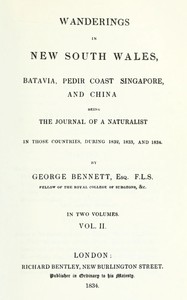
Wanderings in New South Wales, Batavia, Pedir Coast, Singapore, and China, Vol. 2 (of 2) — Edition Insights

(6 User reviews)   1483
In Category - Geography
Bennett, George, 1804-1893 Project Gutenberg 2024 Not confirmed
New South Wales -- Description and travel; Asia -- Description and travel; Natural history -- Australia -- New South Wales Readers of public-domain and historical texts
Project Gutenberg digital edition en

Edition facts

Words 93,922
Reading time 409 min
Text sections 25

Wanderings in New South Wales, Batavia, Pedir Coast, Singapore, and China, Vol. 2 (of 2) — Edition Insights can be approached with a clearer sense of reading commitment from its source measurements: 93,922 words, 6 hr 49 min estimated reading time, and 25 detected text sections.

The text analysis averages about 33.6 words per sentence, while the detected sections provide another way to judge how the source is divided.

Project Gutenberg metadata also associates the work with “New South Wales -- Description and travel,” connecting these edition facts with the source record’s subject description.

George Bennett's 1834 journal records natural history observations during travels in Southeast Asia and China. This volume includes detailed dissections of birds, descriptions of Macao's aviaries, and negotiations on the Pedir coast, offering a naturalist's perspective on colonial encounters and exotic fauna.
Share
Editorial Edition Score 4.9/5

Calculated from edition completeness, EPUB availability, text structure and catalogue metadata. Not a user rating.

How this score is calculated
  • Description quality20 pts
  • Title & short description10 pts
  • Source metadata20 pts
  • Text length15 pts
  • Chapters / structure15 pts
  • EPUB file integrity20 pts

Total of 100 points, scaled to a 2.5-5.0 range. Editions with an empty description or a missing EPUB file are not scored.

Edition quality

Read the Text

Pedir coast—Treaty with the Acheenese—Anarchy—Syed Hussain’s claims—Trade in the Areka-nut—Visit to the Village of Gingham—Negociation for the restoration of a Penang brig—An amulet—Visit of the Rajahs to the Queen—Gingham—Trade of the coast 1

Arrive at Singapore, and sail for China—The Lemma Islands—Their inhabitants—Boats—Hong Kong Islands—Dr. Abel’s visit to the shore—A pilot’s surprise—Cap, Sing, Moon—Cum, Sing, Moon—Outlaw ships—Trade in opium—Researches about the hills—Botanica productions—Macao—Its streets—Vain endeavours to open a trade with the Chinese ports—The Rev. C. Gutzlaff— Harbour of Macao—Jealousy of the Chinese government—Fruit Wang, hee canes—The Casa Garden—Cave of Camoens—Tributary verses to that poet 16

Museum at Macao—Mr. Beale’s splendid aviary and gardens—The Paradise bird—Natural history of this splendid creature—Anecdotes—Superb magpie—Loris—Description of the aviary 35

Reeve’s pheasants—Golden pheasants—Silver pheasants—Blue pigeons—Stabbed-breast pigeons—Widow birds—The horned Tragopan—The mandarin teal—Conjugal fidelity—Nicobar pigeons—Peacock pheasants—Pink cockatoo—The Ounderou monkey—A Pitta—Mr. Beale’s gardens—Rare productions of the vegetable kingdom—Native drawings—Extortionate custom 55

Leave Macao for Whampoa—Entrance to the Bocca Tigris—Country about Chuen, pee—Scene at Whampoa—Approach to Canton—The town and suburbs—The sailor’s coffee-shop—Selling by weight—Dwarf orange trees—The tea shrub—Visit to the celebrated Fa-tee gardens—Topics of conversation—Exaggeration—Rambles in the suburbs—The city gate—Manufactories—Sandal-wood 81

Visit to the Temple of Honan—Colossal figures—The priesthood—Votive offerings—Mummery—Holy pigs—Their corpulency—The hall of the factory—Duck-boats—Alabaster—Chinese snake—Leave Canton and return to Macao—Visit the Lappa Island—Hill-pines—Mass of granite rocks—Their sonorous qualities—Tanka-boats—Chinese burial-grounds—Cassilhas Bay—Manufacture of ropes—Portuguese ladies at Macao—Origin of that name—Another temple near Macao 107

The Jesuits’ church and college of San José—The gardens—Sail from Macao for Singapore—Pass Pedro Blanco—Island of Singapore—The town—Treaty for the cession of the island to the British—Hills—Salubrity of the settlement—European burial-ground—Vicinity of the settlement—Government hill—Grand prospect—Commercial prosperity—New roads 124

Description of an Ungka ape—His habits—Anecdotes of him—His death—Dissection 142

The Botanic Garden—The Croton tiglium—The true Camphor-tree—The Malaleuca Kayu-puteh—Excursion into the interior of the island—Botanical productions—Chinese farms and plantations—Pepper harvest—Plantain-trees—Gambir plantations—Boiling houses—Cultivation and preparation of Gambir—Dense vegetation of the Jungles—Establishment of a Chinese-planter 174

Excursion further inland—Dense forest—An extensive swamp—Parasitical plants—Fungi—The pitcher plant—Return to Singapore—The wild pine-apple—Use of that plant—Manufactory of pearl sago—Visit to the Rajah of Johore—Interview with his Highness—Excursion to St. John’s Island—Pulo Panjang—Impenetrable jungle—New Harbour—Agar-agar 202

Sail for England—Crowned Pigeons—Straits of Dryan—Banca Straits—Zutphen Islands—Escape and re-capture of a crowned pigeon—Death of one of those birds—Dissection—Pass the Cape of Good Hope—Fine weather—The trumpet weed—Volcanic rocks—St. Helena—Buttermilk Point—James’s Town—Ficus Religiosa—Over-population of James’s Town—Visit to the late residence of Napoleon 228

Tomb of Napoleon—The willows—Contrasted feelings of the French and English visitors to Buonaparte’s grave—Fish—Sail from St. Helena—Island of Ascension—Frigate birds—Shark, Sucking, and Pilot Fish—The Sargasso weed—Condition of the Crowned pigeons—A swallow captured during migration—Temperature—Arrival at Gravesend 246

Morbid Appetite in Sheep 343

Notes on the Plantain and Banana Tree 399

The Inhabitant of the Nautilus Pompilius 406

On the habits of the Viverra Mussunga, or Java Cat 412

Luminosity of the Ocean 421

Treaty between the British and Acheenese governments 424

_Page 243, line 19_, after island, _insert_ with passengers of the French nation.

Pedir coast—Treaty with the Acheenese—Anarchy—Syed Hussain’s claims—Trade in the Areka-nut—Visit to the Village of Gingham—Negociation for the restoration of a Penang brig—An amulet—Visit of the Rajahs to the Queen—Gingham—Trade of the coast.

It is stated, that during the life of the former rajah, Pedir was not a tributary district to the territory of Acheen, but commanded the whole line of coast to the eastward, and from that circumstance the Betel-nut coast, which extends to the eastward, and not to the westward of Pedir, received the name of the Pedir coast: the old rajah was also very expeditious in loading ships, and took the goods in barter from the traffickers at the fixed price, unless they were rated extravagantly high.

I had an opportunity of obtaining a copy of the treaty made with the Acheenese, by Sir Stamford Raffles, and ratified by the Marquis of Hastings, then Governor-General of India: it was executed at a village near Pedir, which was pointed out to me from the roadstead, the rajah of Acheen being at that time obliged to reside there, from political circumstances. I annex a copy of the treaty,[1] the origin of which is stated in the “Life and Public Services of Sir Stamford Raffles,” by his widow. (4to. 1830, pp. 396, 397.) And in a letter from Sir Stamford to Sir Robert Harry Inglis, he says the Acheen country “at one period attracted more attention in Europe than most eastern countries, but which has long declined in importance.” “For the last four years, (1819,) the country of Acheen had been a prey to disorder and anarchy. A rich merchant of Penang, Syed Hussain, patronized by the late Mr. Petrie, taking advantage of the unsettled state of the capital, set up claims to the sovereignty; and, having expended an immense sum in briberies and corruption, contrived, by means of his superior naval force, and the advantage of equipping his vessels from Penang, to command the trade of the Acheenese ports, and to invest one of his sons with the title of sultan. The Penang government, taking part with this side of the question, strongly recommended the support of it by the supreme government, and a force of a thousand men was actually applied for, with proper equipments, in order to establish the newly-created king thoroughly on his throne. Captain Coombs, a protégé of Mr. Petrie’s, and who had been employed as the agent of the Penang government, was in Bengal at the time of my arrival, and Lord Hastings asked my opinion. I had no hesitation in giving it, as far as it was then formed; and the supreme government was induced to pause. I was subsequently joined in a commission with Captain Coombs, for the purpose of finally adjusting the question.

“After my arrival at Penang, I was informed that Colonel Bannerman had protested against my interference at Acheen, and had written in such terms to the supreme government, that it was incumbent on me to await the answer. I complied with this request; and while the question was pending, proceeded to this place, (Singapore,) effected my object, and returned to Penang in time to receive the further instructions of the supreme government. These only tended to confirm what I had formerly received, and Captain Coombs and myself accordingly proceeded to Acheen. We remained there nearly seven weeks; during the early portion of which, we were directly opposed in our politics; but at length, after a paper war, which actually occupies above a thousand pages of the Company’s largest sized paper, he came round to my opinion, and was satisfied, that in justice and honour, there was but one course to pursue, namely, supporting the cause of the legitimate sovereign. The spurious claims set up by Syed Hussain were proved to be unfounded, and it was clear he had grossly deceived our government. We therefore concluded a treaty, and effected all the objects we required, namely, the right of having a resident and establishment at Acheen, and to exclude all foreign European nations from having a fixed habitation. All that we had then to do, was to require the governor of Penang to restrict Syed Hussain from further interference, and troops and equipments of course became unnecessary.

“I never had a more disagreeable duty, and consequently was highly satisfied to bring our mission to so desirable a conclusion. It was an object of great importance to take the right side of the question; and had our government been once committed on the other, and troops introduced, we should soon have been so deeply involved, that a worse than Candian war might have been apprehended. In a country like Acheen, by military operations, we had every thing to lose, and nothing to gain.”

It was discovered, when too late, by the supercargo, that the village of Pedir was the worst place on the coast to procure either a quick dispatch or a cheap cargo of the Areka-nut; for the rajah is obliged to treat with merchants, to supply the ship with the requisite quantity which has been agreed upon: the other European vessels had anchored at the village of “Gingham,” about eight or nine miles further to the eastward. At this place, the contracts are made with merchants, not with the rajah; and the merchants pay the rajah his dues. It is always best to contract with the merchants, who can supply it at a quicker and cheaper rate than the rajahs, who must themselves apply at last to the merchants; and the payment proceeding through the hands of the rajah, or his ministers, the latter take care that some remains behind for their special use; and, at the termination of the affair, the buyer will find that he is the loser, not the seller. Sawang, Tellisomoy, and other places on the coast, abound also in the Betel-nut.[2]

Another error which was fallen into by not being acquainted with the custom of the place, was purchasing the nut by the pecul instead of the _laxar_, by which much loss is sustained by the buyer. The luxur or laxar is in weight one pecul and thirty-five-hundredths of a pecul: it consists of ten thousand nuts, and from ten to twenty-five per cent., according to the bargain previously made, is given over, for nuts which may be rotten or otherwise damaged.

Several vessels, the Eleanor, Helen, Dania, (Denmark ship,) and Peru, were lying in Gingham roads, for cargoes of Areka-nut. I took an opportunity of visiting the village of Gingham, proceeding thither in the ship’s boat. The coast to the eastward still maintained the same picturesque character as about Pedir, except perhaps in some parts where it was more densely wooded with cocoa-nut and other trees close to the beach. We passed a cluster of palm-leaved thatched, bamboo huts, which was the village of Ilbu. The village of Gingham was not visible from the roadstead, being situated a short distance up a river, and hidden by the dense foliage of various kinds of trees growing about it. A short distance further to the eastward, a cluster of habitations formed the village of Buron; and Sawang (or, as called by the Malays, Putukurra) is several miles still further in the same direction.

I have before mentioned, that a Penang brig had been seized by the Acheenese grab, the Nacodar (or master) of which, having been accused of trading in arms and ammunition, with one of the rajahs upon the coast, at present at war with the ruler of Acheen: many of the commanders of vessels then on the coast were desirous of getting, if possible, the vessel returned. She was the property of several native merchants at Penang, and had been chartered by an English merchant there for the Pedir coast, first calling at the Maldive islands for a cargo of dried fish.

A brother of the Acheenese rajah, named Pungarang Ibrahim, a fine and handsome Malay, was on board the grab; and to him application was made for the restoration of the vessel. He had a very intelligent Malabar native as an interpreter, who spoke several European languages—English, French, Spanish, &c.—fluently. The question, whether or not the vessel was a legal prize to the Acheenese government, was discussed by the native party with considerable force and eloquence. The Nacodar was accused of having disposed of arms and ammunition, under British colours, to the rajah mudar of Sambalangang, against the treaty concluded between the British and Acheenese governments, the rajah of Sambalangang being at war with the king of Acheen; and one of the articles of the treaty states, that any British vessel supplying an enemy of the rajah of Acheen with arms and ammunition, is liable to confiscation; and upon this article of the treaty, it was contended that the brig was a legal capture. The Pungarang[3] Ibrahim then produced the original treaty, written in the Malay and English languages, duly signed by the governor-general of India, Sir Stamford Raffles, and Captain Coombs.

The Nacodar stated, in his defence, that he having given, and not sold, the arms and ammunition in question, the brig was not liable to the consequences of a breach of the treaty. The discussion concluded by the rajah declaring, that if the commanders would return in one or two hours, they should receive his final decision, as he would consult the old queen, who has much power, upon the subject. When the commanders returned on board the grab, the queen was present, who was a fine old lady, and received her European visitors in a very cordial manner. The subject relative to the vessel was then renewed: they were anxious to procure the nacodar, (who had sought refuge on board one of the ships,) and take him to Acheen, where, most probably, his life would be sacrificed; or the rajah offered to send him to Penang, in irons, to be tried by the authorities at that place, if any commanders of the vessels going to that port would take charge of him.

In the renewed discussion of the subject, the justice of the case appeared decidedly in favour of the rajah’s party, as it was now ascertained that a shot had been fired from the brig, which had killed a man on board the grab.

The rajah summed up his final decision to the following effect, through the medium of an interpreter:—“Let the native Nacodar be sent on board my vessel; I will not injure him; I will make a solemn engagement with you to that effect; but I intend sending him to the settlement of Penang in chains, there to be dealt with as the judges at that settlement may determine: if the man has not done wrong, why is he afraid to come on board? here are plenty of Europeans.” And thus concluded an address replete with excellent sense and sound discrimination—“I appeal to your English laws whether I have not decided justly, and according to the treaty solemnly ratified between the Sri Sultan Alla, Iddeen Jowhara, Allum, Shah, Sultan of Acheen, and the British government?”

One of the commanders, who afterwards asked the rajah to give up the vessel as a matter of courtesy, received the following sensible reply—“Would one of your men-of-war surrender a prize which had been proved a legal capture?” He then added, that the vessel should be taken to Acheen, and when there, if found by his brother, the rajah of Acheen, to be illegally seized, she should be returned forthwith to Penang, and the owners indemnified for her detention, and any damage she might have sustained while in their possession.[4]

The rajah is a fine and handsome young man, of very pleasing manners, and an intelligent countenance; his face was full, broad, and had the true Malay characteristics; he had upon his left arm a large seal, or amulet, of about two inches in diameter, upon the stone of which (called “Pungli” by the Malays) a sentence of the Koran was engraved; he said it was intended as a charm against his being injured; “so the Acheenese believe,” he added, but did not appear to place much faith himself in its supposed powers.

The different rajahs came on an appointed day from the different districts in the vicinity, to Pedir, to pay their respects to the old queen previous to her departing to Acheen in one of the men-of-war, which she did on the evening of the 20th of July, accompanied by the whole of the Acheenese fleet.

Accompanied by Captain M’Alister, I visited the village of “Gingham.” At the entrance of the river, a bar, (similar to, I believe, the whole of the rivers upon this coast,) on which usually rolls a heavy surf, rendering its entrance somewhat dangerous for boats; the river maintained a very winding course even to the village: a number of shrubs abounded in the water, and about the banks, among which were the _Acanthus ilicifolia_, and several others. The village of Gingham is situated about a mile distant from the entrance of the river; the thatched-houses, of which it is composed, were partially concealed by the graceful and elegant Bamboo, Eju, Cocoa, and Areka palms. Having landed and ranged about the village, I made inquiry of the native merchants, who were the Moormen of Hindostan, many of whom had been born in India, and others on the coast, respecting the trade of the place, which consists exclusively of the Betel-nut; they informed me that they contracted with the supercargoes of vessels[5] visiting the coast, paying to the rajah a certain tribute. The export is from forty to sixty thousand peculs annually, during the months of May, June, July, and some part of August. The total amount collected upon the coast, the greatest portion of which grows some distance inland, is computed at or about eighty or ninety thousand peculs.

The number of vessels, of all classes, freighted every year upon this coast during the season, varies, and depends a great deal upon their size; sometimes forty of all classes had been loaded, but when a large Bombay Indiaman comes and takes ten thousand peculs at one time, of course it occasions a scarcity for the smaller ones; in this case, therefore, although the number of vessels loaded is not so great, the quantity exported is pretty nearly the same.[6]

The cargo sent on board the ship in which I visited Pedir, came not from the Pedir district alone, but was brought (by contracts entered into by the rajah of Pedir, with the native merchants of those places) from Gingham, Sawang, &c., and of course at an increased price. I made inquiry, if a ship was brought next month, (August,) whether they could load her with Areka-nut, and what period of time they would take to deliver six thousand peculs on board. The reply was, that at this season a greater scarcity of nut prevailed than usual, on account of internal wars drawing away the men, and causing a scarcity of hands to collect and shell it; my informant, therefore, would not engage to deliver any next month, but the following May would engage to supply the quantity of six thousand peculs in a week, receiving dollars, cambrics, long cloths, opium, iron, &c., in exchange, and delivering the Areka-nut at one dollar the pecul; however, much depends on the agreement of price between the contracting parties at the time, and the greater or less demand for the European and other goods brought into the market.

There was an abundant supply of fish in the fish-market at Gingham, consisting of very large specimens of Acanthurus, or lancet-fish, Chœtodons, Cyprinus, several species of the Perch tribe, the Barracouta, Shark, as well as a number of others, varying in form, size, and colour; and it appeared from the collection exhibited, that abundance was taken upon the coast.

On the evening of the 23d of July, we sailed from “Pedir,” bound for Singapore and China, having six thousand and eight peculs of Areka-nut on board. The cargo was purchased for five thousand four hundred and forty Spanish dollars, forty peculs of iron, thirty kits of Swedish steel, thirty peculs of lead, and three chests of opium. Upon the iron a profit was gained upon the invoice prices of 77½ per cent.; upon the lead, 81½ per cent.; and upon the steel, 48 per cent. Upon the opium there was, as I have before mentioned, but very little profit; indeed, the price of a dollar and a-half per pecul was too high for this article; but, unfortunately, the speculation originated at Batavia, and being the first ship chartered for the purpose from thence, the parties were consequently ignorant of the people and country, and of the kind of merchandize most advantageous for barter. From the number of ships requiring nut at the same time, payment in dollars, and at an advanced price, is sometimes the only means of procuring a cargo, unless the vessel remained so long as to be ruinous to the speculators.[7]

George Bennett, a surgeon and Fellow of the Linnean Society, opens this second volume with a treaty negotiation on the Pedir coast, immediately establishing the blend of diplomacy and natural history that characterizes his journal. The reader encounters a world where trade in areka-nut and the restoration of a Penang brig sit alongside descriptions of amulets and visits from rajahs. Bennett's voice is that of a methodical observer, equally attentive to political maneuvers and the plumage of a bird.

The excerpts reveal a structure that alternates between travel narrative and scientific inquiry. Early chapters move from the Pedir coast to Singapore and then to China, but the heart of the volume lies in Macao, where Bennett spends several chapters cataloging the collections of Mr. Beale's aviary and gardens. This is not a continuous story but a series of vignettes, each anchored by a specific location or specimen.

A Naturalist's Dissecting Table

The most striking passages in the excerpts are Bennett's detailed post-mortem examinations of birds. When a Nicobar pigeon dies suddenly aboard ship, Bennett performs a full autopsy, measuring a polypus that caused the obstruction. He notes the "gruelly liquid" discharged from the bill, the pallid muscles resembling fish, and the "very vascular" crop. The precision is clinical: the polypus measured "two inches and six-eighths" in length. Bennett preserves the diseased eye in spirits, a detail that underscores his collector's instinct.

These dissections reveal Bennett's dual role as surgeon and naturalist. He does not merely describe; he seeks causes, fearing that other birds might die and frustrate his plans to bring them to England alive. The reader witnesses the practical challenges of transporting live specimens in the 1830s—broken feathers, confined spaces, and sudden mortality. Bennett's scalpel becomes a tool for understanding, and his notes read like a casebook.

Macao's Menagerie and Gardens

Chapters III and IV are devoted to Mr. Beale's aviary and gardens in Macao, a private collection that Bennett catalogs with evident enthusiasm. He lists Reeve's pheasants, golden pheasants, silver pheasants, blue pigeons, stabbed-breast pigeons, widow birds, the horned tragopan, mandarin teal, Nicobar pigeons, peacock pheasants, pink cockatoos, and a monkey called Ounderou. The list is exhaustive, but Bennett also includes anecdotes: the conjugal fidelity of mandarin teals, the behavior of the paradise bird.

The gardens themselves are described as containing "rare productions of the vegetable kingdom," though the excerpts do not specify which plants. Bennett's focus remains on the aviary, which he calls "splendid." The reader senses that this is a highlight of his journey—a concentrated display of exotic life that contrasts with the wild specimens he encounters elsewhere. The chapter on the paradise bird includes natural history and anecdotes, suggesting Bennett's interest in both scientific classification and local lore.

Trade, Diplomacy, and the Coast

The opening chapter on the Pedir coast introduces a different side of Bennett's travels: negotiations with Acheenese rajahs over a treaty and the restoration of a Penang brig. The trade in areka-nut is mentioned, and Bennett visits the village of Gingham. The excerpts do not reveal the outcome of these negotiations, but they establish the political context of the region. Bennett's role as a naturalist does not isolate him from commerce; he moves through ports where opium ships and outlaw vessels are part of the landscape.

Later, in China, Bennett describes the approach to Canton via the Bocca Tigris, the scene at Whampoa, and the Fa-tee gardens. He notes the "jealousy of the Chinese government" and the difficulties of opening trade. These passages are brief in the excerpts, but they frame the natural history within a world of colonial enterprise. Bennett is a traveler dependent on local authorities and European networks, and his journal reflects the tensions of that position.

The Texture of Daily Observation

Beyond the set pieces, Bennett's journal is filled with small, precise observations that give texture to his narrative. He notes the "film over one of the eyes" of the Nicobar pigeon before its death, the "yellowish fat" around the crop, and the "serous fluid" between skull and integuments. These details are not merely clinical; they reveal a mind attuned to the physical world. Even in describing a bird's death, Bennett remains the naturalist, measuring and recording.

The excerpts also hint at Bennett's interactions with local people. He mentions "native drawings" and "extortionate custom" in Macao, and a pilot's surprise at Hong Kong. These moments are fleeting, but they remind the reader that Bennett is an outsider, dependent on interpreters and guides. His journal is a record of what he sees, but also of what he cannot fully understand—the languages, customs, and politics that surround him.

Bennett's volume rewards a reader who appreciates detail over narrative momentum. The journal moves from coast to coast, but its coherence comes from the naturalist's eye, not from plot. Pay attention to the dissections and the lists of specimens; they are the core of Bennett's project. The political and commercial passages, though less developed in the excerpts, provide essential context. Read slowly, and let the specific observations—the polypus, the film over the eye, the list of pigeons—guide your attention.

There’s something about a traveler’s old journal that stays with you—the way Bennett quietly dissects a bird on a remote shore, as if the world’s wonders were simply part of a long, thoughtful day. I felt that same patient stillness reading A Summer in the Wilderness embracing a canoe voyage up the Mississippi and around Lake Superior — Background and Themes, where the water and woods ask for nothing but your presence. Both books leave a gentle ache, a wish to have been there, notebook in hand.

Oliver White
1 month ago

Ella Nguyen
1 month ago

Alexander Anderson
1 month ago

Liam Allen
4 weeks ago

Charlotte Jones
1 month ago

5
5 out of 5 (6 User reviews )

Add a Review

Your Rating *
  • ...
    Mary Sloan - 1 month ago
    {'rating': 2, 'text': "The author's narrative lacks focus, jumping from one observation to another without a clear thread. While some episodes are intriguing, they are buried under excessive detail about commerce and colonial life. The writing is often dry, and the author's imperial attitudes are cringe-worthy. A tedious read that requires patience to find the rare gems."}

  • ...
    Brandon Wilson - 3 weeks ago
    {'rating': 4, 'text': "A delightful travelogue that takes you through 19th-century Australia, the East Indies, and China. The author's observations are sharp, often humorous, and full of local color. His descriptions of New South Wales, the bustling ports of Batavia and Singapore, and the Chinese landscape are vivid and engaging. A great read for armchair travelers and history buffs alike."}

  • ...
    Matthew Brendan Jackson - 2 weeks ago
    {'rating': 3, 'text': "This second volume of the author's travels offers a mixed bag of fascinating anecdotes and tedious details. The sections on Batavia and China are particularly interesting, but the author's penchant for long-winded descriptions of trade statistics can be dull. The prose is serviceable, though dated, and the book would benefit from better maps. An okay read for enthusiasts of colonial-era travel."}


Reader reflection

How did this book work for you?

Your answers remain private and are stored only in this browser.

Your progress 0 / 10
1

How far have you progressed with this book?

2

Was reading this book enjoyable?

3

How likely are you to recommend this book?

4

What was the reading difficulty like?

Related eBooks