1

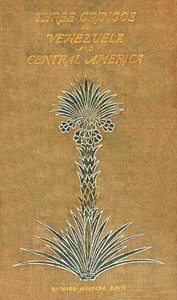
Three gringos in Venezuela and Central America — Key Ideas to Explore
(0 User reviews)
422
Project Gutenberg
2022
Not confirmed
Central America -- Description and travel; Venezuela -- Description and travel; Louisiana State Lottery Company
Readers of public-domain and historical texts
Project Gutenberg digital edition
en
Edition facts
Words
49,799
Reading time
217 min
Text sections
16
The catalog record for Three gringos in Venezuela and Central America — Key Ideas to Explore provides practical reading context through 49,799 words, 3 hr 37 min estimated reading time, and 16 detected text sections.
The text analysis averages about 36.1 words per sentence, while the detected sections provide another way to judge how the source is divided.
Project Gutenberg metadata also associates the work with “Central America -- Description and travel,” connecting these edition facts with the source record’s subject description.
Source:
Project Gutenberg record #69354
Richard Harding Davis's 1896 travelogue follows three American men through Venezuela and Central America, blending firsthand observations of political instability, lottery exile, and canal construction with a journalist's eye for detail.
Read the complete public-domain text at its original source.
Read on Project GutenbergRichard Harding Davis, a journalist and war correspondent, traveled through Venezuela and Central America in the 1890s with two companions, H. Somers Somerset and Lloyd Griscom. The resulting book, Three Gringos in Venezuela and Central America, is a first-person account that mixes travelogue with political reportage. Davis's narrative voice is direct and observational, often noting the contrast between the region's natural beauty and its political turbulence.
The catalog lists the Louisiana State Lottery Company as a subject, and the excerpts confirm that Davis devotes a chapter to the lottery's exile from the United States to Honduras. This specific focus, along with his detailed descriptions of revolutions and infrastructure, makes the book a document of both travel and geopolitical commentary.
The Lottery in Exile
One of the book's most distinctive chapters is titled "The Exiled Lottery," which Davis uses to examine the Louisiana State Lottery Company's relocation to Honduras after being banned in the U.S. He describes the lottery's operations in a building that stands out in the local landscape, and he interviews officials about its impact. Davis notes that the lottery was "exiled" from the United States but found a new home in a country where such enterprises were welcomed. This section is less about gambling than about the intersection of American capital and Central American governance. Davis's tone is skeptical but not moralizing; he reports the lottery's scale and the government's reliance on its revenue without overt condemnation.
Revolutions as Routine
Davis's account of Honduras is dominated by the aftermath of a recent revolution. He describes bullet holes in hotel walls, the siege of Tegucigalpa, and the casual attitude of locals toward political violence. One anecdote stands out: a soldier, while digging his own grave during a battle, was saved when his side unexpectedly won. Davis uses this story to illustrate what he calls "the advisability of doing what every one has to do in this world, even up to the very last minute, in a thorough and painstaking manner." He also notes that revolutions disrupt commerce, seize pack-mules, and impose forced loans, making sustained progress impossible. The writing is vivid but detached, treating the violence as a recurring feature of the political landscape rather than a crisis.
Infrastructure and Ambition
The final chapters shift to the Panama Canal and the modernization of Caracas. Davis visits the canal works, describing dredges, workmen's huts, and the scale of the French effort. He is impressed by the engineering but aware of the human cost—disease, difficult terrain, and financial mismanagement. In Caracas, he contrasts the city's Parisian pretensions with its underlying roughness. The book's illustrations, listed in the contents, include maps, portraits of officials, and scenes of daily life, reinforcing Davis's role as a visual reporter. Throughout, he maintains the stance of an outsider—the "gringo"—observing but not fully participating in the cultures he encounters.
Readers should approach Three Gringos as a period piece that reveals late-19th-century American attitudes toward Latin America. Davis's observations are sharp but filtered through his own cultural assumptions. The book is strongest when he lets scenes speak for themselves—a lottery building in the jungle, a bullet-pocked dining room, a man digging his own grave. These details, more than any overarching argument, give the work its lasting value as a travel narrative and historical document.
That rainy afternoon, I kept returning to Davis’s account of foreign men adrift in Venezuela, how their journey unraveled into sketches of chance and ruin. It made me think of another kind of wandering, older and stranger, where Odysseus himself becomes a ghost over Greek islands. So I found myself following that thread into On the track of Ulysses; Together with an excursion in quest of the so-called Venus of Melos Two studies in archaeology, made during a cruise among the Greek islands — Edition Insights, and the rain outside seemed to slow even further, as if waiting for me to turn each page.
There are no reviews for this eBook.
There are no comments for this eBook.
Reader reflection
What did you think of this book?
Answer a few questions and save a private reflection on this device.
Your progress
0
/
10
2
How did the book work for you overall?
3
Would you pass this book on to a friend?
4
How easy was the book to follow?
5
Did the book offer a fresh perspective?
6
Did the book deliver what you hoped for?
7
Did this book create an emotional response?
8
What was the strongest part of the book?
9
What changed or sharpened your thinking?
10