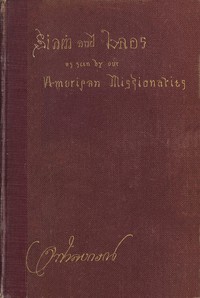
Siam and Laos, as Seen by Our American Missionaries — Themes and Context

(2 User reviews)   542
In Category - Geography
Backus, Mary [Editor] Project Gutenberg 2020 Not confirmed
Thailand -- Description and travel; Laos -- Description and travel; Missions -- Thailand; Missions -- Laos Readers of public-domain and historical texts
Project Gutenberg digital edition en

Edition facts

Words 116,585
Reading time 507 min
Text sections 37

Siam and Laos, as Seen by Our American Missionaries — Themes and Context can be approached with a clearer sense of reading commitment from its source measurements: 116,585 words, 8 hr 27 min estimated reading time, and 37 detected text sections.

The text analysis averages about 23.2 words per sentence, while the detected sections provide another way to judge how the source is divided.

Project Gutenberg metadata also associates the work with “Thailand -- Description and travel,” connecting these edition facts with the source record’s subject description.

A collection of firsthand accounts by American missionaries in 1880s Siam and Laos, covering geography, customs, religion, and mission work. The preface highlights the contributors' long-term residence and roles as teachers, physicians, and translators, offering an insider perspective on Siamese society, Buddhism, and the impact of Western contact.
Share
Editorial Edition Score 4.9/5

Calculated from edition completeness, EPUB availability, text structure and catalogue metadata. Not a user rating.

How this score is calculated
  • Description quality20 pts
  • Title & short description10 pts
  • Source metadata20 pts
  • Text length15 pts
  • Chapters / structure15 pts
  • EPUB file integrity20 pts

Total of 100 points, scaled to a 2.5-5.0 range. Editions with an empty description or a missing EPUB file are not scored.

Edition quality

Read the Text

CHAPTER I. PAGE THE INDO-CHINESE PENINSULA. _An Introductory Sketch._ 15

SIGHT-SEEING IN BANGKOK. _Mrs. S. R. House, formerly of Bangkok._ 81

TOURING IN SIAM. _Mrs. S. R. House, formerly of Bangkok._ 96

IN AND ABOUT PETCHABUREE. _Miss Sarah Coffman, Petchaburee._ 112

ANIMALS OF SIAM. _Mrs. S. R. House, Bangkok._ 120

THE CHINESE IN SIAM. _Mrs. N. A. McDonald, Bangkok._ 145

VARIETIES OF SIAMESE LIFE.

A SIAMESE WEDDING. _Mrs. J. W. Van Dyke, Petchaburee._ 162

HOUSEKEEPING IN SIAM. _Miss M. L. Cort, Petchaburee._ 175

CHILD-LIFE IN SIAM. _Miss H. H. McDonald, Bangkok._ 184

FIRST HAIR-CUTTING OF A YOUNG SIAMESE. _Samuel R. House, M. D., Bangkok._ 193

THE SCHOOLS OF SIAM. _Mrs. S. G. McFarland, Bangkok._ 206

HOLIDAYS IN SIAM. _Mrs. S. R. House, Bangkok._ 224

A GAMBLING ESTABLISHMENT. _The late D. Bradley, M. D., Bangkok._ 233

SIAMESE THEORY AND PRACTICE OF MEDICINE. _E. A. Sturge, M. D., Petchaburee._ 236

CHOLERA-TIMES IN BANGKOK. _Samuel R. House, M.D._ 241

SIAMESE CUSTOMS FOR THE DYING AND DEAD. _The late D. Bradley, M. D., of Bangkok._ 247

THE WATS OF SIAM. _A Compilation._ 269

HISTORICAL SKETCH OF SIAM. _Rev. Eugene P. Dunlap, Petchaburee._ 304

MISSIONARY LADIES IN THE KING’S PALACE. _Mrs. Mattoon, formerly of Bangkok._ 320

CORONATION OF HIS MAJESTY THE SUPREME KING OF SIAM. _Rev. N. A. McDonald, Bangkok._ 338

HISTORY OF THE MISSIONS IN SIAM AND LAOS. _Samuel R. House, M. D., Bangkok._ 351

LAOS LAND AND LIFE. _Mrs. S. C. Perkins, Philadelphia._ 419

FROM BANGKOK TO CHEUNG MAI. _Mrs. Jonathan Wilson, Cheung Mai._ 460

RECOLLECTIONS OF CHEUNG MAI. _Miss Emelie McGilvary, Cheung Mai._ 479

A DAY AT CHEUNG MAI. _Mrs. Jonathan Wilson, Cheung Mai._ 491

A LAOS CABIN. _Rev. Jonathan Wilson, Cheung Mai._ 497

SUPERSTITIONS OF THE LAOS. _Dr. and Mrs. Cheek, Cheung Mai._ 504

TREATMENT OF THE SICK. _M. R. Cheek, M. D., Cheung Mai._ 511

A TOUR IN THE LAOS COUNTRY. _The late G. W. Vrooman, M. D., Cheung Mai._ 525

CHINA TO BRITISH INDIA, VIA CHEUNG MAI. _M. A. Cheek, M. D., Cheung Mai._ 543

HIS SUPREME MAJESTY, CHULALANGKORN I., KING OF SIAM. _Frontispiece._ BURMESE TEMPLE 23 RUINS OF A PAGODA AT AYUTHIA 29 SIAMESE GENTLEMAN IN MODERN COURT-DRESS 32 SIAMESE LADY IN MODERN COURT-DRESS 33 VIEW OF PAKNAM, ON THE MENAM 37 PORT OF CHANTABOON 41 LION ROCK, AT THE ENTRANCE OF THE PORT OF CHANTABOON 44 TYPES OF WOMEN OF FARTHER INDIA 57 SCENE ON AN ORIENTAL RIVER 65 THE BREAD-FRUIT 72 THE LOTUS 74 BIRD OF PARADISE 77 MONKEYS PLAYING WITH A CROCODILE 79 BANGKOK, ON THE MENAM 83 HOUSE-SPARROW 84 FLOATING STORES AT BANGKOK 89 MISSIONARY-BOAT FOR TOURING IN SIAM 97 PRABAT 103 HOUSE AT PETCHABUREE 113 VIEW OF THE MOUNTAINS OF PETCHABUREE 116 MONKEYS 121 JAVA SPARROWS 122 THE COBRA 123 HUNTING THE CROCODILE 127 ELEPHANTS AT HOME 129 AN ELEPHANT PLOUGHING 131 THE WHITE ELEPHANT 141 HOME OF RICH CHINAMAN 146 CHINESE BOAT-PEOPLE 151 CHINESE CEMETERY 152 PAPER PRAYERS 155 PARLOR OF CHINESE HOUSE 156 MISSION-HOUSE 171 SIAMESE LADIES DINING 179 A YOUNG SIAMESE PRINCE 189 A CHINESE STREET-SHOW 191 REMOVAL OF THE TUFT OF A YOUNG SIAMESE 195 A SCHOOL IN SIAM 215 A FEW OF THE CHILDREN OF THE LATE FIRST KING OF SIAM 223 CARRYING THE KING TO THE TEMPLE 231 SIAMESE ACTRESS 234 CREMATION TEMPLE: A TEMPORARY BUILDING 251 TOMB OF A BONZE 263 BANYAN TREE 270 SIAMESE TEMPLE 271 TEMPLE AT AYUTHIA 275 MONASTERY OF WAT SISAKET 277 BRASS IDOL IN A TEMPLE AT BANGKOK 279 THE GREAT TOWER OF THE PAGODA WAT CHEUG 283 BUDDHIST PRIEST 285 BUDDHIST PRIESTS GATHERING FOOD 295 RUINS OF A TEMPLE AND STATUE AT AYUTHIA 303 ATTACHÉ OF SIAMESE EMBASSY: COURT-COSTUME IN 1883 313 THE LATE FIRST KING AND QUEEN 323 SOMDETCH CHOWFA CHULALANGKORN 339 HALL OF AUDIENCE, PALACE OF BANGKOK 341 BRAHMAN AT WORSHIP 345 CORONATION OF A LAOS KING 421 A LAOS FUNERAL 429 TAPPING THE BORASSUS PALM 449 A LAOS HOME 499 CAMPING IN A LAOS FOREST 529

_THE INDO-CHINESE PENINSULA._

When about to visit a foreign country the prudent traveler is careful to seek in guidebooks and from maps some data in regard to its position, prominent features and relation to adjacent regions. Such information adds interest to each stage of his journey. Climbing a mountain, he overlooks two kingdoms. Such a valley opens into a rich mining district; the highlanders of that range are descendants of the original lords of the soil; the navigability of this river is of commercial importance as a possible trade-route.

In like manner, bold outlines of the whole peninsula furnish the best introduction to a careful study of Central Indo-China, showing the trade-connection of Northern Laos with Burmah and the richest mining province of China, and the relation of Siamese progress to certain Asiatic commercial problems. New views also are thus gained of the great work actually accomplished by our American missionaries for science and civilization in this corner of the globe during their self-imposed exile of half a century.

Indo-China is the south-east corner of Asia, a sharply-defined, two-pronged peninsula outjutting from China just below the Tropic of Cancer, its long Malayan arm almost touching the equator, bounded east, south and west by water. Southward, the Eastern Archipelago stretches toward Australia, “a kind of Giants’ Causeway by means of which a mythological Titan might have crossed from one continent to another.”

Along the north the extreme south-west angle of the Celestial Empire, by name Yunnan, lies in immediate contact with the Burmese, the Laos and the Tonquinese frontiers, whence the main rivers of the peninsula divide their streams.

YUNNAN may be regarded as a lower terrace projecting from the giant Thibetan plateau――an extensive, uneven table-land, separated for the most part by mountains from contiguous regions. The northern portion is a confused tangle of lofty ranges, with peaks rising above the snowline, and few inhabited valleys――a region, in a word, compared to which Switzerland is an easy plain――of wild romantic scenery, ravines, torrents and landslips, but with little industry or commerce. Maize is used for food throughout the sparsely-populated district, since rice cannot be cultivated at such altitudes. The main ranges have a north-and-south trend, subsiding some thousand feet before reaching the Indo-Chinese frontier. Parallel to the lower south and south-east chains of mountains are a series of rich upland valleys, each basin supplied with its own watercourse or lake, and tenanted more or less densely by the busy villages situated near the water. Rice, pepper and the poppy are extensively cultivated.

The choicest portion of this province lies within the open angle formed by the divergence of four large rivers――viz. “the Yangtse, taking its course due north, till, bending to the east, it makes its final exit into the Chinese Sea at Shanghai; the Mekong, pursuing a tortuous course south to the China Sea near Saigon; the Si-Kiang, originating near the capital of the province, flows due east to Canton; while a fourth, the Songkoi, or ‘Red River,’ goes south-east to Hanoi and the Gulf of Tonquin. A central position amidst such mighty waterways and with so wide a circumference of outside communication indicates the great importance of the district either for administration or trade――a fact early appreciated by the sagacity of the Chinese, who as far back as the third century established fortified colonies among the then savage and recalcitrant tribes of Yunnan. For export Yunnan has three capital products to offer――opium, tea and metals. The opium-yielding poppy grows almost everywhere. The celebrated tea of the south-east is in great request, being considered by the Chinese themselves superior to all other qualities of tea throughout the empire. Its cultivation offers no difficulties, the high price it commands outside of the region being solely due to the costliness of transport. But it is the metal-trade which will in all probability be the prominent feature of commerce. The great tin-mines have supplied the whole of China from time immemorial; copper abounds throughout the province; lead, gold, silver, iron, and last, but not least, coal, make up the list. Curiously enough, the vast Chinese empire includes no other truly metalliferous province except the bordering region of Western Ssu-ch’nan, geologically, though not administratively, a part of Yunnan; nothing but the inaccessibility, and too-often disturbed and lawless condition, of the country has thus far hindered its mines from becoming sources of really incalculable wealth to the province, to the Chinese empire at large, and, by participation, to foreign commerce.”

The affluent circumstances of the peasantry in the southern districts are in marked contrast with those of the north. The women do not compress their feet. Many of the men bear the Muslim’s physique and features. Indeed, before the merciless massacre of the Panthays, Mohammedans formed the majority of the population. But the last quarrel, begun by miners in 1855, only ended in 1874 by wellnigh the extermination of the entire Muslim community. Mounted expresses were despatched to seventy-two districts with instructions to the principal mandarins from the governor of the province. Families were surprised and butchered by night, their homes sacked and mosques burned. A cry of horror ran from village to village. The Mohammedans rushed to arms, collecting in vast numbers, and upward of a million Chinese were killed in revenge. In the end the Panthays were crushed out, but more than one-fourth of the inhabitants of Yunnan had perished or emigrated. Plague and famine followed the great rebellion and fearfully devastated the whole region, which is only now slowly recovering its former prosperity.

The aboriginal inhabitants of Yunnan are apparently of the same stock as the Laos, just across the border. The variety of their clans and picturesque costumes recalls the wild Highlanders of Scotland.

The chief lack of Yunnan is good roads. Going east or west, the highways run up the ridge, over the saddle or watershed, and dip down into another valley, and this up-and-down process must be repeated from town to town; ravines must be crossed, torrents must be bridged, and often the narrow causeway lies along the side of a precipice or the ascent may be some hundred feet up the face of a mountain. Merchandise crossing the Laos frontier must be carried long distances at an enormous cost. Thus the celebrated so-called Puekr tea of North-eastern Laos, just a little south of the Yunnan border, while freely used by the peasantry of that province, is too expensive by the time it reaches the nearest Chinese port to export to Russia or Europe. Yet the amount of goods and produce that move to and fro _viâ_ Szmao, the last Chinese administration town, to Laos, and _viâ_ Cheung Mai to Burmah, is surprising,――thus affording the best possible guarantee for an increased amount to follow were only communication facilitated. Railroad communication for an overland route is warmly advocated. “From Yunnan,” as Baron Richthoren puts it, “the elongated ridges of the Indo-Chinese peninsula (the land of the Burmese, Malays, Siamese, Laos and Cochin-Chinese) stretch southward as fingers from the palms of a hand.”

The configuration of the peninsula is easily remembered as separated by longitudinal belts of hills, spurs from the northern ranges, into principal basins, or funnels, for the rich drainage of the surrounding highlands, _viâ_ Burmah, or the basin of the Irawaddy; the valley of the Menam and that of the Cambodia or Mekong River; and Tonquin, connected by a narrow coast-strip with the French delta.

The fluvial system of each of these great valleys is dominated by one important river, whose downward course is more or less impeded by cataracts, until the upper plateaux gradually subside into undulating tracts, which increase in width and levelness as they approach the several deltas. Throughout Indo-China these waterways, with their intersecting streams and canals, are the main highways of population, commerce and travel. Native villages often consist of one long water-street running through a perfect jungle of palms and other tropical trees, the little bamboo huts and the wats nearly hidden in the foliage. Boats are used instead of carts, carriages or cars. In the upland districts buffaloes and elephants are used; but, with the exception of the pack-peddlers and caravans at certain seasons, the traveler off the waterways would rarely meet any trace of human life.

I. THE FIRST BASIN――BURMAH.

The westernmost basin embraces the kingdom of Ava, ruled by a most cruel native autocrat, and the three British provinces of Lower Burmah, governed by a chief commissioner residing at Rangoon and subject to the viceroy of India at Calcutta.

What is known of Burmah is chiefly embraced in the valley of the Irawaddy. This large stream, rising in Thibet, flows almost due south some twelve hundred miles, receiving tributaries east and west, and communicating by numerous branches with the Salween, running parallel on the east, but almost useless for travel, owing to its rapids.

The Burmese delta (a network of intercommunicating waters from the Indian border-ranges to the banks of the Salween near the Siamese frontier) has some fourteen outlets, but most of these are obstructed by sandbars and coral-reefs. Bassein and Rangoon are the seagoing ports. The latter is a large city of over one hundred thousand inhabitants, and now ranks third in commercial importance in the Indian empire. This plain from the coast to Prome is subject to periodical inundations and is exceedingly productive. It is a great rice-district. Below the northern frontier of British Burmah the Irawaddy is nearly three miles broad. In the neighborhood of Prome the face of the country changes. Ranges of lofty mountains approach nearer and nearer, and finally close in on the stream, the banks becoming precipitous and the valley narrowing to three-quarters of a mile. Above the latitude of Ava the whole region is intersected by mountains, and not far from Mandalay, the capital of Upper Burmah, is their lowest defile. The banks at this point are covered with dense vegetation and slope down to the water’s edge. Still ascending the river, before reaching Bhamo one enters an exceedingly picturesque defile, the stream winding in perfect stillness under high bare rocks rising sheer out of the water. The current of the upper defile above Bhamo is very rapid, and the return waters occasion violent eddies. When the water is at its lowest no bottom is found even at forty fathoms.

For centuries the Irawaddy has furnished the sole means of communication between the seaboard and interior. The Irawaddy Flotilla Company, started in 1868, employs over one thousand hands, and sends twice each week magnificent iron-clad steamers with large flats attached to Mandalay. The time-distance between the two capitals is greater than from New York to Liverpool. Smaller vessels go on to Bhamo. The native craft are estimated at eight thousand. The rapid increase of trade along this river attracts colonists and has greatly enriched British Burmah.

Bhamo, on the left bank, near the confluence of the Taping and close to valuable coal-mines, is within a few miles of the Chinese frontier. The old trade-route noted by Marco Polo is still in use, but the ranges to be crossed, the great cost of land-carriage, together with the dangerous neighborhood of the Kachyen banditti, render the road of limited avail for trade-purposes beyond the fertile Taping valley. The China Inland Mission and the American Baptists have stations at Bhamo.

The Rangoon-Prome railroad was opened in 1878. The Rangoon-Toungoo line will be in use this year, following the Sittang valley to the borders of Siam. British capitalists have now under contemplation a road crossing from Maulmain to Cheung Mai, a distance of about one hundred and sixty miles, with only one comparatively low hill-chain east of the Salween River. A terminus at Cheung Mai would create an increased traffic, leading to a further extension _viâ_ Kiang Kung to Szmao on the Yunnanese frontier, a distance roughly estimated at two hundred and forty miles, with no intervening mountain-system. Although as yet untraveled by European exploration, this track is in use by the native caravans, and the projected railroad will open a most important exchange market with millions of well-to-do, industrious inhabitants, occupying some of the richest mining and agricultural districts of Southern Asia.

The official census report of Burmah states: “There is possibly no country in the world whose inhabitants are more varied in race, customs and language. There are said to be as many as forty-seven different tribes in the narrow boundaries of the two Burmahs, but these may be classed under four――Peguans, Burmese, Karens and Shans or Laos. The Peguans seem to have first occupied the country. The Burmese followed, and took possession of the plains and valleys of Upper and Lower Burmah. Their language is used in the English courts of justice, and is probably destined to be the prevailing language of the country. The Laos, occupying the north-eastern plateaux skirting the Chinese border, are from a great trunk of uncertain root which appears to have been derived originally from Yunnan, where the main stem still retains its primitive designation of La’o――a name commonly exchanged for ’shan’ in the language of the modern Burmese and English writers. The Karens, scattered along the Siamese frontiers, are various tribes having their own customs, dialects and religion. They have a tradition that when they left Central Asia they were accompanied by a younger brother, who traveled faster, went directly east and founded the Chinese empire. Before the British acquired Lower Burmah these simple mountaineers were subjected to brutal persecutions. So late as 1851 the Burmese viceroy told Mr. Kincaid that he ‘would instantly shoot the first Karens he found that could read.’”

The Karens live among the vast forests, now in one and anon in another valley, clearing a little patch for rice-fields and gardens, their upland rice and cotton furnishing food and clothing and the mountain-streams fish in abundance. They seldom remain more than two seasons in one spot, and all through the jungles are found abandoned Karen hamlets, where rank weeds and young bamboo-shoots supplant the cultivated fields.

II. THE SECOND BASIN――SIAM.

The river Menam (or Meinam) is formed by the union of streams from the north. About halfway in its course mountains close upon the river, which passes from the upper plateaux of Laos into the valley of Siam proper through some of the finest mountain-scenery in the world.

The rich alluvial plain of Siam is estimated at about four hundred and fifty miles in length by fifty miles average breadth. The main stream, above Rahany, is known as the Maping. Below the rocky defiles the river divides several times, and contains some larger and smaller islands; Ayuthia is built on one of the latter. The founding of this city, about 1350 A. D., was one of the most memorable events in Siamese history. In 1766 the Burmese depopulated the country and burned Ayuthia. A new dynasty, with Bangkok for the capital, was founded about a century ago.

Bangkok, sometimes called “the Venice of the Orient,” is the Siamese metropolis――the first city in size, wealth and political importance. Old Bangkok is changing rapidly. European fashions and architecture are introduced among the nobility and wealthy. The new palace is a mixture of European architectural styles, retaining the characteristic Siamese roof. The furniture is on a most costly scale, having been imported from England, it is stated, at an expense of some seventy-five thousand pounds. The large library is filled with books in several languages and furnished with all the leading European and American periodicals. The royal guards are in European uniform, but barefooted, only the officers being permitted to wear boots. In the surrounding area are courts and rows of two-storied white buildings, the barracks, mint, museum and pavilions. The entrance to the throne-room is up a fine marble staircase lined with ferns, palms and plants. The throne-room is a long hall hung with fine oil paintings and adorned with costly busts of famous personages. The spacious drawing-room adjoining is furnished in the most luxurious European style.

The palace of the second king (named George Washington by his father, who was a great admirer of our celebrated American statesman) is also European in many of its appointments, with mirrors, pictures and English and French furniture. This prince, still in the prime of middle life, devotes a great part of his time to scientific pursuits, and has collected in his palace much machinery, including a small steam-engine built by himself. He is fond of entertaining European guests in European style; his reception-room is brilliantly illuminated with innumerable little cocoanut-oil lamps.

The Krung Charoon, or main highway of Bangkok, is several miles in length, and used by the nobility and foreigners for driving, except during the high tide of the river, when it is often partly under water. The liveliest quarters in the capital are those mainly occupied by the Chinese, with their eating-houses, pawnbrokers’ and drug-shops and the ubiquitous gambling establishments, and with a Chinese _waiang_, or theatre, near by.

The finest view of the city and its surroundings is from the summit of Wat Sikhet.

The summer palace recently erected by His Majesty, a few miles below Ayuthia, is a large building in semi-European style, standing amid lovely parks and gardens, ornamented with fountains and statuary, with streams spanned by bridges, and a fine lake with an island on which is built a most delightful Siamese summer-house. The royal wat (temple) opposite this palace is a pure Gothic building fitted with regular pews and a handsome stained-glass window.

This volume assembles chapters from a score of American missionaries who lived and worked in Siam and Laos during the late nineteenth century. The preface emphasizes that these contributors were not casual visitors: some were born in Indo-China, others spent decades in the field, and several had already died by the time of publication. Their accounts, originally written for a missionary periodical or composed amid the demands of daily work, claim a special authority based on prolonged contact with Siamese people in homes, schools, markets, and ceremonies.

The book’s opening pages immediately establish a tension between the missionaries’ religious purpose and their role as observers of a society they both admired and sought to change. The editor, Mary Backus, draws on standard works by Pallegoix, Bowring, and Mouhot, but insists that the missionaries’ contributions have “special value” because of their intimate access. The result is a hybrid text: part travelogue, part cultural report, part justification of mission work.

A Composite Portrait of Siam

The book’s structure is deliberately polyphonic. The preface names a “score of missionaries” as contributors, including physicians, translators, and teachers, and notes that two writers had already “entered into rest.” This multiplicity of voices creates a layered view of Siam, but also introduces inconsistencies. For instance, the historical chapter on early Siamese kingship describes a “doubtful narrative” of mythological origins, while later sections presumably offer more empirical observations of daily life.

The editor acknowledges that adaptation and condensation make “special credit often impossible,” yet claims that “doubtful points have been verified by reference to competent authority.” This balancing act—between firsthand testimony and scholarly verification—shapes the entire work. Readers encounter both the missionaries’ personal anecdotes and their reliance on earlier European travelers like Mouhot and Bowring. The result is a text that constantly negotiates between eyewitness authority and the need for external validation.

Buddhism, Kingship, and the Missionary Lens

The excerpt on Siamese history reveals a critical stance toward Buddhism. The author describes how priests “fabricate any ingenious theories” and flatter kings by claiming they are “lineal descendants of Buddha.” The tone is dismissive: “marvelous legends of a mythological character” are woven into the narrative. Yet the same passage credits the late king—a former monk—as “the best historian that the country has had,” suggesting respect for individual scholarship even within a system the missionaries sought to undermine.

This tension recurs throughout. The preface boasts that missionaries have “given a great shock to the grosser forms of idolatry” and “undermined the old hopeless Buddhist theories.” But the historical chapter also records Siamese achievements: a canal system “almost as important to Bangkok as that of Holland,” aqueducts, and the introduction of European improvements by a Greek merchant named Constantine Faulkon. The missionaries’ own role is presented as transformative—they introduced printing, vaccination, and surgery—yet the text acknowledges that Siam was already a complex civilization.

The Missionary as Insider and Outsider

The preface claims that missionaries enjoyed “full opportunity of studying the natives at work, at play and at worship,” and were “recognized as public benefactors by the king and many high officials.” This positioning as honored guests gave them access that ordinary travelers lacked. Yet the same paragraph describes their work as “undermining” Buddhist theories, implying a fundamental opposition between their role as observers and their role as evangelists.

The book’s title itself—As Seen by Our American Missionaries—signals a deliberate perspective. The contributors are not neutral ethnographers; they are agents of change who measure their own success by the “leavening” of Siamese society. The preface’s final claim, that missionaries “almost imperceptibly, but steadily” undermined Buddhism, frames their presence as both observational and transformative. Readers must weigh the detailed descriptions of Siamese life against the authors’ clear agenda.

This edition preserves a rare document of cross-cultural encounter, where the observers are also participants. Readers should attend to the gaps between the missionaries’ confident assertions and the evidence they present. The book’s value lies not in its conclusions about Siam, but in the specific details—the white elephant with black tusks, the canal system, the assassination of Faulkon—that survive despite the authors’ overriding purpose. Approach the text as a primary source for understanding how nineteenth-century American missionaries constructed their own role in Southeast Asia.

Leafing through those old missionary letters from Siam, I kept noticing how they tried to map an unfamiliar world onto familiar terms—temples, rivers, customs. It reminded me of another quiet record of a place being learned slowly, The Naturalist in Vancouver Island and British Columbia, Volume 1 (of 2) — Reading Companion. Both feel like someone simply noting what they see, without hurry, letting the landscape teach them its own names.

Michael Moore
1 month ago

Theodore Jackson
1 month ago

5
5 out of 5 (2 User reviews )

Add a Review

Your Rating *
  • ...
    Candice Lewis - 4 weeks ago
    {'rating': 4, 'text': "This is a compelling account of missionary work in Siam and Laos, offering a unique blend of cultural observation and religious history. The writers provide detailed descriptions of local customs, Buddhism, and the daily challenges faced by missionaries. Their respect for the people and their openness to learning make this a fascinating read for anyone interested in Southeast Asian history and Christianity's role."}

  • ...
    Erica Jill Schultz - 2 weeks ago
    {'rating': 2, 'text': 'This is essentially a promotional piece for the missionary effort, and it shows. The authors are overtly biased, often portraying Buddhism and local traditions as superstitious and inferior. The narrative is more about justifying their mission than understanding the people. The prose is dated and the coverage is often superficial. Not recommended for a balanced cultural study.'}

  • ...
    Victor Brian Walton - 2 weeks ago
    {'rating': 3, 'text': "A thorough record of the American missionaries' experiences, rich in cultural detail and historical context. The book effectively conveys the difficulties of the mission field and the complexities of interacting with local cultures. However, it suffers from a rather dry, reportorial style and can feel repetitive. Still, it is a useful primary source for scholars."}


Reader reflection

How did this book work for you?

Your answers remain private and are stored only in this browser.

Your progress 0 / 10
1

Where are you in your reading?

2

How did the book work for you overall?

3

Would you encourage someone else to read it?

4

Did the language feel accessible?

Related eBooks