1

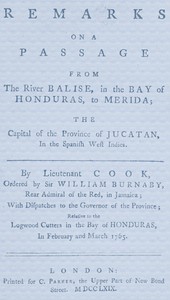
Remarks on a passage from the river Balise in the bay of Honduras, to Merida — Text and Context
(0 User reviews)
81
Project Gutenberg
2024
Not confirmed
Yucatán (Mexico : State) -- Description and travel; Belize -- Description and travel; Belize -- History
Readers of public-domain and historical texts
Project Gutenberg digital edition
en
Edition facts
Words
7,076
Reading time
31 min
Text sections
2
This digital edition of Remarks on a passage from the river Balise in the bay of Honduras, to Merida — Text and Context is described by source-level measurements including 7,076 words, 31 min estimated reading time, and 2 detected text sections.
The text analysis averages about 35.4 words per sentence, while the detected sections provide another way to judge how the source is divided.
Project Gutenberg metadata also associates the work with “Yucatán (Mexico : State) -- Description and travel,” connecting these edition facts with the source record’s subject description.
Source:
Project Gutenberg record #74378
Lieutenant James Cook's 1765 report details the coastal and inland route from Belize to Merida, blending navigational hazards, Spanish colonial society, and Yucatec Maya customs in a concise, observational style.
Read the complete public-domain text at its original source.
Read on Project GutenbergLieutenant James Cook's 1765 report opens with a precise navigational description: the passage from the Balise road to Baccalar is entirely by water, first coastwise to the Rio Hondo, then through an arm of that river and three small lagoons to the lake of Baccalar. The coastal stretch, nearly thirty leagues, is likened to a broad river due to a chain of low islands or 'quays' covered with mangrove and palmeta trees. Cook notes the extreme shallowness—flats drawing only four or five feet often ground, raising mud for a mile together—and compares the navigation to pilotage on the Thames. This opening establishes a tone of practical, firsthand observation, grounded in the specific challenges of moving logwood and dispatches through a treacherous, shoal-filled coast.
Navigating the Shoals and Quays
Cook’s account is anchored in the physical realities of the coast. He describes the 'quays'—small, mangrove-covered islands running parallel to the main at five or six leagues' distance—and notes that beaches are rare. The course is about N.N.W., and the water so shallow that flat-bottomed boats used by baymen frequently ground. Cook’s comparison to the Thames is telling: this is a pilot’s water, requiring local knowledge. He also records the wildlife encountered: Goannas (iguanas) shot for food, and alligators lurking under mangrove bushes. The detail that he traveled with a master of a merchant ship and a 'considerable bay merchant' named Maud in a schooner-rigged flat with a tolerable cabin grounds the narrative in a specific social and logistical context.
Spanish Colonial Society in Merida
Upon reaching Merida, Cook turns his attention to the inhabitants. He distinguishes between 'provincials'—those born in the colony—and 'old Castilians' holding crown offices or engaged in trade. The provincials, he observes, dress lightly even in their calashes (carriages), with women wearing crimson satin embroidered scarves, braided hair tied in pink ribbons, and being 'very free and unreserved.' The old Castilians, by contrast, dress as in Old Spain and hold the provincials in low esteem. This social stratification is drawn with a few sharp strokes, reflecting Cook’s eye for visible markers of rank and origin.
Yucatec Maya: Dress, Labor, and Governance
Cook provides a detailed portrait of the Jucatan Indians, whom he describes as 'willing, obliging, meek temper’d' and laborious. He notes their midling stature, straight black hair cut short except for a lock on each temple—a badge of subjection to Spain. Their dress includes a short frock, trousers, straw hat, and sandals; when traveling, they go nearly naked. He highlights their dexterity with the 'muschall,' a tool combining knife and cleaver used for clearing bush, dressing meat, and as a weapon. Women are described as short and thick set, with black hair worn clubbed, often with a pink ribbon near Merida. Their cotton clothing, spun and woven at home, is adorned with needlework flowers. Cook also outlines local governance: the Cazique, Teniente, Alcaldi, and Fiscal, each with distinct badges—the Fiscal wears a key and a cat-o'-nine-tails, serving as prison-keeper and executor of punishment. A serivan (clerk) records the arrival and departure of expresses.
Housing, Diet, and Daily Life
The towns, Cook reports, consist of poor, mean huts built with palmeta stakes and thatched with leaves to the ground, resembling large beehives. There are no upper rooms; even provincial Spaniards sleep in grass hammocks made from aloe-tree fibres, with only a cotton cloth for cover. When traveling, they sleep in hammocks hung between two trees, always with a good wood fire nearby. Diet is simple: maize cakes and 'pasoli,' a fermented maize drink sweetened with honey found in the woods. The principal employment is cultivation of plantations, and children are trained from a young age. These details, drawn from direct observation, offer a concrete sense of everyday life in mid-18th-century Yucatán.
Cook’s remarks are best read as a practical report, not a travelogue. The text moves from navigational hazards to social customs with a plain, unadorned style that prizes accuracy over embellishment. Readers should note how Cook’s role as a naval officer carrying dispatches shapes his attention to routes, distances, and local authorities. The excerpts give a vivid but partial view; the full work likely contains further observations on the logwood trade and the return journey. Approach it as a primary source on colonial encounter and environmental perception in the 1760s.
I have often set Lieutenant Cook’s Remarks beside another coastal chronicle, from the far side of the world. Both men took quiet note of tide, reef, and local custom without embellishment. There is a steady hand in such accounts, a kinship of patience. Zanzibar; city, island, and coast. Vol. 2 (of 2) — Text and Context shares that unhurried gaze, as if both writers trusted the water to speak for itself.
There are no reviews for this eBook.
There are no comments for this eBook.
Reader reflection
How did this book work for you?
Your answers remain private and are stored only in this browser.
Your progress
0
/
10
2
Did this book hold your interest?
3
Would you recommend this book to another reader?
4
How easy was the book to follow?
5
How did the pace of the book feel?
6
Would this book work well in a reading group?
7
How strongly did the book affect you emotionally?
8
Could you see yourself revisiting this book?
9
What did this book teach you most?
10