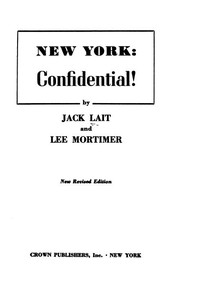
New York: Confidential! — Themes and Context
Edition facts
The catalog record for New York: Confidential! — Themes and Context provides practical reading context through 72,829 words, 5 hr 17 min estimated reading time, and 8 detected text sections.
The text analysis averages about 16.8 words per sentence, while the detected sections provide another way to judge how the source is divided.
Project Gutenberg metadata also associates the work with “New York (N.Y.) -- Description and travel,” connecting these edition facts with the source record’s subject description.
Calculated from edition completeness, EPUB availability, text structure and catalogue metadata. Not a user rating.
How this score is calculated
- Description quality20 pts
- Title & short description10 pts
- Source metadata20 pts
- Text length15 pts
- Chapters / structure15 pts
- EPUB file integrity20 pts
Total of 100 points, scaled to a 2.5-5.0 range. Editions with an empty description or a missing EPUB file are not scored.
Read the Text
amon was our friend and we admired him profoundly, because he could write fascinatingly, almost entirely from imagination, not from photographic impression. Characters like those he concocted never lived, around "Mindy's" or anywhere else. He laughingly said so, himself.
New Yorkers compose plays about New York and any resemblance to the living or dead is carelessness.
In truth, Manhattan--which for most fact or fiction material is New York--cannot be transcribed or translated.
It isn't even itself!
There are so many foreign and unrelated elements undergoing a steady, invisible process of blending; the picture changes slowly, yet ceaselessly; and no human camera is fast enough to catch it in the static focus of repose.
No one has portrayed New York as Dickens did London or Sue did Paris.
Those who tried have had to sectionalize it; none could wrap it all up into a comprehensive entity.
If they grasped the financial or theatrical or criminal or social or artistic or political aspect of the city's life, they could not extend the panorama into the human, the domestic, the personal phases.
If they looked on high they were so spellbound they could not turn to grope into the subterranean.
Those who realized the astounding things and people could not vitalize the humble, the ordinary, the devout and industrious bread-and-butter brothers and sisters.
Manhattan doesn't materialize to even those who spend their lives in it.
A thrilling, throbbing mystery!
_Damon Runyon_ immortalized 47th Street, between Sixth and Seventh Avenues, as "Dream Street." Jack Lait dramatized it as "The Canyon."
It is a shabby, dismal block. Its 200 yards are lined almost unbrokenly by cheap hotels and rooming houses sheltering all manner of strange characters: retired vaudevillians, down-and-out horse-players, dope fiends, grifters and grafters, pickpockets, derelicts (male and female), drunks, stage widows, miserly recluses, tars and their tarts, crap-game steerers and bottom-dealers.
On fine days you see them on the sidewalks. Old women with grotesque young get-ups and peroxided hair, parading their pooches; bewhiskered, unkempt men on the church steps, passionately studying racing scratch sheets; apoplectic dipsomaniacs airing out cheap jags; actors whose world has gone by, talking of starring roles of the past--and next season.
Here is the stage door of the once fabulous Palace, mecca for all vaudevillians. The theatre, pride of its builder, Martin Beck, was the hub of the old Keith-Orpheum Circuit, and on its stage appeared, for a quarter of a century, the top names of show business.
Around the corner is Broadway and the Great White Way.
A block to the east is prosperous Fifth Avenue, glistening in mink and pearls.
But life on Dream Street goes on, oblivious of these other worlds.
You may walk it at any hour. No one will molest you.
Maybe a panhandler will try to mooch a quarter; maybe a flea-bitten, superannuated sister in sin will make a half-hearted signal to you that she can be had. But you won't be in danger.
What goes on upstairs, in those small, old rooms, is something else. There crime and vice and con games and watering whiskey and hypoing horses are hatched.
There adultery is accepted as a fact of life.
There people who work are regarded as outlandish and queer.
But there you find no sluggers, stickups or bullies.
These are kindly folk. Violence is not in their bag of tricks.
This is, rather, a community. The members recognize the right to steal, to cheat, to beg, to scheme, to mate, and to woo weird fancies with hooch and hop.
But, no disorder, please--this is The Canyon!
Yet in the midst of this murk and muck, grew a flower.
Not a peony, not even a rose; a violet, gentle and shrinking and modest, admired and worshiped, but doomed to be crushed by the heavy hobnailed boots of the ruthless underworld and the equally pitiless protagonists of respectability.
In the middle of that bleak block, in a second-story apartment, lived big, hearty Martha Geiss. She was a one-bottle and one-case bootleggers' stock exchange. She didn't handle the stuff herself, but she had worked up a trade in hotels and offices, so small buyers 'phoned her when they wanted something sent up quickly, day or night, and she in turn relayed the orders to the various petty peddlers of gin and what was supposed to be whiskey.
Her commissions were never large and her work was wearisome and confining. But she always laughed and always had enough to help others and to act as a sort of mother to all the neighbors. And she was a mother--the mother of Frances, the only thing clean and virtuous and young and lovely on Dream Street.
When 200-pound Martha parted with her husband and cast her lot with the lawbreakers she brought with her the child, who went to a school in the slums west of Broadway.
Everybody knew her and everybody protected her. Youngsters were a great novelty in those parts and Frances was an unusually winsome and friendly one.
No one around there would harm her or let anyone else even say a questionable word that she might hear.
She was physically precocious and at 14 was a ripe, full-blown beauty, shy, courteous, simply but tastily dressed. Martha's heart was set on having Frances become a schoolteacher.
Of course, the child had eyes and ears--very pretty ones. She knew that this was no kindergarten in which she lived. She saw the liquor and dope-pushers, the demi-mondes and the semi-men. She smiled at them all and they smiled back, but as close as they were to her they were far away.
In the summer vacation, when Frances was 16, going to high school, Martha's business was rather low. It always fell off in summer, when many of the customers were in the country. Frances was eager to do her share, but Martha hated to send her into the world, where, strangely, she would not get the sheltering care and affection which had always been hers on dirty, degraded Dream Street. Across the way from Martha's window, where she could look into it on summer nights, was an Italian restaurant. Caruso, the owner, was her friend and at times her customer. She suggested that he hire Frances during the vacation as a checkroom and cigarette girl.
The patronage was not of the richest, but she did fairly well, what with her beauty and affability. Then, one night, she was called to a private dining room upstairs, where some men were secluded in what seemed to be a heavy conference. At the head of the table sat a stocky, blond, not bad-looking fellow in his thirties, who bought a fistful of cigars and reached for a $10 bill. As he looked up he saw the girl--then he reached for a $20 bill.
Later he came down and went on the make. She turned away and told him she never went out with men. He laughed and asked her:
"Do you know who I am?"
She shook her light brown curls from side to side.
He put his face very close to her ear and said huskily:
"I am Dutch Schultz!"
In every walk of human life there is an upper class. Among the lifers in Alcatraz, who never again will freely see the light of God's sun or draw a free breath, there are classes. A man who has killed three cops looks down upon a piker who only kidnapped a child or robbed a post office.
The name he whispered had an electric effect. Among the prohibition aristocracy none stood as high as Arthur Flegenheimer, a tough boy from Yonkers, who not only controlled a large section of the beer business of New York but was the king of the policy racket--the numbers--in Harlem, with political connections that went right through to the White House. Through his pudgy, uncalloused, overmanicured fingers passed $100,000,000 a year.
Frances ran across the street, breathless, to Martha, and told her the news, in the same emotional exultation that would have possessed a debutante with a sudden invitation from the Prince of Wales.
Martha certainly was not putting her daughter on the market for anybody, but she, too, was swept away with the mighty magnificence of the name. She advised Frances to go for a drive with him in the big, slinky, steel-jacketed and bullet-proof car that she could see from her window. Frances, hatless and flushed, ran back and got an hour off. When Dutch Schultz asked, few people questioned.
As she came out, two men slipped from the front seat, and as one opened the door the other, with his hand inside his coat at his armpit where he carried his gat, looked up and down the block. Schultz and Frances got in and the door closed with that authority which only a high-priced limousine can express with a bang and a click.
Within a month, Frances was Mrs. Arthur Flegenheimer. It was infatuation on the whisper of a name, but it had grown into a tremendous and all-conquering love. Few romances with figures that defy the law were ever more mutually fervent and sincere.
Schultz was always in trouble. Despite the enormous sums he took in, he had to pay out, at times, more. He cheated on his Federal and State income taxes, kept enormous staffs of bodyguards and fixers and collectors, and when he wasn't hunted by the Internal Revenue men he was tracked by gunmen of rivals who wanted to take over. He was frequently arrested and numerous times shot at, and his only chance for a few hours or days of happiness with his bride was to drive to remote villages in New England or 100 miles out on Long Island, where, under an assumed name, he might hole in for a day or two before someone recognized him.
Thus they lived for four years, in which time two children were born, first a girl and then a boy. She proudly named their son Arthur Flegenheimer, Jr.
He bathed Frances in furs which she didn't want to wear, and weighed her down with jewels which she rarely wore; and he got her up in the middle of nights and took her to strange places, whence they frequently had to escape on a moment's notice, more than once to the music of whining bullets.
On October 9, 1935, they were under cover in a hotel in Newark, N.J. They dined in their rooms and then he told her he had to meet some of his henchmen in a little restaurant. She went to a movie. Schultz walked into a little café and joined two other men on a bench in a booth.
The two favorite methods of murder among the outlaws were "put him on the spot" and "take him for a ride." The first was designed to plant a victim, drawn by treachery, to be slaughtered by executioners who would know just where and when, and thus elude the uncertainties of pursuit or having to do a job in a public street. The theory of "taking for a ride" also was usually carried out through misplaced faith, though sometimes at the point of a gun, and its strategy lay in taking the body-to-be out to a quiet, lonely spot where there would probably be no police or witnesses.
Dutch Schultz was put on the spot.
No sooner had he sat down than the two men who had lured him there dived to the floor, as a man in a green hat stepped out from behind a pillar and gave Schultz all his six bullets in the belly, the gangster's favorite target. To make certainty doubly sure, he was shot with slugs dipped in garlic, a deadly poison to the mucous membranes of the bowels. They took him in an ambulance to a hospital, where he died raving, with Frances' name on his lips. The first she knew she was a widow was when two detectives closed in on her as she returned to her hotel.
Of course, she had a faint idea of who had done it or who had ordered it done. But she hadn't been Dutch Schultz' wife for four years not to know the penalty for blowing the whistle on the Mafia which had ordered the execution.
From that moment on, she was hounded and hunted by prosecutors who wanted to know who had killed Dutch Schultz; by tax collectors who wanted to know where his money was--those millions he was supposed to have cached; by his former associates, who thought they were entitled to some of the money--and where was it?
She lived as a fugitive for years. She had no money. She knew of no money. She knew that he owned a brewery in Yonkers worth more than a million dollars, but he had never dared put it in his own name and those who now controlled it shrugged their shoulders and said they knew nothing of any interest he had. She went to "Dixie" Davis, his lawyer, whom Schultz had made rich, but he had nothing and knew nothing. She sold her furs and jewels, which supported her and the children for a couple of years.
Then she was flat broke.
She worked as a saleswoman in Bloomingdale's, as a waitress, and almost went blind inspecting minute precision parts in Sperry's. Martha had died in an automobile accident and she was alone with her babies.
Not only were the essentials of living a problem, but being allowed to live was even more perplexing. For a while she refused to haul down her flag. She was Mrs. Arthur Flegenheimer and her son was Arthur Flegenheimer, Jr. But when boardinghouse keepers learned who Arthur Flegenheimer had been, and cruel little boys learned who Arthur Flegenheimer, Jr., was, Frances had to pack the little she had and move.
From rooming house to cheap hotel to boardinghouse in New Jersey, Westchester, Long Island villages and the fastnesses of Manhattan tenements, where few give a damn about who lives next door, she fled and fled again as the ghost of Dutch Schultz caught up with her.
Exhausted, penniless, she went back to her church, the church she had left when she married out of her faith.
The priests were kind and understanding. They took the children to a place in the Rocky Mountains and, with the mother's consent, gave them a new last name.
No one out there knew Dutch Schultz; few of the rugged folks had ever heard of him.
Frances followed. She, too, took the name the children had assumed. We must not divulge it.
She turned her back on the city which had given her birth, the city which had given her romance and the city which had booted her around and sneered and pointed in derision to her and her children, the widow and the babies of Dutch Schultz.
She is a nurse in a Catholic hospital, still in her early thirties, still soft and attractive. She loves her new purpose and her new surroundings and the peace and usefulness of her life. Your authors know just where she is and who she is, but they will keep it confidential--even from her old friends on Dream Street--The Canyon!
If Broadway is a "state of mind," as some phrase inventor put it, a clinical psychiatrist should diagnose it. He might isolate the precise form of dementia which drives this wacky world of fancy, flesh, piracy, pruriency and pure poesy to its multiform objectives.
Nowhere else do the Lord and the Devil work so nearly side by side.
Here romance, misery, murder, adultery, mother-love and human frailty are commodities; carnal appeal and ridicule and horror are inventoried and price-tagged; the money-changers throng the steps of the temples of art with none to castigate them.
Slashing through the very center of traffic in solid substances, this highway of economic parasitism dominates the scene.
New York is a great seaport--so are Baltimore and Boston; New York is a great factory town--so are Cleveland and Detroit; New York is a great railroad terminal--Chicago is greater; New York is a great seat of learning--so is Los Angeles.
The difference is still Broadway. There is only one!
In its days of richest glory, Broadway's crown jewels were its masters of stage production; their thrones were its theatres where their works reigned.
Of all these, not even excepting the brothers Frohman, the most lustrous was David Belasco. He covered a wider range of time as well as of topic. He was the archdirector, a playwright of cunning talent, a manager and star maker. He was a more intensely exciting character than any he ever dreamed up.
He built the Belasco Theatre, which was his show-case, his workshop, his royal castle, his private museum, and his play pen.
Past 76, he was vigorous, virile, and planning for the future.
Mr. B. (even his mistresses called him that) told one of your authors, who was his intimate friend despite a wide disparity in ages, that he couldn't truly interest himself in a play unless he had a sweetheart in the cast.
Handsome, distinguished, with hypnotic and penetrating eyes under black lashes in contrast with snow-white hair, wearing always a priestlike costume which he had designed and would never explain, his years did not dim the electric effect he exercised on beautiful women.
Six floors above street level, over the stage flies of the Belasco, he had fitted up a private gallery housing the spoils of the ages--tapestries, paintings, rare furniture, Venetian glass, armor, snuffboxes, statues, miscellany.
Beside it was a complete living suite, practical but furnished with antique plunder. There he often lived while in the pangs and ecstasies of conception, preparation, and consummation of his plays. Few ever penetrated that sanctum.
He had another private retreat on the balcony level, walled in off the nave. There he received esoterically but with broad hospitality, with a steward to serve drinks and tidbits.
In that room, one night, while a hit play was in action below, he got word from his stage manager that a feminine principal had fluffed some lines. He sent for her after the act. In the presence of one of your authors, he berated her as a gold-bricker and an ingrate.
"I gave you everything you ever had," he shrilled. "And the first thing I ever gave you was a bath!"
She bitched up no lines in the next act.
The next season another beauty gave him the romantic interest he required for a later success.
At the height of its run, he was stricken with pneumonia. His amazing constitution and will licked it, though he had passed his 76th birthday.
Weakened as the great Belasco was, the soul of the great lover still burned within him. He had been in retirement for weeks. The girl, a blonde this time, was young, and, he feared, fickle. As long as he was on his feet, none of his mistresses dared stray around. But he had been laid up for weeks.
The inamorata of the moment was ensconced in a private three-story residence not far from the Gladstone Hotel where he lived. Because of his family she could not come to see him during his illness. He did not tell her when he would be allowed out again. And, the first night he could ambulate, he decided to spy on her.
He set up his post across the street, where, from behind a light-pole, he could look up and over.
A sudden rainstorm poured out of the sky, and with it a cold wind. But he had seen a shadow--of a man and woman, it seemed to him. And with the consuming zeal and drive with which he did everything, he remained there, drenched and shivering, ignoring everything but those windows.
He found out nothing.
But the exposure resulted in a second attack of pneumonia.
That tawdry anticlimax ended the life of the genius at whose feet Broadway had bowed--a martyr to suicidal jealousy at his advanced age--jealousy over a run-of-the-mill gal whose name no one would remember on the street that will never forget him.
a.--_Give My Regards to Broadway_
When Georgie Cohan penned his crude classic, New York's Main Drag ran from Herald Square at 34th Street, on Broadway, to Times Square at 43rd Street, with tentacles precariously reaching northward a few blocks and a few outposts of the Tenderloin's last frontiers stretching southward.
Broadway's uptown growth had been progressive from historic days when the theatre and hotel zones were around City Hall Park, not far from the Battery.
During the years, successively, Diamond Ditch moved up, centering at 14th Street, then again at 23rd Street, coming to anchor at Herald Square before its final migration to Times Square.
Jack Lait and Lee Mortimer's New York: Confidential! opens with a conspiratorial whisper: "P-s-s-t— Lait and Mortimer want a word with you—confidential." This direct address sets the tone for a guide that promises insider knowledge, but the book's structure reveals as much about its authors' assumptions as about the city itself. The work is divided into four parts—"The Places," "The People," "The Lowdown," and an appendix—each further subdivided into short, punchy chapters with titles like "My Little Gay Home in the East" and "Guys and Pearls." This episodic organization allows rapid movement between scenes, from Broadway theaters to Harlem nightclubs, mirroring the restless energy of mid-century Manhattan.
A Whispered Invitation: The Confidential Frame
The book's title and opening gambit establish a pact of secrecy between authors and reader. Lait and Mortimer position themselves as seasoned insiders who have "turned prematurely gray becoming Broadway-wise." This framing recurs throughout, with chapters often beginning with direct warnings or commands: "Don't be a cluck!" or "BEWARE of steerers." The confidential tone is reinforced by the use of second-person address and imperative verbs, creating a sense of urgency and exclusivity. Yet the structure itself undercuts this intimacy: the book is a mass-produced guide, not a private memo. The tension between the promise of secrets and the public format is a recurring motif, as the authors simultaneously reveal and withhold, inviting readers into a world they can only observe from a distance.
Episodic Geography: The City as a Series of Scenes
The first part, "The Places," moves through New York in a series of short chapters that read like a tour guide's itinerary, but with a cynical edge. Chapters such as "The Canyon" (likely Wall Street) and "The Main Drag" (Broadway) are followed by "Where Men Wear Lace Lingerie" and "It's Not True," which debunks myths about Chinatown. This structure emphasizes the city's fragmentation into distinct, often contradictory zones. The movement between scenes is abrupt, with no transitional passages; each chapter is a self-contained vignette. This technique mirrors the experience of a visitor moving from one neighborhood to another, but it also suggests a city that resists synthesis. The authors' choice to group chapters under broad headings like "The Places" and "The People" imposes an order that the content itself often defies, as the same characters—hustlers, showgirls, gangsters—reappear across sections.
Recurring Images: The Hustler and the Mark
Throughout the excerpts, a binary opposition emerges between the hustler and the mark. The authors repeatedly warn against "steerers," "clip joints," and "B girls," while also offering advice on how to navigate the city without being cheated. In "Guys and Pearls," they caution male visitors: "Manhattan is mined for a lonely guy." The image of the city as a minefield recurs, with women often portrayed as predators: "Gotham gals don't flop for saps, simps or retail buyers. They'll take everything you've got to give 'em." This language reduces social interaction to a transaction, with the reader positioned as a potential victim. The authors' own authority is built on their ability to see through these schemes, yet their advice often reinforces the very stereotypes they claim to expose. The recurring image of the "White Way Wolf"—a savvy operator—serves as an aspirational figure for the reader, who is encouraged to adopt a similarly cynical stance.
Movement Between High and Low: The Theatrical City
The book's structure constantly juxtaposes high and low culture, from the "Theatah" (Broadway) to "Black Ghetto" (Harlem). The authors move between these worlds with ease, but their tone shifts: the chapter on Harlem is titled "Black Ghetto" and uses a glossary of "Harlemisms" in the appendix, while the chapter on high society is titled "There is No Society." This movement is not neutral; it reinforces hierarchies even as it claims to expose them. The theatrical metaphor pervades the text: New York is a stage, its inhabitants performers. The authors themselves play the role of stage managers, directing the reader's attention. The appendix, with its "Backstage Phone Numbers" and "Ticket Stubs," literalizes this metaphor, offering the reader a backstage pass. Yet the final effect is one of controlled access: the reader is always an audience member, never a participant.
Readers approaching New York: Confidential! should attend to the book's structure as much as its content. The rapid shifts between scenes and the recurring warnings create a rhythm that mimics the city's own frenetic pace. But the authors' confident tone should not be mistaken for objectivity; their guide is a performance in itself, one that reveals as much about the anxieties of its era as about the city it purports to describe. For a fuller understanding, compare the advice in "Tips on the Town" with the actual experiences recorded in the appendix's "Gustatory Guide."
There’s a comfort in how that 1948 guide walks its shadowy blocks, scene by scene, as if the city were a hushed collection of rooms. It reminds me of wandering through the woods of The Naturalist in Vancouver Island and British Columbia, Volume 1 (of 2) — Reading Companion—both books simply observe, turning pages like quiet footsteps.
What did you think of this book?
Answer a few questions and save a private reflection on this device.
Victoria Hill
1 week ago