1

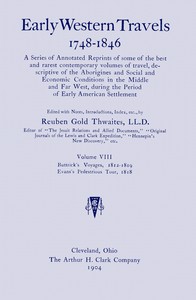
Buttrick's voyages, 1812-1819; Evans's Pedestrious tour, 1818 — Background and Themes
(0 User reviews)
1572
Project Gutenberg
2025
Not confirmed
West (U.S.) -- Description and travel; Buttrick, Tilly, 1783-1859 -- Travel -- West (U.S.); Evans, Estwick, 1787-1866 -- Travel -- West (U.S.)
Readers of public-domain and historical texts
Project Gutenberg digital edition
en
Edition facts
Words
115,637
Reading time
503 min
Text sections
18
This digital edition of Buttrick's voyages, 1812-1819; Evans's Pedestrious tour, 1818 — Background and Themes is described by source-level measurements including 115,637 words, 8 hr 23 min estimated reading time, and 18 detected text sections.
The text analysis averages about 21.2 words per sentence, while the detected sections provide another way to judge how the source is divided.
Project Gutenberg metadata also associates the work with “West (U.S.) -- Description and travel,” connecting these edition facts with the source record’s subject description.
Source:
Project Gutenberg record #75189
Two early 19th-century travel narratives contrast a wanderer's voyages with a pedestrian tour, offering vivid descriptions of the Western frontier and reflections on society.
Read the complete public-domain text at its original source.
Read on Project GutenbergThis volume pairs two distinct travel accounts from the early American frontier: Tilly Buttrick Jr.'s Voyages, Travels, and Discoveries (1812–1819) and Estwick Evans's A Pedestrious Tour (1818). Buttrick, a self-described wanderer, recounts his journeys with a straightforward simplicity that transports readers through the landscapes he beheld. Evans, by contrast, intersperses his four-thousand-mile walk with reflections on religious, moral, and political topics. Together, they offer complementary views of the trans-Appalachian West during a period of rapid change.
Contrasting Narrative Structures
Buttrick's narrative unfolds as a chronological series of voyages, each marked by a clear departure and return. His prose is lean, focusing on observable details—the appearance of a river, the layout of a settlement—without extended commentary. Evans, however, organizes his account as a continuous pedestrian tour, punctuated by digressions into moral philosophy. Where Buttrick moves from scene to scene with little reflection, Evans pauses to expound on the character of a place or the implications of a custom. This structural difference shapes the reader's experience: Buttrick's account feels like a logbook, Evans's like a series of essays stitched together by a journey.
Recurring Images of Water and Movement
Both travelers are drawn to bodies of water, but they describe them differently. Buttrick notes the width and current of rivers with a mariner's eye, as when he observes that the Detroit River is "about one mile wide" and moves "about three miles an hour." Evans, too, remarks on the river's utility and beauty, calling it "yielding to none in point of utility and beauty." Yet Evans's descriptions often carry a symbolic weight: the river becomes a boundary between nations, a conduit for commerce, or a setting for social observation. The repeated attention to water—its appearance, its usefulness, its political significance—anchors both narratives in the physical geography of the region.
Movement Between Scenes and Social Commentary
Evans's tour is as much a social survey as a travelogue. In Detroit, he moves from describing the wharves and windmills to assessing the local society: the French inhabitants, the Lyceum, the academy, the theatre run by military officers. His observations are often prescriptive, as when he predicts that Michigan Territory "will become conspicuous for its literature" and that its laws will be "eminently correct." Buttrick, by contrast, tends to report without judgment, noting the presence of a familiar face in a crowd without moralizing. The movement between physical description and social commentary is more pronounced in Evans, who uses each location as a springboard for broader reflections on education, politics, and national character.
The Role of the Editor and the Series Context
Reuben Gold Thwaites, the editor of the Early Western Travels series, frames these two works as "an interesting contrast and complement to one another." His preface highlights Buttrick's "picturesque clarity of narration" and notes that the same quality makes his journal useful to students of the West. Thwaites's editorial apparatus—including notes, introductions, and an index—provides a scholarly context that modern readers may find helpful. The volume is part of a larger series reprinting rare travel accounts, and its inclusion of both a wanderer's voyages and a pedestrian tour underscores the diversity of early American travel writing.
Readers approaching these texts should attend to the different rhythms of the two narratives: Buttrick's lean, scene-by-scene progression and Evans's more discursive, reflective style. Both offer valuable firsthand perspectives on the early American West, but they reward different kinds of attention—one for its concrete details, the other for its broader social and political observations. The editor's notes provide useful context without overwhelming the original voices.
That rainy afternoon, tracing Buttrick’s muddy trails across the frontier, I felt a quiet hunger for stillness, for old stones rather than raw earth. My hand drifted to another shelf, and there was Italian Backgrounds — Reading Notes, a different kind of journey, all shadow and light. One wanderer’s restlessness simply led me to another’s repose.
There are no reviews for this eBook.
There are no comments for this eBook.
Reader reflection
Your personal reading reflection
Build a private reading journal entry for this title.
Your progress
0
/
10
2
What was your overall reaction to the book?
3
Would you encourage someone else to read it?
4
Did the language feel accessible?
5
Did any part of the book stay with you emotionally?
6
What was the strongest part of the book?
7
How well did it match your expectations?
8
How personally connected did you feel to the book?
9
What changed or sharpened your thinking?
10