1

A thousand miles up the Nile — Story, Setting & Ideas
(0 User reviews)
1874
Project Gutenberg
2023
Not confirmed
Egypt -- Description and travel; Nile River -- Description and travel; Egypt -- History -- 19th century
Readers of public-domain and historical texts
Project Gutenberg digital edition
en
Edition facts
Words
193,903
Reading time
844 min
Text sections
19
The source record for A thousand miles up the Nile — Story, Setting & Ideas measures this digital text at 193,903 words, 14 hr 4 min estimated reading time, and 19 detected text sections.
The text analysis averages about 23.0 words per sentence, while the detected sections provide another way to judge how the source is divided.
Project Gutenberg metadata also associates the work with “Egypt -- Description and travel,” connecting these edition facts with the source record’s subject description.
Source:
Project Gutenberg record #70565
Amelia B. Edwards's 1877 travelogue combines precise observation of Egyptian ruins with practical advice for Nile voyagers, contrasting the grandeur of ancient sculpture with the discomforts of sand-slopes and steamer wrecks.
Read the complete public-domain text at its original source.
Read on Project GutenbergAmelia B. Edwards opens her account of a Nile journey with a wry epigram from Ampère: “A donkey ride and a boating trip interspersed with ruins.” This framing sets the tone for a work that is at once a practical travel guide and a detailed record of archaeological observation. Edwards writes from the perspective of a seasoned traveler, comparing wooden dahabeeyahs to steamers and noting the cost of her own voyage at about £10 per day. Yet the book’s real substance lies in its vivid, analytical descriptions of ancient sites, where she scrutinizes the colossal statues of Abu Simbel with an artist’s eye for proportion and technique.
The Practicalities of Nile Travel
Edwards devotes considerable attention to the logistics of a Nile expedition, weighing the merits of different vessels. She observes that iron dahabeeyahs often run aground and that steamers frequently wreck—she counted three wrecks between Cairo and the first cataract. Her preference is for the old-fashioned wooden dahabeeyah, flat-bottomed and easily poled off sandbanks. She likens the choice between dahabeeyah and steamer to that between post-horses and rail travel: one is “expensive, leisurely, delightful”; the other “cheap, swift, and comparatively comfortless.” Climate also features: December and January are cool, even cold; Nubia’s climate is “simply perfect,” though cold north winds can chill the air near Abu Simbel. These details ground the narrative in the physical realities of 1870s travel.
The Colossi of Abu Simbel: A Study in Scale and Technique
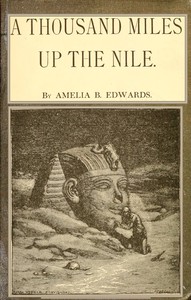
Edwards’s description of the four seated colossi at Abu Simbel is the most sustained piece of art criticism in the excerpts. She notes that the southernmost statue is the only nearly perfect one, and that its face can be correctly seen from only one point—a steep, loose sand-slope that “more disagreeable climbing it would be hard to find.” From below, the face is foreshortened; the British Museum cast, she complains, is “cooped up at the end of a narrow corridor” and shown to “the greatest possible disadvantage.” The ancient artists, by contrast, were “embarrassed by no difficulties of focus.” They carved the mountain “as though it were a cherry stone,” hewing out a great hall and fifteen chambers. The statues sit sixty-six feet high; if standing, they would tower eighty-three feet. Edwards analyzes the sculptors’ choices: the heads are finished in detail, but the trunks and limbs are treated decoratively, with “breadth, massiveness, and repose.” The knee joints, calf muscles, and toe-nails are indicated broadly; the fingers, visible only from below, are treated en bloc. Even the dimples at the corners of the mouth are “circular cavities as large as saucers.”
Contrasts: Ancient Mastery vs. Modern Discomfort
Throughout the excerpts, Edwards sets the sublime achievements of ancient Egyptian artists against the petty hardships of the modern traveler. The sand-slope that must be climbed to see the colossi’s faces is “steep and loose and hot to the feet.” The British Museum display is inept. Yet the ancient sculptors “took a mountain and fell upon it like Titans.” This juxtaposition extends to the journey itself: the Nile traveler endures sandbanks, wrecks, and cold winds, but is rewarded by ruins that inspire awe. Edwards’s tone is wryly practical—she notes the cost of the voyage, the comparative merits of boats—but her prose rises to genuine wonder when describing the statues. The effect is a travelogue that balances the mundane and the monumental, never losing sight of the physical effort required to see these wonders.
Readers approaching A Thousand Miles Up the Nile should expect a hybrid work: part practical handbook for the Victorian traveler, part meticulous record of archaeological observation. Edwards’s voice is that of a knowledgeable, opinionated guide who does not hesitate to criticize museum displays or praise ancient craftsmanship. The book rewards those who read slowly, attending to her descriptions of scale, technique, and the physical sensations of climbing sand-slopes or enduring cold winds. It is a document of a particular moment in travel history, when the Nile was still navigated by sail and pole, and the ruins were less crowded than they are today.
Reading A Thousand Miles Up the Nile, I kept thinking how Edwards’s patient eye caught both the awe of Karnak and the grit of a broken sandal. That same mix of wonder and everyday discomfort seems to linger in Sinners and Saints A Tour Across the States and Round Them, with Three Months Among the Mormons — Text and Context, where grand landscapes and querulous fellow travelers sit side by side, just as they always do when we truly travel.
There are no reviews for this eBook.
There are no comments for this eBook.
Reader reflection
Your personal reading reflection
Build a private reading journal entry for this title.
Your progress
0
/
10
2
How much did you enjoy the reading experience?
3
Would you pass this book on to a friend?
4
How easy was the book to follow?
5
How well did it match your expectations?
6
What was the strongest part of the book?
7
What was its emotional impact?
8
Would you start a conversation about this book?
9
Which lesson or insight stayed with you?
10