
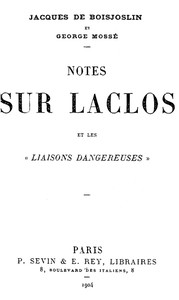
Notes sur Laclos et Les Liaisons Dangereuses by Boisjoslin and Mossé
Most people know Les Liaisons Dangereuses as the ultimate story of seduction and revenge. The Marquise de Merteuil and the Vicomte de Valmont are two of literature's greatest villains, using love as a weapon for sport. But what if their game was about more than just social climbing and personal cruelty? What if the novel itself was playing a much bigger, more dangerous game?
The Story
This book, Notes sur Laclos et Les Liaisons Dangereuses, isn't a novel. It's a critical investigation. Authors Boisjoslin and George Mossé present a bold argument. They claim Laclos's masterpiece was not merely a work of fiction but a deliberate, subversive political act. They piece together evidence from Laclos's life—his military career, his association with the Duke of Orléans (a rival to the throne), and the turbulent years leading to 1789. The authors read the characters' relentless dismantling of social and moral codes not as personal failings, but as a metaphor. They suggest Valmont and Merteuil aren't just ruining individuals; they are demonstrating how a rotten aristocracy destroys itself from within. Every broken vow and exposed hypocrisy in the letters is, in this reading, a critique of the entire Ancien Régime.
Why You Should Read It
This is why I loved it: it gives you a brand new pair of glasses to see a classic. Suddenly, Merteuil's famous manifesto about a woman's survival in a man's world isn't just a feminist cry—it's a revolutionary one. Valmont's bored, calculated cruelty mirrors the indifference of the ruling class. The book made me go back and re-read Liaisons with a completely different eye. It connects the dots between the intimate psychological warfare on the page and the real, bloody warfare that was just around the corner. Mossé, a renowned historian, brings serious weight to the theory, making it feel less like a fun guess and more like a credible, overlooked interpretation. It transforms a chilling story about people into a chilling prophecy about power.
Final Verdict
This is a perfect pick for anyone who has ever read Les Liaisons Dangereuses and felt there was something more simmering under the surface of all those witty, wicked letters. It's for readers who enjoy literary detective work, for history fans fascinated by the powder keg of pre-Revolution France, and for anyone who likes the idea that a book can be a secret weapon. It's a short, dense, and provocative essay that will change the way you talk about one of the most famous novels ever written. Just be warned: you won't be able to see the Marquise de Merteuil as just a villain ever again. She might be a revolutionary.
This book is widely considered to be in the public domain. It is now common property for all to enjoy.
Robert Lewis
1 year agoIf you enjoy this genre, the author's voice is distinct and makes complex topics easy to digest. Worth every second.
Mason Harris
2 years agoUsed this for my thesis, incredibly useful.
Donald Ramirez
7 months agoA must-have for anyone studying this subject.



Lucas Moore
5 months agoIf you enjoy this genre, the depth of research presented here is truly commendable. Truly inspiring.