
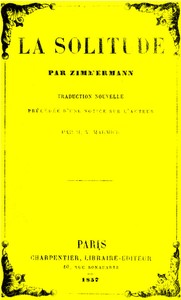
La solitude by Johann Georg Zimmermann
Let's be clear: La solitude (or Solitude) is not a storybook. Published in the 1780s, it's a long, thoughtful essay. Zimmermann, a physician, uses his medical knowledge and wide reading to examine every angle of being alone. He doesn't just describe it; he diagnoses it.
The Story
There's no plot in the traditional sense. Think of it as a guided tour through the landscape of solitude. Zimmermann starts by defining different kinds—the forced loneliness of the outcast, the chosen quiet of the scholar, the divine solitude of the mystic. He packs the book with examples from history and literature, from ancient philosophers to religious ascetics. One moment he's analyzing the melancholy of genius, the next he's warning about the dangers of isolating yourself with nothing but your own dark thoughts. The 'narrative' is his argument unfolding: that solitude is a powerful tool. Used well, it fuels creativity, deepens thought, and strengthens the spirit. Used poorly, it leads to despair, selfishness, and a warped view of the world.
Why You Should Read It
I picked this up expecting a dry, old-fashioned lecture. I was wrong. Zimmermann writes with a passionate, almost urgent voice. He's not just cataloging ideas; he's wrestling with a fundamental human experience. What hit me hardest was how relevant it feels today. We're constantly 'connected,' yet rates of loneliness are high. Zimmermann's exploration made me question my own relationship with quiet and company. His distinction between fruitful solitude and destructive isolation is a lens I now use to check in with myself. It's a slow, rich read—you can't rush it. But on almost every page, there's a sentence that makes you stop and think.
Final Verdict
This is a book for a specific mood. Perfect for a thoughtful reader who enjoys philosophy or psychology but prefers it wrapped in historical examples rather than abstract jargon. It's for anyone who values deep introspection, or who feels curious about how people in the past grappled with emotions we think are modern. If you love the essays of Montaigne or the reflective quality of someone like Marcus Aurelius, you'll find a kindred spirit in Zimmermann. Just don't go in looking for a novel. Go in looking for a conversation with a brilliant, complicated mind from the age of candlelight.
This historical work is free of copyright protections. You are welcome to share this with anyone.
Amanda Flores
3 months agoBased on the summary, I decided to read it and the flow of the text seems very fluid. Definitely a 5-star read.
Sandra Lopez
1 year agoJust what I was looking for.
Betty Thompson
5 months agoIf you enjoy this genre, the emotional weight of the story is balanced perfectly. A valuable addition to my collection.
Elijah Sanchez
2 years agoTo be perfectly clear, the depth of research presented here is truly commendable. I will read more from this author.

Dorothy Nguyen
1 year agoPerfect.