
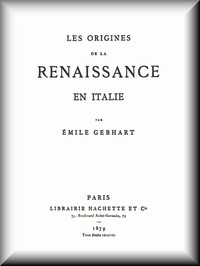
Les origines de la Renaissance en Italie by Emile Gebhart
Emile Gebhart's Les origines de la Renaissance en Italie isn't a dry list of dates and artists. Instead, it's a detective story about a cultural revolution. Gebhart starts with a big question: why did this world-changing rebirth of art, thought, and science happen specifically in Italy around the 14th century? His investigation leads him away from easy answers.
The Story
Gebhart walks us through the centuries leading up to the famous names like Leonardo and Michelangelo. He paints a picture of an Italy that was never truly "dark" after the fall of Rome. The ancient world's ghost, he argues, never left. Its ruins were everywhere, and its Latin language was kept alive by the Church. He shows how the wild political drama of the Italian city-states – the constant wars, rivalries, and shifting alliances – created a hotbed of competition where patrons needed art and architecture to show off their power. Most importantly, he digs into the Italian mind itself, exploring the unique way medieval Italians held onto their pagan Roman heritage while being devout Christians. This internal conflict, for Gebhart, is the real spark.
Why You Should Read It
What I love about this book is how it connects the dots. Gebhart makes you see the crumbling Roman aqueduct not just as a ruin, but as a constant reminder to a 13th-century Florentine of a lost greatness. He explains why a merchant prince would fund a fresco: it was politics, pride, and a search for glory all at once. He treats the Renaissance as a living, breathing thing that grew out of the soil of everyday life, politics, and spiritual longing. It’s a perspective that feels surprisingly modern. You finish the book not just knowing more facts, but feeling like you understand the why on a deeper level.
Final Verdict
This is a perfect book for the curious reader who's visited an art museum and wondered, "How did we get here?" It's for history buffs who enjoy big ideas and cultural analysis over battle chronicles. Because it was written in the 19th century, the prose has a certain elegant charm, but Gebhart's central ideas remain powerful and relevant. If you're looking for a straightforward biography of Renaissance painters, look elsewhere. But if you want a fascinating, idea-driven exploration of how a whole society changes its mind, Gebhart's classic is still a thrilling read.
No rights are reserved for this publication. It is available for public use and education.
Mason Martin
1 year agoGreat reference material for my coursework.
Elizabeth Brown
1 year agoGreat reference material for my coursework.
Lucas Hill
1 year agoAfter finishing this book, the content flows smoothly from one chapter to the next. Don't hesitate to start reading.
Kevin Allen
8 months agoLoved it.









David Clark
1 year agoThe layout is very easy on the eyes.