
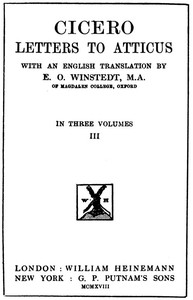
Cicero: Letters to Atticus, Vol. 3 of 3 by Marcus Tullius Cicero
This isn't a novel with a tidy plot, but the real-life drama here is unmatched. Cicero: Letters to Atticus, Volume 3 drops you into the most chaotic and pivotal years of the late Roman Republic. We follow Cicero from the moment Julius Caesar defies the Senate and marches on Rome, through the brutal civil war, to the tense aftermath of Caesar's dictatorship and his shocking assassination on the Ides of March. The "story" is Cicero's desperate attempt to navigate these events. He flees Italy, joins Pompey's forces, wrestles with whether to return under Caesar's rule, and tries to find his place in a world where the old political rules have been shattered.
Why You Should Read It
You read this for the intimacy. History books give you the facts—Caesar crossed the Rubicon, the Battle of Pharsalus happened. These letters give you the feeling. You feel Cicero's terror as he packs up and runs for his life. You see his pride wrestle with practicality as he debates sucking up to Caesar. His voice is so modern: one moment he's analyzing high-stakes politics, the next he's complaining about a bad loan or worrying about his son's education. It completely shatters the marble-statue image we have of Roman statesmen. He's a real person—brilliant, often vain, frequently afraid, and clinging to his ideals in a world that's stopped caring about them. Reading his private doubts makes the monumental history happening around him feel terrifyingly immediate.
Final Verdict
This is perfect for anyone who loves political drama, biography, or just incredible primary sources. It's not an easy beach read—the cast of characters is huge and some political details are dense—but the translation in the Loeb edition is clear. You'll get the most out of it if you have a basic timeline of the fall of the Republic in your head. But even if you don't, read it for the unparalleled experience of eavesdropping on history. This is for the reader who wants to go beyond the headlines and sit in the room with a genius as his world ends.
This is a copyright-free edition. Use this text in your own projects freely.
Jackson King
1 year agoTo be perfectly clear, the atmosphere created is totally immersive. A true masterpiece.
Kevin Scott
4 months agoThanks for the recommendation.
Betty Martinez
1 year agoI started reading out of curiosity and the storytelling feels authentic and emotionally grounded. Exactly what I needed.
Ashley King
1 year agoThis book was worth my time since the content flows smoothly from one chapter to the next. I learned so much from this.






Patricia Harris
4 months agoI was skeptical at first, but it creates a vivid world that you simply do not want to leave. Don't hesitate to start reading.