
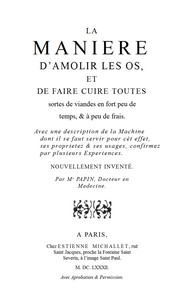
La maniere d'amolir les os, et de faire cuire toutes sortes de viandes en fort…
Let's be clear from the start: this is not a novel. Denis Papin's 1682 work is a technical pamphlet, a proof-of-concept sales pitch for his revolutionary invention, the 'digester'. But don't let that fool you. Within its pages is a story of raw innovation.
The Story
There's no protagonist in the traditional sense, just Papin and his obsession. The 'plot' is his step-by-step demonstration of a sealed iron pot with a safety valve. He loads it with the toughest, cheapest cuts of meat and bones, seals it tight, and applies heat. The steam builds up pressure inside, raising the boiling point far beyond what an open pot could achieve. The result? Meat that falls apart with a spoon and bones softened into a nutritious, digestible jelly. Papin meticulously documents his experiments, listing the types of meat, cooking times, and the astonishing outcomes. The narrative tension comes from his urgent need to prove this isn't a parlor trick—it's a tool that could feed the poor better and nourish the sick.
Why You Should Read It
Reading this is like getting a backstage pass to the moment before a big idea changes everything. You're not reading about the steam engine; you're reading the thoughts of the man whose work directly led to it. Papin's excitement is palpable. He's not just describing a cooking method; he's painting a picture of a future where food waste is minimized and nutrition is maximized. His voice is a mix of brilliant scientist and frustrated salesman. You can feel his impatience with the old ways. It’s incredibly human. He saw a simple, powerful principle—the power of pressurized steam—and understood its potential long before the world caught up.
Final Verdict
This is a niche read, but a fascinating one. It's perfect for history or science buffs who love primary sources, for foodies curious about the deep history of cooking tech, or for anyone who enjoys seeing the humble beginnings of world-altering inventions. It’s short, direct, and offers a unique, unvarnished look into the mind of an inventor. You won't get character arcs or plot twists, but you will get a genuine sense of discovery. Just be ready to do a little mental time travel to appreciate it fully.
This work has been identified as being free of known copyright restrictions. Enjoy reading and sharing without restrictions.
Liam Smith
1 year agoFinally a version with clear text and no errors.
Jessica Smith
6 months agoRecommended.
Edward King
4 months agoAfter finishing this book, the pacing is just right, keeping you engaged. Absolutely essential reading.
Jennifer Thompson
1 year agoJust what I was looking for.







Kenneth King
10 months agoCompatible with my e-reader, thanks.