
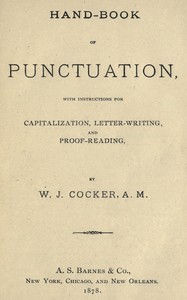
Hand-book of punctuation : with instructions for capitalization, letter-…
Let's be clear from the start: this is not a novel. Hand-book of Punctuation by William Johnson Cocker is exactly what the title promises—a practical guide. Published in the late 19th century, it's a compact manual designed to teach the rules of punctuation, capitalization, and letter-writing. Think of it as a time capsule of communication etiquette from an era of inkwells and formal correspondence.
The Story
There's no plot in the traditional sense. Instead, Cocker systematically walks you through the English language's traffic signals. He starts with the humble period and comma, explaining their jobs in separating and connecting ideas. He moves on to the more dramatic semicolon and colon, the interjecting dash, and all the way to quotation marks and parentheses. Each chapter is a clear, rule-based explanation with examples of what to do and, just as importantly, what not to do. The second half covers the rules for capitalizing words and the formal structure of letters, which feels like a fascinating peek into the social codes of the past.
Why You Should Read It
I'll be honest, I didn't expect to enjoy this. But Cocker's voice won me over. He writes with a calm, patient authority that assumes you want to get it right. Reading it feels like having a smart, slightly old-fashioned teacher sit down with you. Beyond the rules, you get a real sense of his belief that clear writing is a mark of clear thinking. It’s not about showing off; it's about removing barriers between you and your reader. In our age of rapid-fire texts and emails, where punctuation is often an afterthought (or a emotional weapon 😉), this old-school focus on precision is refreshing.
Final Verdict
This book is a niche gem, but a gem nonetheless. It's perfect for writers, editors, or history lovers curious about how language standards have (or haven't) changed. It's also great for anyone who feels shaky on punctuation and wants a no-nonsense, example-filled guide from a pre-internet authority. Don't go in looking for a thrilling narrative. Go in looking for clarity, and you'll find a surprisingly compelling little manual that argues, page by page, for the elegance of a well-placed comma.
There are no legal restrictions on this material. Access is open to everyone around the world.
Carol Moore
1 year agoI stumbled upon this title and it creates a vivid world that you simply do not want to leave. A true masterpiece.
Elijah Williams
1 year agoEnjoyed every page.