
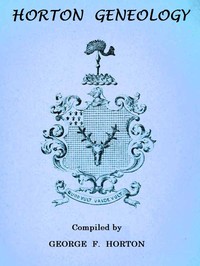
Horton Genealogy by Geo. F. Horton
Let's be clear from the start: this isn't a novel. There's no fictional plot with a tidy beginning, middle, and end. Instead, Horton Genealogy is the real-life story of one man's quest to uncover his roots.
The Story
George Firman Horton, born in 1806, acts as both author and main character. He starts with what he knows—his own immediate family—and works backwards. The book traces the Horton line from its origins in England, follows their brave (or desperate) voyage across the Atlantic in the 1600s, and maps their spread across the growing American colonies, particularly in Connecticut and Massachusetts. It's filled with names, birth dates, marriage records, and land deeds. But the real narrative thread is Horton's own investigation. He constantly pauses to note where the records run out, questions old family tales, and pieces together lives from the dry facts he can find. The "story" is his journey of discovery, the slow assembly of a family portrait from fragments.
Why You Should Read It
You should read this not for sweeping drama, but for its quiet, powerful humanity. What struck me was Horton's voice. This was a personal project for him, not a sterile academic exercise. You can sense his pride in a patriot ancestor who fought in the Revolution, his curiosity about a long-lost cousin who moved west, and his genuine desire to leave this record for the generations coming after him. It turns a list of names into something meaningful. It makes you think about the ordinary people—farmers, mothers, soldiers, tradesmen—whose everyday lives and decisions ultimately led to you being here. It’s a powerful reminder that history isn't just about kings and generals; it's built by families like the Hortons.
Final Verdict
This book is a specific treat for a specific reader. It's perfect for genealogy enthusiasts who want to see how the work was done in the pre-internet age, or for anyone with Horton ancestry (it's a treasure trove!). But more broadly, it's for history lovers who enjoy primary sources and getting a direct, unfiltered look into the mind of a 19th-century person. If you prefer fast-paced fiction, this isn't it. But if you're curious about the patient, painstaking work of reclaiming the past, George Firman Horton's personal mission is surprisingly compelling. It’s a slow, thoughtful read that connects you to the very human urge to know where we belong.
This content is free to share and distribute. You do not need permission to reproduce this work.
Daniel Flores
1 year agoI had low expectations initially, however the arguments are well-supported by credible references. I learned so much from this.
Matthew Walker
1 year agoFast paced, good book.
Dorothy Young
1 year agoGreat digital experience compared to other versions.
Barbara Robinson
3 months agoFive stars!







Lisa Young
5 months agoComprehensive and well-researched.